
Politics
Cory Mills meets with Syrian President in Damascus
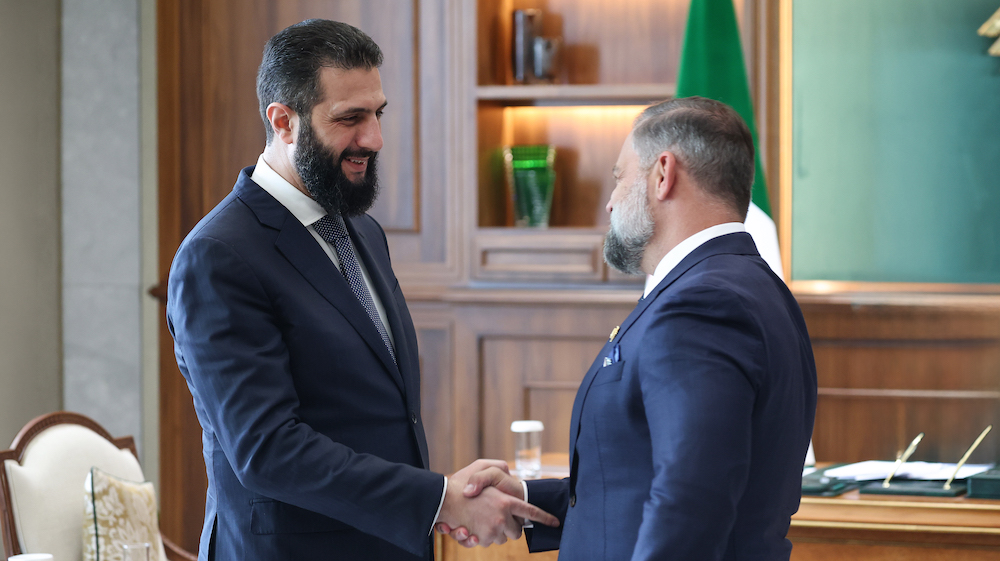
U.S. Rep. Cory Mills made a solo trip to meet with Syrian President Ahmed Al-Sharaa in Damascus. That marks at least the second unofficial trip in the last year to meet with the new Syrian President, who previously fought for an al-Qaeda-tied faction in the region.
Al-Sharaa’s Office promoted the meeting on its own social media.
“President Ahmad Al-Sharaa received, today at the People’s Palace in Damascus, U.S. Congressman Cory Lee Mills,” reads a post on X, accompanied with photos of the Syrian leader with Mills.
“During the meeting, discussions took place on the current regional and international situations, as well as a number of issues of common interest.”
The meeting came as Al-Sharaa opens dialogue channels with the international community more than a year after overthrowing former Syrian President Bashar Assad. The transition has been controversial based on Al-Sharaa’s past ties.
The post about Mills’ meeting came hours after Syrian officials also posted photographs with Al-Sharaa and United Nations officials. Those include Tom Fletcher, the Deputy Secretary-General of the United Nations for Humanitarian Affairs and Emergency Relief Coordinator, and Alexander de Croo, Director of the United Nations Development Programme. The prior day, Al-Sharaa met with King Charles III of Britain.
However, Mills’ Office made clear he did not travel to Syria in his official capacity.
Florida Politics reached out to the State Department, which referred all questions about Mills’ trip to his office.
President Donald Trump’s administration has signaled a willingness to engage with the new regime in Syria. During Eid al-Fitr, the Islamic holiday, Special Envoy to Syria Tom Barrack posted “warmest greetings” to Syrians and those in Turkey, Iraq and Lebanon.
“Small, deliberate choices are what gradually lower the temperature around us, turning division into dialogue and strangers into neighbors,” Barrack posted. “On this blessed day, we reaffirm our commitment to walking that path together — toward peace, shared prosperity, and deeper mutual understanding.”

Mills has closely followed political developments in the Middle East for years, and in February attended a Committee hearing on U.S. relations with a post-Assad Syria.
There, both House Foreign Affairs Committee Chair Brian Mast, a Stuart Republican, and Ranking Democrat Gregory Meeks, a New York Democrat, expressed optimism about the end of the Assad era but extreme trepidation about sectarian violence against religious minorities during Al-Sharaa’s tenure.
Mills at the hearing noted that he visited Al-Sharaa in Syria the prior year during a trip with U.S. Rep. Marlin Stutzman, an Indiana Republican, in an unofficial visit.
“Is Al-Sharaa the best that we could get?” Mills said in the hearing. “No, probably not, but it’s the cards we’re dealt. It’s what the people have chosen in many areas. And I would caution that we have to at least allow the agreements and things that are being put in place to actually take hold.”
He acknowledged Al-Sharaa’s connection to Hay’at Tahrir al-Sham, but also referenced consequences of the de-Baathification of Iraq, the exclusion of members of Iraq President Saddam Hussein’s political allies from a new government there. Many have blamed the decision for spurring insurgencies and destabilizing the region.
“We have to be very cautious of our examples of what we did as America and failed the Iraqi people, what we did as America that failed with regards to Afghanistan, and make sure we don’t repeat that, because Syria is important. It is one of the linchpins for stabilization in the region.”
He also said that under Al-Sharaa, militias tied to Iran and ISIS from smuggling weapons that would have been used against Israel. The nation also joined an anti-ISIS coalition.
Mills said Al-Sharaa had appointed a diverse Cabinet with Christians, Jews, women and other ethnic and religious minorities.
“We have to not look just at the past,” Mills said. “We have to look at the future, the lessons learned, and make sure we have a free Syria that’s going to help with stabilization across the region.”