News that family-owned premium footwear retailer Russell & Bromley could be sold with its stores likely to close hasn’t only dismayed the industry at large. Apparently, some members of the founding family are also concerned about the potential plan.
Billie Piper for Russell & Bromley
The Times reported that some family members favour a sale to Next and its partner in the deal Retail Realisation that would see the former owning the brand and the latter selling off the stock and other assets.
But others are believed to be “pushing for a deal with a private equity company that has pledged to preserve the retailer’s stores and jobs”.
Some Bromley family members want the business to be sold to Auralis, a new group that says it will preserve most of the firm’s 450 jobs, 37 stores across the UK, as well as its HQ and distribution centre.
Next, meanwhile, wouldn’t need the stores as it has its own physical locations in which the brand could operate and its own major online operation. That would leave stock clearance specialist Retail Realisation to deal with the wider shutdown of the business.
So what is Auralis? It was set up in 2025 by the investment firm that also owns Weird Fish, Total Capital partners.
Led by Weird Fish CEO David Butler, The Times quoted him saying it’s looking for retailers that are “limited in their abilities to invest in their own businesses”, rather than pursuing distressed acquisitions as some serial acquirers are doing.
The newspaper also said that disagreements within the Bromley family aren’t new with some members not being confident in CEO Andrew Bromley’s turnaround strategy and favouring a sale. The CEO is believed to have preferred the business to stay independent.
Last year the company appointed Interpath Advisory to look at funding options but with no fresh capital forthcoming, a full sale is now being pursued.
The report said no deal has been struck and other private equity bidders are also still looking at the business. Nobody involved has commented.
Earlier this week we reported on The Very Group’s latest Q1 accounts filing (the three months to late September) and now the business has released a Christmas trading statement saying the six week to 27 December were “resilient” and were “supported by sales growth in higher-margin categories”.
Very Group
The company’s flagship Very UK operation delivered retail sales growth of 1.9% year-on-year, driven by strong performances in standout categories such as Home (+7.9%) and Toys and Beauty (+6.4%).
Including the legacy Littlewoods business and Very Ireland, group retail sales declined slightly (by 0.4%) for the period.
Best-sellers included Nintendo Switch 2, perfumes and Meta Quest 3S with beauty gifts sets and coffee machines also performing well. By brand, Jimmy Choo and Calvin Klein perfumes did well, as did Beauty Works gift sets.
Overall, Black Friday was the group’s best trading day since the pandemic. Some 209,000 items were processed at Skygate, the group’s automated fulfilment centre, on 28 November and 3 million items were processed during Black Friday week – beating last year’s busiest week of 1.2 million items.
CEO Robbie Feather hailed the top-line growth at Very UK despite a “challenging and competitive market”.
He didn’t share any news on how Fashion performed during the Black Friday and festive period, however, and we have to assume it didn’t do as well as might have been hoped.
In the Q1 filing earlier this week, the company had said that Fashion and Sports combined declined 1% in a tough market but, Sports alone was strong. Parts of the Fashion market were buoyant as well with a 30.1% increase in casual womenswear sales during Q1.
Luxury giant Richemont’s Q3 results on Thursday showed the Switzerland-based business with sales that easily beat analysts’ estimates.
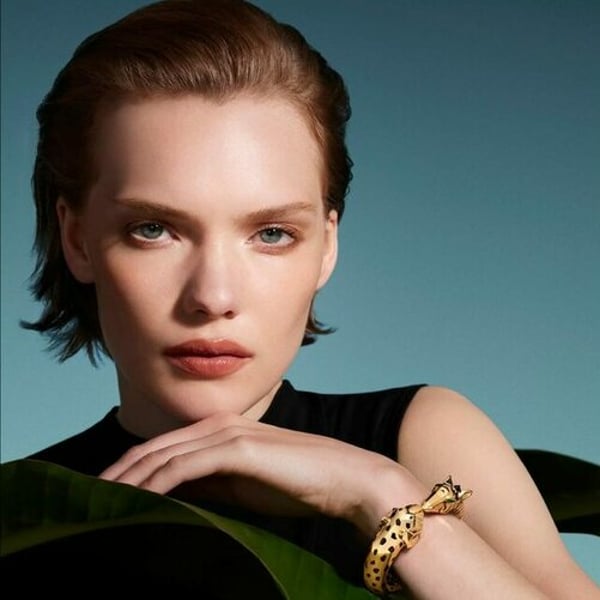
Cartier
In fact, constant currency sales at the world’s second-largest luxury group leapt 11% (analysts had predicted a 7.5% rise) as the jewellery division that includes Cartier and Van Cleef & Arpels was particularly strong.
So let’s look at the numbers in detail. Sales in the quarter to December rose 4% in total to €6.4 billion against expectations of a €6.28 billion total.
That 11% constant currency surge was slower than the 14% jump seen in Q2 but the company said it was up against demanding double-digit comparatives in prior-year period.
Nonetheless, it said it saw “continued strength at Jewellery Maisons, with sales up by 14% at constant rates; further improvement at Specialist Watchmakers, up by 7%; [and] stable ‘Other’ sales, with Fashion & Accessories Maisons up by 3%”.
Peter Millar, Gianvito Rossi stand out
In monetary terms this meant sales of €4.785 billion in jewellery, €872 million in watchmakers and €742 million in the other division. And within Fashion & Accessories, Peter Millar and Gianvito Rossi were “notably showing solid momentum”. The company owns big names such as Chloé, Dunhill and Alaia as well but didn’t share their numbers.
It did say that it also saw growth across all regions at constant exchange rates, with “notable” double-digit performances in the Americas, Japan and Middle East & Africa.
Peter Millar
Growth across all distribution channels was “solid” too, led by retail, which was up by 12% at constant exchange rates.
And its nine-month sales at €17 billion were up by 10% at constant exchange rates and 5% at actual rates.
Show me the money
Looking at the actual monetary figures, European sales rose 8% constant and 6% actual to €1.55 billion, while Asia Pacific rose 6% constant but fell 2% actual to €1.87 billion. The Americas rose 14% constant and 6% actual to €1.74 billion, while Japan increased 17% constant and 7% actual to €632 million. The Middle East & Africa rose 20% constant and 12% actual to reach €607 million.
By distribution channel physical retail was up 12% constant and 5% actual at €4.601 billion. Online retail rose 5% constant and fell 1% actual to €413 million while wholesale and royalty income rose 9% constant and 3% actual to €1.385 billion.
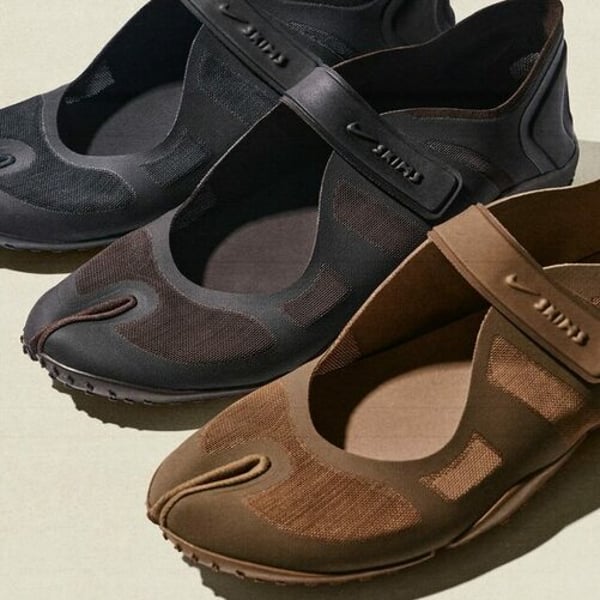
NikeSkims is expanding its collaboration into footwear for the first time with the launch of the NikeSkims Rift, set to launch in North America on January 26.
NikeSkims debuts first footwear style. – NikeSkims
The debut silhouette reimagines the Nike Rift, the split-toe running shoe first introduced in the 1990s, through the lens of NikeSkims’ bold, considered design ethos. The updated design retains the shoe’s most recognizable elements, including the iconic tabi toe, and a single strap across the midfoot for easy entry and a secure fit. A pared-back midsole nods to the Rift’s original focus on barefoot-style movement, while a textured logo outsole completes the look.
The NikeSkims Rift Mesh will be available in three colorways – Black, Velvet Brown, and Archaeo Brown – both online and in select U.S. retail locations for $150.
“There’s something so powerful and beautiful about a ballet flat, which is why reimagining the Nike Rift for the first NikeSkims sneaker felt perfect,” said Kim Kardashian, Skims co-founder.
“The Rift isn’t just a shoe – it’s a 90s icon that women everywhere have fallen in love with. Together with Nike, we focused on creating a version that feels minimalist, sleek and flattering.”
The NikeSkims Rift signals a broader expansion of the partnership, with additional footwear planned for future collections. The move supports NikeSkims’ goal of creating a head-to-toe system of dress that blends performance innovation with elevated design.