Connect with us

Business

Consumers are already paying two-thirds of tariff costs, says Goldman Sachs

Published

on


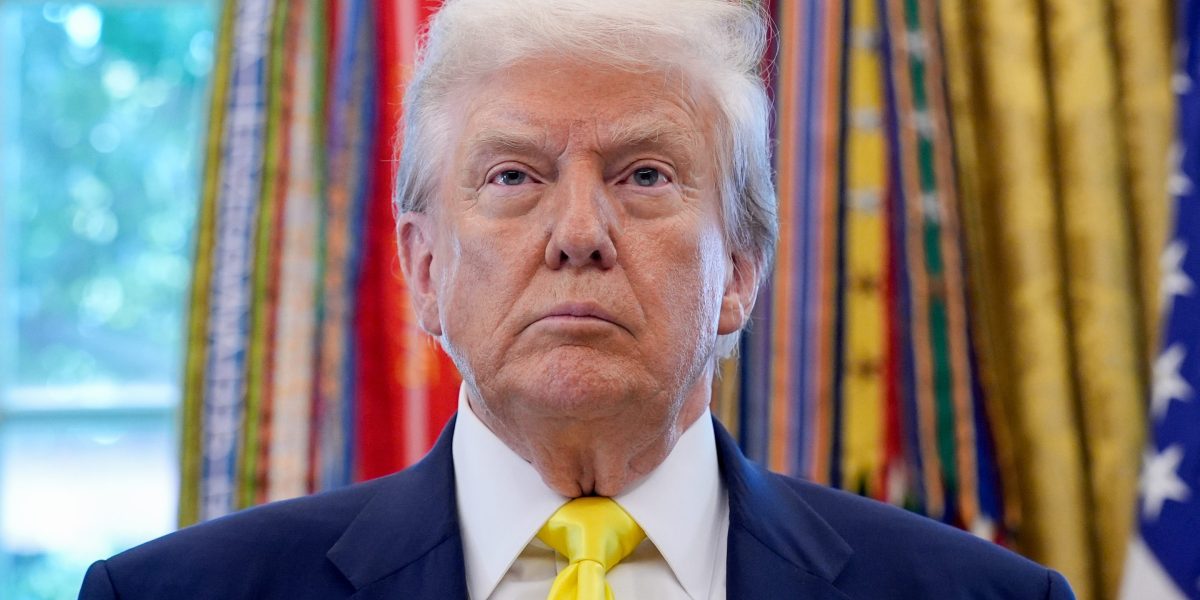
When President Trump announced his tariff agenda, he said it would be foreign companies and consumers that would “eat” the price hikes. That’s a take which may be proved optimistic at best, and misguided at worst.

While tariffs have yet to significantly shift the dial on inflation—prompting individuals like Treasury Secretary Scott Bessent to label them the “dog that didn’t bark”—analysts are widely expecting the hikes to ultimately be paid for by the U.S.

So far the sharpest end of the tariff regime has yet to be felt. President Trump delayed his ‘Liberation Day’ tariffs by three months in order to agree deals with trading partners.

Some negotiations have proved successful, with framework deals done with the U.K., the E.U. and Japan to name a few, drastically lowering tariff rates from Trump’s initial threats back in April. Yet countries which haven’t yet agreed to a deal (who received letters informing them of their new tariff rate) saw their effective export rate rise on the deadline of August 7.

That includes nations like India, which is facing a rate of 25% that may double on August 27 as punishment for buying Russian oil. Likewise, while the Trump administration has touted a deal near-done with China on many occasions, nothing beyond an agreement to delay tit-for-tat price increases until this week has been confirmed.

With a slew of tariffs now effectively in place, Goldman Sachs believes that the cost absorbed by foreign exporters will grow over time, but will remain low.

Economist Elsie Peng wrote in a note yesterday seen by Fortune that Goldman believes exporters absorbed 14% of the costs of all tariffs in June, which will rise to 25% by October if the sanctions follow a similar trajectory to the price hikes administered by the Trump administration in his first term.

But the portion consumers can expect to pay is also on the rise. Peng noted that around 36% of the 2025 tariff costs were passed onto consumer prices after three months of implementation and around 67% were passed on after four months.

The economist added that “although the passthrough rate appears to be increasing rapidly over time, it still remains somewhat below the passthrough rate that we estimate at the same point in time during the 2018-2019 trade war.”

One portion of the economy which intends to reduce its share is U.S. businesses. The Conference Board released its U.S. CEO Confidence report for the third quarter last week, which revealed 64% are certain they’d be passing the price hike onto consumers, and a further 16% said they’re still considering.

This is a higher rate than previously identified (following the prediction of Goldman Sachs) as only in June the New York Fed reported a smaller 45% of services firms were intending to pass on the full extent of their tariff-related increases.

Peng noted that her maths “implies that U.S. businesses have absorbed more than half of the tariff costs so far but that their share would fall to less than 10%. This net impact on U.S. businesses likely masks that some companies have absorbed a larger share of tariff costs, while some domestic producers shielded from import competition have raised their own prices and benefited.”

Inflation passthrough

Of course, if consumers are paying higher prices for goods and services then the Federal Reserve’s job of keeping inflation to 2% will only get more difficult.

Goldman Sachs believes this will be the case, writing: “Our analysis implies that tariff effects have boosted the core PCE price level by 0.20% so far.

“We expect another 0.16% impact in July, followed by an additional 0.5% from August through December. This would leave core PCE inflation at 3.2% year-over-year in December, assuming that the underlying inflation trend net of tariff effects is 2.4%.”

Reflecting on the June CPI report (the latest available at the time of writing), Macquarie’s North America economists David Doyle and Chinara Azizova commented that the data was already showing hints of passthrough inflation.

They wrote last month: “Notable price pressures were apparent in household furnishings and supplies, apparel, video and audio products, sporting goods, and toys. This list suggests impacts from tariffs on the data. One measure that reflects this is core goods ex used cars and trucks. This accelerated to +0.3% MoM, its strongest pace since Feb-23. It also shows an accelerating monthly trend.”

Many economists are hoping Fed chairman Jerome Powell will see through this inflation and lower the base rate, in part to offset an alarming jobs report from the Bureau of Labor Statistics a matter of weeks ago. But analysts can’t hold their breath—after all, Powell made the point at his last press conference that by not raising rates (a move which truly would have upset markets) he is already seeing through such pressures.

Introducing the 2025 Fortune Global 500, the definitive ranking of the biggest companies in the world. Explore this year’s list.


Source link

Continue Reading

Business

US debt crisis: Most likely fix is severe austerity triggered by a fiscal calamity

Published

on


One way or another, U.S. debt will stop expanding unsustainably, but the most likely outcome is also among the most painful, according to Jeffrey Frankel, a Harvard professor and former member of President Bill Clinton’s Council of Economic Advisers.

Publicly held debt is already at 99% of GDP and is on track to hit 107% by 2029, breaking the record set after the end of World War II. Debt service alone is more than $11 billion a week, or 15% of federal spending in the current fiscal year.

In a Project Syndicate op-ed last week, Frankel went down the list of possible debt solutions: faster economic growth, lower interest rates, default, inflation, financial repression, and fiscal austerity. 

While faster growth is the most appealing option, it’s not coming to the rescue due to the shrinking labor force, he said. AI will boost productivity, but not as much as would be needed to rein in U.S. debt.

Frankel also said the previous era of low rates was a historic anomaly that’s not coming back, and default isn’t plausible given already-growing doubts about Treasury bonds as a safe asset, especially after President Donald Trump’s “Liberation Day” tariff shocker.

Relying on inflation to shrink the real value of U.S. debt would be just as bad as a default, and financial repression would require the federal government to essentially force banks to buy bonds with artificially low yields, he explained.

“There is one possibility left: severe fiscal austerity,” Frankel added.

How severe? A sustainable U.S. debt trajectory would entail elimination of nearly all defense spending or almost all non-defense discretionary outlays, he estimated.

For the foreseeable future, Democrats are unlikely to slash top programs, while Republicans are likely to use any fiscal breathing room to push for more tax cuts, Frankel said.

“Eventually, in the unforeseeable future, austerity may be the most likely of the six possible outcomes,” he warned. “Unfortunately, it will probably come only after a severe fiscal crisis. The longer it takes for that reckoning to arrive, the more radical the adjustment will need to be.”

The austerity forecast echoes an earlier note from Oxford Economics, which said the expected insolvency of the Social Security and Medicare trust funds by 2034 will serve as a catalyst for fiscal reform.

In Oxford’s view, lawmakers will seek to prevent a fiscal crisis in the form of a precipitous drop in demand for Treasury bonds, sending rates soaring.

But that’s only after lawmakers try to take the more politically expedient path by allowing Social Security and Medicare to tap general revenue that funds other parts of the federal government.

“However, unfavorable fiscal news of this sort could trigger a negative reaction in the US bond market, which would view this as a capitulation on one of the last major political openings for reforms,” Bernard Yaros, lead U.S. economist at Oxford Economics, wrote. “A sharp upward repricing of the term premium for longer-dated bonds could force Congress back into a reform mindset.”


Source link

Continue Reading

Business

The $124 trillion Great Wealth Transfer is intensifying as inheritance jumps to a new record

Published

on


Nearly $300 billion was inherited this year as the Great Wealth Transfer picks up speed, showering family members with immense windfalls.

According to the latest UBS Billionaire Ambitions Report, 91 heirs inherited a record-high $297.8 billion in 2025, up 36% from a year ago despite fewer inheritors.

“These heirs are proof of a multi-year wealth transfer that’s intensifying,” Benjamin Cavalli, head of Strategic Clients & Global Connectivity at UBS Global Wealth Management, said in the report.

Western Europe led the way with 48 individuals inheriting $149.5 billion. That includes 15 members of two “German pharmaceutical families,” with the youngest just 19 years old and the oldest at 94.

Meanwhile, 18 heirs in North America got $86.5 billion, and 11 in South East Asia received $24.7 billion, UBS said.

This year’s wealth transfer lifted the number of multi-generational billionaires to 860, who have total assets of $4.7 trillion, up from 805 with $4.2 trillion in 2024.

Wealth management firm Cerulli Associates estimated last year that $124 trillion worldwide will be handed over through 2048, dubbing it the Great Wealth Transfer. More than half of that amount will come from high-net-worth and ultra-high-net-worth people.

Among billionaires, UBS expects they will likely transfer about $6.9 trillion by 2040, with at least $5.9 trillion of that being passed to children, either directly or indirectly.

While the Great Wealth Transfer appears to be accelerating, it may not turn into a sudden flood. Tim Gerend, CEO of financial planning giant Northwestern Mutual, told Fortune’s Amanda Gerut recently that it will unfold more gradually and with greater complexity

“I think the wealth transfer isn’t going to be just a big bang,” he said. “It’s not like, we just passed peak age 65 and now all the money is going to move.”

Of course, millennials and Gen Zers with rich relatives aren’t the only ones who sat to reap billions. More entrepreneurs also joined the ranks of the super rich.

In 2025, 196 self-made billionaires were newly minted with total wealth of $386.5 billion. That trails only the record year of 2021 and is up from last year, which saw 161 self-made individuals with assets of $305.6 billion.

But despite the hype over the AI boom and startups with astronomical valuations, some of the new U.S. billionaires come from a range of industries.

UBS highlighted Ben Lamm, cofounder of genetics and bioscience company Colossal; Michael Dorrell, cofounder and CEO of infrastructure investment firm Stonepeak; as well as Bob Pender and Mike Sabel, cofounders of LNG exporter Venture Global.

“A fresh generation of billionaires is steadily emerging,” UBS said. “In a highly uncertain time for geopolitics and economics, entrepreneurs are innovating at scale across a range of sectors and markets.”


Source link

Continue Reading

Business

Apple rocked by executive departures, with chip chief at risk of leaving next

Published

on


Apple Inc., long the model of stability in Silicon Valley, is suddenly undergoing its biggest personnel shake-up in decades, with senior executives and key engineers both hitting the exits.

In just the past week, Apple’s heads of artificial intelligence and interface design stepped down. Then the company announced that its general counsel and head of governmental affairs were leaving as well. All four executives have reported directly to Chief Executive Officer Tim Cook, marking an exceptional level of turnover in Apple’s C-suite. 

And more changes are likely coming. Johny Srouji — senior vice president of hardware technologies and one of Apple’s most respected executives — recently told Cook that he is seriously considering leaving in the near future, according to people with knowledge of the matter. Srouji, the architect of Apple’s prized in-house chips effort, has informed colleagues that he intends to join another company if he ultimately departs.

At the same time, AI talent has been fleeing for tech rivals — with Meta Platforms Inc., OpenAI and a variety of startups poaching many of Apple’s engineers. That threatens to hamper the company’s efforts to catch up in artificial intelligence, an area where it’s struggled to make a mark. 

It all adds up to one of the most tumultuous stretches of Cook’s tenure. Though the CEO himself is unlikely to leave imminently, the company has to rebuild its ranks and figure out how to thrive in the AI era. 

Within the company, some of the departures are cause for deep concern — with Cook looking to stave off more with stronger compensation packages for key talent. In other cases, the exits just reflect the fact that veteran executives are nearing retirement age. Still, many of the shifts constitute a disconcerting brain drain.

While Cook maintains that Apple is working on the most innovative product lineup in its history — a slate that’s expected to include foldable iPhones and iPads, smart glasses, and robots — Apple hasn’t launched a successful new product category in a decade. That leaves it vulnerable to poaching from a range of nimbler rivals better equipped to develop the next generation of devices around AI.

A spokesperson for Cupertino, California-based Apple declined to comment.

The exit of Apple’s AI chief, John Giannandrea, followed a number of stumbles in generative AI. The company’s Apple Intelligence platform has suffered from delays and subpar features. And a highly touted overhaul to the Siri voice assistant is roughly a year and a half behind schedule. Moreover, the software will rely heavily on a partnership with Alphabet Inc.’s Google to fill the gaps in its capabilities.

Against that backdrop, Apple began phasing Giannandrea out of his role in March but is allowing him to remain until next spring.

Within Apple, employees have long expected Giannandrea to step aside — and some have expressed surprise that he’s sticking around as long as he is.

But parting ways with Giannandrea sooner would have been taken as public acknowledgment of a problem, people familiar with the situation said. 

Design veteran Alan Dye, meanwhile, is heading to Meta’s Reality Labs unit — a remarkable defection to one of Apple’s fiercest rivals.

Within a day of that news, Apple turned around and announced that it had poached one of Meta’s executives. Jennifer Newstead, chief legal officer at the social networking company, will become Apple’s general counsel. She helped oversee Meta’s successful antitrust battle with the US Federal Trade Commission — experience that’s likely to prove useful in Apple’s own legal fight with the Justice Department over alleged anticompetitive practices.

Read More: Apple Taps Meta Lawyer as General Counsel in Latest Shake-Up

Newstead is taking over for Kate Adams, who served eight years in the role and will retire in late 2026. Lisa Jackson, vice president for environment, policy and social initiatives, is retiring as well — and her duties will be divided up among other executives. 

Though the news of Adams’ departure was jarring — especially considering the number of Apple legal disputes currently on her plate — she’s had a fairly long tenure for a general counsel at the company.

Jackson, meanwhile, was widely expected to be leaving soon. The former Obama administration official has kept a lower profile during President Donald Trump’s second term, opting to dispatch deputies to handle discussions with the White House. Bloomberg News had previously reportedthat she was considering retirement.

These exits follow an even bigger departure. Jeff Williams, Cook’s longtime No. 2, retired last month after a decade as chief operating officer. Another veteran leader, Chief Financial Officer Luca Maestri, stepped into a smaller role at the start of 2025 and is likely to retire in the not-too-distant future.

The flurry of retirements reflects a demographic reality for Apple. Many of its most senior executives have been at the company for decades and are roughly the same age — either in their 60s or nearing it.

Cook turned 65 last month, fueling speculation that he would join the exodus. People close to the executive have said that he’s unlikely to leave soon, though succession planning has been underway for years. John Ternus, Apple’s 50-year-old hardware engineering chief, is considered by employees to be the frontrunner CEO candidate.

When Cook does step down, he’s likely to shift into the chairman job and maintain a high level of influence over the iPhone maker. That makes it unlikely that Apple will select an outsider as the next CEO, even as executives like Nest Labs founder Tony Fadell are being pushed as candidates by people outside the company. Though Fadell helped invent Apple’s iconic iPod, he left the tech giant 15 years ago on less-than-friendly terms. 

For now, Cook remains active at Apple and travels extensively on behalf of the company. However, the executive does have an unexplained tremor that causes his hands to shake from time to time — something that’s been discussed among Apple employees in recent months.

The shaking has been noticed by both executives and rank-and-file staff during meetings and large company gatherings, according to people familiar with the matter. But people close to Cook say he is healthy and refute rumors to the contrary that have circulated in Silicon Valley.

Read More: The Apple Insiders in the Running to Succeed Cook

A more imminent risk is the departure of Srouji, the chip chief. Cook has been working aggressively to retain him — an effort that included offering a substantial pay package and the potential of more responsibility down the road. One scenario floated internally by some executives involves elevating him into the role of chief technology officer. Such a job — overseeing a wide swath of both hardware engineering and silicon technologies — would potentially make him Apple’s second-most-powerful executive.

But that change would likely require Ternus to be promoted to CEO, a step the company may not be ready to take. And some within Apple have said that Srouji would prefer not to work under a different CEO, even with an expanded title.

If Srouji does depart, which isn’t yet a certainty, the company would likely tap one of his two top lieutenants — Zongjian Chen or Sribalan Santhanam — to replace him.

The recent shifts are already reshaping Apple’s power structure. More authority is now flowing to a quartet of executives: Ternus, services chief Eddy Cue, software head Craig Federighi and new COO Sabih Khan. Apple’s AI efforts have been redistributed across its leadership, with Federighi becoming the company’s de facto AI chief.

Ternus is also poised to take a starring role next year in the celebration of Apple’s 50th anniversary, further raising his profile. And he’s been given more responsibility over robotics and smart glasses — two areas seen as future growth drivers. 

Further reorganization is likely. Deirdre O’Brien, head of retail and human resources, has been with Apple for more than 35 years, while marketing chief Greg Joswiak has spent four decades at the company. Apple has elevated the key lieutenants under both executives, preparing for their eventual retirements.

At the same time, Apple is contending with a talent drain in its engineering ranks. This has become a serious concern for the executive team, and Apple’s human resources organization has been instructed to ramp up recruitment and retention efforts, people familiar with the situation said.

Robby Walker, who had overseen Siri and an initiative to build a ChatGPT-like search experience, left the company in October. His replacement, Ke Yang, departed after only weeks in the job, joining Meta’s new Superintelligence Labs.

To help fill the void left by Giannandrea, Apple hired Google and Microsoft Corp. alum Amar Subramanya as vice president of artificial intelligence. He’ll report to Federighi, the software chief.

But there’s been a broader collapse within Apple’s artificial intelligence organization, spurred by the departure of AI models chief Ruoming Pang. Pang, along with colleagues such as Tom Gunter and Frank Chu, went to Meta, which has used eye-popping compensation packages to lure talent.

Roughly a dozen other top AI researchers have left the organization, which is suffering from low morale. The company’s increasing use of external AI technology, such as Google’s Gemini, has been a particular concern for employees working on large language models.

Apple’s AI robotics software team has also seen widespread departures, including its leader Jian Zhang, who likewise joined Meta. That group is tasked with creating underlying technology for products such as a tabletop robot and a mobile bot.

The hardware team for the tabletop device, code-named J595, has been bleeding talent too — with some headed to OpenAI. Dye also was a key figure overseeing that product’s software design.

Read More: Apple’s AI Push to Hinge on Robots, Security, Lifelike Siri

The user interface organization has been hit as well, with several team members leaving between 2023 and this year. That attrition culminated in Dye’s exit, which stemmed partly from a desire to integrate AI more deeply into products and a feeling that Apple hasn’t been keeping pace in the area. Another top interface leader under Dye, Billy Sorrentino, also left for Meta.

The hardware side of the design group — the team responsible for the physical look and feel of Apple’s products — has been nearly wiped out over the last half-decade. Many staffers followed former design chief Jony Ive to his studio, LoveFrom, or went to other companies.

Longtime interface designer Stephen Lemay is now stepping in as Dye’s replacement. Cook is also taking on more responsibility for overseeing design, a role that had been held by Williams.

Ive, a visionary designer who helped create the iPhone, iPad and Apple Watch, is now working with OpenAI to develop a new generation of AI-enhanced devices. That company acquired Ive’s startup, io, for more than $6 billion to jump-start its hardware business — setting its sights on Apple’s territory.

Like Meta, OpenAI has become a key beneficiary of Apple’s talent flight. The San Francisco-based company has hired dozens of Apple engineers across a wide range of fields, including people working on the iPhone, Mac, camera technology, silicon design, audio, watches and the Vision Pro headset. 

In a previously unreported development, the AI company is hiring Apple’s Cheng Chen, a senior director in charge of display technologies. His purview included the optics that go into the Vision Pro headset. OpenAI recruited Tang Tan, one of Apple’s top hardware engineering executives, two years ago.

Read More: Apple’s Star Designer Who Introduced iPhone Air Leaves Company

And over the summer, the company lost the dean of Apple University, the internal program designed to preserve the company’s culture and practices after the passing of co-founder Steve Jobs. Richard Locke, who spent nearly three years at Apple, left to become dean of the Massachusetts Institute of Technology’s business school.


Source link

Continue Reading

Trending

Copyright © Miami Select.