Connect with us

Business

Construction firm Italian-Thai Development is under fire after consecutive crane collapses

Published

on


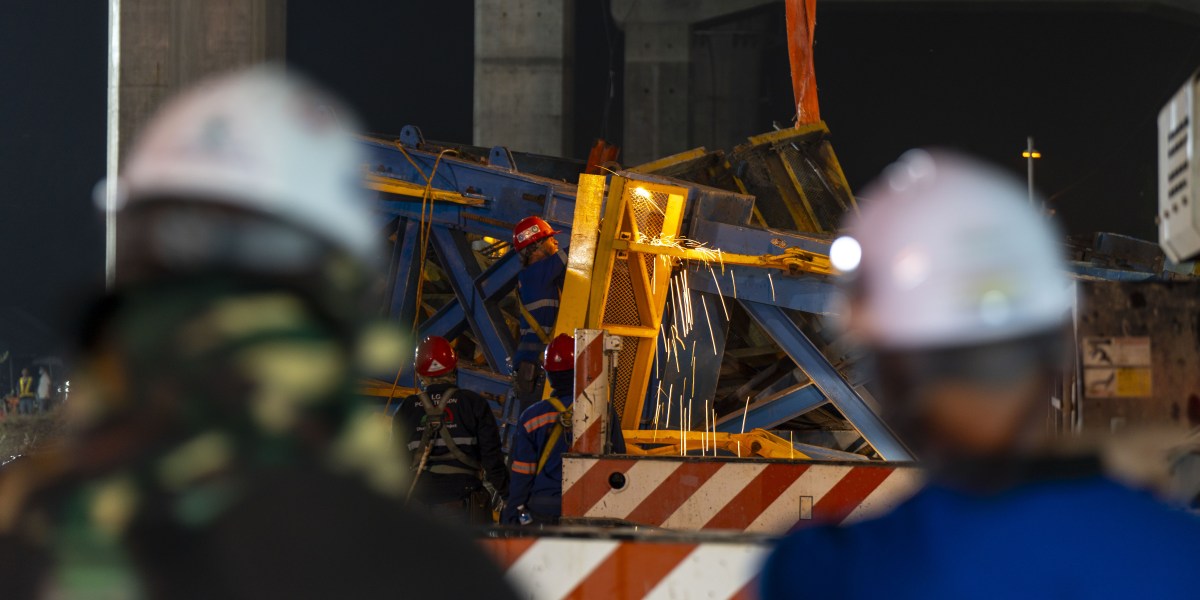
Italian-Thai Development, one of Thailand’s largest construction conglomerates, is in the spotlight after successive fatal incidents on its building sites.

On Jan. 14, a crane collapsed onto a passenger train in the country’s northeast, killing at least 32 people. Just one day later, another crane fell on a highway project in Samut Sakhon province, leading to two deaths. Italian-Thai Development helmed both projects, and so on Jan. 16, Thailand’s Transport Ministry ordered a 15-day construction halt on more than ten projects overseen by the company, citing a “danger to the public.”

Italian-Thai Development released a statement to Thailand’s stock exchange on Jan. 15, noting that it had started the process of assessing damage and will take responsibility by providing compensation. Fortune has reached out to Italian-Thai Development for further comment.

The construction company is also linked to the collapse of a partially-constructed skyscraper in Bangkok last March, following a devastating earthquake in nearby Myanmar. The disaster killed almost 100 people.

Following the skyscraper incident, Premchai Karnasuta, the CEO of Italian-Thai Development, was indicted alongside 22 others, on charges including document forgery and professional negligence causing death. (Executives from China Railway No. 10, a Chinese state-owned construction firm that partnered with Italian-Thai Development, were also charged.)

Italian-Thai Development, with $2 billion in 2024 revenue, ranks No. 174 on Fortune’s Southeast Asia 500 list, which measures the region’s largest firms by revenue. 

Thai businessman Uthai Vongnai and Italian engineer Giovanni Tani founded Italian-Thai Development in 1958, after the two worked together salvaging five ships that sank in the Chao Phraya River. The firm expanded to sectors like real estate, manufacturing and mining, and has had a hand in building some of Thailand’s largest public infrastructure projects, like Bangkok’s subway system.

Still, the firm has had a rocky few years. They lost a total of 6 billion Thai baht ($192 million) between 2020 and 2022, according to the Bangkok Post, in part after its work in Myanmar was stalled after a 2021 coup and imposition of military rule.  

Karnasuta, Italian-Thai Development’s CEO, was also jailed for illegal poaching in 2021, after he was caught with hunting gear and animal carcasses in one of Thailand’s wildlife sanctuaries. He was released on parole in 2023. 

Italian-Thai Development has been forced to slash costs and dump several overseas units. The firm’s market value plunged from a peak of 12 billion baht ($384 million) in 2021 to just 1 billion baht ($32 million) in 2026.


Source link

Continue Reading

Business

Down Arrow Button Icon

Published

on


Stock markets went into a global selloff this morning as world leaders at Davos woke up to the news that U.S. President Trump had texted the prime minister of Norway to say that his repeated threats to take over Greenland were based on the fact that he didn’t win the Nobel Peace Prize.

“Considering your Country decided not to give me the Nobel Peace Prize … I no longer feel an obligation to think purely of Peace, although it will always be predominant, but can now think about what is good and proper for the United States of America,” Trump’s message to Jonas Gahr Støre said. “The World is not secure unless we have Complete and Total Control of Greenland.”

The Norwegian government has no control over how the Nobel Committee awards its prizes. Greenland is a territory of Denmark, not Norway.

Late last night Trump posted again on social media, “NATO has been telling Denmark, for 20 years, that ‘you have to get the Russian threat away from Greenland.’ Unfortunately, Denmark has been unable to do anything about it. Now it is time, and it will be done!!!”

Traders, dismayed at the prospect of a renewed trade war between the U.S. and Europe, reacted by driving down equities all over the world.

S&P 500 futures were down 1.12% this morning—an unusually steep drop. The last session closed flat. (Markets in the U.S. are closed for Martin Luther King Jr. Day.) The STOXX Europe 600 fell 1.25% in early trading, the U.K.’s FTSE 100 was down 0.49% before lunch. Japan’s Nikkei 225 was down 0.65%. China’s CSI 300 was flat. India’s NIFTY 50 was down 0.42%. Bitcoin declined to $93K. The only major national index having a good day was South Korea, where the KOSPI rose 1.32%.

Gold, the traditional safe-haven investment, hit a new record high of $4,673.4, on the Comex continuous contract.  

Wall Street’s analysts are broadly agreed that President Trump’s repeated threats to force Denmark to “give back” Greenland and to impose an escalating series of trade tariffs on the U.K. and E.U. if those countries don’t comply are bad for equities globally. They differ only in their assessment of how bad this will get.

ING’s Carsten Brzeski and Bert Colijn told clients, “Overall, we can only repeat our earlier estimates that additional tariffs of 25% would probably shave 0.2 percentage points off European GDP growth. However, this model-based estimate definitely falls short in capturing the full impact of new uncertainty and geopolitical tensions as a result of escalated tensions.”

They also cautioned, “As has been the case before, it is not exactly clear how this will work out as there has been no official communication from the White House, yet, just Trump’s announcement on social media.”

The pair also warned that Trump may be underestimating how resistant Europe is going to be. “While Europe, at least initially, seems to be determined to stand up against the latest tariff threat and the U.S. President’s claims on Greenland, the reality is that Europe is still dependent on the U.S. in many ways, both from an economic and security point of view. This was likely one of the central reasons behind the E.U.’s agreement last summer to agree to a trade deal with the U.S. that did not benefit Europe. Whether the new tariff threat and the situation in Greenland turn out to be the tipping point that finally triggers European unity and Europe’s rise as a geopolitical power remains to be seen. What is clear is that a full-blown trade war between the E.U. and the U.S. would leave only losers.”

At UBS, Paul Donovan’s morning note warned that new tariffs could rebound against American consumers. “Threatened U.S. tariffs appear more serious than those relating to Iran … they imply U.S. consumer prices of goods from the E.U. and UK will increase 4% to 10% (within about six months). This may reinforce the narrative of the U.S. affordability crisis.”

“Policy uncertainty is resurrected for U.S. businesses. This has constrained investment and hiring, but might have faded as firms adapt. Uncertainty on this scale may again put U.S. corporate activity on pause.”

There is also the question of whether Trump has enough domestic political capital to sustain his desire to conquer Greenland. 

“A Reuters/Ipsos poll last week suggested that only 17% of US citizens supported efforts to acquire Greenland, with 47% against. Only 4% approved of using military force with only 8% of Republican voters agreeing,” Jim Reid and his team at Deutsche Bank told clients this morning.

Here’s a snapshot of the markets ahead of the opening bell in New York this morning:

  • S&P 500 futures were down 1.12% this morning. The last session closed flat. Markets in the U.S. are closed for MLK Day.
  • STOXX Europe 600 was down 1.25% in early trading.
  • The U.K.’s FTSE 100 was down 0.49% in early trading. 
  • Japan’s Nikkei 225 was down 0.65%.
  • China’s CSI 300 was flat. 
  • The South Korea KOSPI was up 1.32%. 
  • India’s NIFTY 50 was down 0.42%. 
  • Bitcoin was down to $93K.


Source link

Continue Reading

Business

Deutsche Bank says US national debt is ‘achilles heel’ in Trump’s Greenland threats

Published

on


President Trump may be overplaying his hand in negotiations for Greenland, economists are warning, after the Oval Office threatened new tariffs on E.U. countries if they did not support America’s demand to purchase the territory.

Over the weekend, President Trump posted on Truth Social (a site he owns) that “starting on February 1st, 2026, … Denmark, Norway, Sweden, France, Germany, The United Kingdom, The Netherlands, and Finland, will be charged a 10% tariff on any and all goods sent to the United States of America.

“On June 1st, 2026, the tariff will be increased to 25%. This tariff will be due and payable until such time as a deal is reached for the complete and total purchase of Greenland.”

President Trump believes the U.S. needs to buy the territory (which is not for sale) for national security reasons, claiming China and Russia also want to control the region. He argues that Denmark, of which Greenland is a self-governing, autonomous part of the kingdom, does not have the ability to defend the land.

Trump’s request to purchase land under the jurisdiction of another nation has not gone down well with the Western world. While the U.S. may be the biggest economy on the planet, patience is wearing thin among its allies, after a year of barbed back-and-forths over tariffs and military spending.

This weekend’s power flex may be a stretch too far, economists are now warning, and Trump’s weakness may prove to be America’s voracious spending habits.

Deutsche Bank’s Jim Reid highlighted that Liberation Day tariffs in April were stepped back a week later, after U.S. Treasury yields saw a “scary” session as investors retreated to safety, away from American borrowing.

“Financial markets may play a big part in how this situation resolves itself,” Reid wrote in a note to clients this morning. “The main Achilles Heel of the U.S. is the huge twin deficits. So while in many ways it feels like the U.S. holds the economic cards, it doesn’t hold all the funding cards in a world that will be very disturbed by the weekend’s events.”

Investors, analysts, and world leaders have long wondered when—or if—a debt crisis would occur in one of the nations burdened by a massive deficit. While the likes of Japan, the U.K., and France are by no means balancing their books, America’s $38 trillion deficit dwarfs its counterparts. While a great deal of that debt is held by the public (including the Fed, where President Trump is also in hot water), vast sums are also owned by foreign governments and overseas investors.

This exposure—to the tune of $8 trillion—ING pointed out, may be something European leaders decide to remind the White House of. Europe being America’s largest lender “illustrates the deep interdependence between the U.S. and Europe but also shows that, at least theoretically, Europe also has leverage on the U.S.,” wrote Carsten Brzeski, global head of macro, and Bert Colijn, chief economist for the Netherlands. The duo added: “Whether in practice, Europe would really engage in a ‘Sell America Inc’ season is a completely different question. There is very little the EU could do to force European private sector investors to sell USD assets; it could only try to incentivise investments in EUR assets.”

Alternative measures: An ACI

The EU also has a weapon in its arsenal that it has yet to deploy. French President Emmanuel Macron has suggested now is the time to use the E.U.’s Anti-Coercion Instrument (ACI). The tool is a set of countermeasures against any foreign powers that unduly interfere in the policy choices of the E.U. or its member states, by restricting U.S. companies from accessing the European market, banning them from bidding for government work, restricting trade, and curtailing foreign investment.

The E.U. could also impose new tariffs on about $100 billion of its imports from the U.S.

This, Goldman Sachs believes, is likely to be one of the reactions European leaders are now weighing. Analysts Sven Jari Stehn and Giovanni Pierdomenico wrote this weekend that the legislation had been designed precisely for situations like this—though perhaps not with a strong ally like the U.S. in mind.

The duo wrote: “Starting the activation does not mean implementation (which requires several steps) but signals potential E.U. action and allows time for negotiation. The ACI could involve a range of policy tools broader than tariffs, such as investment restrictions, taxation of U.S. assets and services.” On services, the E.U. conveniently holds a surplus over the U.S., meaning it would inflict greater harm in this particular industry compared to similar action from across the Atlantic.

Join us at the Fortune Workplace Innovation Summit May 19–20, 2026, in Atlanta. The next era of workplace innovation is here—and the old playbook is being rewritten. At this exclusive, high-energy event, the world’s most innovative leaders will convene to explore how AI, humanity, and strategy converge to redefine, again, the future of work. Register now.


Source link

Continue Reading

Business

Trump, Greenland threats to dominate high-stakes World Economic Forum in Davos

Published

on


Good morning from Davos, Switzerland where the 56th annual meeting of the World Economic Forum is now underway. Organizers are calling this one of the highest-level gatherings in WEF history, a mix of almost 3,000 global leaders with about 850 top CEOs and chairs and a record 400 top political leaders, including 64 heads of state. All eyes will be on President Donald Trump, who’s coming with five cabinet secretaries and a large delegation of other senior officials. The theme this year, WEF’s first without founding chairman Klaus Schwab at the helm: “A Spirit of Dialogue.”

Some might find that conceit to be ironic in a week when Trump threatened to impose tariffs on European nations that oppose his plan to buy Greenland, and Europe vowed to fight back. No wonder the 2026 Edelman Trust Barometer finds a world retreating into isolationism. All the more reason for leaders around the globe to come together at a time when the stakes feel so high.

As I walked past USA House last night, a man lay sprawled on the icy ground, surrounded by paramedics trying to gauge if he could get up on his own. It felt like an apt metaphor for the sentiment I’ve encountered from several non-U.S. business leaders here so far: shell shock, a burst of unfamiliar pain and a desire to stay as close as possible to the U.S. As Mohamed Kande, the Washington-based global chairman of PwC, explained to me last night: “The U.S. continues to be the No. 1 destination for investment; people respect the fundamentals of the economy and the fundamentals of the companies.”

While geopolitics will likely dominate the news agenda, AI will dominate many of the discussions in hotels and sponsored houses along the Davos Promenade, where large numbers of unofficial attendees spend much of their time. That’s where the coveted parties, receptions, programming and dinners take place.

Fortune, for one, is hosting a series of gatherings, from C-suite lunches and the Fortune Most Powerful Women reception to our annual Global Leadership Dinner and a special block of programming this Wednesday at USA House. You can check out our full schedule here

I’ll be joined on the ground by my colleagues Alyson Shontell, Kamal Ahmed and Jeremy Kahn, who will be filing dispatches, taping vodcasts, and moderating conversations throughout the week. (Kamal’s first column is here.)

One of my favorite places in Davos to experience a true spirit of dialogue is Barry’s Piano Bar, also known as “Cloudflare After Dark” since Cloudflare CEO Matthew Prince rescued veteran WEF pianist Barry Coulson when Coulson’s longstanding Davos gig down the street dried up. If the six G7 members who are in town this week could sit around that piano, belting out some tunes, that might give peace a chance.

Contact CEO Daily via Diane Brady at diane.brady@fortune.com

Top leadership news

There’s no business case for taking Greenland 

President Trump is stressing the national security rationale for the U.S.’s desire to annex Greenland. That may be wise since there’s essentially no business case for the move, as Fortune energy editor Jordan Blum reports. The icy island’s harsh environment is only one reason why.

National debt is killing the American dream

Low housing stock, education barriers, and the high cost of living are all crushing the American dream, but one leading economist is naming another culprit: the U.S.’s ballooning national debt, which now totals $38.5 trillion. Fortune‘s Eleanor Pringle explains why.

Ford CEO’s AI warning

Ford CEO Jim Farley is warning that the U.S. won’t achieve its grand AI ambitions if it doesn’t solve its blue-collar labor shortage; such workers are needed to build the AI data centers and related manufacturing facilities. “How can we reshore all this stuff if we don’t have people to work there?” he said.

The markets

S&P 500 futures were down 1.11% this morning; U.S. markets are closed for MLK Day. The last session closed down 0.06%. STOXX Europe 600 was down 1.24% in early trading. The U.K.’s FTSE 100 was down 0.46% in early trading. Japan’s Nikkei 225 was down 0.65%. China’s CSI 300 was up o.05%. The South Korea KOSPI was up 1.32%. India’s NIFTY 50 was down 0.42%. Bitcoin was at $93K.

Around the watercooler

A filmmaker deepfaked Sam Altman for his movie about AI. Then things got personal by Beatrice Nolan 

When Jamie Dimon poached a top Berkshire exec, he called Warren Buffett, who said ‘If he’s going anywhere, at least he’s going to you’ by Marco Quiroz-Gutierrez

Exclusive: Elon Musk’s Boring Co. is studying a tunnel project to Tesla Gigafactory near Reno by Jessica Mathews

Like DoorDash and Google’s CEOs, Informatica boss is a McKinsey alum—he says being ‘pushed around’ by smart consultants helped him grow by Emma Burleigh

Dollar sinks as Trump’s new tariffs raise fears about U.S. debt and reserve currency status. ‘When it’s lost, economic collapse will follow’ by Jason Ma

CEO Daily is compiled and edited by Joey Abrams, Claire Zillman and Lee Clifford.


Source link

Continue Reading

Trending

Copyright © Miami Select.