Connect with us

Business

CME group: BrokerTec EU running again but all other markets remain down

Published

on


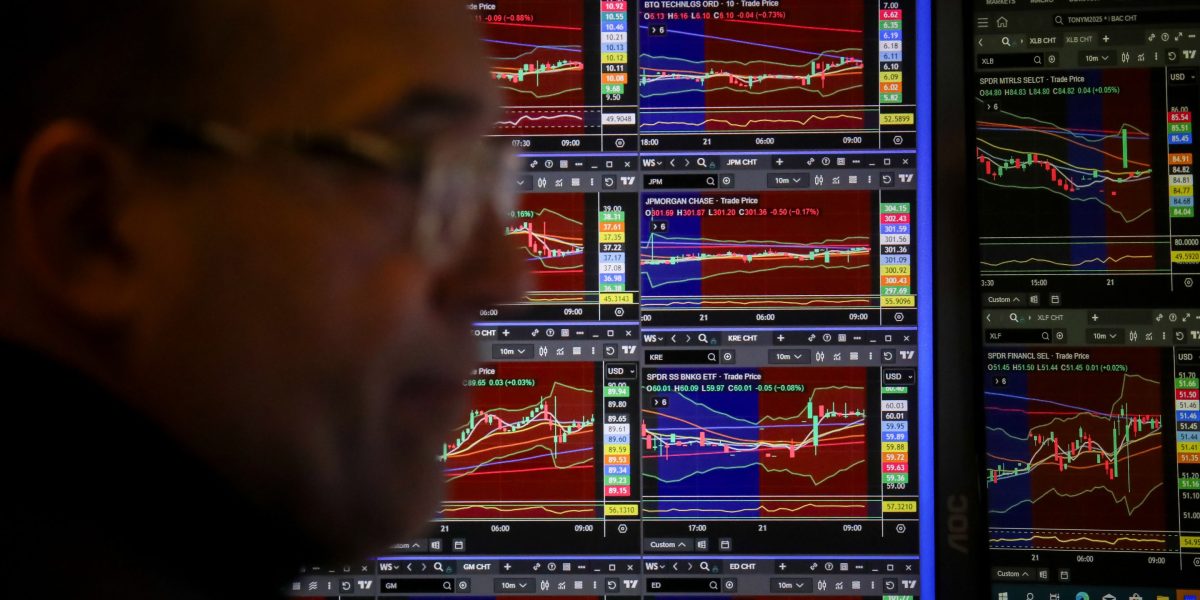
Markets from bonds and commodities to equities and foreign exchange are paused on the Chicago Mercentile Exchange (CME), after a problem with one of the platform’s data centers. Every day, millions of exchanges are made on CME, not only allowing investors access to 24-hour trades in some markets but also providing analysts and the media with real-time updates on market sentiment.

The CME’s FedWatch barometer is often referred to as a snapshot of how convinced the market is of a rate cut, and by how much, and in turn the volatility which may ensue if that bet doesn’t translate to reality.

A message sat on the CME homepage this morning, telling investors: “Due to a cooling issue at CyrusOne data centers, our markets are currently halted. Support is working to resolve the issue in the near term and will advise clients of Pre-Open details as soon as they are available.”

A spokesman for CME told Fortune in a further statement: “BrokerTec EU markets are open and trading. All other CME Group markets remain halted due to a data center cooling issue at CyrusOne. We will provide updates as they are available.”

It is unknown when the problem will be rectified.

The disruption will sting less than it might have in any other week, with many American traders out for the Thanksgiving holiday.

“Whilst our 2026 outlook might be called ‘Anything but dull’, the last 24 hours have been ‘everything dull’ with the U.S. out for Thanksgiving, and few headlines elsewhere,” wrote Deutsche Bank’s Jim Reid to clients this morning “Even an overnight outage at the CME, which means many futures contracts (including U.S. equity futures) haven’t traded since around 2.45am London time, hasn’t really been noticed!” 

“Given the exponential surge in data centres for other reasons in recent quarters that’s an interesting development!”

Not everyone will be so sanguine. Frustration will be inevitable for traders who were holding positions when the platform went dark, with questions mounting from speculators as to why the issue has led to an outage across so many markets.

And hasn’t that been the question of the year: With millions of dollars riding on data infrastructure across the U.S., will it hold up?

This isn’t the first time CME has suffered such problems: In 2019 a technical error halted trading for three hours, impacting markets including grains, crude oils, and metals.

At the time, Hiroaki Kuramochi, global sales trader and chief market analyst at Saxo Bank Securities in Tokyo, told Bloomberg: “This is so annoying for our clients. There are some people who make arbitrage trades in after-hours trading. This poses a risk of hurting investor sentiment.”

The data center issue

The supply of reliable data centers is a problem that isn’t going to go away anytime soon. AI hyperscalers are investing eye-watering sums into specific campuses to fuel the data centers their emerging technology needs.

As McKinsey & Co observed in an August report, global demand for data center capacity could more than triple by 2030, and in the U.S., particularly, demand could grow by 20 to 25% per year by the end of the decade. But on the other hand, “for all the investment, some hyperscalers have pulled back from or paused some of their commitments to building large-scale data centers.”

“This may be the result of several factors, including economic uncertainty, power constraints, construction project delays, or potential oversupply of capacity … All these factors combined highlight the complexity of accurate demand forecasting over the medium to long term.”

This is a breaking news story, updates will be added on an ongoing basis.


Source link

Continue Reading

Business

Nearly three-quarters of Trump voters think the cost of living is bad or the worst ever

Published

on


President Donald Trump and his administration insist that costs are coming down, but voters are skeptical, including those who put him back in the White House.

Despite Republicans getting hammered on affordability in off-year elections last month, Trump continues to downplay the issue, contrasting with his message while campaigning last year.

“The word affordability is a con job by the Democrats,” Trump said during a Cabinet meeting on Tuesday. “The word affordability is a Democrat scam.”

But a new Politico poll found that 37% of Americans who voted for him in 2024 believe the cost of living is the worst they can ever remember, and 34% say it’s bad but can think of other times when it was worse.

The White House has said Trump inherited an inflationary economy from President Joe Biden and point to certain essentials that have come down since Trump began his second term, such as gasoline prices.

The poll shows that 57% of Trump voters say Biden still bears full or almost full responsibility for today’s economy. But 25% blame Trump completely or almost completely.

That’s as the annual rate of consumer inflation has steadily picked up since Trump launched his global trade war in April, and grocery prices have gained 1.4% between January and September.

Meanwhile, Vice President JD Vance pleaded for “patience” on the economy last month as Americans want to see prices decline, not just grow at a slower pace.

Even a marginal erosion in Trump’s electoral coalition could tip the scales in next year’s midterm elections, when the president will not be on the ballot to draw supporters.

A soft spot could be Republicans who don’t identify as “MAGA.” Among those particular voters, 29% said Trump has had a chance to change things in the economy but hasn’t taken it versus 11% of MAGA voters who said that.

Across all voters, 45% named groceries as the most challenging things to afford, followed by housing (38%) and health care (34%), according to the Politico poll.

The poll comes as wealthier households are having trouble affording basics, while discount retailers like Walmart and even Dollar Tree are seeing more higher-income customers.

And in a viral Substack post last month, Michael Green, chief strategist and portfolio manager for Simplify Asset Management, argued that the real poverty line should be around $140,000.

“If the crisis threshold—the floor below which families cannot function—is honestly updated to current spending patterns, it lands at $140,000,” he wrote. “What does that tell you about the $31,200 line we still use? It tells you we are measuring starvation.”


Source link

Continue Reading

Business

Apple is experiencing its biggest leadership shakeup since Steve Jobs died, with over half a dozen key executives headed for the exits

Published

on


Apple is currently undergoing the most extensive executive overhaul in recent history, with a wave of senior leadership departures that marks the company’s most significant management realignment since its visionary co-founder and CEO Steve Jobs died in 2011. The leadership exodus spans critical divisions from artificial intelligence to design, legal affairs, environmental policy, and operations, which will have major repercussions for Apple’s direction for the foreseeable future.

On Thursday, Apple announced Lisa Jackson, its VP of environment, policy, and social initiatives, as well as Kate Adams, the company’s general counsel, will both retire in 2026. Adams has been Apple’s chief legal officer since 2017, and Jackson joined Apple in 2013. Adams will step down late next year, while Jackson will leave next month.

Jackson and Adams join a growing list of top executives who have either left or announced their exits this year. AI chief John Giannandrea announced his retirement earlier this month, and its design lead Alan Dye, who took charge of Apple’s all-important user interface design after Jony Ive left the company in 2019, was just poached by Mark Zuckerberg’s Meta this week.​

The scope of the turnover is unprecedented in the Tim Cook era. In July, Jeff Williams, Apple’s COO who was long thought to succeed Cook as CEO, decided to retire after 27 years with the company. One month later, Apple’s CFO Luca Maestri also decided to step back from his role. And the design division, which just lost Dye, also lost Billy Sorrentino, a senior design director, who left for Meta with Dye. Things have been particularly turbulent for Apple’s AI team, though: Ruoming Pang, who headed its AI Foundation Models Team, left for Meta in July and took about 100 engineers with him. Ke Yang, who led AI-driven web search for Siri, and Jian Zhang, Apple’s AI robotics lead, also both left for Meta.

Succession talks heat up

While all of these departures are a big deal for Apple, the timing may not be a coincidence. Both Bloomberg and the Financial Times have reported on Apple ramping up its succession plan efforts in preparation for Cook, who has led the company since 2011, to retire in 2026. Cook turned 65 in November and has grown Apple’s market cap from about $350 billion to a whopping $4 trillion under his tenure. Bloomberg reports John Ternus has emerged as the leading internal candidate to replace him.​

Apple choosing Ternus would be a pretty major departure from what’s worked for Apple during the past decade, which has been letting someone with an operational background and a strong grasp of the global supply chain lead the company. Ternus, meanwhile, is focused on hardware development, specifically for the iPhone, iPad, Mac, and Apple Watch. But it’s that technical expertise that’s made him an attractive candidate, especially as much of the recent criticism about Apple has revolved around the company entering new product categories (Vision Pro, but also the ill-fated Apple Car), as well as its struggling AI efforts.​

Now, of course, with so many executives leaving Apple, succession plans extend beyond the CEO role. Apple this week announced it’s bringing in Jennifer Newstead, who currently works as Meta’s chief legal officer, to replace Adams as the company’s general counsel starting March 1, 2026. Newstead is expected to handle both legal and government affairs, which is essentially a consolidation of responsibilities among Apple’s leadership team, merging Adams’ and Jacksons’ roles into one.​

Alan Dye, meanwhile, will be replaced by Stephen Lemay, a move that’s reportedly being celebrated within Apple and its design team in particular. John Gruber, who’s reported on Apple for decades and has deep ties within the company, wrote a pretty scathing critique about Dye, but in that same breath said employees are borderline “giddy” about Lemay—who has worked on every major Apple interface design since 1999, including the very first iPhone—taking over.

Meanwhile, on the AI team, John Giannandrea will be replaced by Amar Subramanya, who led AI strategy and development efforts at Google for about 16 years before a brief stint at Microsoft.

Hitting the reset button

All of the above departures cover critical functions for Apple: AI competitiveness, design innovation, regulatory navigation, and operational efficiency. Each replacement brings specialized expertise that aligns with the challenges Cook’s successor will inherit.

The real test will be execution across multiple fronts simultaneously. Can Subramanya accelerate Apple’s AI development to match competitive threats? Will Lemay’s design leadership maintain Apple’s interface advantages as AI reshapes user interaction? Can Newstead navigate regulatory challenges while preserving Apple’s privacy-first approach?

What’s certain is the company will look fundamentally different in 2026—and the executive team that grew Apple into a $4 trillion behemoth is departing. The transformation could be as profound as any since Jobs handed the reins to his COO at the time, Tim Cook, 14 years ago.


Source link

Continue Reading

Business

Elon Musk says Tesla owners will soon be able to text while driving

Published

on


Elon Musk has given the thumbs up to some Tesla drivers texting behind the wheel.

The EV maker recently introduced a 30-day free trial of its Full Self-Driving (Supervised) (FSD) features on its North American cars, which has traffic-aware cruise control, autosteer, and autopark. To the Tesla CEO, the automated features in place are enough to condone texting while driving. According to safety experts, Musk’s suggestion is actually plain illegal.

In response to an X user’s question on Thursday about being able to text and drive while a Tesla is operating FSD v14.2.1, its latest full self-driving capabilities, Musk responded: “Depending on context of surrounding traffic, yes.”

Musk’s response mirrors his comments at Tesla’s annual shareholder meeting last month, where he said the company would soon feel comfortable with a multitasking driver.

“We’re actually getting to the point where we almost feel comfortable allowing people to text and drive, which is kind of the killer [application] because that’s really what people want to do,” Musk said. “Actually right now, the car is a little strict about keeping eyes on the road, but I’m confident that in the next month or two—we’re going to look closely at the safety statistics—but we will allow you to text and drive essentially.”

With a $1 trillion pay package on the line, Musk has worked to jumpstart Tesla after continued lagging sales. His lofty automation goals tied to the compensation plan include delivering 20 million vehicles and having 10 million active FSD subscriptions, as well as 1 million robotaxis on the commercially operational.

FSD roadbumps 

Tesla’s FSD rollout, much like its other automated technologies, has hit snags. In October, the U.S. Department of Transportation-run National Highway Traffic Safety Administration (NHTSA) opened an investigation into the EV maker, alleging its FSD software violated traffic laws and led to six crashes, four of which resulted in injuries. It cited data from 18 complaints from Tesla users claiming the FSD-equipped cars ran red lights or swerved into other lanes, including into oncoming traffic.

There is another complication for Musk’s vision of a Tesla owner typing away behind the wheel: Texting and driving is illegal in nearly the entire country, barring Montana, according to the U.S. Bureau of Transportation Statistics. According to the NHTSA, distracted driving resulted in 3,275 deaths in 2023.

Even Tesla has warned owners against texting while driving, even with some automated features in place: Tesla’s Model Y Owner’s Manual asks drivers not to use their phones while driving with Autopilot software enabled. (Autopilot refers to Tesla’s basic driver assistance features requiring hands on the steering wheel, while FSD is a paid subscription package with enhanced automated features and does not require a driver to have hands on the steering wheel.)

“Do not use handheld devices while using Autopilot features,” the manual said. “If the cabin camera detects a handheld device while Autopilot is engaged, the touchscreen displays a message reminding you to pay attention.”

Tesla did not respond to Fortune’s request for comment.

What experts are saying

Alexandra Mueller, senior research scientist for Insurance Institute for Highway Safety, told Fortune condoning texting while behind the wheel completely undermines the purpose of Tesla’s current automated features Tesla, which are a level 2 on the five-point automation scale, meaning the models require the driver to still be fully in control of the vehicle.

“Having partial automation support doesn’t mean that you suddenly can kick back and text and not worry about driving,” Mueller said, “because that’s just not how these systems are designed to be used—and that’s also not the responsibility that the driver has when using these systems, and that’s by design.”

She said automated systems like Tesla’s are not designed to replace the driver and work because they are “human-in-the-loop” and were designed to support the driver’s discretion behind the wheel. Beeps and notifications from the vehicle if a driver changes lanes without signalling can help shape good behaviors, Mueller noted. Encouraging multitasking behind the wheel turns these features into convenience factors, rather than the safety precautions they were intended to be.

“Suddenly all your safety assessments on the technology don’t apply anymore, because you’ve changed the very nature of how the technology is supporting human-in-the-loop behavior,” Mueller concluded.


Source link

Continue Reading

Trending

Copyright © Miami Select.