Connect with us

Politics

Church security proposal contemplates pistols in the pews. What are the conditions?
Published

on


A Niceville Republican wants people to be protected when worshipping.

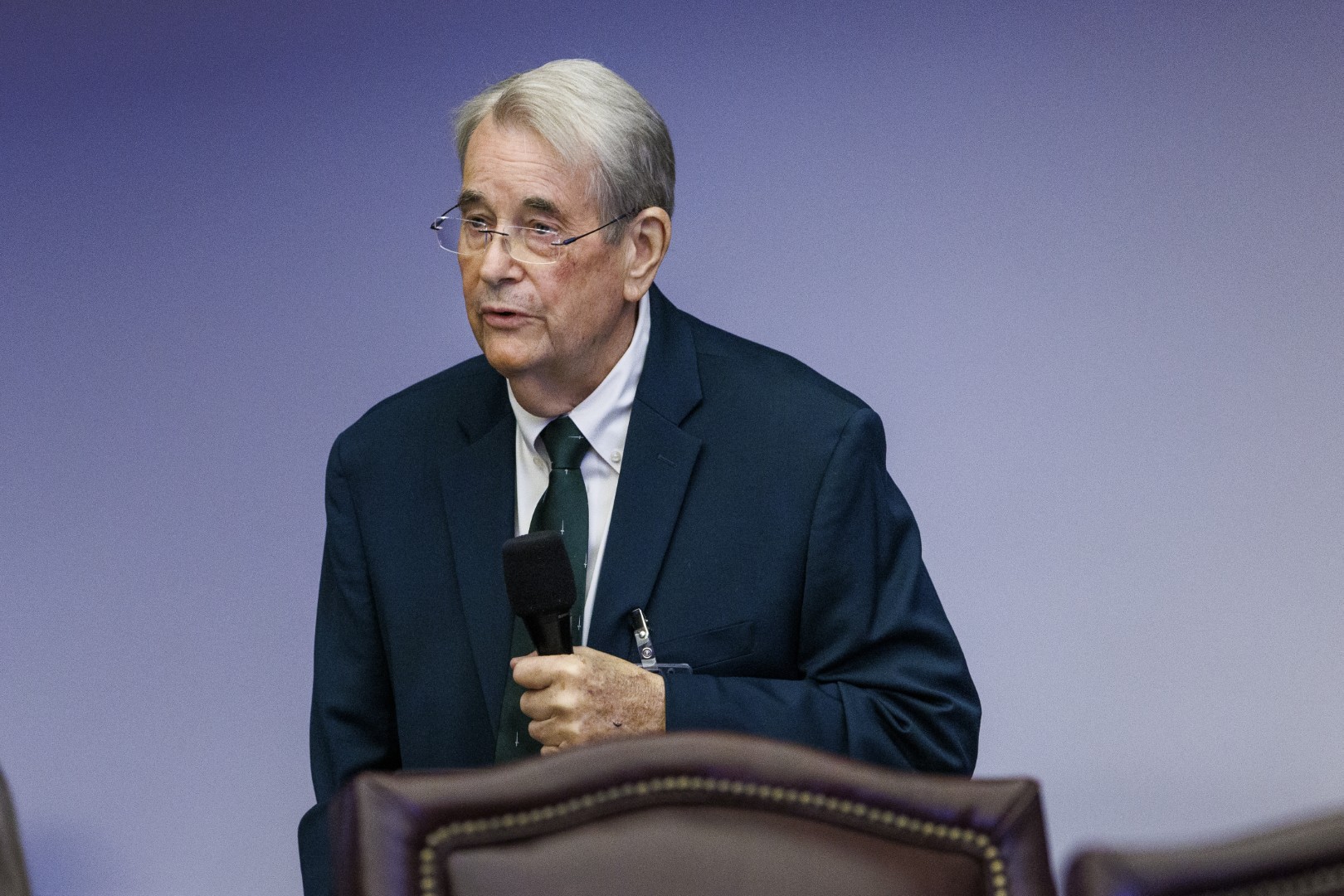
Legislation filed this week by Sen. Don Gaetz would relax requirements for people providing security for churches, synagogues, and mosques.

SB 52 would apply to those packing heat on a “voluntary basis” and “without compensation,” offering exceptions to state Statute 493.6102, which governs private security services.

The following conditions would have to be met.

Security plans would have to be approved ahead of time by the county sheriff. In other words, there couldn’t be an ad hoc decision to do this.

Security volunteers would have to pass level two background checks and hold a concealed weapon permit. While open carry is the law of the state after a judicial ruling that was affirmed by Attorney General James Uthmeier, it would not suffice in this case.

Additionally, security services would be “provided exclusively on the premises of the church, mosque, synagogue, or other place of worship, including any property owned or leased by the religious institution for worship, education, or religious activities.”

Volunteers would not be paid, as mentioned above.

But they would be compensated for “reasonable expenses” related to the cost of training.

The legislation as drafted does not drill down into what those expense are, however.

A House companion has yet to be filed for this bill that would become law in July if it makes it through the process.


Post Views: 0


Source link

Continue Reading

Politics

Gov. DeSantis not worried about federal AI executive order, says Florida limits would prevail in legal challenge

Published

on


Gov. Ron DeSantis is again pushing back against the idea that a “one rule” executive order from President Donald Trump protecting the artificial intelligence industry will limit Florida from passing laws against the industry.

During a roundtable at Florida Atlantic University, DeSantis said he was confident that much of what he wants to do falls within what is permissible under Trump’s order. And he also believes that the state would prevail if Attorney General Pam Bondi took legal action against Florida for going too far.

“The President issued an executive order, and some people were saying, ‘Well, no, this blocks the states from doing it.’ It doesn’t,” DeSantis said.

“First of all, an executive order can’t block the states. You can preempt states under Article 1 powers through congressional legislation on certain issues, but you can’t do it through executive order. But if you read it, they actually say a lot of the stuff we’re talking about are things that they’re encouraging states to do. They say it doesn’t prevent child safety. It doesn’t prevent any of that stuff. So even reading it very broadly, I think the stuff we’re doing is going to be very consistent. But irrespective, clearly we have a right to do this.”

Trump’s order, issued Thursday, compels Bondi to “establish an AI Litigation Task Force (Task Force) whose sole responsibility shall be to challenge State AI laws inconsistent with the policy set forth in section 2 of this order, including on grounds that such laws unconstitutionally regulate interstate commerce, are preempted by existing Federal regulations, or are otherwise unlawful in the Attorney General’s judgment.”

The goal, per the EO, is to establish “a minimally burdensome national standard — not 50 discordant State ones” to “sustain and enhance the United States’ global AI dominance.”

But DeSantis says that unlike “woke” states like Colorado and California that want to pass their own laws, Florida’s would comport with the guidance from the President, much of which is toothless without legislation.

“I don’t anticipate that even happening against any of the stuff we’re doing in Florida. But if it does, I think we would be well-positioned to be able to prevail on that. So I don’t think that’s going to be a bar for us creating a bill of rights for people and making sure,” he said, seemingly unconcerned about what he called the “dormant Commerce Clause.”

At Monday’s event, DeSantis repeated his concerns about data centers and foreign labor brought in to work at them and power usage, as well as deepfakes and people using images and likenesses falsely, Chinese technology, AI mental health therapy, and protections for consumers and parental rights, including data privacy protections.

“This is basically protecting against this technology running amok,” DeSantis said.


Source link

Continue Reading

Politics

Rob Reiner and his wife found dead in Los Angeles home

Published

on


Director-actor Rob Reiner and his wife, Michele, were the two people found dead Sunday at a Los Angeles home owned by Reiner, according to a law enforcement official briefed on the investigation.

The official could not publicly discuss details of the investigation and spoke to The Associated Press on condition of anonymity.

Investigators believe they suffered stab wounds and a family member is being questioned by investigators, the official said.

The Los Angeles Fire Department said it responded to a medical aid request shortly after 3:30 p.m. and found a 78-year-old man and 68-year-old woman dead inside. Reiner turned 78 in March.

Detectives with the Robbery Homicide Division were investigating an “apparent homicide” at Reiner’s home, said Capt. Mike Bland with the Los Angeles Police Department.

Los Angeles authorities have not confirmed the identities of the people found dead at the residence in the upscale Brentwood neighborhood on the city’s west side that’s home to many celebrities.

Reiner was long one of the most prolific directors in Hollywood, and his work included some of the most memorable movies of the 1980s and ’90s, including “This is Spinal Tap,” “A Few Good Men,” “When Harry Met Sally” and “The Princess Bride.”

His role as Meathead in Norman Lear’s 1970s TV classic “All in the Family,” alongside Carol O’Connor’s Archie Bunker, catapulted him to fame and won him two Emmy Awards.

Relatives of Lear, the legendary producer who died in 2023, said they were bereft by the news.

“Norman often referred to Rob as a son, and their close relationship was extraordinary, to us and the world,” said a Lear family statement. “Norman would have wanted to remind us that Rob and Michele spent every breath trying to make this country a better place, and they pursued that through their art, their activism, their philanthropy, and their love for family and friends.”

Messages to Reiner’s representatives were not immediately returned Sunday night.

Los Angeles Mayor Karen Bass called Reiner’s death a devastating loss for the city.

“Rob Reiner’s contributions reverberate throughout American culture and society, and he has improved countless lives through his creative work and advocacy fighting for social and economic justice,” Bass said in a statement. “An acclaimed actor, director, producer, writer, and engaged political activist, he always used his gifts in service of others.”

The son of comedy legend Carl Reiner, Rob Reiner was married to photographer Michele Singer Reiner since 1989. The two met while he was directing “When Harry Met Sally” and have three children together.

Reiner was previously married to actor-director Penny Marshall from 1971 to 1981. He adopted her daughter, Tracy ReinerCarl Reiner died in 2020 at age 98 and Marshall died in 2018.

Killings are rare in the Brentwood neighborhood. The scene is about a mile from the home where O.J. Simpson’s wife Nicole Brown Simpson and her friend Ron Goldman were killed in 1994.


Source link

Continue Reading

Politics

Eliminating or slashing property taxes would deeply undermine city services in Florida

Published

on


A new study from the Florida League of Cities details how eliminating or sharply reducing homestead property taxes would create sweeping fiscal disruptions and weaken essential services.

The analysis found that stripping away homestead property taxes — as is being proposed by Gov. Ron DeSantis and through potential ballot measures now advancing in the House — would intensify structural gaps, threaten bond ratings and push municipalities toward steep cuts.

Property taxes account for roughly 43% of municipal general revenue across all Florida cities. Because Florida has no income tax, the report notes, property taxes “function as the stabilizing base that offsets volatility in consumption-based revenues,” such as sales taxes, where the tax burden would shift.

Nowhere is the strain more apparent than in public safety spending, which consumes more than 56% of municipal general fund dollars statewide. In fact, the analysis found that cities of all sizes spend more on public safety than they receive in property tax revenues, meaning even modest losses can lead to noticeable issues.

In small cities with fewer than 5,000 residents, annual spending on police and fire equals about 90% of yearly property tax collections. Mid-size cities spend 150-175% of their property tax revenue on public safety, while large cities with more than 100,000 residents spend about 140%.

That imbalance means cities of all sizes are already reliant on sales taxes, state-shared revenues, utility funds and fees to maintain baseline policing and fire protection, even before any additional tax cuts.

Other core functions also strain the tax base. General government operations — legislative and executive functions, legal counsel, financial management, planning and administrative services — consume large chunks of property tax revenue. In coastal, urban and infrastructure-heavy municipalities, public works and quality-of-life services like transit often exceed total property tax collections, underscoring how stretched some cities already are.

A microsimulation conducted for the League found that eliminating homestead property taxes outright would trigger a 38% loss in ad valorem revenue and a 14% drop in overall general fund revenue, forcing millage rates to nearly double to avoid service cuts.

Proposals to impose high fixed-dollar property tax exemptions, $250,000 to $500,000, would also produce steep losses of 25-32%, requiring cities to raise millage rates by 20-70% on still-taxable properties to break even.

Not all potential reforms carry the same risk. So-called “clean-slate” reforms that would remove Save Our Homes caps and current exemptions before applying relief would behave differently, the study found. A 32% discount or $100,000 just-value exemption would actually produce net revenue gains for cities, unlike expansions of existing exemptions.

The downstream consequences of large-scale tax cuts, the report warns, would be severe. There would be greater fiscal instability that could weaken bond ratings, capital investments and municipal debt capacity.

City leaders predict likely cuts to police, fire, public works and parks funding unless the state provides replacement revenue. Notably, the House’s eight constitutional amendment proposals include carve-outs for police and school funding, but for nothing else.

Local officials have also raised concerns about state-driven tax policy, arguing that Tallahassee’s push to cap or reduce municipal revenue without providing replacement funding undermines local autonomy and shifts blame to cities as services decline.

Researchers at Wichita State University used a microsimulation model to estimate how various homestead property tax reform proposals would affect municipal revenues across Florida.

After establishing a baseline of each city’s fiscal structure from 2018–2024, they applied reforms — including complete elimination, tiered exemptions and a 32% discount — to parcel-level values under just, assessed and taxable valuation bases.

They then calculated the resulting revenue losses and the millage rate increases needed to keep budgets whole before then breaking the results down by region, population size, housing values and income to show which communities would be most impacted.

The study comes months after DeSantis vetoed a $1 million earmark in Florida’s budget that would have funded a study on the potential impacts of eliminating property taxes. A Florida Policy Institute study released in February found that Florida would need to double its sales tax to 12% to offset the local revenue losses that ending homestead taxes would cause.


Source link

Continue Reading

Trending

Copyright © Miami Select.