Connect with us

Business

Chipotle CEO Scott Boatwright: Gen Z, millennials are cutting back on dining out due to student loans, unemployment

Published

on


Even fast-casual dining may be too much of a financial burden for younger generations.

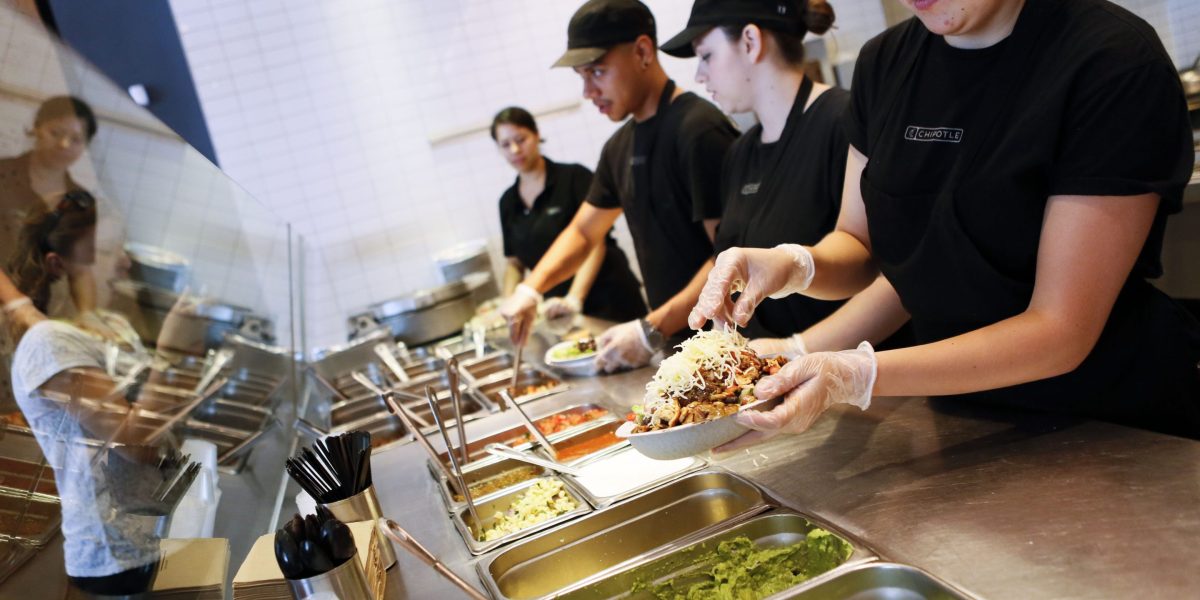
Chipotle CEO Scott Boatwright said young diners between the ages of 25 and 35 are cutting back on dining at the Mexican-inspired fast-casual chain. But these millennial and Gen Z customers are not snubbing Chipotle for other fast-food spots; they’ve stopped dining out as frequently altogether.

“This group is facing several headwinds, including unemployment, increased student loan repayment, and slower real wage growth,” Boatwright told investors at the company’s earnings presentation on Wednesday. “We’re not losing them to the competition. We’re losing them to grocery and food at home.” 

Boatwright noted Chipotle customers making less than $100,000—about 40% of Chipotle’s consumer base—are also pulling back. 

“They feel the pinch, we feel the pullback from them as well,” he concluded.

Chipotle cut its same-store sales forecast for its third consecutive quarter as quarterly revenue missed expectations and traffic declined by 0.8%, also its third straight dip.

Two-tier economy

Other fast-food chains have noted the emergence of a two-tier economy of high-income earners shelling out for meals out while low-income earners tighten their belts. This includes McDonald’s, which has been largely propped up by customers willing to spend more money at the chain. 

”There’s a lot of commentary around, ‘What’s the state of the economy, how’s it doing right now?’” McDonald’s CEO Chris Kempczinski told CNBC last month. “And what we see is, it’s really kind of a two-tier economy. If you’re upper-income, earning over $100,000, things are good…What we see with middle- and lower-income consumers, it’s actually a different story.”

Fast-food restaurants have also made a concerted effort to attract Gen Z diners, including McDonald’s adult Happy Meals, Taco Bell’s customizable drinks, and KFC spinoff Saucy’s flight of chicken tender dipping sauces. Chipotle has made similar attempts with limited-time offers of novelty condiments, with some success.

“Through our research, we found that over 90% of Gen Z consumers say they would visit a restaurant just for a new sauce,” Boatwright said on Wednesday.

Chipotle did not immediately respond to Fortune’s request for comment.

Gen Z cutting back on dining out

Amid an affordability crisis, it may take more than Chipotle’s Adobo Ranch or Red Chimichurri to get young customers into stores more often. Gen Z in particular has changed how they dine out to save money, taking advantage of cheaper menu options like splitting appetizers and ordering kids’ meals.

Dining out is coming at the expense of Gen Z and millennials, who are trying to pay their bills. A Redfin survey of 4,000 U.S. homeowners and renters, conducted in August, found 40% of Gen Z and millennial renters were eating out less to afford monthly payments. More than 20% reported skipping meals entirely to make ends meet.

Mounting data may confirm Boatwright’s suspicions about Gen Z’s financial burdens. Gen Z’s credit scores experienced the steepest annual drop of any generation since 2020, in part because of the return of student loan payments, according to a recent FICO report. And beyond grappling with a stubbornly expensive housing market, young generations are struggling to get or maintain jobs to advance their careers. 

A JPMorganChase Institute report released Wednesday found that young people aged 25 to 29 had the lowest income growth over the past decade. The unemployment rate for 16-to-24-year-olds reached about 10.5% in August, nearly three times that of their millennial and Gen X counterparts, according to Federal Reserve Bank of St. Louis data

In an era of “job hugging” in a low-fire, low-hiring labor market and anxiety around AI displacing entry-level workers, Gen Z is missing out on a key period of career advancement that comes from switching jobs to make more money, JPMorganChase noted in the report. This decreases their spending power—and makes it clear their worries go beyond whether they want carnitas or chicken on their burrito bowls.

“We’re already seeing that young people are having a hard time getting a foothold on the homeownership ladder,” George Eckerd, wealth and markets research director for JPMorganChase Institute, told Fortune. “They’re delaying home purchases because they need to climb further up their career ladder to be able to afford it all, and that career ladder is getting flatter.”


Source link

Continue Reading

Business

Trump’s $2,000 tariff ‘dividends’ would cost twice as much as the revenue coming in, budget watchdog warns

Published

on


President Trump’s recent proposal to pay Americans “at least $2,000 a person” from new tariff revenue—a policy he calls “tariff dividends”—is facing sharp criticism from a budget watchdog, who calculates that the plan will actually lose twice as much money for the country as the tariffs are generating.

Writing in a weekend post on Truth Social, Trump argued that tariff revenues could be redistributed directly to individuals in the form of annual payments, with “high income people” excluded from the payouts. The idea, pitched as a way both to reward taxpayers and possibly reduce the national debt, bears a strong resemblance to the structure of the COVID-era Economic Impact Payments, according to an analysis by the nonpartisan Committee for a Responsible Federal Budget (CRFB).

But the numbers reveal a steep fiscal challenge. The CRFB estimates that distributing just a single round of $2,000 payments to Americans—calculated to match the COVID payments, which included both adults and children—would cost the federal government around $600 billion per year. By contrast, the tariffs that Trump has championed have raised about $100 billion to date and, even accounting for pending legal cases, are only projected to raise about $300 billion annually going forward.

Deficits could skyrocket

“If tariff dividends are paid annually, deficits would increase by $6 trillion over ten years,” the CRFB writes, “roughly twice as much as President Trump’s tariffs are estimated to raise over the same time period.” This means not only that the revenue from tariffs would fail to cover dividend payouts, but also that the policy would exacerbate America’s long-term fiscal challenges.

To put the numbers in perspective, if dividends were paid out on a “revenue neutral” basis—matching payouts to actual tariff revenue—the analysis estimates that payments could be made only every other year, starting in early 2027. Should the Supreme Court uphold current lower court rulings that have deemed some of Trump’s tariffs illegal, remaining tariffs would only cover the dividend payments once every seven years.

Debt implications

Beyond blowing past the revenue generated, diverting all tariff proceeds to pay these dividends would restrict the government’s ability to use tariff income for reducing deficits or paying down debt, as some administration officials have proposed. The CRFB warns that using all tariff revenue for rebates would push federal debt to 127% of Gross Domestic Product (GDP) by 2035, compared to 120% under current law. If $2,000 dividends were paid annually, that figure could jump further, reaching 134% of GDP over the same period.

Such projections come at a time when annual budget deficits are nearing $2 trillion and national debt is quickly approaching an all-time high, making fiscal discipline a top concern for watchdogs and policy analysts.

Trump’s proposal draws inspiration from pandemic-era Economic Impact Payments (EIPs), but those measures were carefully income-tested to phase out payments for individuals earning over $75,000 and joint filers over $150,000. The CRFB said its analysis used similar eligibility parameters for its cost estimate, suggesting that without strict limits, the fiscal hit could be even higher.

For this story, Fortune used generative AI to help with an initial draft. An editor verified the accuracy of the information before publishing. 


Source link

Continue Reading

Business

Wendy’s plans hundreds of store closures to boost profits

Published

on


Wendy’s plans to close hundreds U.S. restaurants over the next few months in an effort to boost its profit.

The Dublin, Ohio-based chain said during a conference call with investors Friday that it planned to begin closing restaurants in the fourth quarter of this year. The company said it expected a “mid-single-digit percentage” of its U.S. stores to be affected, but it didn’t give any more details.

Wendy’s ended the third quarter with 6,011 U.S. restaurants. If 5% of those locations were impacted, it would mean 300 store closures.

The new round of closures comes on top of the closure of 240 U.S. Wendy’s locations in 2024. At the time, Wendy’s said that many of the 55-year-old chain’s restaurants are simply out of date.

Ken Cook, Wendy’s interim CEO, said Friday the company believes closing locations that are underperforming – whether it’s from a financial or customer service perspective – will help improve traffic and profitability at its remaining U.S. restaurants.

Cook became Wendy’s CEO in July after the company’s previous CEO, Kirk Tanner, left to become the president and CEO of Hershey Co.

“When we look at the system today, we have some restaurants that do not elevate the brand and are a drag from a franchisee financial performance perspective. The goal is to address and fix those restaurants,” Cook said during a conference call with investors.

Cook said in some cases, Wendy’s will make improvements to struggling stores, including adding technology or equipment. In other cases, it will transfer ownership to a different operator or close the restaurant altogether.

U.S. fast food chains have been struggling to attract lower-income U.S. consumers in the past few years as inflation has raised prices. In the July-September period, Wendy’s said its U.S. same-store sales, or sales at locations open at least a year, fell 5% compared to the same period last year.

Cook said $5 and $8 meal deals — which have been matched by McDonald’s — have helped bring some traffic back to its U.S. stores. But Wendy’s isn’t doing a good job of bringing in new customers, Cook said, so the company plans to shift its marketing to emphasize its value and the freshness of its ingredients.

Wendy’s shares dropped 7% Friday. On Monday, they were down 6% in afternoon trading.


Source link

Continue Reading

Business

Following Elon Musk’s $1 trillion comp, Warren Buffett says more CEOs are seeking eye-popping pay

Published

on


Berkshire Hathaway CEO Warren Buffett said he has seen a burgeoning trend of snowballing CEO pay as executives eyeball each other’s ever-growing compensation deals.

In his annual shareholder letter—the last one he will pen as CEO before Berkshire vice chair Greg Abel takes over on Jan. 1—Buffett suggested chief executives are driven by greed and selfishness to drive up their own pay after seeing competitors ratchet up their own remunerations.

“What often bothers very wealthy CEOs—they are human, after all—is that other CEOs are getting even richer,” he said. “Envy and greed walk hand in hand. And what consultant ever recommended a serious cut in CEO compensation or board payments?”

Buffett’s remarks come on the heels of Tesla investors approving CEO Elon Musk’s record-breaking $1 trillion pay package on Thursday. The compensation package, contingent on the EV company reaching an $8.5 trillion market capitalization, would make the already-world’s-richest-man into the first trillionaire. Musk’s net worth is currently about $449 billion.

The next day, EV competitor Rivian announced a $4.6 billion compensation package for CEO RJ Scaringe over the next decade, modeled after Musk’s plan. The package, which would double Scaringe’s base salary of $2 billion, is also dependent on the automaker reaching certain operating income and cash flow targets over the next seven years.

Tesla and Rivian did not immediately respond to Fortune’s requests for comment.

Buffett, reflecting on 60 years of leading his multi-industry conglomerate, said in his letter that companies’ disclosures of CEO pay was in part an effort to make executives at least a little self-conscious about the amount of money they were earning. However, what was intended as a gesture to humble instead became a contest of superiority.

“During my lifetime, reformers sought to embarrass CEOs by requiring the disclosure of the compensation of the boss compared to what was being paid to the average employee,” Buffett said. “Proxy statements promptly ballooned to 100-plus pages compared to 20 or less earlier. But the good intentions didn’t work; instead they backfired.” 

“Based on the majority of my observations—the CEO of company ‘A’ looked at his competitor at company ‘B’ and subtly conveyed to his board that he should be worth more. Of course, he also boosted the pay of directors and was careful who he placed on the compensation committee,” he added. “The new rules produced envy, not moderation.”

Indeed, compensation packages have swelled extravagantly, climbing 34.7% among the U.S.’s 100 largest low-wage employers from 2019 to 2024, according to an August report from the Institute for Policy Studies. The CEO-to-worker pay ratio similarly ballooned, growing from 560:1 in 2019 to 632:1 last year. Inordinate pay packages have helped make the country’s wealthiest billionaires $698 billion richer this year, per an Oxfam report published this month. Buffett, in contrast, has an annual salary of $100,000 (though his net worth sits at around $150 billion thanks to his investments, making him the 11th richest person on earth).

Other financial giants have spoken out against exorbitant pay packages, Musk’s in particular. Norges Investment Management, the entity behind Norway’s $2 trillion sovereign wealth fund and a 1.14% stakeholder in Tesla, voted against Musk’s compensation plan.

“While we appreciate the significant value created under Mr. Musk’s visionary role,” the group said in a statement last week, “we are concerned about the total size of the award, dilution, and lack of mitigation of key person risk—consistent with our views on executive compensation.”


Source link

Continue Reading

Trending

Copyright © Miami Select.