Chinese exporters are heartened by lower US tariffs following a summit between leaders of the two economic superpowers Thursday, but say they’re still keen to hedge exposure to any future setbacks in bilateral trade ties.
Bloomberg
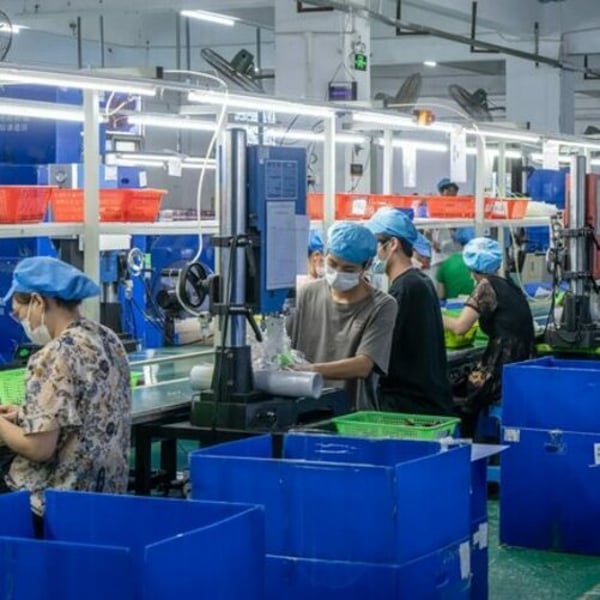
For buyers and sellers alike of consumer goods in the US, the risks of relying solely on China for production for everything from fast fashion to holiday ornaments have begun to outweigh the country’s edge as a low-cost production hub.
Even with the trade truce, US retailers aren’t likely to reconsider plans to move supply chains out of China and Chinese manufacturers are committed to expanding exports to markets beyond the US to limit their vulnerability.
“The tariff cut buys us more time,” said Huang Lun, sales manager at a Guangzhou-based retailer that sells underwear and yoga pants through online retailers including Amazon.com Inc., Shein Group Ltd. and PDD Holdings Inc.’s Temu.
While American buyers made up 80% of his company’s total annual sales last year, Huang’s firm initially sought to lower that dependence on the US to just 20% with growth in other markets. An unexpected surge of sales before tariffs kicked in upended that goal this year, but shifting away from the US is “the only way to reduce trade risks for the long term,” he said.
Chinese President Xi Jinping and US President Donald Trump announced the trade détente after their highly anticipated meeting in South Korea. As part of their agreement to ease tensions, the Associated Press reported Thursday the US agreed to lower tariffs on Chinese imports to 47%, down from 57% previously — and well below a threatened 157% levy.
While that’s higher than the rate US has levied on other Asian nations such as Vietnam at 20%, Chinese exporters say that production at home is more competitive due to China’s established manufacturing eco-system and skilled workers.
Several Chinese exporters Bloomberg News spoke with were optimistic the improved trade relations will result in an uptick in order flow between the world’s largest economies, bolstering profitability for businesses that have been squeezed by US tariffs of more than 50% in recent months on imports from China.
“We are going to get better deals with US clients,” said Andre Huang, a sales manager working for a firm selling household cleaning products like mops from Ningbo, an export base in eastern China.
The company’s expansion in the US has been stalled by the high tariffs imposed earlier in the year, but Huang noted things have started to brighten up lately amid growing expectations for a breakthrough at the Trump-Xi summit. He said more American clients showed up for a trade fair currently being held in Guangzhou than did for a similar event just a few months ago.
Yet the prospect of more business in the US no longer excites Chinese exporters as it once did. Many said they’ve learned their lessons from Trump’s trade brinkmanship and now realize they can’t rely solely on access to the world’s biggest consumer market.
The push into markets beyond the US already is evident in China’s trade data. The country is on track for a record $1.2 trillion trade surplus this year as shipments to Europe, Africa and other parts of Asia offset a slump in exports to the US.
At the same time, many buyers in the US have begun to rethink their dependence on a China-based sourcing strategy. They’re asking suppliers to set up manufacturing operations outside of China, even if it means higher costs and lower efficiencies in the near term.
For Lin Qian, who runs factories making toys in both the southern China boomtown of Shenzhen and in Vietnam, the lower US levies mean his Chinese factories will continue to handle the bulk of orders from US clients in the near term. But longer-term, he sees a shift away from China to steer clear of further disruption.
“Both us and our clients are clear the diversification pace won’t change as the China-US relationship is still tricky,” he said.
Establishing a production facility in nearby Vietnam is non-negotiable for a company that counts US toy brands for three-quarters of its revenue. Those clients, who Lin wouldn’t specify, threatened to stop placing orders altogether earlier this year unless he moved more production to the Southeast Asian country.
Production at Lin’s toymaking factory in Vietnam finally kicked off in September, three months later than expected. “Challenges are obvious.” he said, adding “we really have to leave our comfort zone.”
Having factories both at home and abroad has provided more of a sense of security for many China-based exporters.
“We’re no longer afraid of ups and downs in tariff rates,” said Barry Shan, whose company currently makes holiday ornaments for Walmart Inc. at its factory in eastern Chinese province Zhejiang. He will soon do the same at a new plant in Cambodia.
Even Chinese exporters who still want to maintain the US as their primary market, diversifying production outside of China is viewed as essential to staying competitive.
“Everybody is diversifying,” said Shanghai-based freight forwarder Keven Chen. “It’s now an industry consensus that US market can’t just rely on China’s supply chain, while Chinese manufacturers can’t merely count on the US market.”
Barcelona-based label Desigual is expanding its line-up of international collaborations. The label has unveiled a new collection co-created with Masha Popova, a Ukrainian designer based in London, resulting in an offering that blends Mediterranean spirit with a distinctly London edge and will be available from February 17 across all the company’s physical retail outlets and online.
The new capsule created with Masha Popova will be available from 17 February in stores and online – Desigual
The collection has been conceived as a dialogue between Desigual’s archive and the bold, sensual, and rebellious aesthetic that defines Popova’s creative universe. The pieces reinterpret the brand’s bohemian essence through a contemporary lens, combining craftsmanship, a raw attitude and a confident, modern visual language; garments include hand-finished denim, fitted silhouettes, and avant-garde pieces.
This launch comes at a strategic moment for Desigual in the UK market. In 2025, the company posted double-digit digital growth in the UK, with a 16% increase in turnover, cementing it as one of the brand’s most promising European markets. At present, the brand operates in the country exclusively via its e-commerce platform, with no brick-and-mortar network.
Furthermore, through this new alliance, Desigual reaffirms its commitment to collaborating with international brands and designers as a driver of creative renewal and global reach. In this vein, the label has recently developed capsules with the French label Egonlab and Botter, founded by designers Lisi Herrebrugh and Rushemy Botter in Amsterdam.
Founded in 1984 by Thomas Meyer, Desigual is a Barcelona-based fashion company with more than 280 company-owned stores and a presence in 107 markets across ten sales channels. On the economic front, the company closed the 2024 financial year with turnover of €332 million, supported especially by its international expansion and the growth of its digital business.
This article is an automatic translation. Click here to read the original article.
Alix Morabito, director of assortment and buying at Galeries Lafayette, is rounding out her team within a newly restructured buying division. To lead buying for the pivotal womenswear and leather goods segment, the Parisian department store has turned to a rival currently in the midst of a revamp: La Samaritaine.
Victoria Dartigues has been appointed Director of Womenswear and Leather Goods Buying at Galeries Lafayette – David Atlan/ Galeries Lafayette
Victoria Dartigues has taken up her new post after four years heading buying and merchandising at LVMH’s Right Bank department store in Paris. Since 2019, she has been with DFS, the luxury group’s duty-free subsidiary that spearheaded the Paris project, and played a key role in the relaunch of La Samaritaine.
For Victoria Dartigues, a graduate of HEC Montréal and IFM, this appointment at Galeries Lafayette is something of a homecoming: her first experience in Parisian department stores was as a buying assistant at Galeries Lafayette. She went on to join rival Printemps as a womenswear buyer in 2012.
After more than six years at the Printemps group, where she rose to head of merchandising overseeing the designer offer, she spent a stint at Kenzo before moving to DFS in 2019.
“A specialist in the multi-brand and department store sector, she has built strong relationships with brands over the years, curating assortments and leading negotiations,” Galeries Lafayette said in a press release. The group added that her appointment completes a buying leadership team comprising Alice Feillard for menswear and footwear, Pascale Leboutet-Reberat for beauty, and Violaine Moreau, who has been promoted to head up childrenswear, home and luggage.
“This new structure addresses the strategic challenge of asserting Galeries Lafayette’s commercial and creative vision through an increasingly exclusive offering,” the group said in its press release.
This article is an automatic translation. Click here to read the original article.
Great Portland Estates (GPE) has appointed a new chief financial officer, with Jayne Cottam joining the London-centric commercial property firm’s board from 16 March.
Great Portland Estates
She succeeds Nick Sanderson who is stepping down as GPE’s chief financial & operating officer to take up the position of chief financial officer at British real estate services company Savills from 30 January.
Cottam “brings significant financial leadership and operational experience” stock market-listed GPE said on announcing her appointment to the London Stock Exchange Monday (19 January).
Most recently, she served as CFO of healthcare property company Assura from September 2017 to December 2025.
GPE chair William Eccleshare said: “Jayne brings a wealth of skills, knowledge and experience which will be invaluable to the board and management team as we progress our growth agenda.” And CEO Toby Courtauld added: “Jayne brings an excellent blend of financial, operational and leadership qualities with the right values for GPE’s culture.”
She joins at a time when analysts are noting that GPE continues to outperform the broader UK property sector, boosted not only by slowly increasing demand for London offices but also via its catchment area of prime prime West End retail sites that continue to be in high demand as the company continues to capture the ‘flight to quality trend’.
The company’s most recent investor commentary reiterated “stable-to-improving” leasing momentum across its core West End and City portfolio.








 Politics8 years ago