Business
China’s auto industry is faster, cheaper and better. Here’s how the West can close the gap
When Covid ended and the blanket lifted, Western auto executives got the shock of their careers. China hadn’t just kept pace — it had made a quantum leap. Now, sales are slowing, tariff costs are biting, and war is pushing gas prices higher. Any one of these business headwinds would be enough to cause concern. But the thing that is really keeping executives up at night is China.
The Detroit 3 have lost 16 points in global market share over the last 20 years — almost a point a year. At the same time, Chinese car companies have gone from less than 1% to 12% global market share. Western automakers used to generate substantial profits in China; those profits are disappearing as Chinese manufacturers take over their home market and aggressively expand everywhere else. China’s automakers are advancing across Europe, Southeast Asia, and Latin America. The U.S. remains the last significant market keeping Chinese models out — and trade barriers won’t hold forever.
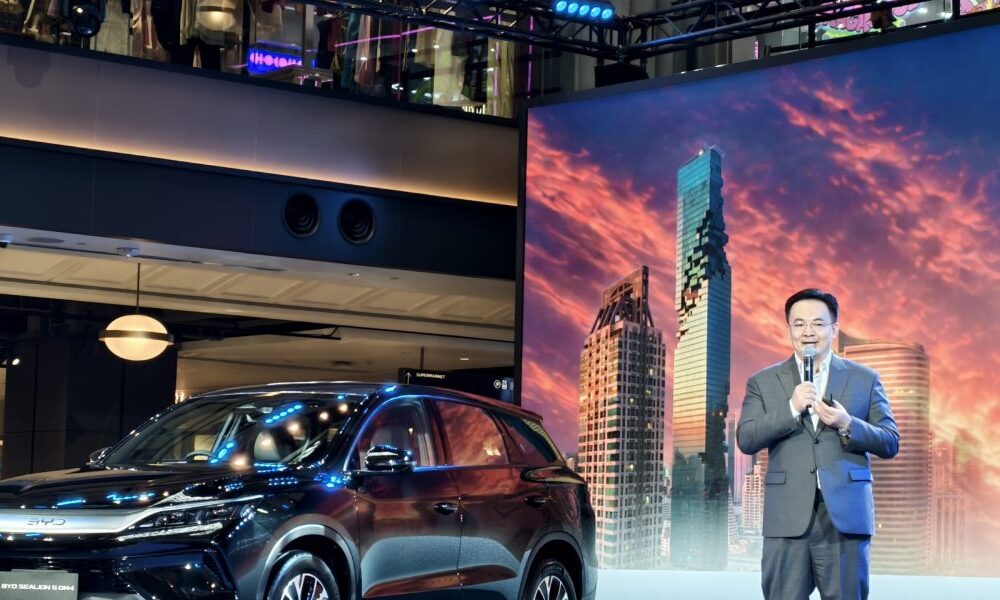
The scale of China’s advance is visible on the ground. BYD now operates around 200 sales outlets in Germany alone. This is not a distant threat. It is already reshaping markets Western automakers once considered protected home turf.
The pressure is now hitting American showrooms directly. McKinsey’s just-released Mobility Consumer Pulse survey finds that as tariff-driven price increases take hold, U.S. buyers are trading down on their next purchase or holding onto current vehicles longer. That’s a demand signal Western automakers cannot afford to misread — particularly as more affordable competition is still at least a year away from market.
Over several decades, Chinese automakers learned from their Western joint-venture partners. The Chinese government steadily followed a 20-year EV master plan — and executed it with remarkable discipline and patience. When the world reopened, Western auto executives realized too late what had happened: China was dramatically ahead in technology and operational excellence. Chinese disrupters were cranking out new models with development cycles of 20 to 24 months, compared to 40 to 50 months in the West. That means mature technology reaches the showroom faster. They are also producing at 30% lower bill-of-materials cost and 30% lower capital expenditure.
And here is the part that is hardest to hear: sometimes you are fighting a car that is not only cheaper — it is also better. On software, connectivity, automated driving features, and range, Chinese vehicles are frequently more advanced than their Western counterparts. The assumption that Chinese automakers compete only on price is no longer accurate. As our research confirms, the market is noticing: Gen Z and Millennial car buyers are meaningfully more open to purchasing a Chinese EV than their older counterparts, and more likely to switch brands specifically to get better driver-assisted technology. The loyalty Western brands have long counted on is not guaranteed for the next generation.
If present trends continue, it will be game over for Western automakers. The window to act is measured in years, not decades. The stakes couldn’t be higher. In the U.S., the auto business accounts for 5% of gross domestic output and $150 billion in exports. Ten million jobs are tied to cars, parts and dealers — the economic backbone of entire regions that have no obvious fallback. If this analysis frustrates you, good. It frustrates me, too. The obstacle is not a lack of understanding. We know what needs to be done. The question is whether we have the will to do it.
It’s time to take a hard look at how the industries in the West and China have diverged. Fortunately, there are clear lessons that can be applied. Here is a plan to reinvigorate automakers in North America, Europe, Japan and South Korea before it’s too late.
Regain scale — and standardize to get there. Geopolitics have pushed the industry towards a more “local for local” setup. Powertrain proliferation means a much more fragmented supply chain. The pie (as in new vehicle sales) has not grown much – and it’s being cut into many more pieces. Automakers need to regain scale by teaming up on production, sharing platforms, powertrains and development — especially on big-ticket items like battery technology, EV charging infrastructure, autonomous driving and vehicle software. Portfolio simplification is another way to regain control over costs.
Deploy AI where it moves the needle. AI is largely still deployed in pilots across Western autos. The profit-and-loss benefits have not yet been realized across software development, manufacturing, or in support functions. Incentive spending, one of the largest and most opaque cost lines, can be optimized through AI. The gap between AI’s potential and its current impact is one of the industry’s largest untapped opportunities.
Generate additional revenues across the entire lifetime of the vehicle and in adjacencies. Volumes in US and Europe are stagnant. Market share in China is down. Where else can revenues come from? First, by generating revenue across the vehicle lifecycle through dealer retention and subscriptions. Second, by generating revenue in near adjacent markets like robotics, defense, energy storage systems – and even through the data-center boom.
Compete as an ecosystem. Conduct a thought experiment. Imagine a Western vehicle built not by a single firm, but by an orchestrated alliance drawing on the West’s best capabilities: autonomous software from Silicon Valley; leading-edge semiconductors; breakthrough battery chemistry from VC-backed startups; a best-in-class electric powertrain and highly efficient manufacturing from Detroit; and legendary West Coast design. That vehicle wouldn’t just compete with China’s best. It would beat it.
The urgency of that vision goes beyond today’s price war. Another thing the Consumer Pulse survey revealed should alarm very legacy automaker: within ten years, the attributes that define a premium brand are expected to shift decisively, away from quality, heritage and comfort, and toward driver-assisted technology, powertrain innovation and sustainability. Exactly the terrain where Chinese manufacturers are advancing fastest. The brands that don’t move now won’t just lose market share. They’ll risk the meaning of the brand itself.
China didn’t wait for consensus. It didn’t ask permission. It built — faster, cheaper, and better than anyone in the West anticipated. The question for Detroit, and for every Western automaker, is whether they still can. The answer depends on whether they recognize that they are no longer competing solely against individual companies, but against an automotive ecosystem operating at unprecedented speed and scale. The industry that defined the last century will not win the next one by operating the same way.
The opinions expressed in Fortune.com commentary pieces are solely the views of their authors and do not necessarily reflect the opinions and beliefs of Fortune.