Connect with us

Business

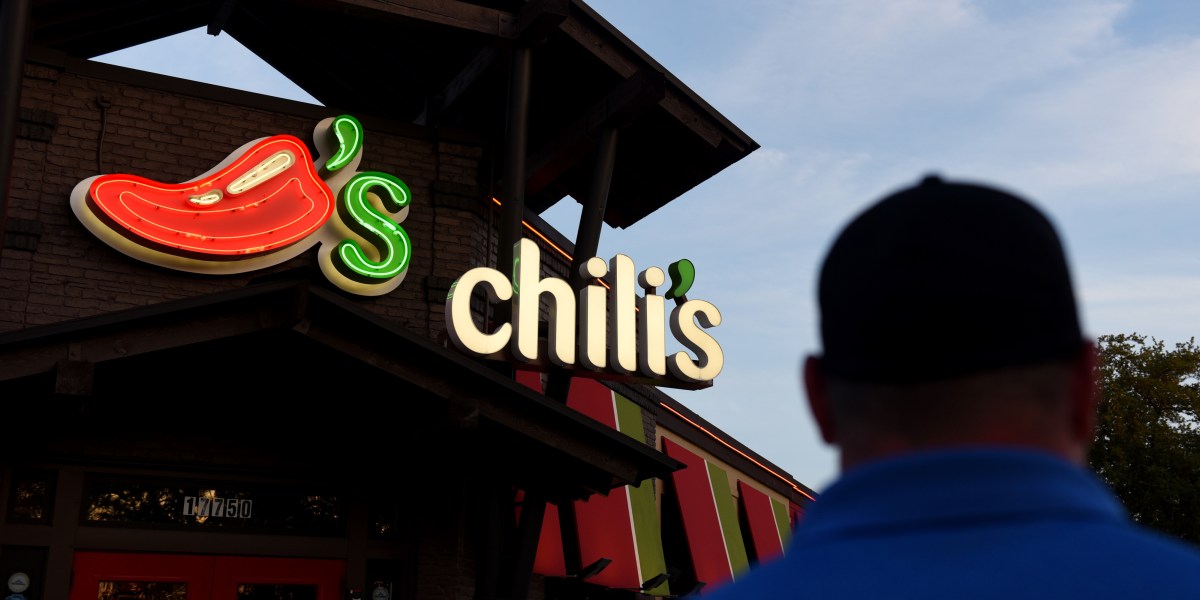
Chili’s has poured $105 million into its marketing budget in just 3 years—and sales are sizzling
Published

on


“Chili’s is officially back, baby back,” Brinker CEO Kevin Hochman said in the company’s fourth-quarter earnings report released Wednesday, a nod at the beloved casual-dining chain’s iconic jingle from the 1990s.

Chili’s has been winning at fast-casual dining this year while competitors have stifled due to tariffs and changing dining habits. The brand has made itself brutally efficient and has reigned supreme in the value-meal wars. And it’s been a viral sensation on social media for its quirky marketing campaigns and epic cheesepulls

“Chili’s has always had a history of really having fun with advertising and trying to be in the zeitgeist or pop culture,” Hochman told Fortune. “We don’t take ourselves too seriously. You can be silly about the burger because at the end of the day, we’re just selling burgers and booze.”

Not only has Chili’s been the proverbial talk of the town, but it has the hard data to show for its success: The chain reported a 24% spike in sales and 16% jump in traffic this quarter. 

Much of the boost in enthusiasm for and business to the chain has stemmed from its recent marketing campaigns. During the past three years, Chili’s increased its marketing budget by $105 million; in 2022, it had just $32 million allocated, but its 2025 marketing budget is a whopping $137 million, according to Hochman. AdAge crowned Chili’s on its 2025 list of Creativity Award winners

Winning marketing campaigns

Hochman regularly credits Chili’s CMO George Felix with the brand’s renewed success. Felix previously served as CMO of Tinder and Pizza Hut and as director of marketing and director of brand communications for KFC, where he breathed new life into the brand’s emblematic mascot through the “Return of Colonel Sanders” campaign.

Felix is implementing a similar playbook at Chili’s, using nostalgia to attract customers. One example was the opening of a Chili’s restaurant in Scranton, Penn., a nod to The Office episode where character Pam Beesly exclaims, “I feel God in this Chili’s tonight.”

Photo courtesy Chili’s

“For decades, Chili’s has inserted itself in culture—introducing the now-famous Baby Back Ribs jingle, and most recently unleashing Triple Dipper cheese pulls on TikTok,” Felix said in a statement. “But we’ve also seen the brand come to life on screen through the years, and that includes being tied to Scranton despite never having a location there. That changes this year.”

Felix told Marketing Dive that while Chili’s attracts customers in a variety of ways, the marketing push behind its Scranton restaurant leaned toward a “millennial, nostalgic audience.”

“That was certainly a nostalgia play, but the interesting part about that is, there’s all of us that watched it when it was on, and now it’s had this whole resurgence… that really expands generations,” he said. “It started as a nostalgia play, but I think it also resonates with the younger audience in a fun way.”

Chili’s has gotten creative in other ways, like releasing a Triple Dipper-inspired bedding set and Tecovas cowboy boots made from its archetypal red leather booths. 

Photo courtesy Chili’s

Meanwhile, TikTok and other social-media platforms have been flooded with videos of cheese pulls from the mozzarella sticks as part of the Triple Dipper appetizer platter and Chili’s own social-media team leans into absurdity and humor with many of its own posts. 

In one of its most recent Instagram posts, Chili’s inserted itself into the lore of the upcoming Taylor Swift album posting a close-up photo of a rib likening it to the new album cover.

Hochman even recounted a time where their social-media team saw a couple wanted to cater their wedding with Chili’s, which inspired the precedent of the chain offering free catering to any couple who gets engaged in their restaurants. 

“These are just cool things that a brand that is fun and doesn’t take themselves too seriously are going to lean into,” Hochman told Fortune. “I do think that guests appreciate that, because at the end of the day, they know we’re not corporate stiff types, that we’re just kind of like them. We just want to have fun, and we want them to see that.”

Introducing the 2025 Fortune Global 500, the definitive ranking of the biggest companies in the world. Explore this year’s list.


Source link

Continue Reading

Business

Fortune Brainstorm AI San Francisco starts today, with Databricks, OpenAI, Cursor, and more on deck

Published

on


It’s been a crazy few weeks in AI.

Granted, it feels like it’s always been a crazy few weeks in AI. But this cycle has been especially notable: Reports that Sam Altman has declared a “code red” around improving ChatGPT have made waves, while Databricks is reportedly in talks to raise at a jaw-dropping $134 billion valuation. Anthropic is reportedly looking at a real-life IPO, and everyone’s always watching for news from perhaps the biggest ascent of the year: Cursor, the AI coding juggernaut that’s now valued at more than $29 billion. 

And today, Brainstorm AI starts, and so many of these key players will be with us live in San Francisco, including Databricks CEO Ali Ghodsi, OpenAI COO Brad Lightcap, Cursor CEO Michael Truell, San Francisco Mayor Daniel Lurie, Google Cloud CEO Thomas Kurian, and Rivian CEO RJ Scaringe, plus some starpower from Joseph Gordon-Levitt and Natasha Lyonne. 

If you’re attending the conference, come find me! I’ll realistically be the one running around in a bright pantsuit. And if you can’t make it, we’ll be livestreaming the show, too – tune in here.

See you soon,

See you tomorrow,

Allie Garfinkle
X:
@agarfinks
Email:alexandra.garfinkle@fortune.com
Submit a deal for the Term Sheet newsletter here.

Joey Abrams curated the deals section of today’s newsletter.Subscribe here.

Venture Deals

Antithesis, a Tysons Corner, Va.-based platform designed to validate that software works before it launches, raised $105 million in Series A funding. JaneStreet led the round and was joined by AmplifyVenturePartners, SparkCapital, and others.

ParadigmHealth, a Columbus, Ohio-based clinical research platform, raised $78 million in Series B funding. ARCHVenturePartners led the round and was joined by DFJGrowth and existing investors.

Oxzo, a Santiago, Chile-based provider of oxygenation services for aquaculture, raised $25 million in funding from S2GInvestments.

Quanta, a San Francisco-based accounting platform, raised $15 million in Series A funding. Accel led the round and was joined by OperatorCollective, NavalRavikant, DesignerFund, and others.

LizzyAI, a New York City-based AI-powered talent interviewing company, raised $5 million in seed funding. NEA led the round and was joined by Speedinvest and ZeroPrimeVentures

PvX, a Singapore-based provider of user-acquisition financing for gaming companies, raised $4.7 million in a seed extension from Z Venture Capital, DrivebyDraftKings, and existing investors.

Corma, a Paris, France-based developer of a copilot for AI teams, raised €3.5 million ($4.1 million) in seed funding. XTXVentures led the round and was joined by TuesdayCapital, KimaVentures, 50Partners, OlympeCapital, and angel investors.

Private Equity

NITEOProducts, a portfolio company of HighlanderPartners, acquired Folexport, a Tualatin, Ore.-based manufacturer of carpet, fabric, and hard surface cleaning products. Financial terms were not disclosed.


Source link

Continue Reading

Business

Why the worst leaders sometimes rise the fastest

Published

on


History is crowded with CEOs who have flamed out in very public ways. Yet when the reckoning arrives, the same question often lingers: How did this person keep getting promoted? In corporate America, the phenomenon is known as “failing up,” the steady rise of executives whose performance rarely matches their trajectory. Organizational psychologists say it’s not an anomaly. It’s a feature of how many companies evaluate leadership.

At the core is a well-documented bias toward confidence over competence. Studies consistently show that people who speak decisively, project certainty, and take credit for wins—whether earned or not—are more likely to be perceived as leadership material. In ambiguous environments, boards and senior managers often mistake boldness for ability. As long as a leader can narrate failure convincingly—blaming market headwinds, legacy systems, or uncooperative teams—their upward momentum may continue.

Another driver is asymmetric accountability. Senior executives typically oversee vast, complex systems where outcomes are hard to tie directly to individual decisions. When results are good, credit flows upward. When results are bad, blame diffuses downward, and middle managers, project leads, and market conditions become convenient shock absorbers. This allows underperforming leaders to survive long enough to secure their next promotion.

Then there’s the mobility illusion. In many industries, frequent job changes are read as ambition and momentum rather than warning signs. An executive who leaves after short, uneven tenures can reframe each exit as a “growth opportunity” or a strategic pivot. Recruiters and boards, under pressure to fill top roles quickly, often rely on résumé signals, like brand-name firms, inflated titles, and elite networks, rather than deep performance audits.

Ironically, early visibility can also accelerate failure upward. High-profile roles magnify both success and failure, but they also increase name recognition. An executive who runs a troubled division at a global firm may preside over mediocre results, yet emerge with a reputation as a “big-company leader,” making them attractive for a CEO role elsewhere.

The reckoning usually comes only at the top. As CEO, the buffers disappear. There is no one left to blame, and performance is judged in the blunt language of earnings, stock price, profitability, or layoffs. The traits that once fueled ascent, such as overconfidence, risk-shifting, and narrative control, become liabilities under full scrutiny.

The central lesson for aspiring CEOs is that the very system that rewards confidence, visibility, and narrative control on the way up often masks weak execution until the top job strips those protections away. Future leaders who want to avoid “failing upward” must deliberately build careers grounded in verifiable results and direct ownership of outcomes because at the CEO level, there is no narrative strong enough to substitute for performance.

Ruth Umoh
ruth.umoh@fortune.com

Smarter in seconds

Big biz buy-in. Anthropic is all in on ‘AI safety’—and that’s helping the $183 billion startup win over big business

Old guard upgrade. How the bank founded by Alexander Hamilton is transforming for the future of finance

Pressure test. Inside the Fortune 500 CEO pressure cooker: surviving is harder than ever and requires an ‘odd combination’ of traits

Rank racing. The one-upmanship driving CEOs

Leadership lesson

Anthropic’s Dario Amodei on when a startup gets too big to know all employees: “It’s an inevitable part of growth.”

News to know

Investors are questioning OpenAI’s profitability amid its massive spending while increasingly viewing Alphabet as the deeper-pocketed winner in the AI race. Fortune

Trump warned that Netflix’s $72 billion bid for Warner Bros. Discovery could face antitrust scrutiny, suggesting it would create an overly dominant force in streaming. Fortune

An etiquette camp is trying to help Silicon Valley shed its sloppy image by teaching tech elites how to dress and behave as their influence grows. WaPo

IBM is reportedly in advanced talks to buy data-infrastructure firm Confluent for about $11 billion, bolstering its AI data capabilities. WSJ

Even as women reach top roles in politics and business at record levels, public confidence in their leadership is stagnating or declining. Bloomberg

Terence “Bud” Crawford, the undefeated 38-year-old boxing champion, has earned more than $100 million and even turned Warren Buffett into a fan. Forbes

Big Tech leaders now warn that artificial intelligence is advancing to the point where it could begin replacing even CEOs, reshaping the very top of corporate leadership. WSJ

This is the web version of the Fortune Next to Lead newsletter, which offers strategies on how to make it to the corner office. Sign up for free.


Source link

Continue Reading

Business

The workforce is becoming AI-native. Leadership has to evolve

Published

on


One of the most insightful conversations I have had recently about artificial intelligence was not with policymakers or peers. It was with a group of Nokia early-careers talents in their early 20s. What stood out was their impatience. They wanted to move faster in using AI to strengthen their innovation capabilities. 

That makes perfect sense. This generation began university when ChatGPT launched in 2022. They now account for roughly half of all ChatGPT usage, applying it to everything from research to better decision-making in knowledge-intensive work. 

Some people worry that AI-driven hiring slowdowns are disproportionately impacting younger workers. Yet the greater opportunity lies in a new generation of AI-native professionals entering the workforce equipped for how technology is transforming roles, teams, and leadership.

Better human connectivity 

One of the first tangible benefits of generative AI is that it allows individual contributors to take on tasks once handled by managers. Research by Harvard Business School found that access to Copilot increased employee productivity by 5% in core tasks. As productivity rises and hierarchies flatten, early-career employees using AI are empowered to focus on outcomes, learn faster, and contribute at a higher level.

Yet personal productivity is not the real measure of progress. What matters most is how well teams perform together. Individual AI gains only create business impact when they align with team goals and that requires greater transparency, alignment, and accountability.

At Nokia, we ensure that everyone has clear, measurable goals that support their teams’ objectives. Leaders need to be open about their goals to their managers and to their reports. And everyone means everyone. Me included. That way goals are not only about recognition and reward. They become an ongoing dialogue between leaders and their teams. It’s how we’re building a continuous learning culture that thrives on feedback and agility, both essential in the AI era. 

Humans empowered with AI, not humans versus AI

AI’s true power lies in augmenting human skills. Every role has a core purpose – whether in strategy, creativity, or technical problem-solving – and AI helps people focus on that. 

During the COVID-19 pandemic, more than 60 chatbots were deployed in 30 countries to handle routine public health queries, freeing up healthcare workers to focus on critical patient care. Most health services never looked back. 

The same pattern applies inside companies. Some of the routine tasks given to new hires are drudge work and not a learning experience. AI gives us a chance to rethink the onboarding, training, and career development process.

Take an early-career engineer. Onboarding can be a slow process of documentation and waiting for reviews. AI can act as an always-on coach that gives quick guidance and helps people ramp up. Mentors then spend less time on the basics and more time helping engineers solve real problems. Engineers can also have smart agents testing their designs, ideas, and simulating potential outcomes. In this way, AI strengthens, rather than substitutes, the human connection between junior engineers and their mentors and helps unlock potential faster.

Encourage experimentation and entrepreneurship 

During two decades of the Internet Supercycle (1998-2018), start-ups created trillions of dollars in economic value and roughly half of all new jobs in OECD countries

As AI lowers the barriers to launching and scaling ventures, established companies must find new ways to encourage experimentation, nurture innovation through rapid iterations, and give employees the chance to commercialize and scale their ideas.

There is a generational shift that increases the urgency: more than 60% of Gen Z Europeans hope to start their own businesses within five years, according to one survey. To secure this talent, large organizations must provide the attributes that make entrepreneurship attractive. Empowering people with agility, autonomy, and faster decision-making creates an edge in attracting and keeping top talent.

At Nokia, our Technology and AI Organization is designed to strengthen innovation capabilities, encourage entrepreneurial thinking, and give teams the support to turn ideas into real outcomes.

More coaching, less managing 

Sporting analogies are often overused in business as the two worlds don’t perfectly align, yet the evolution of leadership in elite football offers useful lessons. Traditionally, managers oversaw everything on and off the pitch. Today, head coaches focus on building the right team and culture to win. 

Luis Enrique, the manager of Paris-St. Germain football club, last season’s UEFA Champion’s League winner, exemplifies this shift. He transformed a team of stars into a star team, while also evolving his coaching style, elevating both individual and collective potential.

Of course, CEOs must switch between both roles (as I said, the worlds don’t perfectly align) – setting vision and strategy while also cultivating the right team and culture to succeed. AI can help leaders do both with more focus. It gives us quicker insight into what is working, what is not, and where teams need support.

I have been testing these tools with my own leadership team. We are using generative AI to help us evaluate our decisions and to understand how we work together. It has revealed patterns we might have missed, and it has helped us get to the real issues faster. It does not replace judgment or experience. It supports them.

Yet the core of leadership does not change. AI cannot build trust. It cannot set expectations. It cannot create a culture that learns, improves, and takes responsibility. That still comes from people. And in a world shaped by AI, the leaders who succeed will be the ones who coach, who listen, and who help teams move faster with confidence.

Nokia’s technology connects intelligence around the world. Inside the company, connecting intelligence is about how people work together. It means giving teams the tools, support and culture they need to grow and perform with confidence. Connecting intelligence is how teams win.

The opinions expressed in Fortune.com commentary pieces are solely the views of their authors and do not necessarily reflect the opinions and beliefs of Fortune.


Source link

Continue Reading

Trending

Copyright © Miami Select.