
Politics
Checking the pulse of Florida health care news and policy


Welcome back to Diagnosis, a vertical that focuses on the crossroads of health care policy and politics.
___
— Marketplace Overhaul —
Rep. Taylor Yarkosky has filed legislation to overhaul and rename the Florida Health Choices Program, refocusing it as an employer-based health marketplace.
The measure (HB 141) renames the initiative as the Florida Employee Health Choices Program. It rewrites much of the existing statute governing how small businesses and workers can access private health coverage options. The program, originally envisioned as a health insurance “marketplace” when created in 2008, never reached full scale and was later criticized as redundant after the rollout of the federal Affordable Care Act.
Yarkosky’s bill reorients the program around individual coverage health reimbursement arrangements — a federal model allowing employers to contribute tax-free dollars to employees who then purchase their own health insurance plans. The proposed changes would authorize the creation of a centralized marketplace for participating employers and workers, streamline enrollment processes, and modernize vendor and product eligibility to reflect current insurance regulations.
Under the measure, the administering corporation would be renamed Florida Employee Health Choices, with an eight-member Board that includes appointments from the Governor, Senate President and House Speaker. The corporation would be tasked with establishing and managing a digital platform where employers can help workers purchase individualized coverage and related health services.
The bill removes provisions related to risk pooling and insurance code exemptions, shifting the focus from experimental market structures toward integrating employer and employee health purchasing. If enacted, the overhaul would take effect July 1, 2026.
— Nursing accountability —
Republican Rep. Toby Overdorf has refiled a proposal seeking to tighten oversight and raise accountability standards for Florida’s nursing education programs.
The new bill (HB 121) mirrors much of the language included in the 2025 legislation that was part of Senate President Ben Albritton’s “Rural Renaissance” initiative. The original measure passed with bipartisan support but was blocked in July after the Governor called it an example of “bureaucratic overreach.”
Overdorf’s refiled bill would require the Board of Nursing to impose stricter reporting, testing and remediation requirements for nursing programs and their directors. Among its provisions, the bill directs programs to identify struggling students early, provide tailored support, and administer a mandatory exit exam before graduation. Programs with poor National Council Licensure Examination (NCLEX) passage rates would face heightened scrutiny, probationary status or termination.
The legislation also empowers the Department of Health to conduct on-site evaluations and revoke a program’s approval in cases of persistent noncompliance. It expands the Florida Center for Nursing’s annual reporting duties to track the impact of exit exams and remediation efforts on student outcomes.
Supporters say the changes will help boost nursing education standards amid low statewide NCLEX passage rates and a continued shortage of health care professionals, particularly in rural communities. But the Governor, in his veto message, argued the measure “would deter programs from accepting students” and encourage an overemphasis on test prep instead of hands-on clinical training.
The bill would take effect July 1, 2026, if signed into law.

— Autonomy expansion —
Republican Sen. Keith Truenow of Tavares has refiled legislation aimed at expanding the scope of practice for advanced nurse practitioners in Florida by authorizing psychiatric nurses to work autonomously.
The measure (SB 138) amends state law to allow psychiatric mental health advanced practice registered nurses (APRNs) to provide mental health services without physician supervision, provided they meet criteria set by the Board of Nursing. Current law allows autonomous practice for APRNs in limited fields such as primary care, family medicine, general pediatrics and general internal medicine.

If approved, psychiatric nurses could evaluate, diagnose and treat patients independently and establish their own practices. Supporters say the change could help alleviate Florida’s shortage of mental health professionals and lower treatment costs, aligning the state with more than two dozen others that already grant such authority.
During the 2025 Session, a similar proposal cleared the House but failed to gain traction in the Senate. Opponents raised concerns about oversight and potential impacts on the quality of care, arguing the change could discourage students from pursuing psychiatry through traditional medical pathways.
Under the new bill, certified psychiatric APRNs would be able to admit, manage and discharge patients from health care facilities and perform many functions currently reserved for physicians. If enacted, the legislation would take effect July 1, 2026.
—ROSTER —
The Florida Senior Living Association (FSLA) has a new advocate in the Capitol.
Elaina Morgan has officially registered as a lobbyist for the association, taking on the title of Director of Medicaid and Regulatory Support.
Morgan brings more than seven years of experience in health and Medicaid policy to her new role. Before joining FSLA in July, she served as a Legislative Analyst for the Senate Committee on Health Policy, where she evaluated proposed legislation and provided policy guidance under Senate Presidents Kathleen Passidomo and Albritton.

Earlier, she spent nearly five years at the Agency for Health Care Administration, holding multiple posts within the Bureau of Medicaid Policy, including Government Analyst and Government Operations Consultant. Her portfolio there covered pharmacy and prescribed drug policy, behavioral health, and specialized health services.
— ICYMI —
“NCH planning 150-bed hospital in Ave Maria for eastern Collier” via Liz Freeman of Naples Daily News — Residents of Ave Maria and other communities in eastern Collier County are getting a lot of attention from NCH, which will include a freestanding emergency room and a new hospital. The nonprofit hospital system has developed a detailed plan to address the health care needs of the rapidly growing area of Ave Maria, as well as new developments in the planning stages in the broader region. Barron Collier Companies, Ave Maria’s developer of residential and commercial properties, has donated 18 acres to NCH in exchange for NCH meeting the medical needs of the area, which will ultimately include a 150-bed hospital. The location for the future hospital, targeted for a groundbreaking in 2032, is adjacent to the Arthrex manufacturing plant on the north side of Oil Well Road. Naples-based Arthrex manufactures medical devices.

“Democrats play the hits on health care. Why fewer people are listening.” via Nate Cohn of The New York Times — Health care once defined America’s political divide, but it’s now barely a blip on voters’ radar. Only one percent cited it as a top issue in the 2024 Election, and even the latest government shutdown revolves around it only incidentally. Democrats forced the standoff partly to spotlight expiring Obamacare subsidies and GOP cuts, hoping to rekindle an issue that used to play to their strengths. But Trump-era politics shifted the national focus to immigration, culture wars, and executive power. Republicans no longer campaign against health programs, and Democrats lack a bold new expansion to champion. With 92% of Americans insured and little appetite for sweeping reform, health care has faded as a defining political battleground — replaced by fights over identity and power.
“Bold moves for women’s health: How Baptist Health South Florida is transforming cancer care” via Florida Trend — Breast cancer doesn’t wait for the right time, and for young women, it often strikes amid careers, family plans, and future dreams. Baptist Health’s Young Women’s Breast Cancer Program meets these challenges with a comprehensive, compassionate approach that combines leading-edge medicine with personal support. Its multidisciplinary team — spanning oncology, fertility, genetics, and survivorship — helps patients navigate treatment while preserving their health, fertility, and emotional well-being. Through oncofertility counseling, mental health care, and peer connection opportunities, the program empowers women to face cancer without putting life on hold. By merging advanced science with empathy, Baptist Health ensures every woman has the strength, resources, and confidence to move forward — not just to survive, but to thrive.

— RULES —
The Agency for Health Care Administration’s final rule 59G-6.009, regarding training, education, and clinicals in health funding programs, goes into effect Oct. 26. More here.
The Board of Speech-Language Pathology and Audiology’s final rule 64B20-5.005, regarding requirements for renewal of provisional licenses, goes into effect Oct. 29. More here.
The Board of Respiratory Care’s final rule 64B32-6.004, regarding procedures for approval of attendance at continuing education courses, goes into effect Oct. 29. More here.

— PENCIL IT IN —
Oct. 22
— Happy birthday to Senate President-designate Jim Boyd!


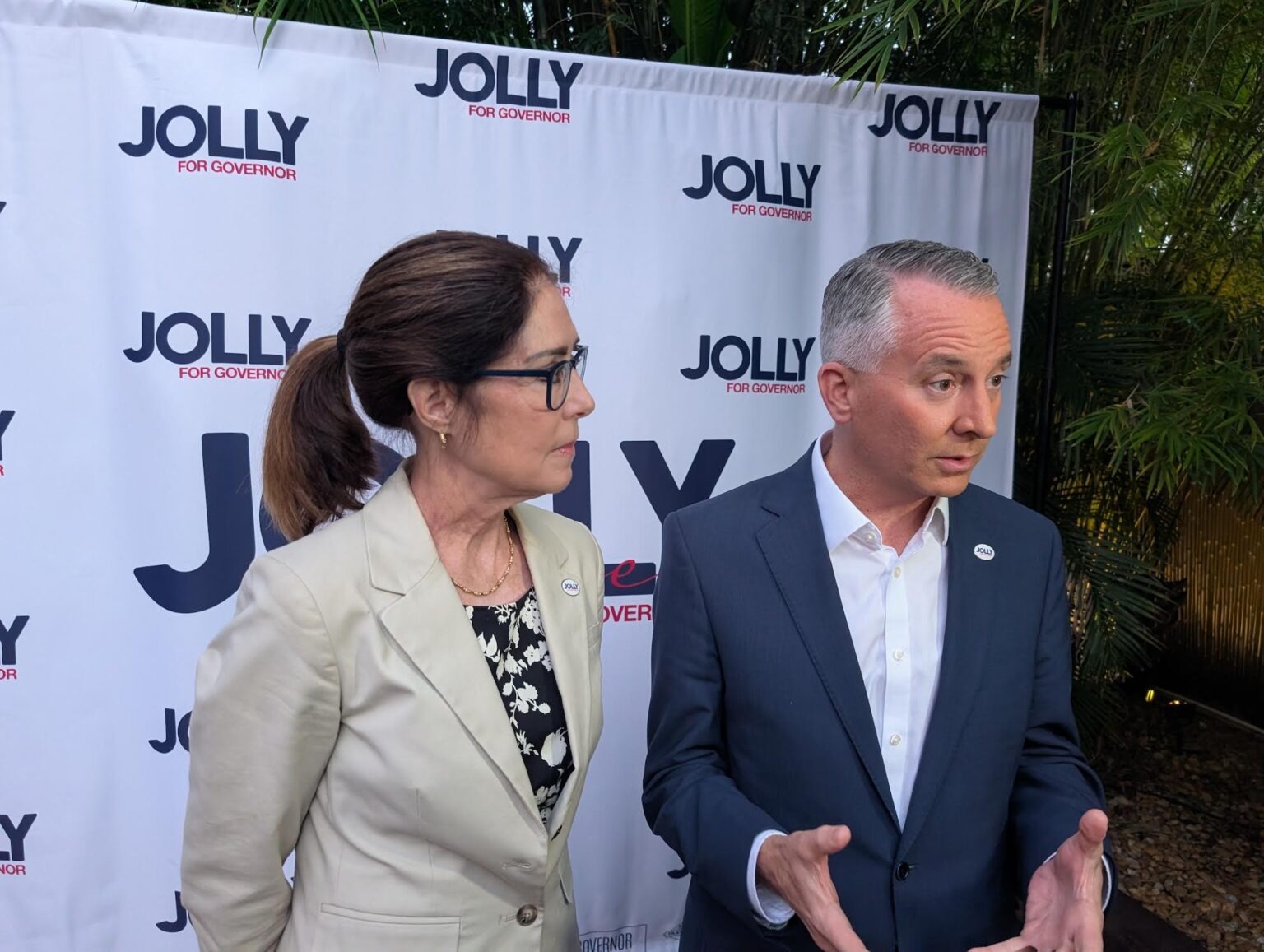
Could Gwen Graham add heft to David Jolly’s candidacy for Governor by becoming his running mate in Florida next year?
That question occurred when the former Tallahassee-based U.S. Representative appeared with Jolly last week during a political rally in Pinellas County that drew 400-plus attendees.
Jolly has been crisscrossing the Sunshine State since entering the Democratic race for Governor in June, and the event at 535 Nova — a wedding venue — was his 130th public gathering since he entered the contest, but the first time he appeared with Graham, the closest thing to Florida Democratic Party royalty. She’s a daughter of Bob Graham, the former Florida Governor and U.S. Senator who died last year at 87.
In an interview before the Thursday event, Gwen Graham, who served in Congress with Jolly from 2015-2017, said it was a “no-brainer” that she would support the former Republican for Governor.
“I would not be standing here if I didn’t know he could win,” she said. “This election is too important. We’ve got to have a candidate in November who can win so we can start reversing the damage that has been done to the state that I love and my father loved, and David can win. So, I’m going to do whatever I can to help him do that.”
Many political analysts considered Graham the favorite to capture the Democratic nomination for Governor in 2018, but she ended up losing to then Tallahassee Mayor Andrew Gillum by 3 percentage points in that year’s Primary. She went on to serve in President Joe Biden’s administration as assistant secretary for legislation and congressional affairs at the U.S. Department of Education from 2021 to 2025.
In introducing Jolly to the audience in St. Petersburg last week, Graham said she was nervous because it was her first public appearance since the death of her father, who served as Florida’s 38th Governor from 1979 to 1987 and in the U.S. Senate from 1987 to 2005.
“I hear my dad’s voice in David’s commitment to the values that I have grown up with and lived,” she said in her speech.
“I hear David’s voice talking about what he cares about for the future of this state. So, while David knows this race will be difficult, the moment is too important. We must all stand together and do our part to define what Florida will look like as a state for the next century.”
Jolly deflected when asked before the event whether he was considering Graham to serve as his running mate, but did say, “We’re going to name a Lieutenant Governor candidate very early. We’re not going to wait until the Primary. And I hope we see Gwen Graham in office again in the state of Florida.”

Considering a Jolly-Graham ticket
Longtime Hillsborough County Democratic strategist Victor DiMaio served at one time as a Press Secretary for Bob Graham. Having Gwen Graham on Jolly’s ticket makes sense on several levels, he said.
“Gwen would be an excellent choice if that’s what (Jolly) decides to do,” he said. “It didn’t hurt other Governors who have selected women as Lieutenant Governors.”
Angela Birdsong, President of the Hillsborough County Democratic Black Caucus, believes Gillum would have defeated Ron DeSantis in 2018 if he had selected Graham, instead of Chris King, to serve as his running mate.
“She would bring in more conservative Democrats, and independents would love her,” Birdsong said of Graham’s appeal in 2026. When asked if that ticket might prove to be too moderate for Florida Democrats, Birdsong disagreed. “I’m with Jasmine Crockett — I think that we’re going to have to run some vanilla candidates for a while.”
(Crockett. a progressive Democratic member of Congress from Texas, said in an interview on Sirius/XM radio in May that, following the Democratic Party’s losses to Donald Trump with Kamala Harris and Hillary Clinton, “we just want to win.”
(She added, “So, there’s a lot of people that are like, ‘You know what? Like, let’s go find the safest White boy we can find.’ I mean, I’m just saying.”)
Some political consultants believe a Democratic gubernatorial ticket consisting of Jolly, a former Republican, and Graham, a political moderate, may offer a General Election appeal to a Florida electorate that has moved considerably to the political right during the past eight years.
But it might be a dead letter within the more progressive precincts of the Florida Democratic Party.
Carolina Ampudia is a former Chair of the Democratic Progressive Caucus in Florida. She sees a Jolly-Graham ticket as “a pathetic retreat, not a step forward.”
“Jolly has a Republican record and ties to Scientology. Graham voted to fast-track the Keystone pipeline and built her career on centrism. Neither of them represents the communities that have been fighting on the frontlines for labor rights, racial justice, LGBTQ+ protections, public education, or environmental survival,” she said in a text message.
“Florida doesn’t need a rebranded Republican and a legacy name,” she continued. “We need leadership that reflects the courage and clarity of the people — not the fears of consultants and donors.”
Florida’s last two elected Governors, DeSantis and Rick Scott, both named women as their running mates (DeSantis selected Jeanette Nuñez in 2018 and Scott picked Jennifer Carroll in 2010). Charlie Crist selected female running mates in his two unsuccessful bids as a Democrat for Governor in 2014 and 2022 (Annette Taddeo in ’14 and Karla Hernández-Mats in ’22).
Meanwhile, discussion about a potential running mate for Jolly comes amid a challenge for the Democratic nomination by Orange County Mayor Jerry Demings, who announced his candidacy a month ago. No major polls comparing the two Democrats have been published since his entry.
Uphill climb
On the GOP side, Southwest Florida U.S. Rep. Byron Donalds is dominating in the polling. According to a survey of 800 likely Republican voters conducted by Florida pollster Ryan Tyson for the American Promise last month, Donalds, who has been endorsed by President Trump, received 43% support while a majority of the electorate (51%) remained unsure. Former House Speaker Paul Renner received 2% of the vote. Lt. Gov. Jay Collins, who has not formally entered the race, received 1%.
A poll conducted by the University of North Florida’s Public Opinion Research Lab of 728 likely voters between Donalds and Jolly in October (before Demings entered the contest) showed Donalds leading both Jolly and Demings by double digits.
The eventual Democratic nominee will be a decided underdog. Florida has not elected a Democrat to lead the state since Lawton Chiles in 1994.
Even before he entered the race for Governor in June, Jolly had been talking about affordability, which has emerged as a buzzword in U.S. politics following Zohran Mamdani’s victory in the New York City Mayor’s race last month.
Thursday night, Jolly said concerns about the quality of life for everyday Floridians encompasses “more than affordability.”
“Affordability is, ‘Am I going to be able to afford rent or housing this week or this month.’ That is real. That’s a crisis. But we’re at a generational inflection point,” he said.
“I think that if Republicans continue with their policies, we’re going to lose the middle in the state of Florida and people are going to begin leaving at a quicker rate than we’re already seeing.”
Among the issues he addressed during his 50-minute-plus speech was the state’s universal school choice program, which expanded significantly in 2023 and was found by a state audit to feature “a myriad of accountability problems.”
“They don’t have to provide an individual education program,” Jolly said of private schools that accept state tuition subsidies.
“They don’t have to provide excellence in academics. Trigonometry in the 10th grade. Access to the trades. Access to the arts. They don’t have to provide any of that because there’s no standards on our choice schools. And so, just like Jeb Bush 25 years ago made the argument that he’s siding with Florida’s kids and families, guess what? Now we are. Because he used to say that public schools were leaving the kids behind. Now are choice schools leaving your kids behind? That’s what’s happening in the state of Florida.”
A plan to add funding for public education
Jolly has proposed a “10-year renaissance” in public education, advocating for a proposed constitutional amendment that would steer a portion of tourist development tax receipts into public education to pay teachers 30% more.
Tourist development taxes are levied in 62 of Florida’s 67 counties with rates ranging from 2% to 6% on sales. State law requires at least 40% of all tourist development tax revenues collected in a county to be spent to promote and advertise tourism.
“We build convention centers with it. We advertise beaches on the Chicago ‘L’ in January. … But guess what? We don’t have a crisis of convention centers in the state of Florida, we have a crisis in education,” Jolly said.
___
Reporting by Mitch Perry. Florida Phoenix is part of States Newsroom, a nonprofit news network supported by grants and a coalition of donors as a 501c(3) public charity. Florida Phoenix maintains editorial independence. Contact Editor Michael Moline for questions: [email protected].
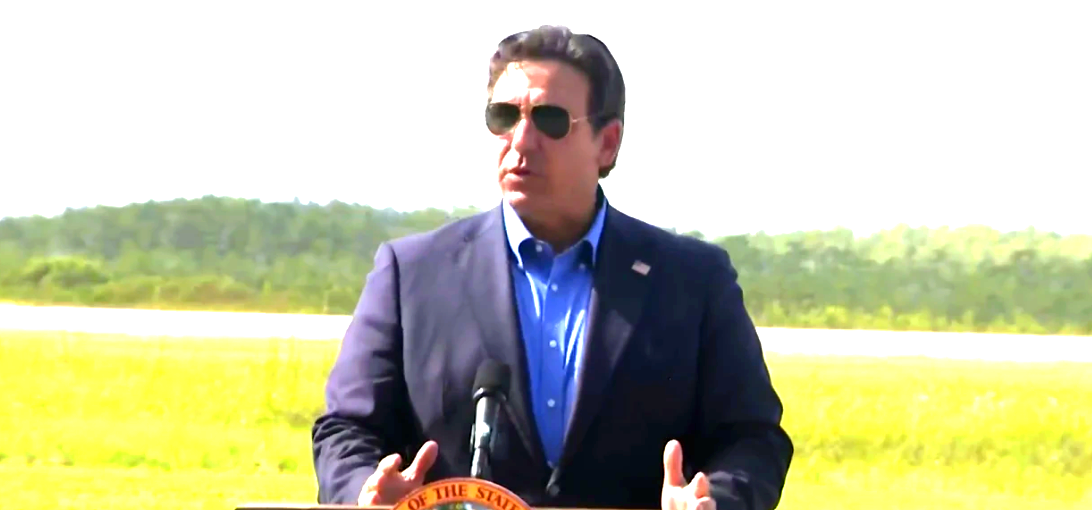
Republicans don’t want to vote for Gov. Ron DeSantis.
But they think others might.
That’s the takeaway from the latest Yale Youth Poll, which shows both Gov. Ron DeSantis and Secretary of State Marco Rubio mired in the mid single digits at 6% and 5%, respectively, far behind the 51% backing Vice President JD Vance for first-choice support.
But when the survey asked respondents who is more “electable,” the Governor and the nation’s leading diplomat are in better shape.
“In a MaxDiff test, Republicans viewed DeSantis (79%) and Vance (75%) as the most electable against a hypothetical Democrat in a General Election, followed by Rubio (71%) and Donald Trump Jr. (67%); results did not differ significantly between younger Republicans and all Republicans,” Yale notes.
The result here, particularly for DeSantis, could bolster the hopes of those who want him to run to succeed term-limited Donald Trump in 2028.
The Governor keeps getting that question from reporters but tells them he’s not looking, saying he has his “hands full” and that he’s “not thinking about anything” regarding his next political move.
Rubio is also an also-ran in the polls, compared to Vance.
However, President Donald Trump seems to think Rubio and Vance would be a functional ticket, one that could clear the still-evolving field of his potential successors.
“I’m not sure if anybody would run against those two. I think if they formed a group, it would be unstoppable,” the President said, according to POLITICO Playbook.



‘Vampire Diaries’ Candice King Turns Baby News Into Ad for Pregnancy Tests

Cautious-but-positive UK shoppers turning to AI for gift inspiration – Accenture report

Florida ranks fourth-most deadly state for road travel during Christmastime
-

 Politics8 years ago
Congress rolls out ‘Better Deal,’ new economic agenda
-
Entertainment8 years ago
New Season 8 Walking Dead trailer flashes forward in time
-
Politics8 years ago
Poll: Virginia governor’s race in dead heat
-
Entertainment8 years ago
The final 6 ‘Game of Thrones’ episodes might feel like a full season
-
Entertainment8 years ago
Meet Superman’s grandfather in new trailer for Krypton
-
Politics8 years ago
Illinois’ financial crisis could bring the state to a halt
-
Business8 years ago
6 Stunning new co-working spaces around the globe
-
Tech8 years ago
Hulu hires Google marketing veteran Kelly Campbell as CMO