In the hours after the Louvre heist, Belgian police received an alert from their French counterparts, urging them to be on the lookout for anyone trying to hawk the stolen jewels, according to two Antwerp police officers.
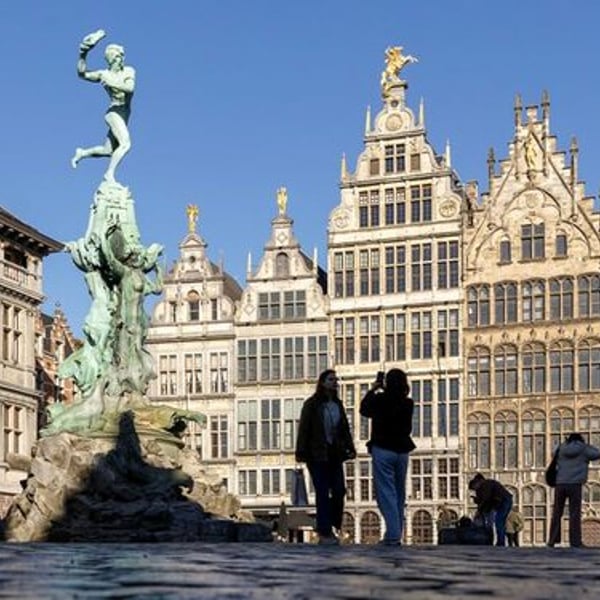
People stroll through the Grand Place (Grote Markt) near the Brabo Fountain in Antwerp, Belgium November 7, 2025 – REUTERS/Geert Vanden Wijngaert
The alert came via the “Pink Diamond” network, a secure channel overseen by EU law enforcement agency Europol that unites investigators specialised in high-value thefts. Antwerp, a Belgian port city, has sat at the heart of the world’s diamond trade since the 16th century. Its wholesalers traded nearly $25 billion worth of stones last year alone.
But over the last 30 years, Antwerp has struggled to contain a growing underworld, home to hundreds of gold and jewellery shops run largely by people of Georgian descent, according to police, prosecutors, court files and municipal documents from Belgium and France. Although most of these shops are law-abiding businesses, some offer criminals from across Europe a channel through which they can sell stolen gold or jewels – a process known as “fencing.”
French authorities have placed four people under formal investigation in connection with the Louvre heist, but have yet to recover jewels worth $102 million. They have given no details about the hunt. Asked whether Antwerp was a focus of the French probe, the Paris prosecutor’s office said: “All hypotheses are being considered.”
Antwerp police mobilised immediately after receiving the “Pink Diamond” alert, the two officers said. “From the moment that happened… especially in Antwerp, with all the jewellery stores, we’ve been alert,” one said.
They reviewed security footage for French plates and tapped informants for tips on anyone trying to sell the jewels. Police also warned some jewellers not to touch the iconic booty. Belgium’s federal police declined to comment, citing the ongoing French investigation.
Georgian traders began settling in Antwerp in the 1990s after the collapse of the Soviet Union, police say. Many had a background in metals trading and deep links with the city’s Jewish diamond traders. There are now some 300 jewellery shops operating just outside the diamond district, a quarter of which are involved in “fencing” stolen product, the two police said.
The Antwerp World Diamond Centre, a trade body representing the wholesalers, told Reuters its reputation “is occasionally put at risk” by being associated with some jewellers with “questionable… money laundering practices.”
Antwerp’s diamond sector is already grappling with a G7 ban on Russian gems and a deluge of lab-grown stones that have led to historically low prices and calls for a sector-wide bailout. But for some jewellers, business is booming. Some suspected fences drive around town in S-Class Mercedes-Benz, regularly open new shops and acquire pricy foreign real estate, one of the officers said.
“You clearly have two worlds here,” they said. “Those who work hard, are legal… and are struggling to survive, and those who apparently do good business in the same neighbourhood selling the same products.”
Kris Luyckx, a lawyer who has defended many jewellers of Georgian descent in court, said compliance regulations were robust, while jewellers are subject to regular police checks. Crime in France has been a reliable source of income for Antwerp jewellers, French and Belgian law enforcement officials said.
After robbing Kim Kardashian in her Paris hotel room in 2016, the mastermind of the plot confessed to selling her melted gold and diamonds in Antwerp for over 25,000 euros, court documents show. French and Belgian officials said they believe the booty was bought by Georgian fences, although nobody was charged as it was never recovered.
Since then, over half-a-dozen French and Belgian investigations have uncovered a criminal corridor between the countries in which Balkan burglars hand their stolen goods to couriers in France, who deliver them to buyers in Antwerp. In most cases, the buyers were Georgian, the Belgian police officers said.
Yakout Boudali, head of intelligence for the French Gendarmerie’s Central Office for the Fight Against Itinerant Delinquency, the unit that ran three of the probes into French thieves transporting booty to Belgium, said that in at least two of those cases, the Antwerp fences were “of Georgian nationality or held dual nationality.” However, she warned against “stigmatising” Georgians or Antwerp, saying Romania-based groups are increasingly active.
Antwerp’s illicit jewellery trade adds to the woes of a city already battling drug gangs using Europe’s No. 2 port to import multi-tonne shipments of cocaine. In an open letter posted on Belgium’s courts website last month, an anonymous Antwerp judge said the country was on the cusp of becoming a narco-state.
Antwerp formalised a specialised police force to oversee the diamond and jewellery sectors in 2021. In a report at the time, which remains the most comprehensive official account of the illicit trade, the mayor’s office warned of “a strong link between fraudulent jewellers and the criminal drug environment.” Jewellers are suspected of “laundering of millions of euros in criminal proceeds,” it added.
Antwerp City Hall did not respond to requests for comment. An omerta among many Georgian jewellers and Indian diamond traders makes it hard to penetrate these close-knit communities, the police officers said.
The jewellers have also rejected what the police sources viewed as an effort to improve transparency, citing a 2017 push by then-Mayor Bart De Wever, now Belgium’s right-wing prime minister, “to drive criminal networks out of the city.” His municipal decree mandated security cameras with facial recognition inside jewellery shops, among other measures, with the images readily available to police.
Jewellers appealed the edict, but eventually conceded on one condition, the police sources said – the cameras could be installed but wouldn’t be turned on. Luyckx, who represented over 100 jewellers in the case, confirmed a deal was struck. He said the law was overly invasive and unfairly targeted the largely Jewish community.
“It was like profiling an area as a sort of criminal ghetto,” he said. Luyckx, who was asked to defend the jewellers by a local rabbi, Yosef Tarab Cohen, said some jewellers’ wariness of cooperating with police was understandable, given the “smell of discrimination and racist profiling.”
Antwerp revoked the decree in 2020 after a state auditor said it risked overreach and conflicted with privacy laws, court documents show. Tarab Cohen declined to comment.
Selling stolen jewels is quick and easy in Antwerp, the two Antwerp police said. Jewellers inspect gold, stones or watches, name a price and pay from undeclared cash reserves. Once bought, items vanish. In back-room smelters no bigger than a printer, gold is melted into one-kilo bricks about the size of a cell phone, they said.
The Louvre loot may be too hot for even the Antwerp jewellers to handle, one of the cops said. The jewels were mainly set in silver, not gold, giving them low melt value. Their oversized sapphires and diamonds are instantly recognisable, so the small circle of Antwerp cutters and polishers won’t touch them. The pool of potential buyers for the pearls is tiny. “It’s not easy money,” one of the officers said.