
Business
Charlie Kirk left behind a network of 500,000 donors who gave Turning Point $85 million in revenue
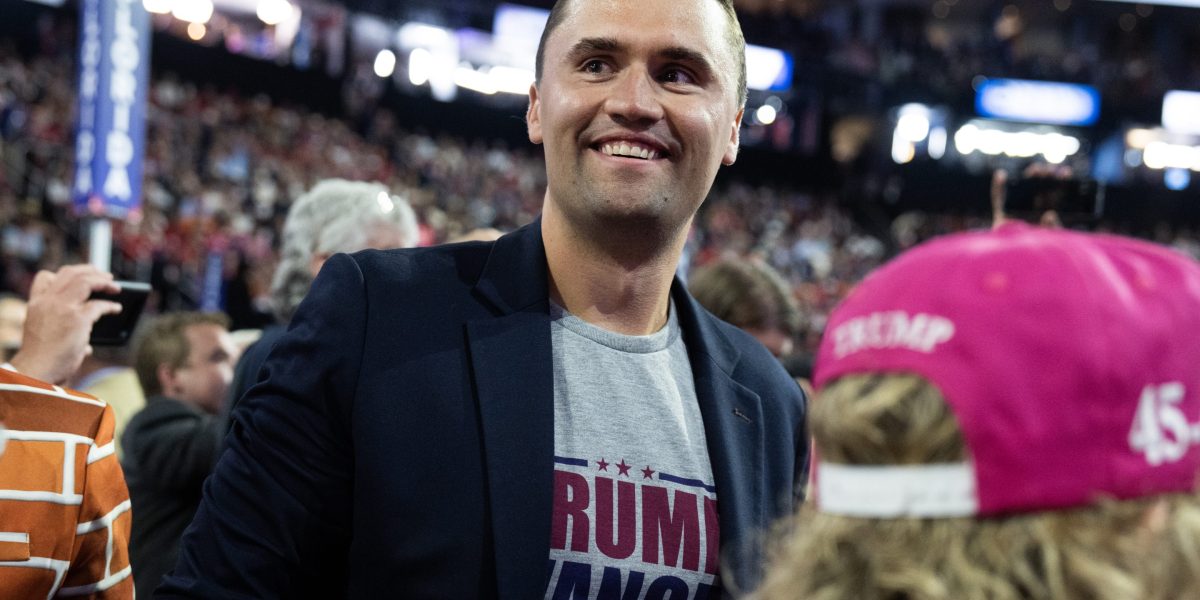
Charlie Kirk was only a teenager when he launched a scrappy conservative student group out of his parents’ suburban Illinois home. A decade later, that group—Turning Point USA—has grown into a political juggernaut, generating nearly a half-billion in total revenue in the 13 years since its inception, creating a sprawling network of campus chapters, and building a media machine that rivals legacy establishments.
On Sept, 10, Kirk, a husband and father of two, was shot and killed at a Turning Point event at Utah Valley University. He was 31 years old. His death has ignited conspiracy theories, calls for gun control, and a nationwide political debate over his legacy. But it has also left the future of his formidable conservative business and non-profit enterprises hanging in the balance.
By channeling polarization and student engagement, Kirk not only built an empire that sits at the center of the American right’s culture wars, but also made himself a multi-millionaire, according to the Associated Press—and one of the nation’s youngest political power brokers, with a seat at President Donald Trump’s table. A review of Kirk’s and Turning Point’s finances shows just how much Kirk benefited from and capitalized on two key trends of the last decade-plus: an energized web of right-wing donors from the business community, and the meteoric rise of the conservative media ecosystem.
Turning Point USA netted $85 million in revenue in 2024 alone, up more than 142% over the last five years. The vast majority, 99.2%, of that revenue comes from charitable contributions, including at least $350,000 from Kirk himself in 2024.
According to Kolvet, the organization brought in approximately 350,000 grassroots, “small dollar” donors.
“The goal was to get over 500,000 this year. And, given all that’s happened, we’ve eclipsed that goal, and that’s exciting,” he added.
Large and hard to trace
How exactly Turning Point spends its money, and who benefits from the organization’s hefty annual revenue, is unclear. Like many political advocacy groups, it’s organized as a 501(c)3 non-profit; the IRS does not require such groups to publicly disclose detailed expenditure accounts. The lack of clarity is compounded by the fact that many of Turning Point’s largest vendors are limited liability companies registered in states that do not mandate public ownership disclosure.
Within Turning Point’s organizational structure, there are also several interconnected nonprofit groups, political action committees, and a for-profit merchandise company, none of which are required to publicly report their finances. One branch, the Turning Point Endowment, held $64.3 million in 2024, having grown from $7.2 million in 2020. The funds in this branch, according to Turning Point, are part of the group’s “50-100 year plan to continue reaching generation after generation of young Americans.”
Turning Point spokesperson Andrew Kolvet told Fortune that the fund exists to ensure the organization’s ability to operate for years to come. “Charlie always had a vision that Turning Point would grow into an institution that would outlive his tenure as CEO, and the endowment was always part of the vision,” he said.
$10,000 and a dream
Kirk often described his political awakening as Barack Obama’s presidency. As he told his podcast listeners last year, “In my local high school, progressive, left-wing Marxist ideas were widespread, and I looked around and I was unimpressed by the conservative organizations that were out there.”
His first taste of political involvement, aside from classroom debates, came in 2010 when he began volunteering for the campaign of Illinois Senator Mark Kirk (no relation) while still in high school.
The trajectory of Kirk’s life, and his future business endeavors, changed dramatically after he met William “Bill” Montgomery, a retired Tea Party activist and marketing entrepreneur.
Montgomery encouraged Kirk to drop out of college entirely, and within one month of their meeting, they launched Turning Point.
Montgomery provided Kirk with the Republican rolodex and access to investors he would need to build his empire. The first person to cut a check to Turning Point was investment manager turned Republican donor Foster Friess, whom Kirk met at the 2012 Republican National Convention.
“I was 18 at the time and Turning Point USA had zero donors, no real presence, and I was just a kid from Chicago with a dream & energy to try and change the world,” Kirk later wrote about meeting and pitching Friess. His proposal, according to Kirk, was simple: “I felt young people needed to hear the conservative message.”
A few weeks later, Friess sent Turning Point $10,000, an investment Kirk would turn into many millions of dollars.
A growing donor base
The organization’s initial years were difficult, with Kirk later admitting he nearly shuttered the operation several times due to financial constraints. But with the help of significant backing from prominent right-wing donors who had made their fortunes in business, Turning Point stayed afloat and gained momentum with students across the nation. Starting in 2013, Turning Point began receiving financial backing from serial entrepreneur Gary Rabine (CEO of the Rabine Group). In 2014, the group received a $100,000 donation from the Bruce Rauner Family Foundation, connected to venture capitalist and former Illinois Governor Bruce Rauner. Kirk also received $275,000 from the Ed Uihlein Family Foundation, the philanthropic arm of the estate of the founder of the Uline packaging and office supply firm, and more than $72,000 from Home Depot co-founder Bernard Marcus’ philanthropic organization.
By 2015, Turning Point had increased its annual revenue from approximately $52,000 in 2012 to $2 million. Kirk claimed at the time the organization had established a presence on 1,000 college and high school campuses nationwide and had more than 40 full-time “field staff.”
Turning Point’s donor base has expanded over the years and includes several key parties in the oil and natural gas industry, including the Hanley family, which owns Hanley Petroleum, an oil and gas field operator, and Barry Russel, president and CEO of the Independent Petroleum Association of America. Many of the organization’s top donors, according to Kirk, also serve on Turning Point’s advisory council, which currently includes the likes of hospitality executive Mike Leven; heir to the Gristedes supermarket fortune John Catsimatidis Jr.; and venture capitalist David Blumberg.
Scaling up a young audience
Kirk’s early messaging at Turning Point focused heavily on traditional conservative tenets of free market economics and limited government. More notably, he aimed to engage younger audiences by ditching traditional lecture-style events and using outdoor and interactive formats that encouraged spontaneous debate.
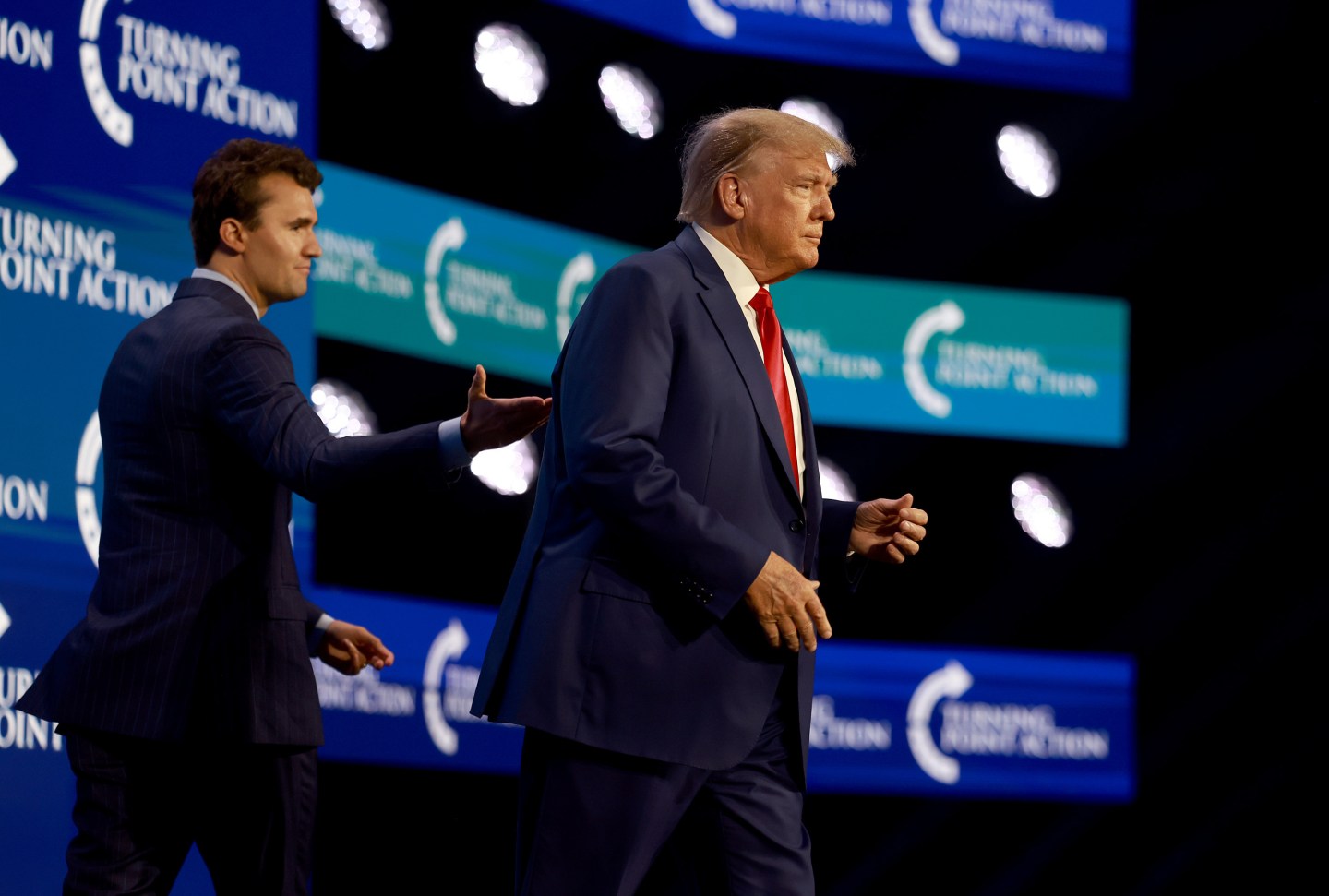
The 2016 Trump election, however, marked a strategic pivot for Kirk and ultimately Turning Point. Although he once described himself as “not the world’s biggest Donald Trump fan,” Kirk quickly embraced the then-presidential candidate and began mirroring his populist, anti-establishment messaging, which resonated with disaffected youth in the U.S.. This shift would prove extremely successful in bolstering Turning Point’s reputation.
It also proved personally lucrative for Kirk, who would, by 2020, secure a book contract with Donald Trump Jr’s Winning Team Publishing, and, later, rake in ad revenue from social media platforms, where his increasingly confrontational approach helped him rapidly build an audience.
JOE RAEDLE—Getty Images
Kirk’s breakthrough came with his signature “Prove Me Wrong” campus format, which he launched in 2018. Unlike traditional campus speakers who delivered lectures in auditoriums, Kirk would grab a microphone, often in busy campus hubs, and invite debate from anyone in the audience. These confrontations positioned Kirk as accessible and confident in his polarizing beliefs and created a sense of intellectual challenge that appealed to competitive young students. But most importantly, these interactions generated viral social media content that reached millions of people unfamiliar with Turning Point. On social media platforms, these clips generated ad and engagement revenue for both Turning Point and Kirk personally.
While it is unknown whether Kirk or Turning Point were paid directly for the Prove Me Wrong appearances, Kirk generated income through speaking fees of upwards of $10,000 per appearance.
From 2016 to 2019, Turning Point’s annual revenue grew 563%, reaching $28.5 million. Membership numbers and chapters increased just as steeply, from an estimated 450 chapters and 25,000 members during Trump’s first campaign to approximately 1,500 chapters and 200,000 members by the end of his first term.
A surge in growth
Kirk’s digital savvy positioned him well during the COVID-19 pandemic. With disgruntled students unable to congregate on campuses, Kirk leaned into the growing angst and launched his podcast, the “Charlie Kirk Show.” As the pandemic fundamentally shifted youth political engagement, the show quickly became one of the nation’s most popular political podcasts, reaching 5 million monthly listeners and 750,000 daily downloads by mid-2025. Kirk’s podcasting venture, according to him, was his primary source of income in addition to his investment portfolio and a $400,000 salary from Turning Point.
Kirk’s podcast benefitted heavily from the explosive growth of the conservative podcast and new media industry. Since 2020, the U.S. podcast industry has seen listenership more than double, reaching 160 million listeners in 2024. Ad revenues have also skyrocketed from $1.5 billion in 2021 to upwards of $4 billion in 2024. Right-leaning shows dominate the political podcast ecosystem, bringing in nearly five times the number of total followers and subscribers across major platforms in 2024 compared to their left-leaning counterparts.
As Kirk grew his brand and notoriety through a mixed media approach, leaning increasingly into provocative rhetoric and conspiracy theories—including equating being transgender to blackface, and calling the Civil Rights Act a “huge mistake”—Turning Point’s success and presence only grew. Revenues rose from nearly $40 million in 2020 to nearly $56 million in 2021.
By 2022, the organization had branched out into events, launching AmericaFest in 2022 with 10,000 attendees. Turning Point’s Student Action Summit hosts approximately 5,000 people annually and its latest Young Women’s Leadership Summit had 3,000 participants.
These events were also revenue drivers. Tickets for the organization’s national summit (Student Action Summit) start at $50 for general admission and reach upwards of $500 for VIP access. Admission to AmericaFest starts at $50 as well, but includes a $300 VIP option. Aside from ticket sales, the conferences benefit from sponsorship deals with prominent conservative organizations, including the Heritage Foundation, the National Rifle Association, and the Alliance Defending Freedom. (The conferences presumably have corresponding overhead costs, but those are not available in existing filings.)

REBECCA NOBLE—Getty Images
Above all, Kirk’s willingness to court controversy continued to be both strategically deft and lucrative. His most controversial statements generated millions of views, expanding his reach far beyond traditional conservative audiences. When he joined TikTok in 2024, he gained 2 million followers in less than a year, with individual videos reaching up to 50 million views.
Social media algorithms fed his content to a young user base that has increasingly leaned to the right. In 2016, 32% of Americans between the ages of 18 and 29 identified as conservative. By 2024, that number had reached 46%. Turning Point’s expansion has continuously reflected this trend. The organization netted $85 million in annual revenue last year, reaching 3,350 chapters (850 college, 2,500 high school), and 700,000 members.
After death, popularity and uncertainty
Posthumously, Kirk’s books and podcasts have soared in the charts. Kirk’s personal Instagram account has gained more than 3.5 million followers since his death, while Turning Point’s account gained more than 1 million. Similar surges have occurred with Kirk and Turning Point’s accounts on TikTok and YouTube. The organization said on Sunday that it reportedly received “over 32,000 inquiries” in the 48-hours after Kirk’s assassination to start new campus chapters.
His widow, Erika, has vowed to continue his legacy at Turning Point. In a tearful, live-streamed public address on Sept. 12, she promised “my husband’s voice will remain,” adding that his distinct college campus tours and his eponymous podcast would continue in the years to come. She did not provide further details about who would take Kirk’s place at those events.
Kolvet told Fortune that he is dedicated to seeing Kirk’s podcast continue, but a detailed plan is still in the works. “I certainly plan on making sure that that happens, whether I have to take a more leading role, or if it’s guests, and friends, and tributes to Charlie. It will probably be an amalgamation of those things,” he said.
In one of his final interviews before his death, Kirk told reporters that his ultimate ambition for Turning Point was for it to “become an institution in this country that is as renowned and influential as the New York Times, Harvard, and major tech companies. And we believe we are on the path to creating that.” Whether or not that path will continue to be forged without Kirk’s bravado and formidable presence, and who will officially take his place atop Turning Point remains unknown. Kolvet told Fortune that it was “too early” to get into a detailed succession plan.
But, in his eyes, one thing is certain: “Erica Kirk is the beating heart, the spiritual center of the Turning Point family moving forward.”