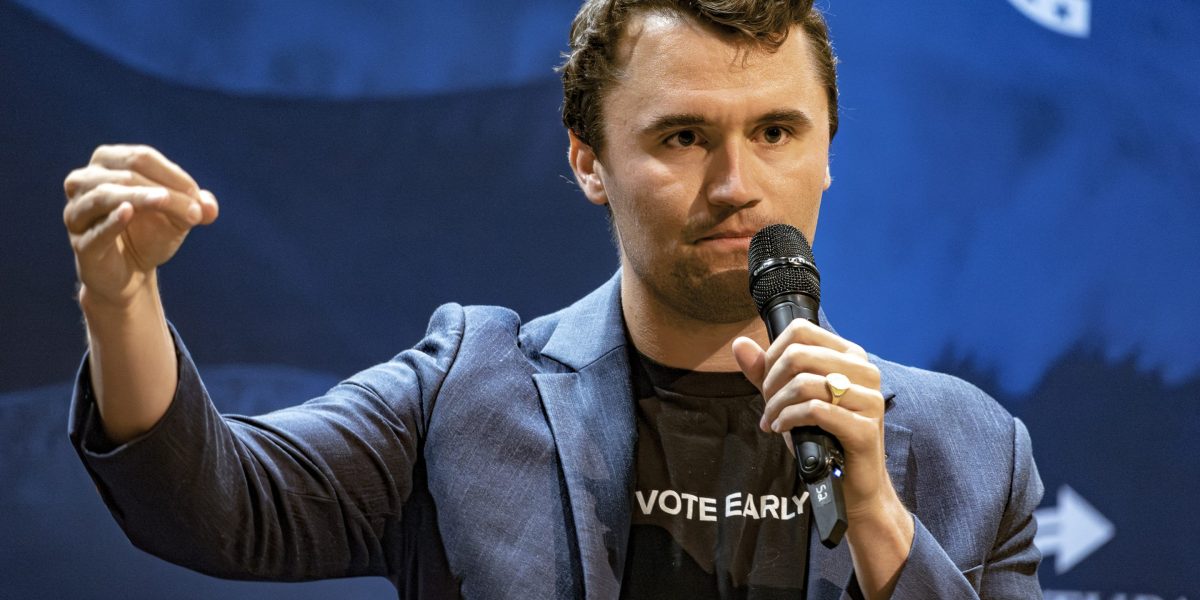
The late Charlie Kirk spent much of his time as CEO of Turning Point USA not in a corner office but on college campuses, sparring with students in open debates. His go-to challenge was simple: “Prove me wrong.”
One of his favorite topics was the value of higher education itself. Kirk, who dropped out of Harper College outside Chicago before building an $85 million-a-year nonprofit, argued that too many young people pursue degrees out of habit rather than purpose.
“College is supposed to provide a pathway to financial security and career success,” he wrote in an op-ed in 2022. “That promise is true for fewer and fewer graduates.”
Kirk believed universities had drifted away from teaching critical skills like writing and problem solving, focusing instead on conformity while saddling students with debt. His philosophy: do whatever it takes to get your foot in the door—and then reassess whether more education is truly necessary.
“You know, something that is so lacking when I talk to employers is hunger and desire,” Kirk told Fox News while promoting the launch of his 2022 book: The College Scam: How America’s Universities Are Bankrupting and Brainwashing Away the Future of America’s Youth.
“What is that piece of paper really going to do for you?”
Many Gen Z are in agreement with Kirk: college isn’t worth it for everyone
While Kirk has been outspoken about his views on higher education’s diminishing return on investment for years, many Gen Zers share his skepticism.
This shift has left over 2 million young men now classified as NEET—meaning not in employment, education, or training—with average student debt nearing $40,000.
For young men looking to not face the same struggles, Kirk’s advice was simple: “do anything” except seek a four-year degree. Instead, make your dreams a reality by doing it on your own terms, encouraging people to pursue entrepreneurship.
At the same time, Kirk often framed his arguments in ideological terms, lamenting that universities were dominated by “far-left professors” who he said pushed “anti-American and progressive ideologies onto students.” Still, he acknowledged exceptions.
“I would say, very bluntly, that maybe if you want to become a doctor or a lawyer or an accountant or an engineer — which, by the way, is a huge minority of people that go to colleges — maybe you should go to college but pick the right one,” Kirk continued. “But the vast majority of kids, the vast majority of kids that go to college, shouldn’t be there at all.”
Fortune Global Forum returns Oct. 26–27, 2025 in Riyadh. CEOs and global leaders will gather for a dynamic, invitation-only event shaping the future of business. Apply for an invitation.
For all the volatility 2025 has endured, things have actually turned out relatively well: The S&P 500 is up by more than 17%, inflation hasn’t spiked despite an onslaught of tariffs, and the unemployment rate has stayed fairly steady.
Analysts and investors are generally feeling positive about 2026 as a result—after all, the U.S. economy’s performance has been above expectations since the pandemic, so why not take a bullish stance in the face of huge fiscal stimulus?
Well, beneath the relatively robust macroeconomic picture, cracks are beginning to show. Those tremors are already being felt; just look at the Fed’s decision to cut the base rate yesterday despite arguments that, under normal circumstances, there would be no particular reason to. Markets expected the cut based on the labor outlook, which is showing some signs of weakness in what Fed chairman Jerome Powell has called a “low-hire, low-fire” economy.
That weakness looks likely to become something of a fixture in 2026, according to ADP’s chief economist, Dr Nela Richardson. ADP’s take on the economy has grown in prominence this year, partly due to the government shutdown which meant public payroll data wasn’t published. In the void came data from ADP, which shares private payroll data insights.
Unlike her economist peers on Wall Street, Richardson tells Fortune: “We’re tracking changes in real time, it’s as high frequency as payroll data [can] get and we have not seen this rosy picture for 2026 in the data. I think [when people] point to an improved labor market next year, they’re highlighting a couple of things in the macro economy, while we’re looking at this very granular data set of private employment.
“They’re highlighting maybe a couple of rate cuts, they’re highlighting some tax advantages on the fiscal side, and they’re probably highlighting some AI and investment paying off—and certainly they’re probably adding some clarity in terms of trade policy and resolving some of the macro [questions]. All fantastic attributes, but it takes longer for those to trickle to mom and pop.”
Richardson points to the latest jobs reporting from her company: U.S. private employment dropped by 32,000 roles in November, lead by weakness from smaller businesses. Companies with between one and 19 employees axed 46,000 roles, while those with 20 to 49 employees cut 74,000. Conversely, companies with 500-plus employees added 39,000 employees.
“Tiny firms are a big chunk of employment, but the tiny firms are making tiny moves, and they’re moving all in the same direction,” Richardson added. “It could be as small as not hiring two teenagers at the bakery or foregoing that delivery driver over a certain season, it doesn’t mean it’s a big, huge layoff, it’s not replacing a worker here or there, and those changes add up.
“If you’re making those micro moves, micro decisions for mom and pop [businesses], these macro drivers are less likely to influence your patterns.”
A rapidly evolving picture
Once upon a time, a sound work ethic and perseverance were enough to get you a foot on the career ladder. In 2025, that’s no longer the case—just ask the business leaders at the top of some of America’s largest corporations.
And while it’s true Gen Z are facing an entirely different job market to their parents, the rules of engagement are evolving so rapidly that market entrants one year to the next are facing a different set of hoops to jump through—making the picture for 2026 all the more complex.
These shifts have not happened in a vacuum, says Richardson, but are more a culmination of trends over the past five years. The so-called “Great Resignation” and the advancement of hybrid work are chief among them. Hybrid work, for example, means the pool of competition has expanded rapidly with hiring managers no longer constrained to a certain geography.
Likewise, “the Great Resignation meant people were able to demand their own terms,” Richardson added. “That meant hybrid work, that meant higher salaries and bonuses, all kinds of promotions happened during that time. Why leave?”
These factors mean the goalposts are constantly changing for market entrants: “It’s not even generation to generation,” Richardson says. “It’s your older brother and sister who graduated three or four years ago, it’s not even their job market anymore.”
Good morning. What do business leaders predict next year for the Magnificent 7? They know all too well how Alphabet, Amazon, Apple, Meta, Microsoft, Nvidia and Tesla have delivered more than half of the S&P 500’s gains in recent years, setting a high bar for everyone else to clear. But things change: One minute, Alphabet is behind the curve on AI and then Google’s latest Gemini launch sparked a ‘Code Red’ from ChatGPT’s Sam Altman.
Earlier this week, while speaking with former Cisco CEO John Chambers about his tech predictions for the year ahead, our discussion turned to his outlook for the Magnificent 7. Having built Cisco from a router manufacturer to the world’s most valuable company in March 2000—and since nurtured a new generation of unicorns through JC2 Ventures—Chambers is a student of market shifts.
He believes 2026 will be a year of divergence within the Magnificent 7. “Two or three do real well, two or three do not do well at all and you have one or two in the middle,” he told me. “If I were betting on momentum today, I would bet Google (Alphabet), Microsoft and Nvidia. By the way, Google would not have made that list a year ago.”
I subsequently asked two dozen leaders at the Fortune Brainstorm AI conference and the Fortune CEO Initiative dinner in San Francisco for their views on the Mag 7. Alphabet was also the winner. The primary source of enthusiasm is Gemini 3, its latest AI model. Though as one CEO cautioned: “I’m more confident about the health of the business than the health of the stock.”
Microsoft and Nvidia were more of a toss-up for second among the leaders I polled. A Fortune 100 leader pointed out that Microsoft has “deep relationships in the enterprise and something tangible to offer in AI,” while an enterprise-tech leader pointed to its struggles with Copilot. As for Nvidia: “I’d rather be in Jensen’s seat than anywhere else,” said one AI founder.
The company that prompted most debate: Amazon. Some ranked it top as a growth bet for next year, saying it’s gaining on AI rivals; others said last, arguing it’s “not attracting top talent.” Several were lukewarm for reasons ranging from recession fears to the Netflix-Warner Bros. deal. Meta also got a mixed prognosis, with one entrepreneur telling me “you can’t win with low morale.”
Apple and Tesla attracted the most pessimism. Several leaders pointed to the departure of key leaders at Apple, along with its mature product line and lack of visible leadership in AI. And the word cloud around Tesla included “China,” “distracted,” “policy risk,” “consumers,” and “Elon Musk.” Said one dinner attendee: “Go test drive a BYD.”
As expected, the Federal Reserve cut interest rates by 25 basis points on Wednesday, despite the biggest revolt among policy makers since 2019. In explaining the cut, Chair Jerome Powell suggested that federal jobs data could be inaccurate. Rather than adding 40,000 jobs a month since April, the U.S. could be losing 20,000 jobs a month. The Bureau of Labor Statistics’ so-called birth-death statistical model has a tendency to juice job numbers; the agency is revamping it in February, which may produce more accurate figures.
What Powell should focus on
Meanwhile, Fed Chair Jerome Powell “risks the Fed’s inflation-fighting credibility” if he continues to primarily blame weak demand for the slowdown in hiring rather than AI,” according to a new analysis shared with Fortune by KPMG Chief Economist Diane Swonk. Cutting rates won’t help declining labor rates if AI and immigration are the true culprits, Swonk argues.
Oracle’s reality check
The Fed decision had boosted markets Wednesday, but Oracle’s disappointing earnings served as a reality check, reigniting concerns about AI overspending. The cloud giant said its capital spending will hit $50 billion next year, up $15 billion from previous estimates, but it missed analysts’ targets for cloud sales and infrastructure business revenue.
DeepMind x U.K.
Google DeepMind, an AI lab, is partnering with the U.K. government to achieve breakthroughs in materials science and clean energy, including nuclear fusion, and to study the societal impacts of AI and ways to make AI decision-making more interpretable and safer. DeepMind will open its first automated research center in the U.K. in 2026 as part of the collaboration.
Circle CEO praises Trump for embracing crypto
In this week’sepisode of Leadership Next, Circle CEO Jeremy Allaire credits the Trump administration with creating an “innovation-forward, technology-forward, entrepreneur-forward environment.” Allaire, once a kid who traded baseball cards, went from being a lone wolf in Washington to having one of the most influential IPOs of the year.
Disney nominates former Apple COO to board
Disney nominated Jeff Williams, the former Apple COO who retired last month after 27 years with the company, to its board of directors. In a press release, Disney praised Williams’ “leadership and unique experience at the intersection of technology, global operations, and product design.” Williams will stand for election at Disney’s 2026 annual shareholders meeting.
The markets
S&P 500 futures were down 0.57% this morning. The last session closed up 0.67%. STOXX Europe 600 was up 0.11% in early trading. The U.K.’s FTSE 100 was up 0.06% in early trading. Japan’s Nikkei 225 was down 0.9%. China’s CSI 300 was down 0.86%. The South Korea KOSPI was down 0.59%. India’s NIFTY 50 is up 0.55%. Bitcoin is down at $90K.
Today, we meet James Eder, the 42-year-old cofounder of Student Beans (a discount coupon company targeting the college crowd), who is now a work-life coach splitting his time between London and the French Alps, and author of The Collision Code.
Eder was inspired to build Student Beans in 2005 after organising his university’s summer ball—a party for over 600 students where he was responsible for sponsorship. Seeing how much brands wanted access to students—and how much students loved a deal—sparked the idea.
“My calls to big brands led to me asking for samples and raffle prizes,” Eder recalls to Fortune. “Soon, my student hall bedroom was filled with condoms from Durex, Jelly Belly Jelly Beans, Coffee from Starbucks, Pot Noodles and Lush soaps that made it fragrant for months after.”
At the same time, Eder was working as a brand manager for Yell, where he says he’d already worked with more than 30 brands. A business plan assignment in his degree became the perfect place to shape the concept.
So after graduating, he and his older brother—who worked at an investment bank and had his own side hustle, selling titanium power on Ebay—bootstrapped what became one of the U.K.’s defining student platforms, with a £3,000 loan.
Over 15,000 students signed up to get exclusive discount vouchers from over 200 local businesses in its first year. By year three, Student Beans had 150,000 users. And today? It’s rebranded as Pion, works with over 3,500 brands from Gymshark to Uber, with over 5 million customers in more than 100 countries.
While Eder still holds a 35% stake in the £30-million-a-year turnover company, he walked away from day-to-day operations 10 years ago to pursue another idea: A location-based rival to LinkedIn called Causr, where you’d be able to see professionals nearby and connect.
But despite raising £500,000 and attracting 3,000 users, Eder’s second startup collapsed. A heart condition diagnosis forced him to rethink everything.
Having a defibrillator implanted in his chest quietly reshaped how he approaches purpose, work, and the limited resource none of us get back: time.
Today, Eder spends up to half the year in Méribel. He skis most mornings, and is fresh off the launch of The Collision Code—his book, which hit No. 1 on Amazon’s “Most Gifted” list and has already raised more than £8,500 for heart-health charities.
Yet even with the mountain air and flexible schedule, he says the real “good life” is less about escape, and more about learning how to design a life you don’t need to run away from.
The finances
What’s been your best-ever investment?
The best investment I ever made was £400 on a three-day personal development programme called The Landmark Forum in 2009. A friend invited me to an introductory evening. I was sceptical, but I also knew I had nothing to lose. At the very least, I thought it would be three days of reflection, learning about myself and meeting new people.
But it helped me understand how I operate, why I behave the way I do and which beliefs were holding me back. It shifted how I showed up for myself and for others. It gave me the confidence to speak up, build meaningful relationships and say yes to opportunities that scared me. Everything I have done since, from founding companies to writing my book The Collision Code, traces back to the moment I decided to invest in myself.
Once I became a qualified coach, these stepping stones enabled me to design a life that means I live in the French Alps up to six months of the year, enjoying the mountain air and skiing whilst balancing my clients and health.
And the worst?
My second startup, Causr. I raised £150,000, registered for VAT (value added tax) and qualified for R&D tax credits, which brought the total investment closer to £200,000. I also invested three years of my life. We built an app for both Apple and Android and attracted around 3,000 users, but engagement was almost non-existent.
I thought with the success behind me, having built Student Beans, I was so confident the world needed this and I could make this work. But I made the mistake of moving too fast. The moment the funding landed, I felt pressure to spend it and scale immediately. If I could go back, I would have continued testing, validating and learning with a much smaller audience before committing to a full build.
What are your living arrangements like?
I’m fortunate to spend time in between London, Kentish Town, in an old converted school with floor-to-ceiling windows, and a roof terrace that gets the sun for most of the day. I moved there when we relocated the Student Beans offices to Kentish Town and when I was there day-to-day it was just a ten-minute walking commute.
For almost half the rest of the year I’ve chosen to live in the French Alps in a beautiful studio apartment just above Meribel Centre in one of the best and largest ski areas of the world, The Three Valleys. I first fell in love with the mountains, skiing in the same area at around four or five. When I was diagnosed with my heart condition, it was a dream to be able to go back there and make this happen. I feel like I’ve got the perfect balance of the buzz of London and having everything on my doorstep, then mountain escape.
What’s in your wallet?
I never carry any cash. I have two default bank cards I use: The Virgin Atlantic Credit card which affords me to travel regularly in premium and upperclass, or my Revolut, which offers such convenience for different currencies whilst travelling and a brilliant interface.
Do you invest in shares?
I used an advisor for a number of years, making sure I benefited from the ISA tax-free allowances (similar to a Roth IRA in the U.S.). The most fantastic thing I did was invest in a money coach. For the first time, I understood how it works, what a bull and bear market is, what a tracker fund is … I now manage my funds and use Vanguard and Interactive Investor to do the work. I also invest in premium bonds, which are also tax-free investments.
What personal finance advice would you give your 20-year-old self?
I would emphasise the importance of monthly contributions, however small and maximising the tax-free ISA allowances as much as possible.
What’s the one subscription you can’t live without?
My EasyJet Plus subscription. Due to most of my European travel being short-haul with the majority served by EasyJet, it’s a useful perk—priority security, speedy boarding, seat selection and extra handheld luggage.
What’s your most ridiculous ongoing expense?
I don’t have ridiculous ongoing expenses, but I make up for it with travel. Most of my outgoings are on destination travel and related expenses. My annual ski pass for those who don’t ski might be questionable.
Courtesy of James Eder
The Necessities
How do you get your daily coffee fix?
I don’t drink coffee. I never got into it. My weakness is hot chocolate with cream, which I usually drink daily during the winter in the Alps, and it ranges in price from €5 to €10—so a habit of up to €40 a week.
What about eating on the go?
My go-to when I’m in the U.K. is PizzaExpress and Wagamama, reasonably priced and quick eats. I usually eat out three to four times a week. If I’m in town and in between meetings a Pret-A-Manger is a frequent destination. For meetings, I will often be at The Ivy, The Granary Square Brasserie in Kings Cross, The Wolseley or The Delaunay. Novikov or Sketch are also favourites.
Where do you buy groceries?
When I’m in London, I’ll grab food on the way home from being out—a stir fry, or salmon. In France, I do a weekly shop from Carrefour and feel like I have a better balanced diet as I have more time to spend planning and in the kitchen. It’s just a different way of living.
What’s a typical work outfit for you?
I’m usually in jeans from Citizens of Humanity with a shirt and a tailored jacket, polished but relaxed. Day-to-day, I’ve been leaning more casual and think Uniqlo is great for quality basics. I budget up to £1,000 a year on clothes and focus on things I’ll wear again and again.
The Treats
Are you the proud owner of any tech gadgets?
My Apple Watch has been a game-changer. I originally got it with my Vitality Health Care insurance plan and it has helped me identify when I had a change in heart rhythm as well as give me more confidence in exercising.
The one gadget that I think would really improve the quality of my life is a kitchen robot. Of course, there are private chefs, but the idea of having something in my kitchen that can cook with anything is wild.
How do you unwind from the top job?
What’s your take on work-life balance at the top?
In the early days of Student Beans, I was definitely working for over 12 hours a day and felt like I was always on. That was the same at Causr. Since I’m now a coach and author, work ebbs and flows.
Some days I’m out first thing for a breakfast meeting, working through the day, having an interview, doing a photo shoot, a lunch appointment, writing content, speaking at an event, recording a podcast and out for dinner. My take on work-life balance is to reframe it as being about life and whether you’re enjoying it or not.
How do you treat yourself when you get a promotion?
Because I have always worked for myself, promotions were never my milestone. Instead, I celebrated big moments like signing a major client, or raising investment. Those were the times I treated myself to something special. I love the art in my flat and choosing pieces that connect to a memory makes them even more meaningful. One of my favourites is an original limited edition Paul Kenton print of London and the Thames.
How many days annual leave do you take a year?
Whenever I am in France, it naturally feels like a holiday even though I am working. On top of that, I actively take around three months each year to travel and explore.
Take us on holiday with you, where did you go this year?
When I go on the heart transplant list, I’ll need to be within four hours of Cambridge and the transplant hospital at all times, so it’s made me focus on making the most of travelling.
I started 2025 in France, in March, visiting Tignes, another ski resort where I was a social host on European Snow Pride, a week-long gay festival. In April, I went to Gran Canaria for a few days. From there, I flew to Geneva and visited Meribel to get the keys to my new apartment, followed by a few days in Paris for my birthday. I spent a couple of weeks in Sardinia, including a sailing trip on a catamaran around Sardinia and Corsica. I then went to Wales for The Do Lectures, a few days of glamping with a community of over a hundred inspiring people.