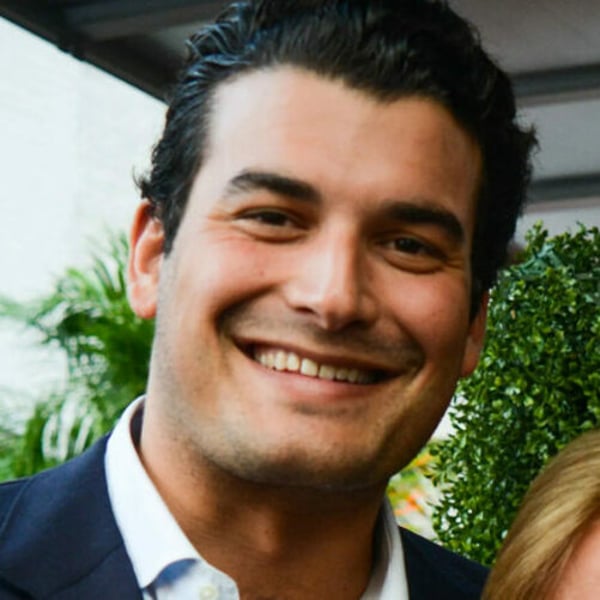
Arthur Heilbronn checks every box of someone groomed to oversee one of the world’s most powerful multi-generational fortunes.
Arthur Heilbronn – Bloomberg
Deep family ties? Check. Ivy League pedigree? Check. Wall Street credentials? Check.
Now, there are growing signs the 38-year-old scion of the family behind Chanel is moving closer to the top of the firm managing its $90 billion fortune.
Since joining Mousse Partners — one of the world’s largest and most discreet family offices — six years ago, Heilbronn has assumed management roles overseeing his family’s investments in real estate, banking, and media. In the latest sign of his rise, the Harvard Business School graduate and former Goldman Sachs banker became a director earlier this year for one of Mousse’s key holding companies, filling the role vacated by longtime Chanel executive Michael Rena, who passed away, according to registry filings.
Heilbronn is the son of Charles Heilbronn, founder and chairman of Mousse since 1991. Charles is the half-brother of Alain and Gerard Wertheimer, third-generation heirs to the Chanel fortune.
The Wertheimers are grandsons of Pierre Wertheimer, one of Gabrielle “Coco” Chanel’s original business partners when she founded the house in 1910. They share the same mother as Charles, Eliane Heilbronn, who was regarded as the family’s matriarch until her passing last year. All three sons are now in their 70s.
A representative for Mousse declined to comment.
Alain and Gerard Wertheimer — who reportedly own equal shares in privately held Chanel — each have an estimated net worth of $45 billion, according to the Bloomberg Billionaires Index. Their wealth has remained resilient post-pandemic, even as rivals like LVMH, led by Bernard Arnault, and Kering SA, owned by the Pinault family, have been impacted by a slowdown in luxury spending.
Arthur Heilbronn’s ascent offers a rare insight into the succession strategy of a famously private family that has long kept its empire out of public scrutiny. Gerard Wertheimer’s son, David, has launched a private equity venture, though there’s no indication that other Wertheimer children are involved in Mousse.
“They feel less like a family office and more like a private endowment for a luxury empire,” said Marc Debois, founder of FO-Next, an advisory firm for family offices. “Among its peers, what puts them in the true top 1% isn’t size — it’s time; dividend-fed, multi-cycle patience.”
According to Bloomberg, at least 20% of the world’s 500 richest individuals now operate family offices, managing over $4 trillion in wealth.
A recent UBS Group AG survey of 317 family office clients found that just over half have a succession plan in place, with those in the U.S. and Southeast Asia most likely to have arranged one.
Heilbronn joined Mousse as a director in 2019 and later advanced to managing director, according to his LinkedIn profile. He currently co-heads private equity and venture direct investing alongside Paul Yun. He was also appointed to the supervisory board of Rothschild & Co. after Mousse Partners joined two other French dynasties in 2023 to help take the bank private — one of its most high-profile deals to date.
Chanel’s ultimate holding company is Mousse Investments Ltd., based in the Cayman Islands, which does not disclose its financial information. Mousse Partners is its investment arm, with offices in New York, Beijing, and Hong Kong.
Described as managing “a broad range of asset classes in public and private markets,” Mousse doesn’t reveal its total assets under management. However, public filings and media reports indicate holdings in stocks, real estate, credit, and private equity.
Mousse Partners employs more than three dozen professionals globally, including former analysts from JPMorgan Chase & Co. and Wells Fargo & Co. Its chief investment officer, Suzi Kwon Cohen, joined nearly a decade ago after heading private equity for Singapore’s sovereign wealth fund in North America — placing her among the top female executives in the male-dominated family office sphere.
Over the years, Mousse has backed a wide variety of startups, including Brightside Health (mental health), Brandtech Group (digital advertising), Evolved by Nature (biotech), Harmless Harvest (food), and Thirty Madison (health care). In 2023, the firm joined the L’Oréal SA heiress in investing in luxury fashion brand The Row.
Not every investment has paid off. Beautycounter collapsed last year, and two of Mousse’s public holdings — an 8% stake in French digital firm NetGem SA and a 5.7% stake in Olaplex Holdings Inc. — have seen their shares plummet since their IPOs.
Mousse has also held a longstanding position in France’s publishing and audiovisual sectors through Media-Participations, which owns publishing houses, specialised media outlets, and produces comics and animated content.
The Chanel family — whose fashion house sells $970 sunglasses, $6,500 handbags, and $23,400 J12 watches — has also followed other French luxury dynasties into media. Bernard Arnault owns Les Echos, Le Parisien, and Paris Match. The Pinault family controls Le Point and Point de Vue. Chanel’s backers, through Mousse, hold stakes in Media-Participations.
Though Mousse is not involved in Chanel’s operations, both companies have offices in a luxury glass tower just south of Central Park in Manhattan — on the famed “Billionaires’ Row.” It’s one of the most expensive office buildings in the city and houses major financial tenants. Both Arthur and Charles Heilbronn list that location as their business address — the same building where Alain Wertheimer has maintained an office for many years.
Behind closed doors on that street, the next chapter in the Chanel dynasty’s succession plan may already be unfolding — but the family is unlikely to offer any public insight.
“We’re a very discreet family,” Gerard Wertheimer said in 2001. “We never talk.”