Business
CFOs believe AI is paying off. Researchers aren’t so sure—yet

Good morning. AI is already making workers more productive, but the financial results haven’t yet caught up.
“Artificial Intelligence, Productivity, and the Workforce: Evidence from Corporate Executives” is a new working paper by researchers at Duke University’s Fuqua School of Business and the Federal Reserve Banks of Richmond and Atlanta. It finds that while CFOs report productivity gains from AI, revenue-based evidence tells a more measured story—for now.
Based on surveys of nearly 750 executives, the research identifies a “productivity paradox.” Companies reported AI-driven productivity gains averaging 1.8% in 2025, but when researchers calculated implied gains using actual revenue and employment data, those gains were much smaller across all major industries—in both 2025 and 2026, the report found.
“It’s not really hitting the top line yet in full force,” John Graham, a professor of finance at Duke’s Fuqua School of Business and a co-author of the study, told me. “There is some level of delay in here for sure.”
“It is possible that CFOs are just optimistic about all the potential,” Graham said. “By productivity, we explicitly ask output per employee.”
But he points primarily to timing. Companies that ramped up AI investment in late 2025 haven’t fully rolled out capabilities, adjusted pricing, or realized revenue gains. Reported 2025 gains closely match revenue-implied gains for 2026—suggesting a one-year lag.
The pattern mirrors the famous “productivity paradox” described by economist Robert Solow in 1987, who noted that computer use was widespread but invisible in productivity statistics for years. The paper’s authors argue AI may be following the same trajectory.
Regarding AI, gains are uneven across industries. High-skill services like finance show the strongest growth, while manufacturing, construction, and low-skill services lag but remain positive. Differences reflect how AI is deployed across sectors and company types.
“For some industries, AI is going to be about replacing the call center,” Graham said. “For another, it’s going to be about something to do with a conveyor belt in a factory. For another, it’s going to be about having fewer analysts—having the AI take the place of a financial analyst.”
Importantly, these gains are driven less by capital investment and more by efficiency and quality improvements.
For CFOs, the challenge is justifying AI spending before returns are visible.
“ROI often depends on exactly how you calculate it—a point-in-time estimate like this year’s revenue increase divided by this year’s investment,” Graham said. “What you’d really want to do is say, the amount I’m investing today—how much will that increase value this year, next year, the year after?”
He continued, “You really want to use some measure of value creation that captures several years, at least, of forward-looking improvements, rather than just a point in time.”
Graham advises a multi-year perspective: “If you can’t kind of show it over a three or four year horizon, then you might have to be a lot more cautious.” It could be that you’re caught up in the trend, but you haven’t mapped out yet how it’s going to actually benefit your company, he said.
“You want to look over longer than just a one-year horizon, but you have to do it with discipline, so you’re not just kind of pie in the sky hoping it gets better,” Graham said.
Sheryl Estrada
sheryl.estrada@fortune.com
Leaderboard
Brittany Cerwin was promoted to CFO of The Middleby Corporation (Nasdaq: MIDD), a foodservice equipment company, effective immediately. Cerwin succeeds Bryan Mittelman, who has served as CFO since 2019 and will transition to the role of special advisor to the CEO. Cerwin joined Middleby in 2011 and has held several leadership roles in finance. Most recently, she served as chief accounting officer; prior to that, she served as corporate controller. Before joining Middleby, she was with Grant Thornton LLP in Chicago.
James Suva was appointed CFO of Velo3D, Inc. (Nasdaq: VELO), a metal 3D printing technology company, effective April 6. Suva replaces Bernard Chung, who has been serving as acting CFO since Dec. 31. Chung will continue to serve as the company’s controller. Suva brings more than 20 years of capital markets and technology sector experience, most recently serving as SVP and treasurer at Cricut.
Big Deal
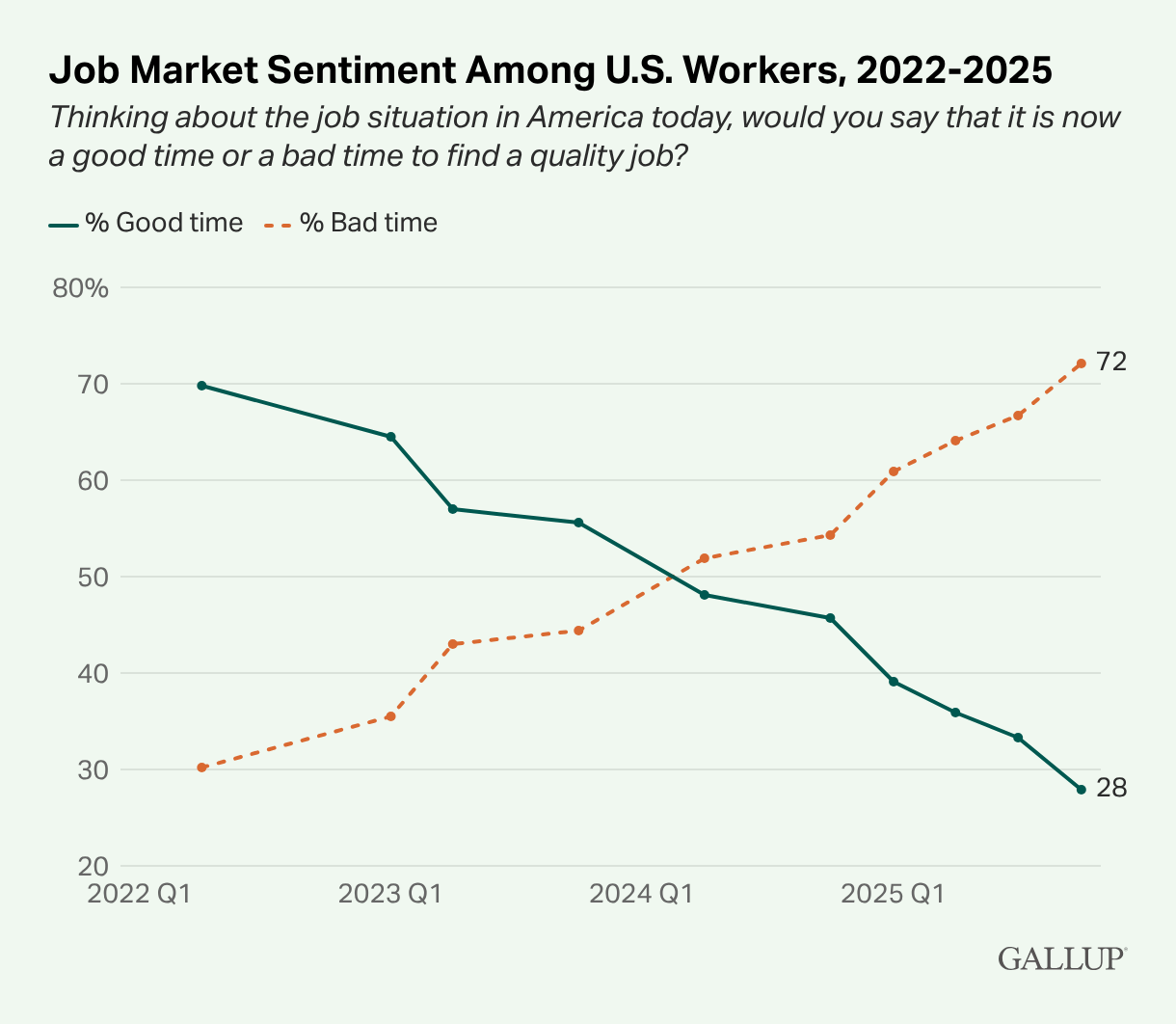
A new Gallup report finds a downturn in U.S. workers’ well-being since 2022, along with worsening perceptions of the job market.
In Q4 2025, 28% of U.S. employees said now is a good time to find a quality job, while 72% called it a bad time. That marks a “dramatic reversal” from mid-2022, when nearly 70% of workers were optimistic, according to Gallup. “The 42-point decline since then represents the largest collapse in job market confidence Gallup has recorded in the past four years,” the report states.

Going deeper
Fortune has unveiled its 2026 America’s Most Innovative Companies list. The ranking is built on three pillars: product innovation, process innovation, and innovation culture.
This is the fourth year Fortune has published the list—and for the fourth year in a row, Alphabet has come out on top. Rounding out the top 10 are Microsoft, Apple, Abbott Laboratories, KLA, IBM, Nvidia, Nike, Adobe, and Oracle.”
Overheard
“We’ve got 14 grandkids and 11 great-grandkids, and I think nine or 10 of the grandkids are in the business too, so they seem to like the business. Looks like it’s going to carry on the way we have built it.”
—Jerry Murrell, 82, founder of burger franchise Five Guys, told Fortune in an interview. The company is celebrating its 40th year in business. Murrell opened the first location in 1986 with his wife, Janie.