Connect with us

Business

CFOs are central to AI mindset shift, says Google veteran

Published

on


Good morning. When I was in Chicago earlier this week, talent and AI were on the agenda.

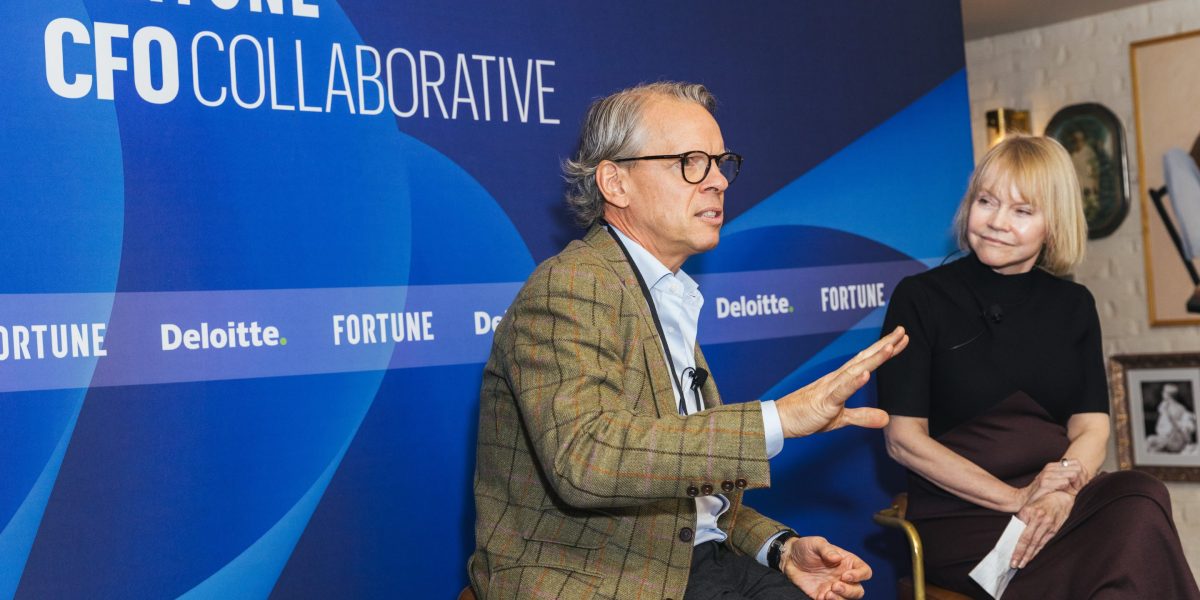
At Fortune’s CFO Collaborative dinner on Wednesday night, sponsored by Deloitte, Ted Souder—CEO and co-founder of Quoin, a startup developing AI-powered infrastructure for private capital markets—drew on his decades-long career, including more than 20 years at Google and his role in founding the Google CFO Forum, to share his perspective on AI’s impact across organizations.

Now an adviser to startups and venture capital funds on AI and business transformation, Souder spoke with Fortune’s Diane Brady before an audience of leading CFOs from Chicago and beyond, sharing observations from his global travels. Everywhere he goes, he finds businesses asking similar questions: How do we implement AI? How do we measure ROI? What does it mean for our workforce? And how do we build strategies for long-term success?

Whether at intimate gatherings or major summits, one thing stands out: no company feels far ahead or behind in its AI journey. “We’re all in this unknown together,” Souder said. He noted that this shared sense of challenge makes events like these invaluable for learning and connection—even as competitive pressures lead some leaders to withhold lessons or setbacks.

“For many businesses, if they have big AI wins, they don’t necessarily want to share them—perhaps because it’s a competitive advantage,” he said. “And if they’re not having AI wins, they don’t really want to share that either. So we’re all in the same boat.”

Why success requires a long-term vision

AI will impact every job, industry, and country, Souder told the CFOs. “We need to start thinking about how we’re embracing this today,” he explained. “We can’t wait and see how this pans out.” He cautioned against postponing AI initiatives simply because other projects take priority.

Souder emphasized that effective AI adoption demands collaboration across the C-suite. “This is a mindset shift,” he said. “This isn’t a tech project. This isn’t an ERP implementation.” 

Finance chiefs have unique visibility across the organization; CFOs can be central to driving an AI “mindset shift,” Souder said. He added that C-suite leaders—including CMOs, CIOs, and CEOs—should break down silos and work together.

To foster real change, Souder recommends that leaders visibly commit to AI, set clear policies, allocate resources, and focus on talent by investing in workforce training. He suggested practices such as tying AI proficiency to performance reviews, which help connect employee development to organizational transformation.

Souder also advocated forming AI councils or “tiger teams” to oversee strategy, implementation, and governance—including privacy and ethics. With the right structures, companies can create a culture of experimentation and learning, rather than expecting overnight success, he said.

Success with AI adoption, Souder said, requires a willingness to embrace incremental impact and “shake out some of the bad decisions.” Boards, he added, must get comfortable with long-term visions, not just quarterly results or instant ROI. “From the CFO perspective, having that board exposure is really important,” Souder said.

Sheryl Estrada
sheryl.estrada@fortune.com

Leaderboard

Fortune 500 Power Moves

Todd Cunfer was appointed EVP and CFO of The Campbell’s Company (No. 425), effective Oct. 20. Cunfer succeeds Carrie Anderson, who is leaving the company to pursue new opportunities. Cunfer brings over 25 years of experience. He joins Campbell’s from Freshpet, where he served as CFO since 2022. Before that, he was CFO at Simply Good Foods Company, a nutritional foods and snacking products company. Previously, Cunfer spent over 20 years in senior finance roles at The Hershey Company, including VP of international finance, VP of global supply chain finance and VP of North America finance.

Every Friday morning, the weekly Fortune 500 Power Moves column tracks Fortune 500 company C-suite shifts—see the most recent edition

More notable moves

Brent Wahl, CFO of NextDecade Corporation (Nasdaq: NEXT), has resigned from his position, effective Oct. 20. The company has appointed Mike Mott, SVP of enterprise transformation, as interim CFO. Wahl is leaving NextDecade to join a digital infrastructure company, and he has agreed to serve in a consultant capacity through Dec. 31, 2025. The company will initiate a search process to find a permanent successor.

Mark Schmitz was appointed CFO of Deep Fission, Inc., a nuclear energy company. Schmitz brings more than 40 years of global finance leadership experience. He has served as CFO for companies, including Goodyear, Itron, Plug Power, and Alghanim Industries, and has held senior finance positions in China, Brazil, the U.K., and the Middle East.

Big Deal

The startup Zip’s inaugural “State of Spend” report finds that 75% of companies now factor AI into hiring decisions, with 17% requiring proof that AI cannot perform the role before approving new positions.

Technology spending is increasing despite workforce reductions, with 37% of organizations planning to add new vendors—particularly for AI tools. The data is based on a global survey of 1,030 C-suite and senior decision-makers who control corporate spending across procurement, finance, IT, and operations.

“For the first time in history, companies are looking at everything through the lens of AI,” according to Nick Heinzmann, head of research at Zip.

AI fluency topped the list of most valued skills in new hires, with 56% of those surveyed placing it above all other skills, followed by data analysis at 43%, according to the report.

Going deeper

“Battle over Elon Musk’s trillionaire pay package builds as pension funds face off against Tesla” is a Fortune report by Amanda Gerut.

From the report: “Tesla is weeks away from a monumental shareholder vote on CEO Elon Musk’s potential $1 trillion pay package at its annual investor meeting, and the EV-maker is pulling out all the stops to push the measure through. 

Last year, Tesla rallied thousands of mom-and-pop retail investors to vote their shares of stock in favor of Musk’s billions in pay. Now, Tesla is teeing up retail holders for another vote on Nov. 6 that would set Musk on the path to becoming the world’s first trillionaire by granting him up to 12% of Tesla’s outstanding shares divided into 12 tranches through a restricted stock grant.”  You can read the complete report here.

Overheard

“I’m envious of the current generation of 20-year-old dropouts, because the amount of stuff you can build… the opportunity space is so incredibly wide.”

—OpenAI CEO Sam Altman told Rowan Cheung during an interview at the DevDay conference on Monday, Fortune reported. Altman said he envies Gen Z college dropouts, as he hasn’t had a “real chunk of free mental space” in the past couple of years to think about what he’d build now. “But I know that there would be a lot of cool stuff to build,” he added.


Source link

Continue Reading

Business

HP’s chief commercial officer predicts the future will include AI PCs that don’t use the cloud

Published

on


Increased focus on “privacy and security” may open the door for AI-enabled devices rather than rely entirely on cloud computing and remote data centers. 

“In a world where sovereign data retention matters, people want to know that if they input data to a model, the model won’t train on their data,” David McQuarrie, HP’s chief commercial officer, told Fortune in October. Using an AI locally provides that reassurance.

HP, like many of its devicemaking peers, is exploring the use of AI PCs, or devices that can use AI locally as opposed to in the cloud. “Longer term, it will be impossible not to buy an AI PC, simply because there’s so much power in them,” he said. 

More broadly, smaller companies might be served just as well by a smaller model running locally than a larger model running in the cloud. “A company, a small business, or an individual has significant amounts of data that need not be put in the cloud,” he said. 

Asian governments have often had stricter rules on data sovereignty. China, in particular, has significantly tightened its regulations on where Chinese user data can be stored. South Korea is another example of an Asian country that treats some locally sourced data as too sensitive to be housed overseas. 

Governments the world over, and particularly in Asia, are also investing in local sovereign AI capabilities, trying to avoid relying entirely on systems and platforms housed wholly overseas. South Korea, for example, is partnering with local tech companies like search giant Naver to build its own AI systems. Singapore is investing in projects like the Southeast Asian Languages in One Network (SEA-LION), which are better tailored to Southeast Asian countries. 

Asian AI adoption

Asia is HP’s smallest region, but also its fastest-growing. Revenue from Asia-Pacific and Japan grew by 7% over the company’s 2025 fiscal year, which ended in October, to hit $13.3 billion. That’s around a quarter of HP’s total revenue of $55.3 billion. (HP’s other two regions are the Americas; and Europe, the Middle East, and Africa.)

McQuarrie also suggested that there was an opportunity to be “disruptive” in Asia. While many business leaders have been eager to embrace AI, at least rhetorically, actual adoption is proving more difficult. A recent survey from McKinsey reports that two-thirds of companies are still in the experimentation phase of AI. 

But McQuarrie believed that AI adoption in Asia could be “just as quick, if not quicker,” than other regions. 

Asia seems to be more comfortable with the use of AI, at least when it comes to users. An October survey from Pew found that fewer people in countries like India, South Korea and Japan reported feeling “more concerned than excited” about AI compared to the U.S. 

When it comes to convincing more companies to adopt AI, let alone AI PCs, McQuarrie said the answer was to make AI functions as seamless as possible, so “that it doesn’t really matter whether you understand that you’re embracing AI or not.”

“What we’re doubling down on is the future of work,” McQuarrie said. “The future of work is a device that makes your experience better and your productivity greater.”

“The fact that we’re using AI in the background? They don’t need to know that.”


Source link

Continue Reading

Business

Trump administration waives part of a Biden-era fine against Southwest Air for canceled flights

Published

on


The U.S. Department of Transportation is waiving part of a fine assessed against Southwest Airlines after the company canceled thousands of flights during a winter storm in 2022.

Under a 2023 settlement reached by the Biden administration, Southwest agreed to a $140 million civil penalty. The government said at the time that the penalty was the largest it had ever imposed on an airline for violating consumer protection laws.

Most of the money went toward compensation for travelers. But Southwest agreed to pay $35 million to the U.S. Treasury. Southwest made a $12 million payment in 2024 and a second $12 million payment earlier this year. But the Transportation Department issued an order Friday waiving the final $11 million payment, which was due Jan. 31, 2026.

The department said Southwest should get credit for significantly improving its on-time performance and investing in network operations.

“DOT believes that this approach is in the public interest as it incentivizes airlines to invest in improving their operations and resiliency, which benefits consumers directly,” the department said in a statement. “This credit structure allows for the benefits of the airline’s investment to be realized by the public, rather than resulting in a government monetary penalty.”

The fine stemmed from a winter storm in December 2022 that paralyzed Southwest’s operations in Denver and Chicago and then snowballed when a crew-rescheduling system couldn’t keep up with the chaos. Ultimately the airline canceled 17,000 flights and stranded more than 2 million travelers.

The Biden administration determined that Southwest had violated the law by failing to help customers who were stranded in airports and hotels, leaving many of them to scramble for other flights. Many who called the airline’s overwhelmed customer service center got busy signals or were stuck on hold for hours.

Even before the settlement, the nation’s fourth-biggest airline by revenue said the meltdown cost it more than $1.1 billion in refunds and reimbursements, extra costs and lost ticket sales over several months.


Source link

Continue Reading

Business

Trump slams Democratic congressman as disloyal for not switching parties after pardon

Published

on


Trump blasted Cuellar for “Such a lack of LOYALTY,” suggesting the Republican president might have expected the clemency to bolster the GOP’s narrow House majority heading into the 2026 midterm elections.

Cuellar, in a television interview Sunday after Trump’s social media post, said he was a conservative Democrat willing to work with the administration “to see where we can find common ground.” The congressman said he had prayed for the president and the presidency at church that morning “because if the president succeeds, the country succeeds.”

Citing a fellow Texas politician, the late President Lyndon Johnson, Cuellar said he was an American, Texan and Democrat, in that order. “I think anybody that puts party before their country is doing a disservice to their country,” he told Fox News Channel’s “Sunday Morning Futures.”

Trump noted on his Truth Social platform that the Democratic President Joe Biden’s administration had brought the charges against Cuellar and that the congressman, by running once more as a Democrat, was continuing to work with “the same RADICAL LEFT” that wanted him and his wife in prison — “And probably still do!”

“Such a lack of LOYALTY, something that Texas Voters, and Henry’s daughters, will not like. Oh’ well, next time, no more Mr. Nice guy!” Trump said. Cuellar’s two daughters, Christina and Catherine, had sent Trump a letter in November asking that he pardon their parents.

Trump explained his pardon he announced Wednesday as a matter of stopping a “weaponized” prosecution. Cuellar was an outspoken critic of Biden’s immigration policy, a position that Trump saw as a key alignment with the lawmaker.

Cuellar said he has good relationships within his party. “I think the general Democrat Caucus and I, we get along. But they know that I’m an independent voice,” he said.

A party switch would have been an unexpected bonus for Republicans after the GOP-run Legislature redrew the state’s congressional districts this year at Trump’s behest. The Texas maneuver started a mid-decade gerrymandering scramble playing out across multiple states. Trump is trying to defend Republicans’ House majority and avoid a repeat of his first term, when Democrats dominated the House midterms and used a new majority to stymie the administration, launch investigations and twice impeach Trump.

Yet Cuellar’s South Texas district, which includes parts of metro San Antonio, was not one of the Democratic districts that Republicans changed substantially, and Cuellar believes he remains well-positioned to win reelection.

Federal authorities had charged Cuellar and his wife with accepting thousands of dollars in exchange for the congressman advancing the interests of an Azerbaijan-controlled energy company and a bank in Mexico. Cuellar was accused of agreeing to influence legislation favorable to Azerbaijan and deliver a pro-Azerbaijan speech on the floor of the U.S. House.

Cuellar has said he his wife were innocent. The couple’s trial had been set to begin in April.

In the Fox interview, Cuellar insisted that federal authorities tried to entrap him with “a sting operation to try to bribe me, and that failed.”

Cuellar still faces a House Ethics Committee investigation.


Source link

Continue Reading

Trending

Copyright © Miami Select.