Connect with us

Business

CEOs are increasingly worried about an economic downturn, inflation, and an asset bubble bust

Published

on


Good morning. The World Economic Forum published its 2026 Global Risks Report this morning, ahead of its annual meeting in Davos, Switzerland next week. This annual survey of more than 1,300 global leaders and experts shows a fascinating divide in perceptions of short-term and longer-term risks. Most are anxious about physical conflict in the short term, ranking ‘geoeconomic confrontation’ as the most pressing global risk over the next two years. Misinformation and disinformation came second, with societal polarization coming third. Collectively, economic risks showed the largest jump, with more concerns about an economic downturn, inflation and an asset bubble burst

When asked to rank the impact of global risks over the next decade, though, the physical environment came first, with extreme weather events, biodiversity loss and a ‘critical change to Earth systems’ topping the list. The specter of adverse outcomes from AI technologies is seen as a longer-term threat. You can read the full report here.

Why does it matter? For one thing, this is not a public opinion poll but rather a survey of global elites: the political leaders, CEOs, and experts charged with shaping policy in their countries and setting strategy for their companies. Their job is to identify, prioritize and deal with the risks of today and tomorrow. It’s also a global survey, which illustrates how perceived risks like climate change are playing out in different parts of the world.

WEF’s main value, in my view, is in creating a place for leaders with diverse backgrounds and points of view to learn from each other, to talk about the big problems and partner on the big opportunities. It can also be a place of more talking than listening, with too little focus on those who can’t afford to gather at a Swiss ski resort. But I’ve found it’s a place where leaders are often more reflective, relaxed and ready to debate. 

This year, Fortune will create even more opportunities to foster those discussions through expanded programming and coverage. I’ll be joined on the ground by a team that includes editor in chief Alyson Shontell, AI editor Jeremy Kahn, and Kamal Ahmed, executive editorial director for the U.K. and Europe. We’ll bring you dispatches and insights in CEO Daily all week, along with videos, vodcasts and articles. In addition to C-suite lunches, partner events and annual gatherings like Fortune’s Most Powerful Women reception and the Global Leadership dinner, we’re creating Fortune @USA House, a special afternoon program of newsmaker conversations and analysis at USA House, followed by a VIP reception on Jan. 21, when President Trump is expected to speak in Davos. 

Curious to know what global risks are on your radar and what you’d like to ask the leaders we meet next week.

Contact CEO Daily via Diane Brady at diane.brady@fortune.com

Top news

Saks Global files for bankruptcy 

The parent company of Saks Fifth Avenue, Neiman Marcus, and Bergdorf Goodman has filed for bankruptcy roughly a year after an ill-fated merger put the high-end department stores under one roof. Saks Global executive chairman Richard Baker, who briefly served as its CEO, orchestrated the deal, which flopped due to the company’s debt load and slumping luxury sales. Former Neiman CEO Geoffroy van Raemdonck will lead Saks through its bankruptcy

China’s record trade surplus

China recorded the largest trade surplus ever in 2025—$1.19 trillion, up 20% from the year prior—as it flooded the world with goods and services, despite U.S. tariffs intended to stifle China’s exporting power. (China’s trade surplus with the U.S. shrank 22%.) Another big driver of the surplus is China’s relatively low imports as Beijing pushes for an economy that’s self-reliant. 

Dimon v. Trump

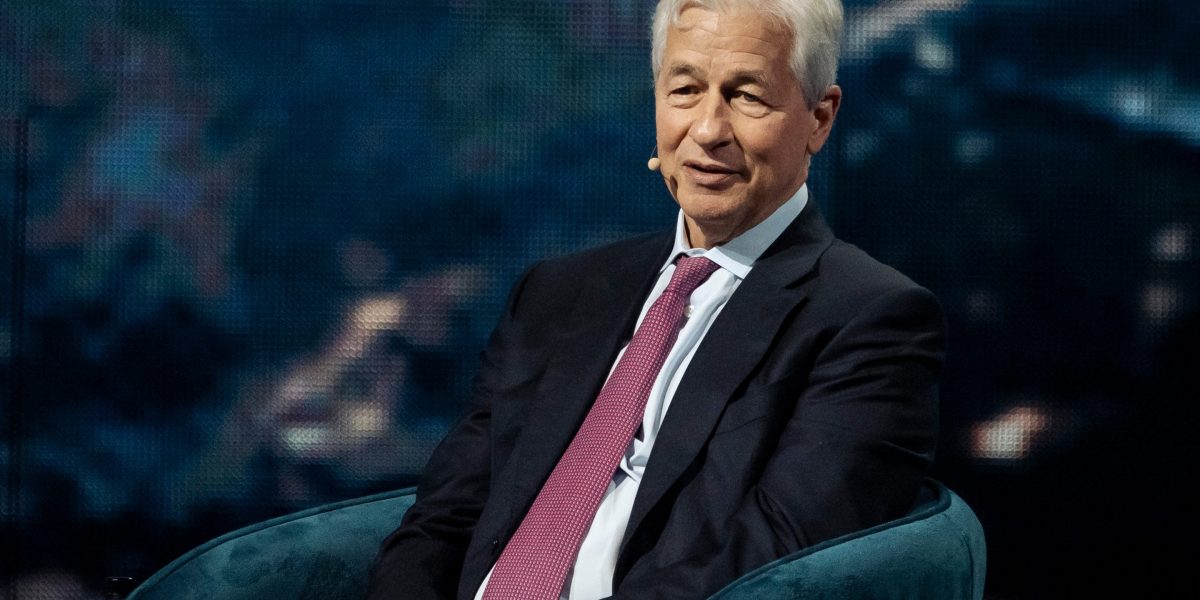
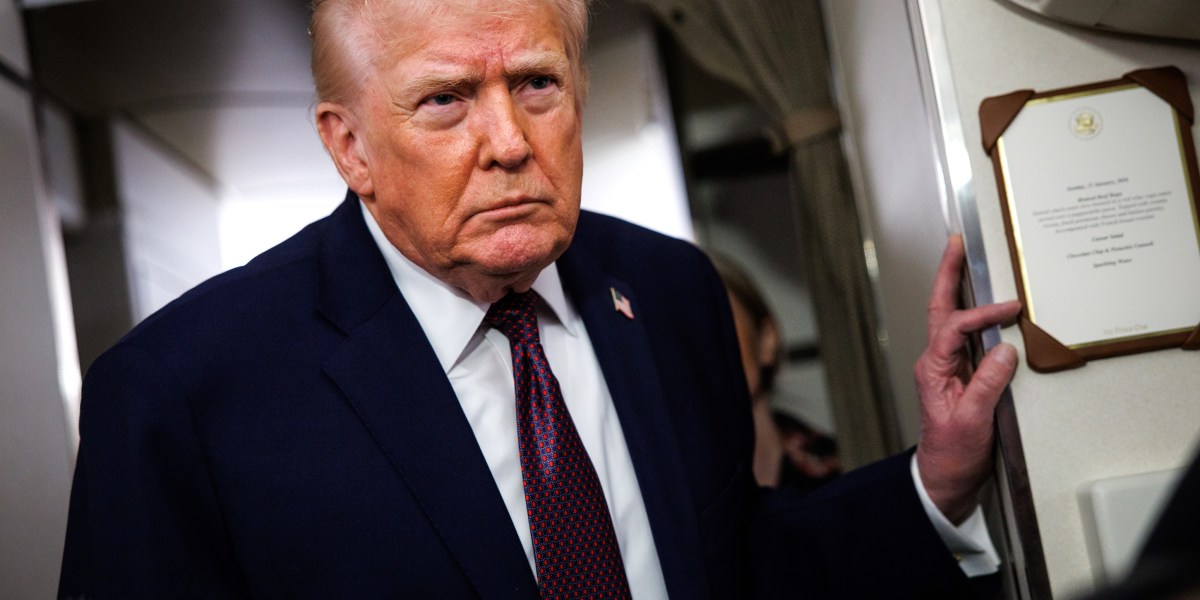
President Donald Trump said JPMorgan CEO Jamie Dimon was “wrong” to criticize the DOJ’s crimination investigation of Fed Chair Jerome Powell. “I think it’s fine what I’m doing,” Trump said. “We have a bad Fed person.” Dimon has expressed concern that the probe “chips away” at Fed independence. 

Delta’s K-shaped earnings

Delta Airlines reported earnings on Tuesday, posting $58.3 billion in full-year revenue on the back of strong demand for its premium offerings. On the earnings call, CEO Ed Bastian said demand for more price-sensitive offerings is “struggling greatly,” with the airline only logging gains among more affluent customers.

What Apple and Google’s partnership means

Earlier this week, Apple announced a partnership with Google to integrate the latter’s AI technology into the iPhone, including an upgrade to the Siri digital assistant. The deal is a significant endorsement of Google’s AI capabilities, and likely spells bad news for competitor OpenAI.

McKinsey’s new AI test for job candidates

McKinsey is asking graduate candidates to use its in-house AI assistant to complete tests that are part of its notoriously tough screening process. The pilot is intended to replicate how the top-tier consulting firm expects its new hires to get work done. 

Meta’s new performance review platform

Meta is joining the likes of Amazon and X in debuting a new performance review platform that values employee output over effort, according to internal documents obtained by Business Insider. “While our employees have always been held to a high-performance, impact-based culture, this new direction allows for more frequent feedback and recognition in a more efficient way,” a Meta spokesperson told Fortune.

The markets

Around the watercooler

Watercooler

U.S workers just took home their smallest share of capital since 1947, at least by Sasha Rogelberg

Why the $38 trillion national debt doomed Fed independence regardless of the Trump/Powell drama, top economist says by Eva Roytburg

Carhartt CEO says they always focused on blue-collar workers—but hipsters came anyway: ‘We welcome anyone … that wants to celebrate hard work’ by Nick Lichtenberg

Gen X CEO uses AI versions of Steve Jobs and Warren Buffett as a ‘fantasy board of directors’ to help him prepare for meetings and performance reviews by Preston Fore

CEO Daily is compiled and edited by Joey Abrams, Claire Zillman and Lee Clifford.


Source link

Continue Reading

Business

JPMorgan CEO Jamie Dimon says US national debt issue will ‘bite eventually’

Published

on


JPMorgan Chase CEO Jamie Dimon had a dose of reality for analysts and investors tuning into his company’s earnings call this week: At some point, governments around the globe are going to have to examine their spending habits.

Shares in America’s largest bank declined following its Q4 2025 earnings call yesterday, which reported revenue of $45.8 billion and assets under management of $4.8 trillion, representing an 18% year-over-year increase.

On the call, Dimon shared a mixed outlook on the economy, saying that “while labor markets have softened, conditions do not appear to be worsening.” He added that consumers remain resilient in their spending and “businesses generally remain healthy.” That’s despite upheaval in markets, which last year had to wrangle with rapidly changing foreign and trade policy from the White House.

While the billionaire banker was bullish on artificial intelligence, he also reiterated his warning that a looming shadow over the macroeconomic outlook is government debt. He has previously cautioned that Washington faces a market “rebellion” over the issue.

When asked about his outlook for 2026, Dimon said the short-term looked good. He explained: “Call it six months and nine months and even a year, it’s pretty positive. Consumers have money. There’s still jobs, even though it’s weakened a little bit. There’s a lot of stimulus coming from the One Big Beautiful Bill. Deregulation is a plus in general, not just for banks, but banks will be able to redeploy capital.”

However, the macro “backdrop” must also be considered, he added, and these work on different timelines: “Geopolitical is an enormous amount of risk … It’s just a big amount of risk that may or may not be determining the fate of the economy.”

He continued: “The deficits in the United States and around the world are quite large. We don’t know when that’s going to bite. It will bite eventually because you can’t just keep on borrowing money endlessly.”

That doesn’t seem to have trickled through to government, which spent $276 billion on interest payments on the national debt in the final three months of 2025 alone. In its most recent budget review released Friday, the Congressional Budget Office reported that the deficit totaled $601 billion in the first quarter of the fiscal year 2026 (October to December), $110 billion less than the deficit recorded the same period last year. 

Following the release, Maya MacGuineas, president of the Committee for a Responsible Federal Budget, said the U.S. government is already on track for a $2 trillion deficit in 2026. “Meanwhile, despite being more than a quarter into [fiscal 2026], our government is still not fully funded for the rest of the fiscal year, with another funding deadline around the corner in just over two weeks,” she added. “Lawmakers should come to an agreement on appropriations that avoids increasing our debt even more, restores the caps on discretionary spending, and maintains flat funding from the last fiscal year.”

White House officials have argued that tariff revenue will offset some of the government’s borrowing (despite the president also promising it for other uses), but Dimon remained realistic. “We have to deal with the world we got, not the world we want,” he said, adding his focus is not to guess economic outcomes but serving clients.

Who owns America’s debt?

One of the paths out of a potential debt crunch is that a central bank could simply print more money. By increasing the supply of money, the value of a currency is pushed down, making the interest payments on borrowed money relatively cheaper. However, this comes with inflationary, or hyperinflationary, side-effects.

Moreover, buyers of debt may realise the returns they are getting are decreasing in value, and so demand higher interest payments in the future.

This would be less of a concern for some buyers than others. For example, according to Treasury data analysis by the Peter G Peterson Foundation, which focuses on maintaining a stable fiscal future, the Federal Reserve System is the largest single holder of U.S. debt, owning $4.5 trillion as of March 2025. State and local governments own $1.7 trillion, and mutual funds own $4.4 trillion.

A problem may come from further afield, particularly if geopolitical tensions continue to rise, tempting foreign governments to order their central banks to ditch U.S. debt in protest. That would hurt the value of the dollar, generate inflation, and force the interest yield on U.S. debt upward—all scenarios that would make life more expensive for the federal government.

Investors in Japan, China, and the U.K. are among the highest buyers of U.S. debt, owning $1.1 trillion, $779 billion, and $765 billion, respectively. “While the holdings of U.S. debt by both [Japan and the U.K.] have declined over the past decade, China’s purchases of U.S. Treasury securities have declined more than Japan’s,” the foundation wrote.


Source link

Continue Reading

Business

Down Arrow Button Icon

Published

on


President Donald Trump announced yesterday he would impose a new tariff of 25% on any country trading with Iran. He also predicted disaster if the U.S. Supreme Court were to rule his tariff orders are illegal. The president estimated that “many Hundreds of Billions of Dollars” or even “Trillions” were at stake if the government was forced to refund anyone who paid them.

“It would be a complete mess, and almost impossible for our Country to pay,” he said on Truth Social. “If the Supreme Court rules against the United States of America on this National Security bonanza, WE’RE SCREWED!”

The court could issue a ruling as soon as Wednesday. It had been expected to rule last week. It is not clear why the court is delaying.

But Wall Street analysts are increasingly sanguine about the ruling. As time goes by, many say, the tariff issue becomes less and less dramatic. And in the bigger macro picture, the tariffs are less significant than predicted.

The longer the delay in the ruling the more likely it is the court is leaning toward Trump, according to JPMorgan.

“Legal experts continue to expect the Supreme Court to rule against the use of emergency powers [under the International Emergency Economic Powers Act] to authorize tariffs, but note that each week the Supreme Court delays its decision increases the likelihood of the Trump administration prevailing,” JPMorgan analysts Amy Ho and Joyce Chang told their clients. “Historically, SCOTUS reserves its most impactful decisions for the end of its term in June, which allows for extended deliberation.” Both Supreme Court cases on the Affordable Care Act were pushed to June, they wrote.

The pair also note that in the underlying case, only $135 billion in potential tariff refunds are at stake. 

Although Trump has touted the tariffs as a method of paying off the $38 trillion national debt, the reality is that collections so far have been too small to have much of an affect, according to James Knightley, ING’s chief international economist in the U.S. “Since April, tariff revenues are up $206 billion in those eight months relative to [fiscal] 2024, but not all are the IEEPA tariffs—they are estimated to perhaps be $130 billion. Sounds a lot, but the U.S. is a $30 trillion–plus economy,” he told Fortune in an email.

“Many companies will be wary of drawing the ire of the president by claiming a refund, and the hoops to jump through to reclaim through the courts could be quite onerous and deter others. Hence the actual amount that is reclaimed may be quite a lot less than $130 billion.”

Besides, he said, even if Trump loses the Supreme Court case he will likely reimpose the tariffs via some other regulation. “Given tariffs are a signature policy and the Republican polling isn’t looking very strong right now ahead of the midterms, the administration will move swiftly to reinstate tariffs through other legally recognized routes. The promise of a $2,000 tariff dividend needs to be paid for somehow. This is merely shuffling money around seeing as Americans paid the tariffs in the first place only to get money returned, so it is difficult to argue this will be a major stimulus for the economy,” he said.

Tariff revenue is being generated at a current rate of $30.4 billion per month, for an annualized rate of $364.5 billion, according to data from Bloomberg provided to Fortune via Pantheon Macroeconomics. However, those revenues are already in decline as companies find workarounds and as Trump himself cuts deals, compromises, or delays the imposition of harsher measures. 

Convera analyst Antonio Ruggiero is also unruffled by the upcoming ruling. If the tariffs are ruled illegal, “we expect the immediate [foreign currency exchange] reaction to be limited, as the broader consensus is that alternative mechanisms will be found to keep tariff revenues intact.

“That said, in the medium term, we cannot exclude the possibility of mild bearish pressure on the dollar tied to expectations of further uncertainty and erratic trade maneuvers should the administration be forced to remove such tariffs, particularly at a time when USD sentiment is increasingly fragile amid concerns over Federal Reserve independence,” he advised clients in an email seen by Fortune.

Here’s a snapshot of the markets ahead of the opening bell in New York this morning:

  • S&P 500 futures were down 0.15% this morning. The last session closed up 0.16%. 
  • The STOXX Europe 600 was flat in early trading.
  • The U.K.’s FTSE 100 was up 0.05% in early trading. 
  • Japan’s Nikkei 225 was up 3.1%.
  • China’s CSI 300 was down 0.6%. 
  • The South Korea Kospi was up 1.47%. 
  • India’s Nifty 50 was down 0.25%. 
  • Bitcoin was at $92K.


Source link

Continue Reading

Business

Down Arrow Button Icon

Published

on


The S&P 500 fell 0.19% yesterday but, interestingly, the “equal weight” S&P 500 (a notional index that values each stock equally) was marginally up. That’s because more investors are picking between winners and losers on the index—and many of the losers are the “Magnificent Seven” tech stocks.

The market as a whole is up 0.48% year-to-date. Given that the year is only a few days old, that pace promises healthy gains ahead.

But only two of the Mag 7 stocks are in positive territory so far, Alphabet and Amazon. All the others are down. Some of them are down bad. Tesla has lost 4.73% so far, Apple is down 4.83%.

The collapse of the Mag 7 is important because in the last few years the valuation of those stocks has grown so big that they now form more 30% of the value of the S&P as a whole. It created a situation where even if you bought an S&P 500 exchange-traded fund your results were mostly affected by the Mag 7.

To give you an idea of how worried analysts are about this concentration risk, Apollo Global Management chief economist Torsten Sløk recently published a note whose opening page looked like this:

But the dominance of the Mag 7 is likely to come to an end this year, many on Wall Street believe—if only because their valuations can’t exponentially go up forever. 

Morgan Stanley Wealth Management Chief Investment Officer Lisa Shalett believes the market is undergoing a healthy rotation away from tech stocks and back into the non-tech components of the S&P.

“We see several drivers of healthy deconcentration of the current ‘top 10’ components persisting,” she said in a recent note. “First is relative earnings acceleration. Growth rates are apt to continue to decline for the ‘Magnificent Seven’ while those of ‘the 493’ improve. Second, stock-buyback activity among the tech giants is falling as operating cash flow increasingly goes to [AI-related] capex.” 

The result is something that traders are pretty happy about because—as yesterday’s equal weight S&P performance shows—the other 493 stocks are still able to generate gains even if the Mag 7 are crumbling.

“On a [year-to-date] basis, the bull market in the S&P 500 is broadening, as we expected it might this year. The S&P 400 and S&P 600 are outperforming the S&P 500,” Ed Yardeni of Yardeni Research told clients this morning:
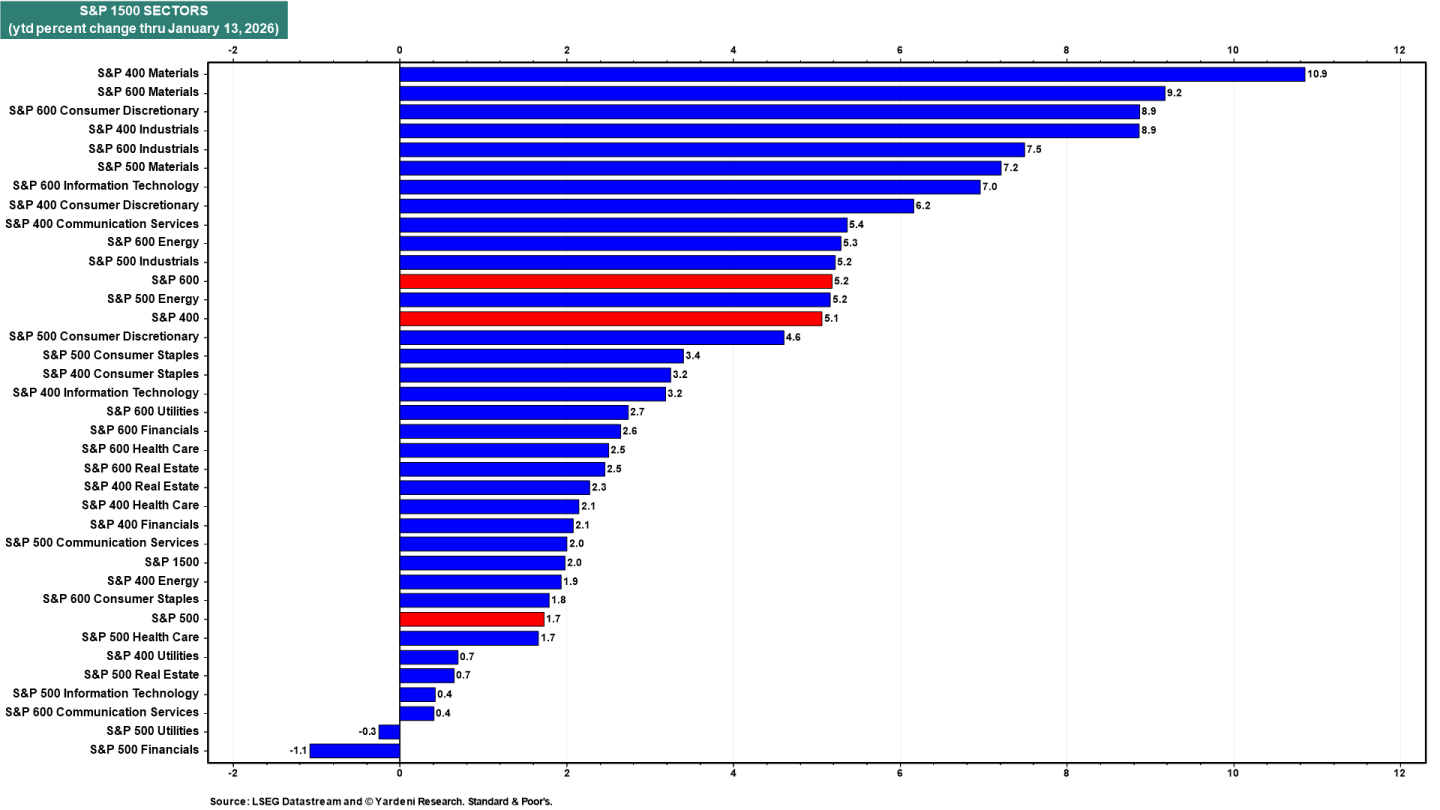
The Mag 7 has been in decline for two and a half months. “The Impressive-493 has outperformed the Magnificent-7 since last November. We expect this will continue in 2026, as last year’s LargeCap laggards catch up,” Yardeni said.

Here’s a snapshot of the markets ahead of the opening bell in New York this morning:

  • S&P 500 futures were down 0.44% this morning. The last session closed down 0.19%.
  • STOXX Europe 600 was up 0.27% in early trading.
  • The U.K.’s FTSE 100 was up o.3% in early trading. 
  • Japan’s Nikkei 225 was up 1.48%.
  • China’s CSI 300 was down o.4%. 
  • The South Korea KOSPI was up 0.65%. 
  • India’s NIFTY 50 was down 0.26%. 
  • Bitcoin was at $95K.
Join us at the Fortune Workplace Innovation Summit May 19–20, 2026, in Atlanta. The next era of workplace innovation is here—and the old playbook is being rewritten. At this exclusive, high-energy event, the world’s most innovative leaders will convene to explore how AI, humanity, and strategy converge to redefine, again, the future of work. Register now.


Source link

Continue Reading

Trending

Copyright © Miami Select.