The combination of gold and share prices soaring in unison is a phenomenon not seen in at least half a century and raises questions of a potential bubble in both, global central bank umbrella body, the Bank for International Settlements, says.
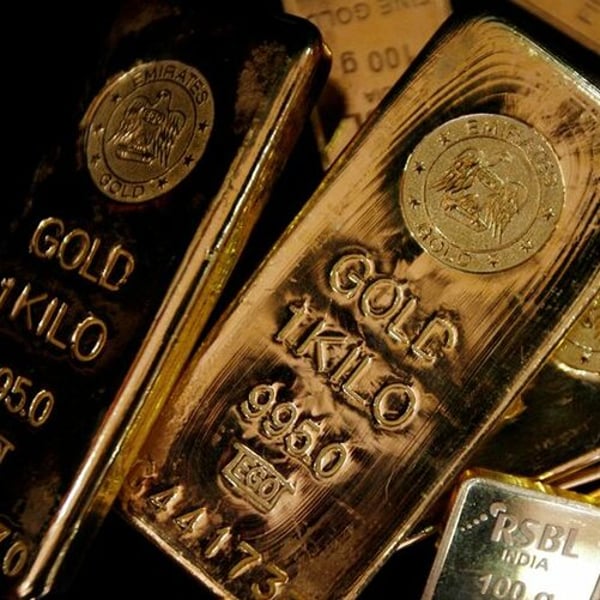
Gold seized included coins, bars, and jewellery (photo for illustrative purposes only) – REUTERS/ Ajay Verma/File Photo/File Photo
While equity markets continue to be driven by AI and tech gains, gold’s 60% surge this year is set to be its biggest since 1979, fuelling debate about whether its traditional role as a safe-haven asset has changed. “Gold has behaved very differently this year compared to its usual pattern,” Hyun Song Shin, economic adviser and head of the Monetary and Economic Department at the BIS said as it released its final report of the year on Monday. “The interesting phenomenon this time has been that gold has become much more like a speculative asset.”
Dubbed the central bank to the world’s central banks, the BIS has given regular warnings about potential stock market bubbles in recent years, but its concern around the co-movement with gold is two-fold. Where would investors shelter if stocks and gold both crash. And what could it mean for central banks and other reserve managers given some have been heavy buyers of gold.
The BIS’ analysis concluded that this year has been the first time gold and the S&P 500 have jointly exhibited “explosive behaviour” in the last 50 years. Not only is gold up 60% this year, it is up more than 150% since 2022 when the post-Covid pandemic surge in inflation began to impact markets, alongside Russia’s invasion of Ukraine and subsequent Western sanctions on Moscow.
Another possible bubble warning sign is that retail investors have also been piling in. Gold exchange-traded fund (ETF) prices have been consistently trading at a premium relative to their net asset value (NAV) this year, signalling “strong buying pressure coupled with impediments to arbitrage,” the BIS said.
Central banks’ purchases have “clearly set a very firm tone in the price of gold,” Shin added. “Whenever you have prices actually doing quite well, you will see other investors jumping in, and certainly retail investors have also taken part (in the rally), and not just in gold”.
The BIS gave a broader warning too about the “growing fragility” of the risk-on environment amid the concerns about artificial intelligence (AI) valuations and the recent 20% dives in cryptocurrencies like bitcoin. The European Central Bank and Bank of England have both raised their own AI bubble concerns in recent weeks and the risk of an abrupt burst if investors’ rosy expectations are not met.
Shin said the profits being made by the AI firms- now spending enormous amounts on data centres- was an important difference between now and the “dotcom bubble” of the early 2000s when firms weren’t making money. The “fundamental question,” however, is whether those expenditures will be seen as being justified in the long run, Shin said, adding that the other key determinant for markets will be how the global economy holds up next year. “So far, activity has been surprisingly resilient,” Shin said.
The BIS is also watching where the dollar goes from here. This year it is headed for its biggest annual drop since the Lehman Brothers collapse in 2007. “After the April episode (when US President Donald Trump announced sweeping trade tariff plans), the dollar has been relatively stable,” Shin said. “I think the hedging behaviour of non-US investors is going to be a very, very important input into how markets will co-move from here.”
Share purchases in key companies are always interesting but we wouldn’t normally mention anyone buying a relatively small amount of shares, especially not an amount adding out to ‘only’ £75,000.
Image: Dr Martens
But given that the company concerned saw fit to announce the purchase itself and given that the company is in the middle of a major turnaround, it’s of more interest than it might usually be.
Dr Martens announced on Monday that Robert Hanson, who joined the board as an independent non-executive director in March, has purchased 96,000 shares in Dr Martens – worth over £75,000.
Share purchases by insiders are particularly significant given that those insiders tend to have the best view of how the company is faring with its turnaround and an individual committing a significant sum of their own money is particularly interesting.
Hanson currently serves as CEO of The Duckhorn Portfolio. His previous roles include EVP and president of Constellation Brands’ Wine & Spirits, president of Americas at Levi’s as well as CEO roles at American Eagle Outfitters and John Hardy.
He purchased 96,000 ordinary shares at a price of £0.7886 per share. The buy suggests he believes that the shares, which are much lower than their all-time high of £5+, represent good value and should rise.
Dr Martens is currently working through a recovery from a major period of weakness and it seems to be yielding results. Its first half update in November showed progress, with America recovering in particular even though EMEA still showed weakness.
A week later, it also announced the opening of its new Soho, London flagship and that’s a key development. The store “represents the most elevated expression of the… brand to date”. The first-ever ‘beacon’ store is on Brewer Street with its two floors spanning 3,400 sq ft to make it the brand’s biggest UK flagship – “built to bring the people and product of Dr Martens together”.
Boss is further deepening its role as a patron of the international art scene and as a partner of Art Basel. At the inaugural Art Basel Awards Night in Miami Beach last week, the fashion house presented the Boss Award for Outstanding Achievement for the first time. The 2025 award goes to the artist Meriem Bennani, whose multimedia practice is renowned for its innovative, humorous, and critically engaged storytelling.
Meriem Bennani is known for weaving humour, pop-cultural aesthetics, and digital language into her storytelling. – BOSS
The Moroccan-born New Yorker works across a variety of artistic media, including video, sound, animation, sculpture, and large-scale installations. She is known for combining humour, pop-cultural aesthetics, and digital language in her narratives to create immersive, playful yet incisive works that resonate with audiences.
The prize was presented by CEO Daniel Grieder and creative director Marco Falcioni. The award will continue to recognise artistic practices that open up new perspectives and spark relevant social dialogue.
“I am deeply honoured to have my work recognised by such an iconic brand that has long championed innovative art that speaks to a wider public. This award inspires me to continue creating works that challenge perspectives and celebrate the beauty of collective experiences,” said Meriem Bennani at the award ceremony.
The highlight of the ceremony was the installation of an immersive catwalk entitled “1995–2025: 30 Years of Arts Sponsorship,” which spotlighted the brand’s arts patronage over the past three decades. Milestones included the “Paper Suit” by artist James Rosenquist from 1998, which marries the timeless craftsmanship of tailoring with the ephemerality of paper. Also featured were the Hugo Boss Prize, awarded for many years in collaboration with the Solomon R. Guggenheim Foundation and Museum, and a retrospective of the Hugo Boss Asia Art Award, launched jointly with the Rockbund Art Museum in Shanghai.
“Art has been an integral part of our DNA for over 30 years, and our partnership with Art Basel takes our commitment to a new level. We are proud to present the inaugural Boss Award for Outstanding Achievement to its first recipient, Meriem Bennani. This award marks the beginning of an exciting journey, and we look forward to shaping the future of art together,” said CEO Daniel Grieder.
The Art Basel Awards, launched in February, honoured 36 medallists from the contemporary art sector in nine categories. Bottom right, Meriem Bennani holds the Boss Award. – HUGO BOSS
“Fashion is an integral part of our everyday lives and serves as a bridge between the individual and society, often blurring the line between functionality and art. From our beginnings to our latest fashion show, Hugo Boss has been committed to the dialogue between fashion and contemporary art, as it continues to inspire innovation, creativity, and forward-thinking ideas,” added creative director Marco Falcioni.
The Boss Award is endowed with $100,000 and supports both future projects and a charitable initiative of the laureate’s choice. The award is open to living artists working across all media, with a particular focus on emerging talents who are shaping discussions within and beyond the art world.
This article is an automatic translation. Click here to read the original article.
The Comité Colbert has unanimously elected Hélène Poulit-Duquesne to be the new chair of the leading French luxury federation. Poulit-Duquesne, the CEO of Maison Boucheron, succeeds Laurent Boillot. She will take up her new responsibilities in June 2026, working alongside Bénédicte Épinay, general delegate of the Comité Colbert.
Hélène Poulit-Duquesne – Boucheron
Poulit-Duquesne has been a long-term active member of the Comité Colbert. As CEO of Maison Boucheron, she has served on the association’s board of directors since 2018 and became its vice president in May 2022.
“I am proud and happy for the trust placed in me today. My roadmap is to continue supporting the Comité Colbert’s major challenges: promoting our expertise and supporting our industries, collectively promoting our values and our Houses internationally, and placing sustainable development, a future challenge for the planet and our professions, at the heart of our strategies,” said the Boucheron CEO in a release.
The Comité Colbert’s membership includes a wide variety of French luxury labels such as fashion houses like Louis Vuitton, Balenciaga, Dior, Givenchy, Jean Paul Gaultier, and Balmain; fine wines like Château Lafitte Rothschild and Perrier Jouët champagne; perfume brands- Frédéric Malle, Guerlain, and Francis Kurkdjian; jewellers such as Van Cleef & Arpels and Messika; and master chefs and restaurants including Yannick Alléno, Taillevent, and Guy Savoy.
“Each Maison of the Comité Colbert, beyond its individual performance and regardless of its market share and size, has a greater role to play: that of defending values that are universal and cement the foundation of our collective: the values of art, culture, and craftsmanship, the hand of man. Because they have meaning, they give meaning. They enrich the lives of millions of people and inspire them to dream,” insisted Poulit-Duquesne.
A notably experienced executive, Poulit-Duquesne has held senior positions in three of the largest luxury groups in the world- LVMH, Richemont, and Kering.
Hélène Poulit-Duquesne is a graduate of ESSEC Business School in the Paris suburbs, who began her career at LVMH before joining Cartier International, the key brand in the Richemont Group, in 1998. In 2010, she joined its Executive Committee as director of international marketing, before joining the Kering Group at the end of 2015 as CEO of Maison Boucheron.
“I am delighted at the prospect of working with Hélène Poulit-Duquesne to serve, together with our collective, the influence of an industry whose excellence and creativity are one of the major jewels in the crown of the French economy. We are committed to supporting its development, honouring its expertise, and amplifying its international influence,” added Épinay.
Created in 1954 on the initiative of famed perfumer Jean-Jacques Guerlain, the Comité Colbert is a non-profit association recognised as being of public interest, bringing together 98 French luxury houses and 17 cultural institutions. The Comité Colbert’s goal is to work together to promote the French art of living internationally, as well as to preserve and pass on French expertise and creativity.