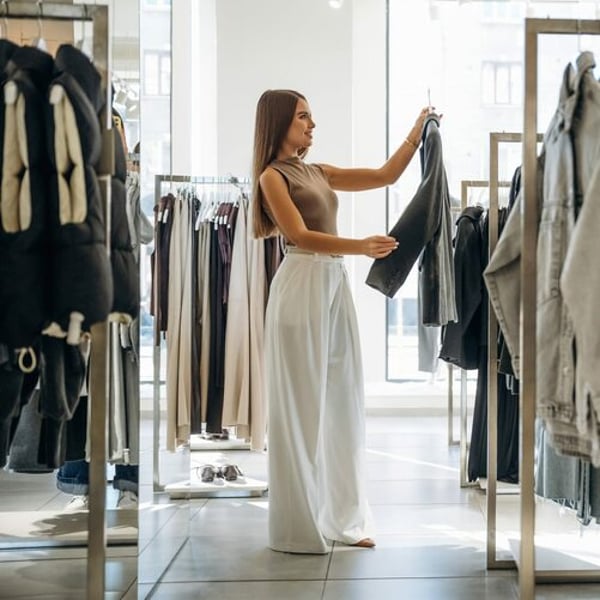
A Deutsche Bank report this week has sent the share prices of a number of UK retailers down on the back of falling consumer confidence, and it looks like retailer confidence is low too if the latest CBI retail report is a guide.
Shutterstock
First, a quick look at that Deutsche Bank report. It showed UK consumer confidence at a post-pandemic low and raised fears that autumn will be tough for discretionary retailers. Big names such as Next, M&S and Primark owner ABF saw their share prices falling with ABF’s price down as much as 6% in recent days.
It coincided with the latest CBI retailer survey that showed retail sales volumes “fell at a strong pace in the year to August, extending the downturn to an 11th consecutive month”.
That said, the business body reported retailers expecting the pace of decline to ease in September. So perhaps those share price falls may be reversed soon?
Regardless, the CBI report wasn’t exactly upbeat. It said weak demand and gloomy sentiment continue to weigh on retailers’ investment and hiring plans. Price pressures remain elevated, with selling prices rising at their fastest rate since November 2023.
Year-on-year retail sales volumes fell at a strong pace in August with a weighted balance of -32% from -34% in July. Sales are expected to decline at a slower rate next month (-16%).
First though, an explanation. Those figures don’t mean that the volume of sales fell by 34%. Instead, the weighted balance showed 34% of retailers saying their sales fell to one degree or another.
Back with the report, retail sales for the time of year were judged to be “poor”, to a somewhat greater extent than in July (-19% from -10% in July). Next month’s sales are set to remain below seasonal norms to a similar degree (-20%).
Sentiment among retailers remained poor, with their business situation expected to deteriorate over the coming quarter, but to a lesser extent than last quarter (-10% from -29% in May).
Retailers also expect to reduce capital expenditure over the next 12 months (compared to the previous 12) to a slightly lesser degree than in May (-42% from -47% in May), but intentions remain poor by historical standards (long-run average of -3%).
Meanwhile retail employment continued to decline at a broadly unchanged rate in the year to August (-14% from -15% in May). Headcount is expected to fall at a slightly quicker pace next month (-19%).
And the survey showed retail selling prices rose in the year to August at the fastest rate since November 2023 (+65% from +35% in May). Retailers anticipate selling prices to increase at a relatively slower pace in September (+43%).
Online retail sales volumes were broadly flat in the year to August (+3% from +4% in July) but are expected to contract at a fast rate in September (-35%).
Martin Sartorius, CBI Principal Economist, said of this: “Retailers endured another tough month in August. Weak demand and higher labour costs continue to put pressure on margins, dampening sentiment across the retail and wider distribution sector. This downbeat outlook is reflected in firms’ plans to scale back investment and hiring.
“The government’s fiscal decisions are continuing to bite, and retailers’ struggles send a clear signal: business cannot be asked to balance the books again at the Autumn Budget. Building business confidence through delivery must be the priority — starting with a rethink of the Employment Rights Bill, which risks piling on unnecessary costs and holding back jobs and investment.”
The demerger of Unilever‘s ice cream division, to be named ‘The Magnum Ice Cream Company,’ which had been delayed in recent months by the US government shutdown, will finally go ahead on Saturday, the British group announced.
Reuters
Unilever said in a statement on Friday that the admission of the new entity’s shares to listing and trading in Amsterdam, London, and New York, as well as the commencement of trading… is expected to take place on Monday, December 8.
The longest federal government shutdown in US history, from October 1 to November 12, fully or partially affected many parts of the federal government, including the securities regulator, after weeks without an agreement between Donald Trump‘s Republicans and the Democratic opposition.
Unilever, which had previously aimed to complete the demerger by mid-November, warned in October that the US securities regulator (SEC) was “not in a position to declare effective” the registration of the new company’s shares. However, the group said it was “determined to implement in 2025” the separation of a division that also includes the Ben & Jerry’s and Cornetto brands, and which will have its primary listing in Amsterdam.
“The registration statement” for the shares in the US “became effective on Thursday, December 4,” Unilever said in its statement. Known for Dove soaps, Axe deodorants and Knorr soups, the group reported a slight decline in third-quarter sales at the end of October, but beat market expectations.
Under pressure from investors, including the activist fund Trian of US billionaire Nelson Peltz, to improve performance, the group last year unveiled a strategic plan to focus on 30 power brands. It then announced the demerger of its ice cream division and, to boost margins, launched a cost-saving plan involving 7,500 job cuts, nearly 6% of the workforce. Unilever’s shares on the London Stock Exchange were steady on Friday shortly after the market opened, at 4,429 pence.
This article is an automatic translation. Click here to read the original article.
Burberry has named a new chief operating and supply chain officer as well as a new chief customer officer. They’re both key roles at the recovering luxury giant and both are being promoted from within.
Matteo Calonaci becomes chief operating and supply chain officer, moving from his role as senior vice-president of strategy and transformation at the firm.
In his new role, he’ll be oversee supply chain and planning, strategy and transformation, and data and analytics. He succeeds Klaus Bierbrauer, who’s currently Burberry supply chain and industrial officer. Bierbrauer will be leaving the company following its winter show and a transition period.
Matteo Calonaci – Burberry
Meanwhile, Johnattan Leon steps up as chief customer officer. He’s currently currently Burberry’s senior vice-president of commercial and chief of staff. In his new role he’ll be leading Burberry’s customer, client engagement, customer service and retail excellence teams, while also overseeing its digital, outlet and commercial operations.
Both Calonaci and Leon will join the executive committee, reporting to Company CEO Joshua Schulman.
JohnattanLeon – Burberry
Schulman said of the two execs that the appointments “reflect the exceptional talent and leadership we have at Burberry. Both Matteo and Johnattan have been instrumental in strengthening our focus on executional excellence and elevating our customer experience. Their deep understanding of our business, our people, and our customers gives me full confidence that their leadership will help drive [our strategy] Burberry Forward”.
Traditional and occasion wear designer Puneet Gupta has stepped into the world of fine jewellery with the launch of ‘Deco Luméaura,’ a collection designed to blend heritage and contemporary aesthetics while taking inspiration from the dramatic landscapes of Ladakh.
Hints of Ladakh’s heritage can be seen in this sculptural evening bag – Puneet Gupta
“For me, Deco Luméaura is an exploration of transformation- of material, of story, of self,” said Puneet Gupta in a press release. “True luxury isn’t perfect; it is intentional. Every piece is crafted to be lived with and passed on.”
The jewellery collection features cocktail rings, bangles, chokers, necklaces, and statement evening bags made in recycled brass and finished with 24 carat gold. The stones used have been kept natural to highlight their imperfect and unique forms and each piece in the collection has been hammered, polished, and engraved by hand.
An eclectic mix of jewels from the collection – Puneet Gupta
Designed to function as wearable art pieces, the colourful jewellery echoes the geometry of Art Deco while incorporating distinctly South Asian imagery such as camels, butterflies, and tassels. Gupta divides his time between his stores in Hyderabad and Delhi and aims to bring Indian artistry to a global audience while crafting a dialogue between designer and artisan.