Connect with us

Business

Cava CFO: Automation to ‘enhance the human experience, not replace it’

Published

on


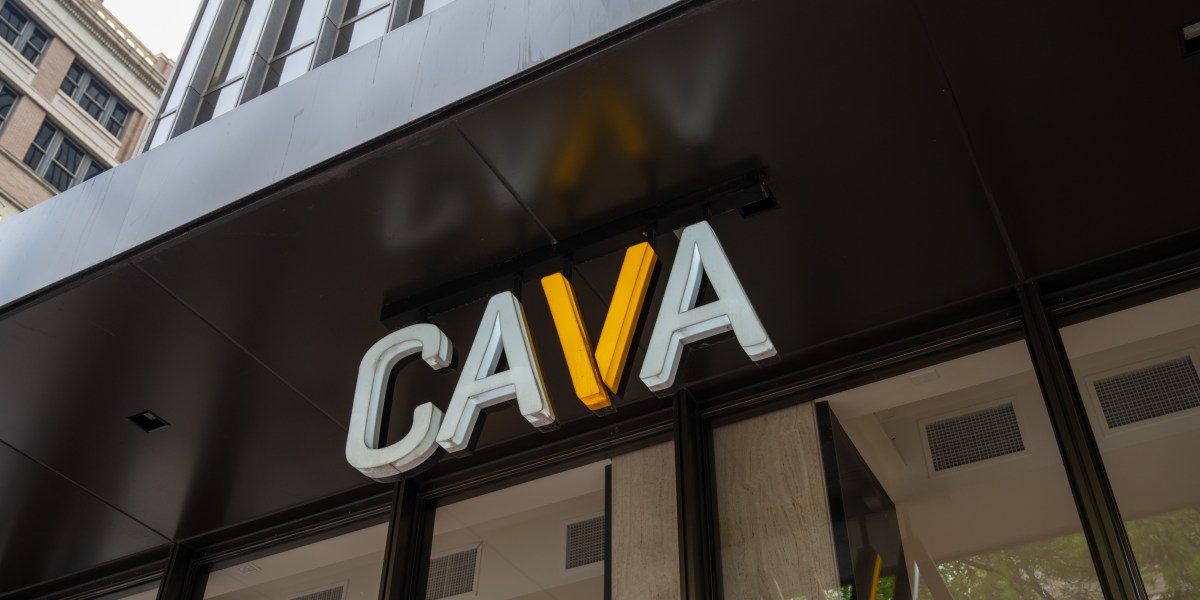
Good morning. As automation gains momentum in the food service industry, Mediterranean restaurant chain Cava—known for fan favorites like pita chips—is making its first major investment in the space.

Cava has invested $5 million in Hyphen—a foodservice platform that automates culinary operations such as meal production at assembly stations—and committed an additional $5 million, subject to terms. The $25 million funding round was also backed by Chipotle’s Cultivate Next venture fund, which previously invested $15 million in July 2024.

“We believe that technology should enhance the human experience, not replace it, and Hyphen’s equipment does just that,” Cava CFO Tricia Tolivar told me. After months of evaluating Hyphen and similar concepts, the company is confident this partnership is a smart move, she added.

Deloitte’s recent “State of AI in Restaurants” survey—based on interviews with 375 restaurant executives across 11 countries—found that 8 in 10 expect to increase their AI investments in the next fiscal year. Casual dining brands, in particular, prioritize benefits such as optimizing food preparation.

At Cava, Hyphen will be used on what Tolivar calls the “second-make line”—a back-of-house station where staff prepare all bowls and pitas for digital delivery and pickup. The system lets employees assemble a bowl or pita on the top level while automatically producing additional bowls below from the same ingredients, boosting speed, throughput, and digital order accuracy, she said. “Most importantly, it’s really about making our team members’ lives easier,” Tolivar said. Cava is still testing the technology and expects to roll it out in a few months.

‘Whitespace opportunity’

For its fiscal second quarter ended July 13, Cava reported on Tuesday revenue of $278.2 million, up 20.3% year over year. About 37% of sales were digital. Same-restaurant sales rose 2.1%, below analyst estimates, but the company outperformed the broader industry trend of same-store declines. Cava lowered its same-store sales forecast to 4%–6%, down from 6%–8%, while maintaining expectations for restaurant-level profit margins of 24.8%–25.2% and adjusted EBITDA of $152 million–$159 million.

The company added 16 net new restaurants in the quarter, bringing its total to 398—a 16.7% increase from last year. Cava raised its 2025 net new openings forecast to 68–70, up from 64–68, and continues to target 1,000 locations by 2032.

Alex Fascino, an equity analyst at CFRA Research, commented on Cava’s expansion plans in a Tuesday research note. “In our view, this strategic pivot toward prioritizing expansion over same-store sales growth validates the substantial whitespace opportunity and unit growth potential in the current market backdrop,” he wrote.

Cava’s 2025 new-restaurant class is on track to deliver average unit volumes (AUVs) above $3 million, ahead of expectations. Overall AUV for Q2 2025 was $2.9 million, up from $2.7 million a year earlier. 

The AUV or average sales for each location is increasing across the country, Tolivar said. “Not only are you seeing it in Detroit, Indianapolis, and Chicago, but in smaller cities like Lafayette, Louisiana or Burlington, North Carolina.”  

Tolivar also revealed a new flavor of the Cava’s popular pita chips—cinnamon sugar served with a side of honey. 

“One of the best parts about being in the office is spending time with our chefs in the kitchen,” she said. “I’ve been part of this journey and the evolution, and I think they’ve nailed it.”

Sheryl Estrada
sheryl.estrada@fortune.com

Leaderboard

Fortune 500 Power Moves

Aunoy Banerjee was appointed EVP and CFO of Citizens Financial Group, Inc. (No. 341), effective Oct. 24. As previously announced, current CFO John Woods will depart the bank on Aug. 15. Chris Emerson, EVP and head of corporate planning and enterprise finance, will serve as CFO during the interim period.  Banerjee joins Citizens from Barclays, where he currently serves as CFO of Barclays Bank PLC, leading a multifunctional team.  Before Barclays, Banerjee served in finance and transformation roles at State Street over eight years, most recently as head of investments and third-party management and chair of State Street India. He also served as chief transformation officer.  Banerjee previously spent 11 years at Citi in several roles, including business unit CFO for Capital Markets and Securities Services.

Every Friday morning, the weekly Fortune 500 Power Moves column tracks Fortune 500 company C-suite shiftssee the most recent edition.

More notable moves

 Aric McKinnis was promoted to SVP and CFO of FormFactor, Inc. (Nasdaq: FORM). McKinnis succeeds Shai Shahar, who resigned from these positions effective Aug. 8. Shahar will serve as an executive advisor through Dec. 31. McKinnis, who joined FormFactor in August 2019, serves as its VP and corporate controller and was previously corporate controller at MKS Instruments. Earlier, he served in various external audit roles at Deloitte, including audit manager

David Hedley was appointed CFO of Bramshill Investments, an alternative asset management firm. Hedley has been working as the firm’s chief strategy officer since 2021. He replaces the firm’s former CFO, Gina Cifello, who retired earlier this year. Hedley has over 34 years of experience. Before joining Bramshill, he was a principal and senior managing director at Ernst & Young Capital Advisors, where he led the Technology Investment Banking Group. Prior to EY, he was a senior investment banker at Canaccord Genuity, UBS Investment Bank, Thomas Weisel Partners and Merrill Lynch. 

Big Deal

According to July inflation data, the Consumer Price Index (CPI) rose 0.2% month over month, and 2.7% year over year—matching June’s annual pace. Core inflation, which excludes food and energy, edged higher to 3.1% annually, remaining well above the Federal Reserve’s 2% target. Flat headline inflation and declining energy prices fueled expectations for a potential rate cut in September. However, analysts cautioned that persistent service-sector costs and possible future tariff impacts could limit further easing in 2025. While markets rallied on the data, Fed officials indicated they remain focused on upcoming jobs reports before making decisions on additional cuts, Fortune reported

Going deeper

“Is AI Pushing Us to Break the Talent Pipeline?” is a new report in Wharton’s business journal. Junior employees may be losing opportunities to develop their skills as more companies rely on AI for entry-level tasks, Wharton’s Cornelia Walther argues.


“Businesses of all sizes should invest in ‘double literacy’ for their employees, and themselves,” Walther writes. “Beyond AI literacy, this is the time to develop a solid understanding of our human skillset, and how it is impacted by the growing artificial treasure chest.”

Overheard

“I disdain corporate speak and owe more than the standard ‘I want to spend more time with my family and Lauren is a great visionary product-centric strategic operator.'”

—Life360 co-founder Chris Hulls wrote in a sign-off blog post. Hulls ignored legal advice and the boilerplate, “I want to spend more time with my family,” in an announcement about why he’s leaving the CEO role, Fortune reported


Source link

Continue Reading

Business

Binance has been proudly nomadic for years. A new announcement suggests it’s chosen an HQ

Published

on


For years, Binance has dodged questions about where it plans to establish a corporate headquarters. On Monday, the world’s largest crypto exchange made an announcement that indicates it has chosen a location: Abu Dhabi, the capital of the United Arab Emirates.

In its announcement, Binance reported that it has secured three global financial licenses within Abu Dhabi Global Market, a special economic zone inside the Emirati city. The licenses regulate three different prongs of the exchange’s business: its exchange, clearinghouse, and broker dealer services. The three regulated entities are named Nest Exchange Limited, Nest Clearing and Custody Limited, and Nest Trading Limited, respectively.

Richard Teng, the co-CEO of Binance, declined to say whether Abu Dhabi is now Binance’s global headquarters. “But for all intents and purposes, if you look at the regulatory sphere, I think the global regulators are more concerned of where we are regulated on a global basis,” he said, adding that Abu Dhabi Global Market is where his crypto exchange’s “global platform” will be governed.

A company spokesperson declined to add more to Teng’s comments, but did not deny Fortune’s assertion that Binance appears to have chosen Abu Dhabai as its headquarters.

Corporate governance

The Abu Dhabi announcement suggests that Binance, which has for years taken pride in branding itself as a company with no fixed location, is bowing to the practical considerations that go with being a major financial firm—and the corporate governance obligations that entails.

When Changpeng Zhao, the cofounder and former CEO of Binance, launched the company in 2017, he initially established the exchange in Hong Kong. But, weeks after he registered Binance in the city, China banned cryptocurrency trading, and Zhao moved his nascent trading platform. Binance has since been itinerant. “Wherever I sit is going to be the Binance office,” Zhao said in 2020.

The location of a company’s headquarters impacts its tax obligations and what regulations it needs to follow. In 2023, after Binance reached a landmark $4.3 billion settlement with the U.S. Department of Justice, Zhao stepped down as CEO and pleaded guilty to failing to implement an effective anti-money laundering program.

Teng took over and promised to implement the corporate structures—like a board of directors—that are the norm for companies of Binance’s size. Teng, who now shares the CEO role with the newly appointed Yi He, oversaw the appointment of Binance’s first board in April 2024. And he’s repeatedly telegraphed that his crypto exchange is focused on regulatory compliance.

Binance already has a strong footprint in the Emirates. It has a crypto license in Dubai, received a $2 billion investment from an Emirati venture fund in March, and, that same month, said it employed 1,000 employees in the country. 


Source link

Continue Reading

Business

Leaders in Congress outperform rank-and-file lawmakers on stock trades by up to 47% a year

Published

on


Stocks held by members of Congress have been beating the S&P 500 lately, but there’s a subset of lawmakers who crush their peers: leadership.

According to a recent working paper for the National Bureau of Economic Research, congressional leaders outperform back benchers by up to 47% a year.

Shang-Jin Wei from Columbia University and Columbia Business School along with Yifan Zhou from Xi’an Jiaotong-Liverpool University looked at lawmakers who ascended to leadership posts, such as Speaker of the House as well as House and Senate floor leaders, whips, and conference/caucus chairs.

Between 1995 and 2021, there were 20 such leaders who made stock trades before and after rising to their posts. Wei and Zhou observed that lawmakers underperformed benchmarks before becoming leaders, then everything suddenly changed.

“Importantly, whilst we observe a huge improvement in leaders’ trading performance as they ascend to leadership roles, the matched ‘regular’ members’ stock trading performance does not improve much,” they wrote.

Leadership’s stock market edge stems in part from their ability to set the regulatory or legislation agenda, such as deciding if and when a particular bill will be put to a vote. Setting the agenda also gives leaders advanced knowledge of when certain actions will take place.

In fact, Wei and Zhou found that leaders demonstrate much better returns on stock trades that are made when their party controls their chamber.

In addition, being a leader also increases access to non-public information. The researchers said that while companies are reluctant to share such insider knowledge, they may prioritize revealing it to leaders over rank-and-file lawmakers.

Leaders earn higher returns on companies that contribute to their campaigns or are headquartered in their states, which Wei and Zhou said could be attributable to “privileged access to firm-specific information.”

The upper echelon also influences how other members of Congress vote, and the paper found that a leader’s party is much more likely to vote for bills that help firms whose stocks the leader held, or vote against bills that harmed them. And stocks owned by leadership tend to see increases in federal contract awards, especially sole-source contracts, over the following one to two years.

“These results suggest that congressional leaders may not only trade on privileged knowledge, but also shape policy outcomes to enrich themselves,” Wei and Zhou wrote.

Stock trades by congressional leaders are even predictive, forecasting higher occurrences of positive or negative corporate news over the following year, they added. In particular, stock sales predict the number of hearings and regulatory actions over the coming year, though purchases don’t.

Investors have long suspected that Washington has a special advantage on Wall Street. That’s given rise to more ETFs with political themes, including funds that track portfolios belonging to Democrats and Republicans in Congress.

And Paul Pelosi, former House Speaker Nancy Pelosi’s husband, even has a cult following among some investors who mimic his stock moves.

Congress has tried to crack down on members’ stock holdings. The STOCK Act of 2012 requires more timely disclosures, but some lawmakers want to ban trading completely.

A bipartisan group of House members is pushing legislation that would prohibit members of Congress, their spouses, dependent children, and trustees from trading individual stocks, commodities, or futures.

And this past week, a discharge petition was put forth that would force a vote in the House if it gets enough signatures.

“If leadership wants to put forward a bill that would actually do that and end the corruption, we’re all for it,” said Rep. Anna Paulina Luna, R-Fla., on social media on Tuesday. “But we’re tired of the partisan games. This is the most bipartisan bipartisan thing in U.S. history, and it’s time that the House of Representatives listens to the American people.”


Source link

Continue Reading

Business

Macron warns EU may hit China with tariffs over trade surplus

Published

on


French President Emmanuel Macron warned that the European Union may be forced to take “strong measures” against China, including potential tariffs, if Beijing fails to address its widening trade imbalance with the bloc.

“I’m trying to explain to the Chinese that their trade surplus isn’t sustainable because they’re killing their own clients, notably by importing hardly anything from us any more,” Macron told Les Echos newspaper in an interview published on Sunday.

“If they don’t react, in the coming months we Europeans will be obliged to take strong measures and decouple, like the US, like for example tariffs on Chinese products,” he said, adding that he had discussed the matter with European Commission President Ursula von der Leyen.

Macron has just returned from a three-day state visit in China, where he pressed for more investment as Paris seeks to recalibrate its relationship with the world’s second-largest economy. France’s goods trade deficit with China reached around €47 billion ($54.7 billion) last year, according to the French Treasury. Meanwhile, China’s goods trade surplus with the EU swelled to almost $143 billion in the first half of 2025, a record for any six-month period, according to data released by China earlier this year.

Tensions between France and China escalated last year after Paris backed the EU’s decision to impose tariffs on Chinese electric vehicles. Beijing retaliated by imposing minimum price requirements on French cognac, sparking fears among pork and dairy producers that they could be targeted next.

‘Life or Death’

Macron said the US approach to China was “inappropriate” and had worsened Europe’s position by diverting Chinese goods toward the EU market.

“Today, we’re stuck between the two, and it’s a question of life or death for European industry,” Macron said, while noting that Germany — Europe’s biggest economy — doesn’t entirely share France’s stance.

In addition to Europe needing to become more competitive, the European Central Bank too has a role to play in strengthening the EU’s single market, Macron said, arguing that monetary policy should take growth and jobs into account, not just inflation, he said.

He also said the ECB’s decision to continue selling the government bonds it holds risks pushing up long-term interest rates and weighing on economic activity.

“Europe must — and wants to — remain a zone of monetary stability and credible investment,” Macron said.


Source link

Continue Reading

Trending

Copyright © Miami Select.