Connect with us

Business

Cava CFO: Automation to ‘enhance the human experience, not replace it’

Published

on


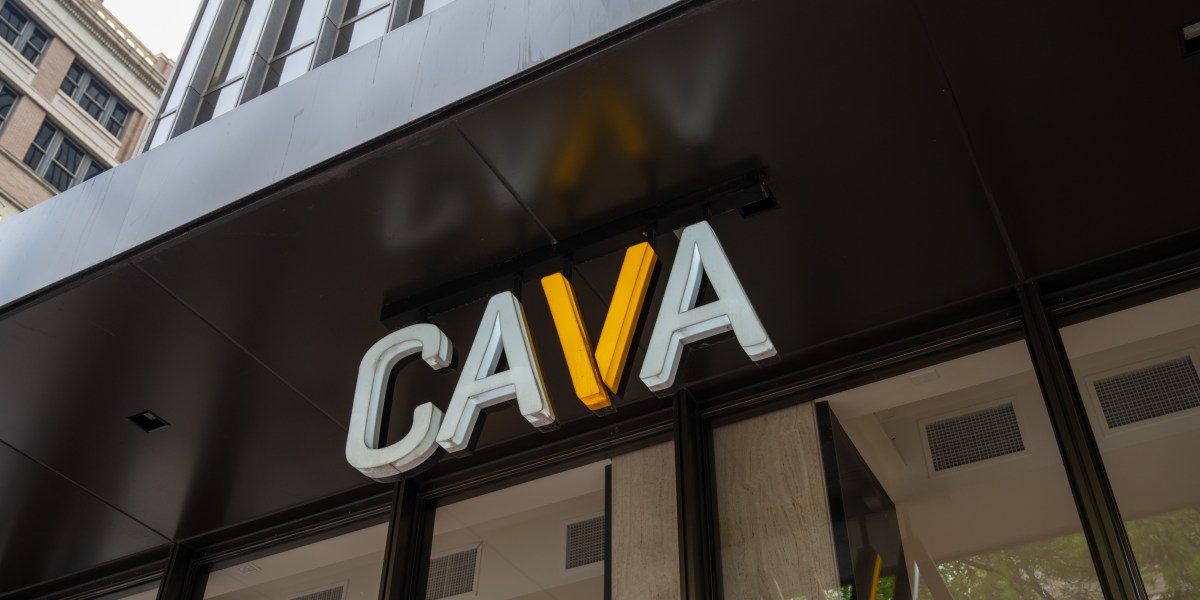
Good morning. As automation gains momentum in the food service industry, Mediterranean restaurant chain Cava—known for fan favorites like pita chips—is making its first major investment in the space.

Cava has invested $5 million in Hyphen—a foodservice platform that automates culinary operations such as meal production at assembly stations—and committed an additional $5 million, subject to terms. The $25 million funding round was also backed by Chipotle’s Cultivate Next venture fund, which previously invested $15 million in July 2024.

“We believe that technology should enhance the human experience, not replace it, and Hyphen’s equipment does just that,” Cava CFO Tricia Tolivar told me. After months of evaluating Hyphen and similar concepts, the company is confident this partnership is a smart move, she added.

Deloitte’s recent “State of AI in Restaurants” survey—based on interviews with 375 restaurant executives across 11 countries—found that 8 in 10 expect to increase their AI investments in the next fiscal year. Casual dining brands, in particular, prioritize benefits such as optimizing food preparation.

At Cava, Hyphen will be used on what Tolivar calls the “second-make line”—a back-of-house station where staff prepare all bowls and pitas for digital delivery and pickup. The system lets employees assemble a bowl or pita on the top level while automatically producing additional bowls below from the same ingredients, boosting speed, throughput, and digital order accuracy, she said. “Most importantly, it’s really about making our team members’ lives easier,” Tolivar said. Cava is still testing the technology and expects to roll it out in a few months.

‘Whitespace opportunity’

For its fiscal second quarter ended July 13, Cava reported on Tuesday revenue of $278.2 million, up 20.3% year over year. About 37% of sales were digital. Same-restaurant sales rose 2.1%, below analyst estimates, but the company outperformed the broader industry trend of same-store declines. Cava lowered its same-store sales forecast to 4%–6%, down from 6%–8%, while maintaining expectations for restaurant-level profit margins of 24.8%–25.2% and adjusted EBITDA of $152 million–$159 million.

The company added 16 net new restaurants in the quarter, bringing its total to 398—a 16.7% increase from last year. Cava raised its 2025 net new openings forecast to 68–70, up from 64–68, and continues to target 1,000 locations by 2032.

Alex Fascino, an equity analyst at CFRA Research, commented on Cava’s expansion plans in a Tuesday research note. “In our view, this strategic pivot toward prioritizing expansion over same-store sales growth validates the substantial whitespace opportunity and unit growth potential in the current market backdrop,” he wrote.

Cava’s 2025 new-restaurant class is on track to deliver average unit volumes (AUVs) above $3 million, ahead of expectations. Overall AUV for Q2 2025 was $2.9 million, up from $2.7 million a year earlier. 

The AUV or average sales for each location is increasing across the country, Tolivar said. “Not only are you seeing it in Detroit, Indianapolis, and Chicago, but in smaller cities like Lafayette, Louisiana or Burlington, North Carolina.”  

Tolivar also revealed a new flavor of the Cava’s popular pita chips—cinnamon sugar served with a side of honey. 

“One of the best parts about being in the office is spending time with our chefs in the kitchen,” she said. “I’ve been part of this journey and the evolution, and I think they’ve nailed it.”

Sheryl Estrada
sheryl.estrada@fortune.com

Leaderboard

Fortune 500 Power Moves

Aunoy Banerjee was appointed EVP and CFO of Citizens Financial Group, Inc. (No. 341), effective Oct. 24. As previously announced, current CFO John Woods will depart the bank on Aug. 15. Chris Emerson, EVP and head of corporate planning and enterprise finance, will serve as CFO during the interim period.  Banerjee joins Citizens from Barclays, where he currently serves as CFO of Barclays Bank PLC, leading a multifunctional team.  Before Barclays, Banerjee served in finance and transformation roles at State Street over eight years, most recently as head of investments and third-party management and chair of State Street India. He also served as chief transformation officer.  Banerjee previously spent 11 years at Citi in several roles, including business unit CFO for Capital Markets and Securities Services.

Every Friday morning, the weekly Fortune 500 Power Moves column tracks Fortune 500 company C-suite shiftssee the most recent edition.

More notable moves

 Aric McKinnis was promoted to SVP and CFO of FormFactor, Inc. (Nasdaq: FORM). McKinnis succeeds Shai Shahar, who resigned from these positions effective Aug. 8. Shahar will serve as an executive advisor through Dec. 31. McKinnis, who joined FormFactor in August 2019, serves as its VP and corporate controller and was previously corporate controller at MKS Instruments. Earlier, he served in various external audit roles at Deloitte, including audit manager

David Hedley was appointed CFO of Bramshill Investments, an alternative asset management firm. Hedley has been working as the firm’s chief strategy officer since 2021. He replaces the firm’s former CFO, Gina Cifello, who retired earlier this year. Hedley has over 34 years of experience. Before joining Bramshill, he was a principal and senior managing director at Ernst & Young Capital Advisors, where he led the Technology Investment Banking Group. Prior to EY, he was a senior investment banker at Canaccord Genuity, UBS Investment Bank, Thomas Weisel Partners and Merrill Lynch. 

Big Deal

According to July inflation data, the Consumer Price Index (CPI) rose 0.2% month over month, and 2.7% year over year—matching June’s annual pace. Core inflation, which excludes food and energy, edged higher to 3.1% annually, remaining well above the Federal Reserve’s 2% target. Flat headline inflation and declining energy prices fueled expectations for a potential rate cut in September. However, analysts cautioned that persistent service-sector costs and possible future tariff impacts could limit further easing in 2025. While markets rallied on the data, Fed officials indicated they remain focused on upcoming jobs reports before making decisions on additional cuts, Fortune reported

Going deeper

“Is AI Pushing Us to Break the Talent Pipeline?” is a new report in Wharton’s business journal. Junior employees may be losing opportunities to develop their skills as more companies rely on AI for entry-level tasks, Wharton’s Cornelia Walther argues.


“Businesses of all sizes should invest in ‘double literacy’ for their employees, and themselves,” Walther writes. “Beyond AI literacy, this is the time to develop a solid understanding of our human skillset, and how it is impacted by the growing artificial treasure chest.”

Overheard

“I disdain corporate speak and owe more than the standard ‘I want to spend more time with my family and Lauren is a great visionary product-centric strategic operator.'”

—Life360 co-founder Chris Hulls wrote in a sign-off blog post. Hulls ignored legal advice and the boilerplate, “I want to spend more time with my family,” in an announcement about why he’s leaving the CEO role, Fortune reported


Source link

Continue Reading

Business

Warren Buffett: Business titan and cover star

Published

on


Warren Buffett’s face—always smiling, whether he’s slurping  a milkshake, brandishing a lasso, or palling around with fellow multibillionaire Bill Gates—has graced the cover of Fortune more than a dozen times. And it’s no wonder: Buffett has been a towering figure in both business and 

investing for much of his—and Fortune’s—95 years on earth. (The magazine first hit newsstands in February 1930; Buffett was born that August.) As Geoff Colvin writes in this issue, Buffett’s investing genius manifested early, and he bought his first stock at age 11. By Colvin’s calculations, over the 60 years since Buffett took control of his company, Berkshire Hathaway, its returns have outpaced the S&P 500 by more than 100 to one.  

Buffett has always had a special relationship with Fortune, particularly with legendary writer and editor Carol Loomis, who profiled him many times, and to whom he broke the news of his paradigm-shifting moves in philanthropy in 2006 and 2010. The end of an era is upon us, as Buffett on Dec. 31 will step down from his role as Berkshire’s CEO. We’re grateful to have been along for the ride. 

Warren Buffett on the cover of Fortune in 2009 and 2010.

Cover photographs by David Yellen (2009), and Art Streiber (2010)

Warren Buffett on the cover of Fortune in 2003 and 2006.

Cover photographs by Michael O’Neill (2003), and Ben Baker (2006)

Warren Buffett on the cover of Fortune in 2001 and 2002.

Cover photographs by Michael O’Neill

Warren Buffett on the cover of Fortune in 1986 and 1998.

Cover photographs by Alex Kayser (1986) and Michael O’Neill (1998)


Source link

Continue Reading

Business

Kimberly-Clark exec says old bosses would compare her to their daughters when she got promoted

Published

on


Women have their own unique set of challenges in the workforce; the “motherhood penalty” can set them back $500,000, their C-suite representation is waning, and the gender pay gap has widened again. One senior executive from $36 billion manufacturing giant Kimberly-Clark knows the tribulations all too well—after all, she’s one of few women in the Fortune 500 who holds the coveted role. 

Tamera Fenske is the chief supply chain officer (CSCO) for Kimberly-Clark, who oversees a massive global team of 22,665 employees—around 58% of the global CPG manufacturer’s workforce. She’s in charge of optimizing the company’s entire supply chain, from sourcing raw materials for Kimberly-Clark products including Kleenex and Huggies, to delivering the final product into customers’ shopping carts. 

It’s a job that’s essential to most top businesses operating at such a massive scale; around 422 of the Fortune 500 have chief supply chain officers, according to a 2025 Spencer Stuart analysis. However, most of these slots are awarded to white men; only about 18% of executives in this position are women, and 12% come from underrepresented racial and ethnic backgrounds. It’s one of the C-suite roles with the least female representation, right next to chief financial officers, chief operating officers, and CEOs. 

In fact, Fenske is one of just 76 Fortune 500 female executives who have “chief supply chain officer” on their resumes. However, the executive tells Fortune it’s an unfortunate fact she “doesn’t think about” too often—if anything, it motivates her further.

“Anytime someone tells me I can’t do something, it makes me want to work that much harder to prove them wrong,” Fenske says. 

The first time Fenske noticed she was one of few women in the room

Fenske has spent her entire life navigating subjects dominated by men—something she didn’t even consider until college. 

Her father, aunts, uncles, and grandfather all worked for Dow Chemical, so she grew up in a STEM-heavy household. Naturally, she leaned into math and science as well, eventually pursuing a bachelor’s in environmental chemical engineering at Michigan Technological University. It was there that her eyes first opened to the reality that she was one of few women in the room. 

“It definitely was going to Michigan Tech, where I first realized the disparity,” Fenske said, adding that there was around an eight-to-one male-to-female ratio. “As you continue through the higher levels and the grades, it becomes even more tighter, especially as you get into your specialized engineering.” 

Once joining the world of work, it wasn’t only Fenske who noticed the lack of women in senior roles—some bosses would even point it out. 

The Fortune 500 boss is paying it forward—for both men and women

After Fenske graduated from Michigan Tech, she got her start at $91 billion manufacturer 3M: a multinational conglomerate producing everything from pads of Post-It notes to rolls of Scotch tape. Fenske was first hired as an environmental engineer in 2000. Promotion after promotion came, but all people could seem to focus on was her gender.

“It would come to light when I moved relatively quickly through the ranks. Some of my bosses would say, ‘You’re the age of my daughter,’ and different things like that. ‘You’re the first woman that’s had this role at this plant or in this division,’” Fenske recalls. Over the course of 2 decades, she rose through the company’s ranks to the SVP of 3M’s U.S. and Canada manufacturing and supply chain. 

And anytime she was asked about her gender? She’d flip the questions back at them while standing her ground. “I would always try to spin it a little bit and ask them questions like, ‘Okay, so what is your daughter doing?’…I always try to seek to understand where they are coming from, but then also reinforce what brought me to where I am.”

Now, three years into her current stint as Kimberly-Clark’s CSCO, the 47-year-old is paying it back—but not just to the women following in her footsteps.

“I never saw myself as necessarily a big, ground-breaker pioneer, even though the statistics would tell you I was,” Fenske says. “I tried to give back to women and men, to be honest. Because I think men [are] one of the strongest advocates for women as well. So I think we have to teach both how to have that equal lens and diverse perspective.”


Source link

Continue Reading

Business

SpaceX to offer insider shares at record-setting $800 billion valuation

Published

on


SpaceX is preparing to sell insider shares in a transaction that would value Elon Musk’s rocket and satellite maker at as much as $800 billion, people familiar with the matter said, reclaiming the title of the world’s most valuable private company. 

The details, discussed by SpaceX’s board of directors on Thursday at its Starbase hub in Texas, could change based on interest from insider sellers and buyers or other factors, said some of the people, who asked not to be identified as the information isn’t public. SpaceX is also exploring a possible initial public offering as soon as late next year, one of the people said. 

Another person briefed on the matter said that the price under discussion for the sale of some employees and investors’ shares is higher than $400 apiece, which would value SpaceX at between $750 billion and $800 billion. The company wouldn’t raise any funds though this planned sale, though a successful offering at such levels would catapult it past the record of $500 billion valuation achieved by OpenAI in October.

Elon Musk on Saturday denied that SpaceX is raising money at a $800 billion valuation without addressing Bloomberg’s reporting on the planned offering of insiders’ shares. 

“SpaceX has been cash flow positive for many years and does periodic stock buybacks twice a year to provide liquidity for employees and investors,” Musk said in a post on his social media platform X. 

The share sale price under discussion would be a substantial increase from the $212 a share set in July, when the company raised money and sold shares at a valuation of $400 billion. The Wall Street Journal and Financial Times earlier reported the $800 billion valuation target.

News of SpaceX’s valuation sent shares of EchoStar Corp., a satellite TV and wireless company, up as much as 18%. Last month, EchoStar had agreed to sell spectrum licenses to SpaceX for $2.6 billion, adding to an earlier agreement to sell about $17 billion in wireless spectrum to Musk’s company.

Subscribe Now: The Business of Space newsletter covers NASA, key industry events and trends.

The world’s most prolific rocket launcher, SpaceX dominates the space industry with its Falcon 9 rocket that lifts satellites and people to orbit.

SpaceX is also the industry leader in providing internet services from low-Earth orbit through Starlink, a system of more than 9,000 satellites that is far ahead of competitors including Amazon.com Inc.’s Amazon Leo.

Elite Group

SpaceX is among an elite group of companies that have the ability to raise funds at $100 billion-plus valuations while delaying or denying they have any plan to go public. 

An IPO of the company at an $800 billion value would vault SpaceX into another rarefied group — the 20 largest public companies, a few notches below Musk’s Tesla Inc. 

If SpaceX sold 5% of the company at that valuation, it would have to sell $40 billion of stock — making it the biggest IPO of all time, well above Saudi Aramco’s $29 billion listing in 2019. The firm sold just 1.5% of the company in that offering, a much smaller slice than the majority of publicly traded firms make available.

A listing would also subject SpaceX to the volatility of being a public company, versus private firms whose valuations are closely guarded secrets. Space and defense company IPOs have had a mixed reception in 2025. Karman Holdings Inc.’s stock has nearly tripled since its debut, while Firefly Aerospace Inc. and Voyager Technologies Inc. have plunged by double-digit percentages since their debuts.

SpaceX executives have repeatedly floated the idea of spinning off SpaceX’s Starlink business into a separate, publicly traded company — a concept President Gwynne Shotwell first suggested in 2020. 

However, Musk cast doubt on the prospect publicly over the years and Chief Financial Officer Bret Johnsen said in 2024 that a Starlink IPO would be something that would take place more likely “in the years to come.”

The Information, citing people familiar with the discussions, separately reported on Friday that SpaceX has told investors and financial institution representatives that it’s aiming for an IPO of the entire company in the second half of next year.

Read More: How to Buy SpaceX: A Guide for the Eager, Pre-IPO

A so-called tender or secondary offering, through which employees and some early shareholders can sell shares, provides investors in closely held companies such as SpaceX a way to generate liquidity.

SpaceX is working to develop its new Starship vehicle, advertised as the most powerful rocket ever developed to loft huge numbers of Starlink satellites as well as carry cargo and people to moon and, eventually, Mars.


Source link

Continue Reading

Trending

Copyright © Miami Select.