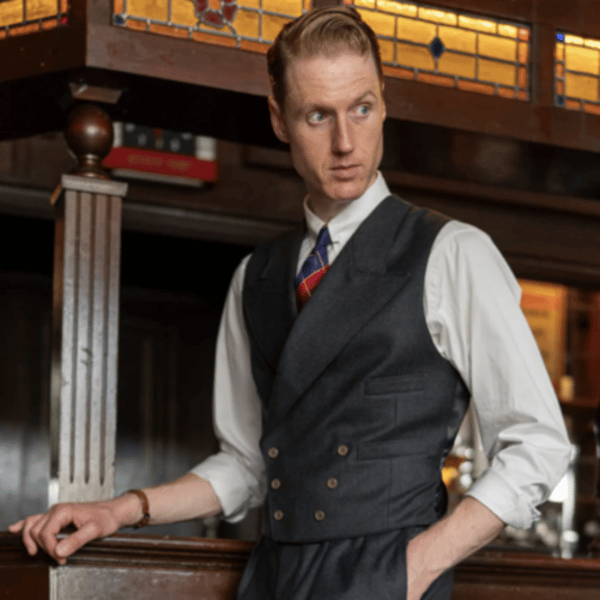
Cathcart London is set to bring British heritage menswear to the world stage next month, making its Pitti Uomo debut in Florence.
Cathcart London
Its appearance will be a “significant step in international expansion” for the 11-year-old family business, as the brand unveils its AW26 collection to international press and buyers across 13-16 January.
Director James Cathcart said: “Exhibiting at Pitti Uomo for the first time is a pivotal step for the brand and the market equally. Our goal has always been to excite, offering rare designs with honesty and integrity. Pitti is the ideal stage to present our classic British style to a new global audience.”
The AW26 collection will showcase eight distinct styles of tailored suit jackets all crafted from pure wool including flannel, worsted multi-stripe, and herringbone, headlined by the popular King Cole Double Breasted Jacket.
These are complemented by six styles of matching pure wool trousers, arriving in wide, classic and narrow heritage cuts. The collection is completed by double breasted and single breasted waistcoats, offered in four versatile colourways.
It also features six distinct knitwear styles, including the return of Fair Isle Jumper, Jazz Jumper and other original vintage inspired knits hand produced in England.
The workwear collection sees the return of the Deck Jacket and Battle Trousers, both made from 100% cotton corduroy, “offering a balance of sophisticated tailoring and versatile daily utility for the modern man”.
The outerwear range completes the collection, featuring three classic British heritage coat styles. These include a new Herringbone Ulster Coat crafted from luxury herringbone wool woven in Yorkshire, alongside returning favourites, the Polo Coat and the Mackinaw.
For several years now, Milan’s fashion trade fairs have been joining forces, fostering synergies to counter the challenges the sector has faced since Covid. But for the February 2026 edition, two shows will go even further, thanks to the strategic project ‘Reinventing Mipel & Micam,’ developed in collaboration with Lombardini22, a leading name in architecture and engineering.
The press conference presenting the “Reinventing Mipel & Micam” project. – Ph: FNW/EP
“We like to describe Lombardini22 as a ‘collective-thinking company’ that brings together around 500 professionals and develops projects collaboratively, often starting by listening,” explained Cristian Catania, Reinventing Fairs project director at Lombardini22, during the press conference presenting the project. “We did the same for Micam and Mipel, analysing the status quo of previous editions and holding consultations with major exhibitors. What we realised is that the paradigm shift lies in continuing to give exhibitors the visibility they deserve while, at the same time, putting the visitor and their needs at the centre, so that their time at the fair can be more productive, less tiring and more seamless. The guidance we received was to build on the heritage and longevity of the events, expand the services on offer, and think not only about product but also about the sector’s cultural growth, through social connections, networking, new opportunities and new stimuli. We need to move beyond the concept of mere exhibition and create an experience for visitors.”
As part of the project, for the February edition (February 22–24, 2026), which will coincide with the Milan–Cortina Winter Olympic Games, the Mipel experience will be completely reimagined: the event will move to the front section of Hall 5 at Fiera Milano Rho, gaining greater visibility and a more central position within the exhibition centre. The layout will be redesigned by Lombardini22 to make visits clearer, more immersive and instantly legible, with optimised routes and new areas dedicated to product, innovation, and creativity, while the pre-built exhibition stands will also be reinterpreted in a contemporary, functional way to meet the needs of exhibiting companies.
The floor plan of the halls
Above all, at the centre of Hall 5, ‘M&M- The Hub’ will take shape: a new space conceived to host initiatives and projects developed in full synergy between Mipel and Micam, with the aim of offering visitors to both fairs an integrated experience. The Hub will be home to Micam Academy and Mipel Factory, in an environment designed to foster a continuous journey of learning and relationship-building, bringing together education, research, technical experimentation, and professional development. The Italian Startup project, created in collaboration with ICE-Agenzia and the Ministry of Foreign Affairs and International Cooperation (MAECI), has also been confirmed; it will shine a spotlight on a selection of emerging Italian companies that are highly innovative and technology-driven. There will also be a dedicated product area, offering a concise, curated overview of the key trends for the Autumn/Winter 2026–2027 season.
“The partnership with Lombardini22 is strategic because it can help us better communicate our fairs. Our goal is to support companies on their path to growth and greater international exposure, because trade fairs are a key driver of internationalisation. The events must enrich our companies, promote Made in Italy and help strengthen the recognition that Italian leather goods companies enjoy worldwide in terms of innovation, creativity, expertise, and excellence,” added Claudia Sequi, president of Mipel and Assopellettieri. “Moving Mipel to Hall 5 is not just a relocation, but the desire to rethink our fair in a strategic, contemporary way, with a layout designed to create usable, useful spaces for exhibitors and visitors- an immediate, intuitive, and engaging experience for buyers.”
From left: Giorgio Passagno (CEO Micam), Claudia Sequi (President Mipel), Giovanna Ceolini (President Micam), Federica Bevilaqua (Mipel Director) and Cristian Catania (Lombardini22)
“We are convinced that joining forces is essential for those who come to our fairs, who enter an ecosystem where products are certainly important, but where different visions are even more so,” stressed Giovanna Ceolini, president of Micam and Assocalzaturifici. “Let us remember that, in addition to Micam and Mipel, the February edition will also bring together Sì Sposa Italia Collezioni, Milano Fashion&Jewels, and The One Milano, providing buyers with a comprehensive overview of the different segments of Made in Italy fashion; Lineapelle and Simac will not be present because of the Olympics, but will return in September. This synergy between fairs works to everyone’s advantage; at the last edition we welcomed around 40,000 visitors from 38 countries- an incredible figure. With the ‘Reinventing Mipel & Micam’ project, we hope to strengthen further; we know that together we are stronger and can represent Made in Italy at its best.”
For the February edition, Micam will also introduce a new configuration for Halls 1 and 3 which, together with Halls 2 and 4, will make the visitor journey more coherent, intuitive, and functional.
This article is an automatic translation. Click here to read the original article.
On the occasion of the Contrastes programme, presented from December 1 to 31, 2025 at the Opéra national de Paris, Alainpaul unveils its first collaboration with choreographers Imre and Marne van Opstal. Their new piece, Drift Wood, offers an ideal canvas for exploring the relationship between body, material, and narrative, a space where costumes become integral to movement.
Alain Paul collaborates with Imre and Marne van Opstal – Benoîte Fanton
Inspired by the image of driftwood, shaped by time and carried by the currents, Alainpaul’s costumes give physical form to the tension at the heart of the piece: that which both opposes and binds conscious humanity to instinctive nature. Poised between fragility and resistance, the silhouettes move like a second skin, moulding to the dancers’ movements. This focus on texture and construction renders, in visual terms, the contradictions that course through Drift Wood, where bodies oscillate between self-control and impulse.
“A moment of fulfilment”
Conceived as a poetic diorama, the piece unfolds within a landscape shaped by the elements: sound, image, and movement interweave to explore vulnerability, connection, and ambiguity. In this floating world, the costumes play a central role. Rooted in Alainpaul’s signature sculptural clarity and fluidity, they amplify the emotional language imagined by the Van Opstal duo. For the house, this collaboration marks a powerful return to the stage, where clothing reconnects with its primary origin: gesture.
Drift Wood will be performed at the Paris Opera in December as part of the Contrastes programme. – Benoîte Fanton
“Collaborating with Imre and Marne, as well as with the Opéra national de Paris’s exceptional atelier, was an immense honour,” said Alain Paul, the house’s founder. “These are the first Alainpaul costumes created for a contemporary ballet, and we are deeply grateful for the trust placed in us for Drift Wood. We have forged a genuine dialogue between movement and the construction of the costumes. Having grown up in the world of dance, this project represents a moment of fulfilment and a profound way of uniting my two worlds.”
Alainpaul, a brand inspired by choreography
This creation forms part of Contrastes, a programme that brings together three choreographic worlds: two major works by Trisha Brown, the entry into the repertoire of David Dawson’s Anima Animus, and Drift Wood, the Van Opstals’ first piece for the Paris Opera. Together, these works explore the tensions and oppositions running through dance today, from minimalist radicalism to sculptural power.
Alain Paul’s work has always been influenced by choreography. – Benoîte Fanton
Founded on a choreographic approach to clothing, the house Alainpaul has, from the outset, drawn on the vocabulary of choreographers such as Pina Bausch and Merce Cunningham. Its pieces, with their experimental lines and sculptural silhouettes, reinterpret the dancer’s wardrobe within a timeless, urban aesthetic. With Drift Wood, this ambition takes on a new dimension: that of a garment fully animated by movement.
This article is an automatic translation. Click here to read the original article.
Omnichannel rules! Expect hybrid shopping “to define Christmas spending this year” as 87% of UK consumers plan to shop both online and in-store for gifts this year.
Image: CACI
That’s according to data specialists CACI, who flip the data to show that just 7% intend to shop exclusively in-store, and only 6% plan to do all their shopping online.
Generational and gender differences, of course, come into play, revealing further nuances with 19% of male Gen Zers saying they intend to shop entirely online, compared with just 1% of females in the same age group.
At the other end of the spectrum, 13% of male and 7% of female Baby Boomers expect to purchase all their gifts in-store, “showing that physical retail remains more prominent among older shoppers”, although not in the numbers we might expect.
The report highlights that last year’s retail performance “further supports the advantage of having a strong multichannel presence” as brands that enabled both physical and digital buying behaviour, with seamless integration, personalisation, and strong app and online experiences, “had some of the biggest gains”.
CACI took Korean beauty retailer PureSeoul as an example: “Known for combining digital reach with selective in-person experiences, the… brand more than doubled its sales in December 2024 compared with the same month the year before (up 118%)”.
Meanwhile clothing/lifestyle giant Uniqlo reported a 22% year-on-year omnichannel increase in December 2024 sales.
Alex McCulloch, Director at CACI, said: “If we look at the data from last Christmas, and what we’re hearing from consumers now, it’s clear that the brands set to win this season are the ones that recognise the need for a true multichannel approach.
“Not just because it’s practical, but because physical stores help build loyalty that carries over to online. That loyalty is being reinforced even earlier, as more retailers turn their stores into experiential spaces – some operating almost like ‘clubhouses’ that create connection and community long before a purchase is made.”