Castore is continuing a very busy year on the business development front with another big announcement — it has just inked a five-year partnership with Apparel Brands Ltd to develop, manufacture and distribute Castore-branded socks and underwear across the UK and Europe.
Castore
Socks and underwear are major categories for any sports brand and there’s clearly a lot of potential in this area with those who’ve enthusiastically bought into its other training or athleisure clothing likely to be keen to tap into any category expansion it offers up.
The range will be developed for men, women, and youth, and will be rolled out with key retail partners. Design and collaboration between Castore and Apparel Brands is already under way.
The company said the deal “represents a natural evolution for Castore as it continues to expand its product offering across high-performance and lifestyle apparel categories”.
Apparel Brands will leverage its full-service brand platform, encompassing design innovation, product development, and international distribution to bring the new socks and underwear range to market.
Castore’s commercial chief Danny Downs said: “Our partnership is a significant milestone as we continue to evolve our premium apparel offering for customers. Socks and underwear are fundamental layers for athletes and everyday consumers alike, and we’re confident that Apparel Brands’ expertise will help us deliver excellence in both innovation and distribution.”
The company has had something of a meteoric rise in recent years and as well as opening stores and winning a raft of sports club licenses, it recently became the new owner of high-end brand Belstaff.
River Island has had a newsworthy year with the company having reportedly been on the brink of collapse if its restructuring plan hadn’t been approved. And having just filed its accounts for 2024, we can see what was going on in the period that led up to the need for the comprehensive restructuring, including store closures.
River Island
The company — River Island Holdings Limited — made a loss before tax of £124.3 million, much wider than the £32.2 million loss of the year before. That came as turnover fell to £690.1 million from £701.5 million and gross profit dropped to £37 million from £46.7 million. The operating loss also widened dramatically to £125.7 million from £34.1 million. And the net loss for the financial year was £138.4 million after a loss of £24.4 million in the previous year.
Recent years have been particularly tough for the business with it having swung to that £32.2 million pre-tax loss in 2023 after having made a profit of £7.5 million for 2022. Turnover during 2023 had fallen 15.1% although the previous year had been flattered by being a 53-week period rather than 52 weeks.
But at the time of releasing its 2023 figures in October 2024 it had said that 2023 was a year of “reset for the business” with product ranges refocused and a new leadership structure put in place, plus other key moves.
It had also said it was starting to see the benefits from its investment with customers “reacting positively” and “improved business performance”.
The lower sales and wider losses it has just released for 2024, followed by the 2025 restructuring, would suggest that the improved trading either ended or simply wasn’t enough to turn around the company’s performance. Yet there were undeniable signs of the company starting to get back on track even last year.
In 2024, the turnover drop was only 1.6% and like-for-like turnover that excluded closed stores was down only 0.3%.
Higher costs
So what caused the very much wider pre-tax loss? The firm was hit by a non-cash provision of £80.4 million on an inter-company loan balance, as well as an £11.2 million increase in its trading loss. And it was impacted by a significant inflationary increase in the cost of good sold, which contributed to a lower gross margin on a percentage basis. That caused a 20.8% fall in gross profit.
It also saw significant inflationary pressures in its operating costs with staff costs increasing by 7.6%. And while cost savings in multiple areas did help, it’s overall distribution and admin costs increased.
As we know, the company has put a major restructuring plan in place which was approved in August by the High Court. This enabled a step change in the size and profitability of the retail estate and secured long-term funding. It now has a new and secure financing facility until 2028 and has been putting its restructuring plan into action that it said should allow it to return to profitability.
Part of that plan is Ben Lewis having returned as group CEO, having managed the business for nearly a decade before he stepped down in 2019. The company also appointed a new CFO in late 2024.
Its transformation plan sees it now working on right-sizing its store estate, growing like-for-like sales at improved margins and investing in growth and productivity.
It said it’s already seeing significant returns on its strategy with the gross margin percentage greatly improved, costs significantly reduced and underlying sales in its retail estate returning to growth. It’s expecting “a significant improvement in profitability” for the current year, although we probably won’t find out the details of this for some time, unless the company chooses to share the good news in advance of its next Companies House filing.
French cosmetics group L’Oreal is to increase its stake in Swiss dermatology firm Galderma to 20% from about 10%, the Swiss firm said in a statement on Monday.
Galderma is a dermatology specialist – Reuters
L’Oreal is buying the stake for an undisclosed sum from a consortium led by Swedish private equity firm EQT, which includes Abu Dhabi Investment Authority and Auba Investment Pte. Ltd. The deal is due to close in the first quarter of 2026. As a result, Galderma is looking into replacing board members representing the consortium by two non-independent board candidates from L’Oreal at the company’s next annual general meeting in 2026, it said.
“Galderma continues to deliver impressive growth, strong innovation, and category leadership across its broad, science-based dermatology portfolio,” said Galderma’s CEO Flemming Ørnskov in a press release. “With strengthened commercial execution, continued platform and portfolio expansion, and an increasingly consumer-focused approach to innovation, we are rapidly scaling into a dermatology powerhouse. We are pleased with L’Oréal’s increased investment, which affirms our direction and the meaningful value creation we expect in the years ahead. As we move into 2026, we remain fully focused on our Integrated Dermatology Strategy and on serving our customers, consumers, and patients.”
The businesses also plan to explore additional scientific research projects of mutual interest with a shared focus on skincare and skin health, innovation, and long-term growth. Galderma, originally set up as a joint venture between Nestle and L’Oreal before the latter sold its 50% stake in 2014, listed an initial tranche of its stock in March 2024.
Under fire since his alliance with Shein, Frédéric Merlin, the young head of BHV whose rise has been meteoric, admits he “underestimated” the challenge posed by the Paris department store, but stands by his strategy, intended to “keep retail alive.”
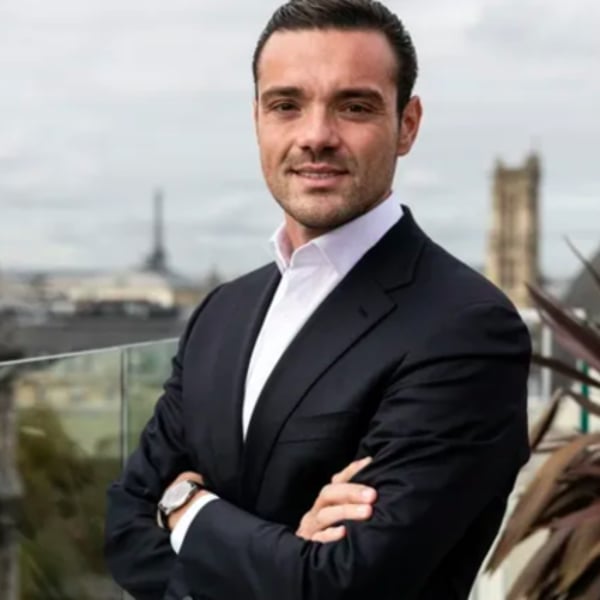
Frédéric Merlin, president of Société des Grands Magasins (SGM) and owner of BHV, during a photo shoot in Paris, 22 October 2025. – (AFP – Thibaud MORITZ)
“I always try to be humble, because at 34, you don’t know everything,” the executive recently told AFP during an interview on the sixth floor of the Bazar de l’Hôtel de Ville.
It is here that Shein, the Asian e-commerce giant accused of unfair competition and environmental pollution, is due to open its first permanent shop on Wednesday, under an agreement with Société des Grands Magasins (SGM), the commercial property company founded in 2021 by Frédéric Merlin and his sister, Maryline.
Originally from the Lyon region and raised by a father who ran a small industrial piping business and a stay-at-home mother, the siblings’ fortune is estimated at €600 million, ranking them 233rd in France, according to Challenges.
A “friend” of former president Nicolas Sarkozy, Merlin benefited from the financial backing of businessman Jean-Paul Dufour, a shareholder alongside SGM with “a 42.5% stake in the majority of the group’s subsidiaries,” according to its latest social report published in August 2024, as noted by L’Express.
“Ocean liner”
The owner of the BHV business since 2023, SGM also operates a dozen shopping centres, as well as seven Galeries Lafayette stores in the provinces, five of which are set to host Shein.
In protest, several brands have announced they are leaving the Paris department store, already shunned by suppliers unhappy about a build-up of unpaid invoices, which Merlin says are linked to “tools” issues that are being resolved, and not to cash-flow problems.
Dropped by Banque des Territoires (an entity of Caisse des Dépôts et Consignations) for the acquisition of the BHV building, SGM has also been excluded from the Union du grand commerce de centre-ville (UCV), while the Galeries Lafayette group refuses to allow Shein to set up in stores bearing its name.
“Who would want to work with a pathological liar?” said Yann Rivoallan, president of the Fédération Française du Prêt-à-Porter Féminin, on RMC.
Merlin “is not collaborative”, Nicolas Bonnet-Oulaldj, the deputy mayor of Paris in charge of commerce, told AFP.
“He told everyone that he had the support of Anne Hidalgo regarding Shein, which is totally false.” More generally, Merlin didn’t realise he was taking on “an ocean liner”, according to the department store’s inter-union body.
“What I underestimated was all the political and media attention that comes with taking on this Paris monument right opposite City Hall,” admits Merlin, denouncing the “surrounding hypocrisy” in the face of Shein and its many consumers.
“Head of the family”
“We could have done better,” admits the man who says he has made BHV “profitable” and works “14 hours a day.”
Born in the Lyon suburb of Vénissieux, Merlin grew up in a family that gave him “self-confidence” and “entrepreneurial drive.” After a spell at law school, the young man obtained a BTS in property, having been drawn to the profession during a placement.
Armed with a “€15,000 student loan,” he and his sister founded, at the age of 20, a commercial property consultancy (IMEA) before launching another (ADI) in 2014, specialising in the redevelopment of commercial buildings.
The Merlins hired their father, who brought his “industrial rigour,” until his death in 2018, the year SGM was launched, turning around shopping centres that nobody wanted any more in towns such as Roubaix or Mulhouse.
“You had to have a lot of nerve,” recalls Fabrice Fubert, co-director of a commercial property consultancy, who notably suggested in 2021 that Merlin acquire seven Galeries Lafayette stores.
Not “from the establishment,” Merlin is “an audacious man who takes risks and shakes things up,” as when he brought in Pokémon or YouTuber Squeezie for pop-up shops at BHV, says Fabrice Fubert.
The father of a young boy, Merlin asserts his role as “head of the family,” putting himself on the front line to “protect” his sister and his mother, Dominique, SGM’s deputy managing director.
This article is an automatic translation. Click here to read the original article.






 Politics8 years ago