Connect with us

Business

Canada joins Britain and Australia in recognizing a Palestinian state despite opposition from U.S.

Published

on


Canada recognized a Palestinian state on Sunday despite opposition from the U.S, with the hope it paves the way for peace based on two states living side by side.

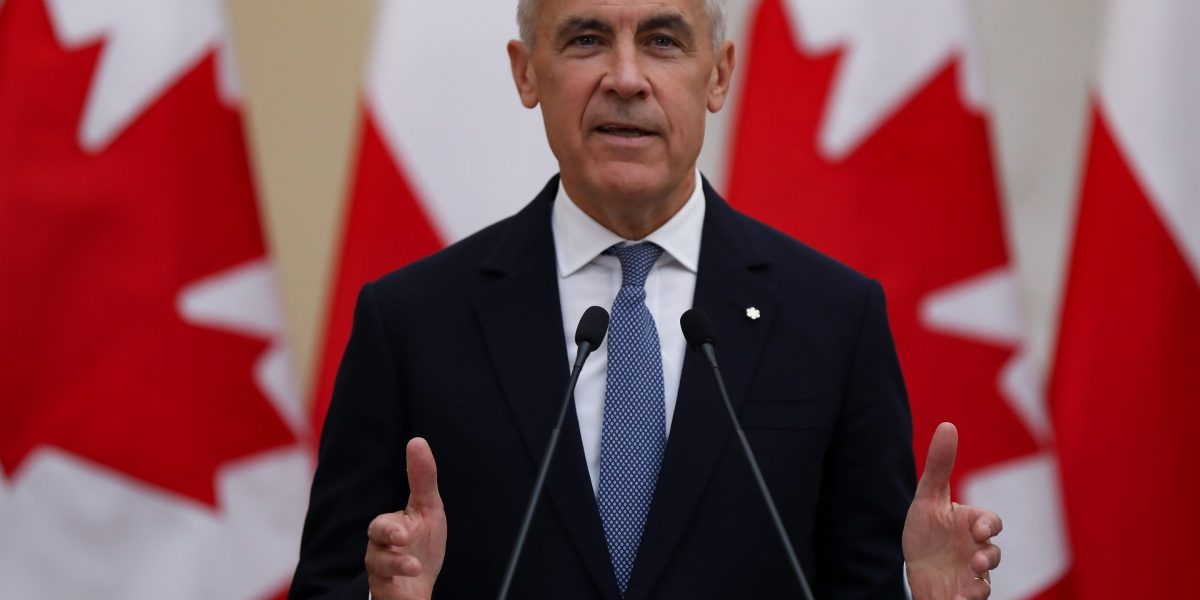
Prime Minister Mark Carney announced on the social platform X that Canada had recognized a Palestinian state. Britain and Australia also announced that they were doing the same on Sunday.

Carney had already said in late July he would do so as many Western countries are increasingly dismayed by the intensifying war in Gaza.

The moves comes ahead of the U.N. General Assembly this week, where other nations, including Australia and France, are also expected to recognize a Palestinian state.

The formal recognition of Palestinian statehood by Western countries has angered Israel and the United States, which say recognition emboldens extremists and rewards Hamas, the group that led the Oct. 7, 2023, attacks into southern Israel that triggered the war.

U.S. President Donald Trump had previously threatened Canada, saying Canada’s announcement “will make it very hard” for the United States to reach a trade agreement with its northern neighbor.

Pressure to formally recognize Palestinian statehood has increased since French President Emmanuel Macron announced this summer that his country will become the first major Western power to do so in September.

Macron is to formally declare France’s recognition of a Palestinian state on Monday at a United Nations conference in New York co-chaired with Saudi Arabia, at the start of the U.N. General Assembly.

More than 145 countries already recognize a Palestinian state, including more than a dozen in Europe.

Carney has previously said Canada is working with other states “to preserve the possibility of a two-state solution, to not allow the facts on the ground, deaths on the ground, the settlements on the ground, the expropriations on the ground, to get to such an extent that this is not possible.”

Israeli Prime Minister Benjamin Netanyahu’s government rejects a two-state solution.

Canada has long supported the idea of an independent Palestinian state existing alongside Israel, but has said recognition should come as part of a negotiated two-state solution to the conflict.

Israeli bombardment over the past 23 months has killed more than 65,100 people in Gaza, according to the territory’s Health Ministry, destroyed vast areas of the strip, displaced around 90% of the population and caused a catastrophic humanitarian crisis, with experts saying Gaza City is experiencing famine.

Forty-eight hostages remain in Gaza, with fewer than half believed to still be alive. Hamas-led militants stormed into southern Israel on Oct. 7, 2023, killing around 1,200 people, mostly civilians, and abducting 251 others.

Fortune Global Forum returns Oct. 26–27, 2025 in Riyadh. CEOs and global leaders will gather for a dynamic, invitation-only event shaping the future of business. Apply for an invitation.


Source link

Continue Reading

Business

A San Francisco woman just gave birth in a Waymo robotaxi — and Waymo says it’s not the first time

Published

on


 Self-driving Waymo taxis have gone viral for negative reasons involving the death of a beloved San Francisco bodega cat and pulling an illegal U-turn in front of police who were unable to issue a ticket to a nonexistent driver.

But this week, the self-driving taxis are the bearer of happier news after a San Francisco woman gave birth in a Waymo.

The mother was on her way to the University of California, San Francisco medical center Monday when she delivered inside the robotaxi, said a Waymo spokesperson in a statement Wednesday. The company said its rider support team detected “unusual activity” inside the vehicle and called to check on the rider as well as alert 911.

Waymo, which is owned by Google’s parent company, Alphabet, declined to elaborate on how the vehicle knew something was amiss.

The company has said it has cameras and microphones inside as well as outside the cars.

The taxi and its passengers arrived safely at the hospital ahead of emergency services. Jess Berthold, a UCSF spokesperson, confirmed the mother and child were brought to the hospital. She said the mother was not available for interviews.

Waymo said the vehicle was taken out of service for cleaning after the ride. While still rare, this was not the first baby delivered in one of its taxis, the company said.

“We’re proud to be a trusted ride for moments big and small, serving riders from just seconds old to many years young,” the company said.

The driverless taxis have surged in popularity even as they court higher scrutiny. Riders can take them on freeways and interstates around San Francisco, Silicon Valley, Los Angeles and Phoenix.

In September, a Waymo pulled a U-turn in front of a sign telling drivers not to do that, and social media users dumped on the San Bruno Police because state law prohibited officers from ticketing the car. In October, a popular tabby cat named Kit Kat known to pad around its Mission District neighborhood was crushed to death by a Waymo.


Source link

Continue Reading

Business

What it takes to be wealthy in America: $2.3 million, Charles Schwab says

Published

on


“If I had a million dollars… I’d be rich,” the Barenaked Ladies sang in their hit 1988 song.

At the time, a million dollars felt like a lot. But as inflation and tariffs have made essentially everything more expensive, that amount of money doesn’t feel like all that much at all. In fact, Americans now think it takes an average of $2.3 million to be considered wealthy, according to a Charles Schwabreport.

The financial services firm surveyed 2,200 adults between the ages of 21 to 75 from April 24 to May 23, so a variety of generations offered their input. The average response for what it takes to be considered “financially comfortable” was $839,000. 

While the reported $2.3 million was a slight drop from last year’s Modern Wealth Survey at $2.5 million, it’s still 21% higher than the 2021 figure of $1.9 million.

Respondents also reported the bar to achieve monetary wealth feels as if it’s increasing, and 63% said it feels like it takes more money to be wealthy today compared to last year, citing the impacts of inflation, a worsening economy, and higher taxes.

Brad Clark, founder and CEO of financial advisory firm Solomon Financial, said these sentiments are relatively reflective of what he hears from his clients. There are a large number of millionaires in the U.S. when you factor in all assets, he told Fortune, but this typically includes their home, meaning their investable assets are typically less than $1 million.

“With so many middle-class Americans being considered millionaires, it stands to reason that the average individual would consider $2.3 million to be wealthy, as it may seem out of reach,” Clark said. 

But experts said being considered wealthy doesn’t necessarily equate being opulent in all life choices. 

The $2.3 million figure is “not luxury for everyone, but security. It’s wanting to have a house, retire well, have family, and have one’s time,” William “Bill” London, a lawyer and partner at Kimura London & White LLP who routinely handles high-net-worth families and individuals in divorces and estate cases, told Fortune. “Affluence is not about excess, but about reducing anxiety.”

What it means to be wealthy for different generations

The Charles Schwab survey showed when compared with other generations, Gen Z tends to set lower thresholds for what it takes to be wealthy and financially comfortable—$1.7 million and $329,000, respectively. Meanwhile, millennials and Gen Xers say it takes $2.1 million to be wealthy, and $2.8 million for baby boomers. 

That may have to do with how exactly different generations define wealth. Earlier generations like baby boomers more frequently frame wealth in terms of security, London said, with a focus on property, pension, and assets that get passed down. Younger generations, on the other hand, more frequently consider experiences, freedom from debt, and lifestyle decisions, he added.

“More of my younger clients are more concerned about breathing space and time than they are about a big house or pricey assets,” London said. “Their definition of wealth is more about lifestyle than about acquisition.”

But it could also be the fact younger generations have a harder time acquiring large assets like a home due to comparatively high mortgage rates and home prices. 

“Millennials and Gen Z are justifiably pessimistic about the prospects of home ownership, which historically was the most common way for Americans to build wealth,” Markus Schneider, associate professor and chair of the economics department at University of Denver, told Fortune. “There are lots of reasons why millennials and Gen Z may feel less secure about the world than the boomers did when they were the same age, and that may also impact how they feel about their wealth.”

Despite the differences among generations, experts agree it takes more than money to feel wealthy—and it shows in the Charles Schwab report. Some of the most popular personal definitions of wealth include happiness, physical health, mental health, quality of relationships, accomplishments, amount of free time, and material possessions.

“You don’t have to look too far to find a study that shows how depressed ultra-wealthy people often are. If you are defining wealth solely based on dollars, you likely will be disappointed when you achieve the number,” Clark said. “True wealth is being able to use your assets to free up your time to benefit those around you. The happiest people tend to be those with a greater purpose in life.”

A version of this story was published on Fortune.com on July 10, 2025.


Source link

Continue Reading

Business

Netflix’s takeover of Warner Brothers is a nightmare for consumers

Published

on


If the government approves Netflix’s megadeal to buy Warner Brothers Discovery—the parent company of HBO Max and the mammoth library of Warner Bros. content—it would be a disaster for consumers and a deathblow for Hollywood. Giving the world’s largest streaming platform even more control over what Americans watch and what content gets produced will mean fewer options for consumers and, inevitably, higher prices.

There is another path forward. Paramount Skydance has submitted its own hostile bid to compete with Netflix’s. Combining Paramount Skydance with Warner Bros. Discovery would create a new competitor with the scale and resources necessary to challenge Netflix’s dominant grasp on the streaming and entertainment landscape. That deal would maintain – and arguably enhance – competition in the space, bolstering cost discipline and choices for consumers. Importantly, Paramount has also said it remains committed to theatrical releases, a stark contrast to Netflix, whose leadership has written off theaters as outdated and anti-consumer.

Instead, the Netflix acquisition of Warner Brothers will create an entity that would dominate the media industry. This year, Netflix announced its largest-ever subscriber increase to over 300 million users, making it the largest Subscription Video on Demand (SVOD) service in the U.S. and the world.

On the same day it released its subscriber increase it also announced a price hike. If this is any indication of what Netflix does when it has increased market power, consumers can expect higher subscription prices in a less competitive market.

Netflix promotes itself as an innovator: as recently as October, CEO Ted Sarandos told investors that the company is “more builders than buyers.” But its skyhigh bid for Warner Brothers suggests that its trendsetter days have peaked and it’s now pivoting toward acquisition for subscriber growth rather than spending money to create new content.

The streaming giant’s recent dispute with Hollywood writers, which ended with a $42 million settlement, seems to confirm Netflix’s pivot away from investing in new content. One industry analyst opined that “a Netflix purchase of Warner would be a death knell for some of the movie business’s most important aspects, properties, and long-held traditions.”

The merger between Warner Brothers and Netflix threatens to push the industry past a dangerous tipping point: The combined company would command about 30 to 40 percent of the market, giving it enough power to dictate the terms of engagement to consumers, content creators, and distributors alike.

The effect on the market could be significant, with some market analysts fearing that it would put an end to the so-called streaming wars. That’s hardly positive news for consumers, who reap the benefits of more content, greater innovation, and lower prices when companies have to compete for viewers.

The downstream impacts of the merger are also problematic for the market: A Warner Brothers acquisition would allow Netflix to exert its newfound power over theaters (it has a notorious reputation for refusing wide-release feature films), writers and creative directors, and the entire entertainment industry ecosystem that relies on the entertainment industry. Director James Cameron, a major player in the market, warned that a merger with Netflix would be a “disaster.”

The increased power the acquisition of Warner would give Netflix is not lost on federal trust busters: Senior White House officials raised concerns last month that a merger with the streaming giant could stifle competition and suggested that the FTC would be compelled to initiate an in-depth investigation of the transaction.

Open markets and robust competition drive innovation, which helps keep prices low, but when a handful of firms dominate an industry, competition disappears. Big Tech’s power has already shown us what happens when companies become “too big to challenge,” and Big Media seems to be intent on replicating that playbook.

The purpose of antitrust law should not be to regulate innovation out of existence, but to ensure that markets remain open, competitive, and aligned with the interests of consumers and the broader economy.

Warner Brothers’ leadership may believe that it is getting the best deal from Netflix. But the merger will surely face intense regulatory scrutiny, and for good reason—it would do a disservice to American consumers.

The opinions expressed in Fortune.com commentary pieces are solely the views of their authors and do not necessarily reflect the opinions and beliefs of Fortune.


Source link

Continue Reading

Trending

Copyright © Miami Select.