Connect with us

Business

‘Californians deserve a life they can afford’: Billionaire Tom Steyer is running for governor in crowded race to succeed Gavin Newsom

Published

on


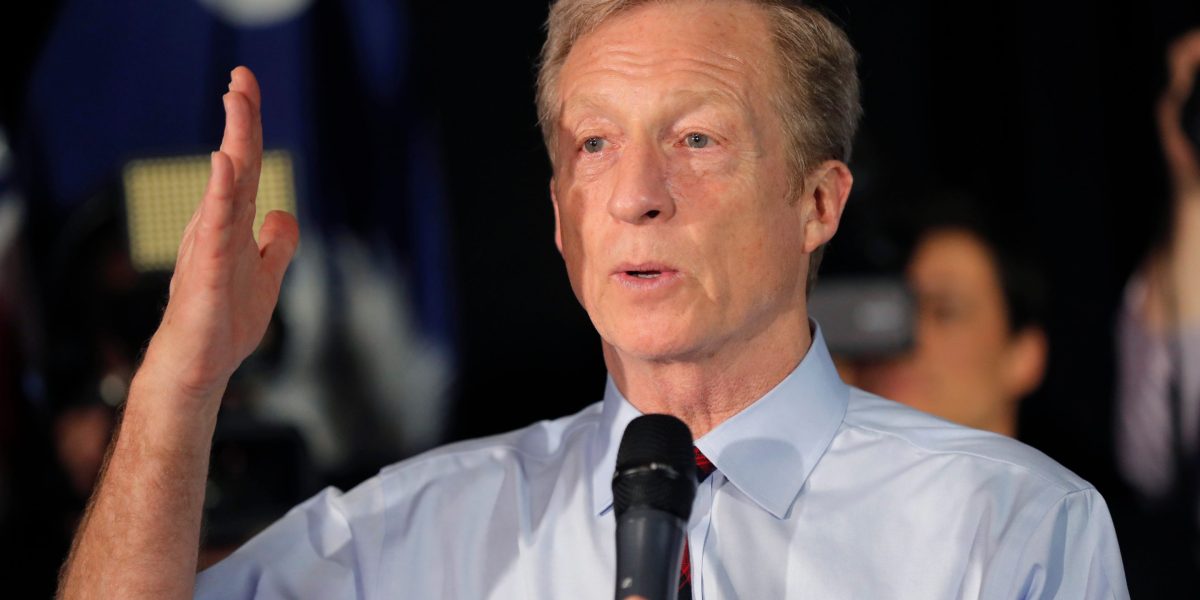
Billionaire businessman and activist Tom Steyer, who once self-financed an unsuccessful White House campaign and spent his own money advocating for President Donald Trump’s impeachment, has launched his bid for California governor as a Democrat.

The 68-year-old’s tremendous wealth immediately makes him a notable contender in a free-for-all that includes more than a half-dozen Democrats and two Republicans competing in an all-party June primary, with the top two vote-getters advancing to a November general election to succeed term-limited Gov. Gavin Newsom.

Steyer announced his candidacy with a pledge to improve economic conditions and by framing his political record as friendly to consumers, working-class voters and the environment.

“Californians deserve a life they can afford,” he said in a video released Wednesday morning. “But the Californians who make this state run are being run over by the cost of living.”

The approach puts Steyer on a collision course with other candidates like progressive Congresswoman Katie Porter, former Los Angeles Mayor Antonio Villaraigosa and former U.S. Health and Human Services Secretary Xavier Becerra.

At one time, Porter was viewed as a top contender but the contest is now seen as wide open. Steyer’s personal fortune could give him an advantage in reaching voters through television and digital advertising in an expansive state with nearly 40 million people and multiple media markets. Still, tremendous wealth has not necessarily translated to statewide electoral success in California: Carly Fiorina, a former Hewlett-Packard CEO, could not unseat Democratic U.S. Sen. Barbara Boxer in their 2010 matchup. Meg Whitman, a onetime CEO of eBay, spent more than $100 million of her own money in a losing governor’s campaign that same year.

Steyer’s money quickly became a target for rivals in the race.

“Tom Steyer tried to buy the presidency — and he failed. The California governorship is not going to be his consolation prize,” said Democrat Betty Yee, a former state controller.

Steyer nodded to his wealth Wednesday, noting his business enterprises made “billions of dollars.” But he also sounded populist tones.

“The richest people in America think that they earned everything themselves,” he said, before dismissing that notion with an expletive for bovine excrement. “That’s so ridiculous.”

Steyer said he would “make corporations pay their fair share again,” and his campaign cited his previous work on ballot initiatives with similar aims. Steyer was a leading advocate for a 2012 ballot initiative that made it harder for corporations to avoid certain taxes. The new revenue was steered to energy improvements in the state’s public schools.

In other referendum work, Steyer helped lead the 2016 campaign that yielded a $2 per-pack tax hike on tobacco products. The money was steered to state health care programs, including tobacco-prevention efforts. And Steyer was a top opponent of a 2010 ballot initiative that would have rolled back California’s clean air and climate law, which has been viewed as a national standard on climate policy.

In another development Wednesday, Villaraigosa launched a digital ad spotlighting Becerra’s connection to an unfolding Sacramento scandal as the two skirmish over votes, including those of Latinos. Prosecutors allege longtime Becerra aide Sean McCluskie was at the center of a plan that siphoned money from one of Becerra’s dormant state campaign accounts to pad his salary after he accepted a job as Becerra’s chief of staff in Washington. Becerra is not implicated in the indictment but the ad attempts to raise doubts about his judgment and features clips from a TV interview in which Becerra said he knew payments were being made from his account but didn’t know they were being improperly used.

Steyer spent millions of his own money touring the country and pushing for Trump’s impeachment during the Republican president’s first term. He then ran for the 2020 Democratic presidential nomination, spending more than $200 million of his fortune and receiving no pledged delegates. After distant finishes in the Iowa caucuses and New Hampshire primary, Steyer doubled-down with an expensive push in South Carolina, only to finish a distant third behind eventual nominee and President Joe Biden and Vermont Sen. Bernie Sanders. Steyer then ended his presidential bid, and he financially supported Biden’s reelection in 2024 before the Democrat bowed out in favor of then-Vice President Kamala Harris, another Californian.

Steyer’s latest campaign comes amid some Democrats questioning Porter’s candidacy after her combative exchanges with a TV journalist spread online in October. He has long been mentioned, along with Harris and U.S. Sen. Alex Padilla, as a potential heavyweight candidate who could join the field.

Harris, who is on a national tour promoting her 2024 campaign memoir, has said consistently that she has no plans to run — suggesting instead that any future campaign would be for the presidency.

“I will be voting,” she told The Associated Press on Oct. 17 when asked about entering the governor’s race. Asked whether she was satisfied with the field as Porter faced her most intense criticism, Harris said only that she wanted Democrats to have “the best and the brightest running and winning” and that she was “not actively involved.”

Padilla has said he will remain in the Senate.


Source link

Continue Reading

Business

Supreme Court to reconsider a 90-year-old unanimous ruling that limits presidential power

Published

on


The justices could take the next step in a case being argued Monday that calls for a unanimous 90-year-old decision limiting executive authority to be overturned.

The court’s conservatives, liberal Justice Elena Kagan noted in September, seem to be “raring to take that action.”

They already have allowed Trump, in the opening months of the Republican’s second term, to fire almost everyone he has wanted, despite the court’s 1935 decision in Humphrey’s Executor that prohibits the president from removing the heads of independent agencies without cause.

The officials include Rebecca Slaughter, whose firing from the Federal Trade Commission is at issue in the current case, as well as officials from the National Labor Relations Board, the Merit Systems Protection Board and the Consumer Product Safety Commission.

The only officials who have so far survived efforts to remove them are Lisa Cook, a Federal Reserve governor, and Shira Perlmutter, a copyright official with the Library of Congress. The court already has suggested that it will view the Fed differently from other independent agencies, and Trump has said he wants her out because of allegations of mortgage fraud. Cook says she did nothing wrong.

Humphrey’s Executor has long been a target of the conservative legal movement that has embraced an expansive view of presidential power known as the unitary executive.

The case before the high court involves the same agency, the FTC, that was at issue in 1935. The justices established that presidents — Democrat Franklin D. Roosevelt at the time — could not fire the appointed leaders of the alphabet soup of federal agencies without cause.

The decision ushered in an era of powerful independent federal agencies charged with regulating labor relations, employment discrimination, the air waves and much else.

Proponents of the unitary executive theory have said the modern administrative state gets the Constitution all wrong: Federal agencies that are part of the executive branch answer to the president, and that includes the ability to fire their leaders at will.

As Justice Antonin Scalia wrote in a 1988 dissent that has taken on mythical status among conservatives, “this does not mean some of the executive power, but all of the executive power.”

Since 2010 and under Roberts’ leadership, the Supreme Court has steadily whittled away at laws restricting the president’s ability to fire people.

In 2020, Roberts wrote for the court that “the President’s removal power is the rule, not the exception” in a decision upholding Trump’s firing of the head of the Consumer Financial Protection Bureau despite job protections similar to those upheld in Humphrey’s case.

In the 2024 immunity decision that spared Trump from being prosecuted for his efforts to overturn the 2020 election results, Roberts included the power to fire among the president’s “conclusive and preclusive” powers that Congress lacks the authority to restrict.

But according to legal historians and even a prominent proponent of the originalism approach to interpreting the Constitution that is favored by conservatives, Roberts may be wrong about the history underpinning the unitary executive.

“Both the text and the history of Article II are far more equivocal than the current Court has been suggesting,” wrote Caleb Nelson, a University of Virginia law professor who once served as a law clerk to Justice Clarence Thomas.

Jane Manners, a Fordham University law professor, said she and other historians filed briefs with the court to provide history and context about the removal power in the country’s early years that also could lead the court to revise its views. “I’m not holding my breath,” she said.

Slaughter’s lawyers embrace the historians’ arguments, telling the court that limits on Trump’s power are consistent with the Constitution and U.S. history.

The Justice Department argues Trump can fire board members for any reason as he works to carry out his agenda and that the precedent should be tossed aside.

“Humphrey’s Executor was always egregiously wrong,” Solicitor General D. John Sauer wrote.

A second question in the case could affect Cook, the Fed governor. Even if a firing turns out to be illegal, the court wants to decide whether judges have the power to reinstate someone.

Justice Neil Gorsuch wrote earlier this year that fired employees who win in court can likely get back pay, but not reinstatement.

That might affect Cook’s ability to remain in her job. The justices have seemed wary about the economic uncertainty that might result if Trump can fire the leaders of the central bank. The court will hear separate arguments in January about whether Cook can remain in her job as her court case challenging her firing proceeds.


Source link

Continue Reading

Business

Inside the Fortune 500 CEO pressure cooker: Surviving harder than ever and requires an ‘odd combination’

Published

on


Thompson, chairman of the Chief Executive Alliance and previously ranked as the world’s top CEO coach, and Loflin, Nasdaq’s Global Head of Board Advisory, joined forces to provide a 360-view of this loaded moment for leadership, from the C-suite and board perspectives, respectively. In a wide-ranging conversation with Fortune, they talked about the Shakespearean themes of leadership and turmoil and the feeling that “heavy is the head that wears the crown.”

For those aspiring to reach the top, Thompson shared the conventional wisdom he’d learned from his mentor, Marshall Goldsmith: “What got you here got you halfway there.” (Goldsmith had a New York Times bestseller in 2007 with What Got You Here Won’t Get You There.)

The transition from being a high-performing executive in a “swim lane” to having the “aperture of having a full enterprise” requires substantial new learning and skill development, Thompson argued, because no matter how great an executive you are or how prepared you think you might be, the stakes are existentially high. The risk that a CEO might “lose his or her head within the next year or so” is “easily like 20% or at the big brands It feels like it’s twice that,” said Thompson, who recently penned an essay on the subject of CEO “decapitation” for Fortune.

Adding to this pressure, Thompson and Loflin added, is the radical shift in board member expectations. Board members, who once might have been “golf buddies,” are now “really under the gun to perform.” They are “less patient” and expected to “actually deliver,” based on their subject matter expertise.

This environment demands nearly every candidate be ready to serve as a “peacetime in a wartime CEO,” Thompson said, capable of harvesting the best aspects of the company culture while also being “disrupting and breaking new ground.” An executive promoted from a functional role, such as a CFO, may possess the “gravitas of understanding the street and the shareholders,” but often lacks the breadth to “light hearts and minds” across the workforce, or do “ride-alongs with customers.”

The loneliness of the tower, and ‘relationology’

Fortune has been tracking this tenuous moment for leaders throughout 2025. Top recruitment firm Challenger, Gray & Christmas found 1,235 CEOs had left (or lost) their jobs through the first half of 2025, a stunning 12% increase from 2024 and the highest year-to-date total since Challenger began tracking CEO turnover in 2002.

Jim Rossman, Barclays’ global head of shareholder advisory, who’s been closely tracking shareholder activism for decades, similarly found record activist-linked turnover at the top for 2025. “It feels like what activists have done is basically [to hold] public companies to the standards of private equity,” Rossman told Fortune in a previous interview, as they have come to view the CEO “more as an operator, not somebody who’s risen through the ranks.” In other words: Results matter.

The intense environment contributes to feelings of isolation. As CEOs often note, being the boss is a lonely job where leaders are caught in the middle, with information they cannot share with reports but must share with the board, creating a huge information asymmetry, as Microsoft CEO Satya Nadella previously told McKinsey.

Carolyn Dewar, the co-leader and founder of McKinsey’s CEO Practice, previously told Fortune that “No one else in your organization or above you, like your board or your investors, see all the pieces you see.” She advocated for leaders to surround themselves with trusted advisors—“a kitchen cabinet” of sorts.

Similarly, Loflin told Fortune he’s fond of the concept of “relationology,” which he describes as “sort of a study of relationships.” He suggested leaders must develop a “portfolio of relationships of intimacy” that are “very context-relevant.” A leader’s effectiveness hinges on having fluency, for instance, when speaking to a CFO about analyst days, or working with a compliance team to keep the business safe or connecting authentically with union executives. Loflin said he’s often seen it being a “big surprise” to accomplished leaders that they have, say, seven different groups they need to engage and maybe as many as six new skills to really flesh out before they’re ready to take the enterprise to the next level.

This need for deep, context-aware connection also applies to personal life, Loflin added. The idea that a personal life and professional life can be entirely separate “undermines leadership and undermines the fabric of a company.” Critically, Loflin said, the chair must really know his CEO “at a deep level, like a Shakespearean level,” requiring a transparency that ensures appropriate accountability. After all, Loflin noted as one example, boards have to be mindful that a personal relationship that violates company policy can jeopardize corporate governance at the drop of a hat. The board really needs to know who their CEO is, maybe better than the CEO knows themselves.

The power and the privilege, the hubris and the humility

Loflin, who admitted to Fortune that he’s a bit of a Shakespeare nerd, noted the difference between a tragedy and a comedy is determined by “the vulnerability and the self-awareness of the protagonist,” and a tragic outcome results from a feeling he likened to “never recognizing whether I needed to grow or change.”

Thompson added that surviving as a CEO requires an “odd combination” of traits you might read in a Greek tragedy: hubris and humility.

The CEO must possess the hubris, or excessive pride, to believe they can be the best in their field, but also the profound humility that acknowledges they can’t do it alone.

The professional mandate is relentless, Thompson added, citing a key interview for the book from Qualcomm CEO Cristiano Amon: if you were the “same guy you were a year ago, you don’t deserve to be promoted.” Thompson said he thinks of hubris of being at “the edge of your competence, so rather than retreating, you actually should lean into that” to acquire the skills and help you need to keep growing as a professional.

For top leaders, Thompson said, the top job is not a prize to be won, but a “privilege to do this role.” Just as Olympic athletes must constantly improve, he added, leaders must recognize that breaking a record only attracts more competition.

Loflin urged boards and executives alike to move beyond a Wolf of Wall Street mindset and into “what it means to authentically care for and build the confidence and foster appropriate accountability.” He said that for many executives, admitting you have areas to improve on and get better at is a “special vulnerability.” He argued boards need more genuine, interpersonal affection—sometimes of the tough love variety—is needed to prevent a truly Shakespearean tragedy on their watch.

Loflin said he’d just had breakfast with a board director for a $30 billion company and the subject of love arose: “Do you love your management team?” The director said yes, definitely, almost like relatives. After all, they had been with the company over a decade and come to have deep relationships with other directors and their C-suite. Loflin argued that over decades of advising boards on corporate governance, he wishes more would adopt this sort of attitude.

“I don’t think it’s going to hurt anything in business because a good father has to talk to a troubled son, hopefully he’s mentoring when [the son is] getting himself in trouble.” After all, Loflin continued, “bad stuff happens, and I think some of these metaphors are important.” In other words, it shouldn’t be the Wolf of Wall Street, but the wolf—or the activist—is always at the door.



Source link

Continue Reading

Business

So much of crypto is not even real—but that’s starting to change

Published

on


We spend a lot of time on the road meeting with LPs, fellow investors, and founders. No matter where the conversation starts – whether it’s in Singapore, Abu Dhabi, London, or anywhere else – it often drifts to a simple, sometimes rhetorical question: Is any of this real?

It’s a fair question. Crypto has become a strange reflection of our economy and society more broadly: part financial spectacle, part social experiment, part collective delusion. For every breakthrough in cryptography or blockchain infrastructure, there are ten new ways to speculate. The mood across the ecosystem has shifted. It’s not outrage or denial anymore…it’s fatigue.

Over the past few years, crypto has rotated through one speculative narrative after another: Layer 1 blockchains that quickly traded to huge valuations; NFTs that promised culture and delivered cash grabs; Metaverse real estate in the clouds; “Play-to-earn” games that collapsed before they even shipped. The most recent cycle brought us a flood of memecoins, which grew the universe of tokens from 20,000 in 2022 to over 27 million today, and now represent as much as 60%+ of daily application revenue on Solana. Then there are perpetual futures platforms that offer 100X leverage to largely retail traders.

Each cycle creates a new form of entertainment and a new way for speculative capital to churn. To date, the current era’s three most successful crypto retail applications – Pump.fun, Hyperliquid and Polymarket – have all fed this speculative bubble. One reality has become perfectly clear. The casino always finds a new table.

And yet, buried under all the speculative noise, something real is taking shape.

The most obvious sign is stablecoins bursting into the mainstream with a host of real-world use cases. Already, stablecoin circulation has reached more than $280 billion, and led financial incumbents to scramble for a response. The stablecoin boom reflects how institutional investors and asset managers are becoming less focused on the speculative nature of crypto and toward what can actually be built now that the pipes actually work and the advantages of faster, cheaper, and more secure rails are becoming clear.

AI, meanwhile, is accelerating the cognitive part of the equation. Where blockchain builds verifiable systems of record, AI introduces adaptability, reasoning, and speed. These two technologies complement each other in powerful ways: verifiable and immutable data for intelligent models, intelligent models for decentralized networks. Together, they create the architecture for products that address real-world use cases that couldn’t exist before – autonomous systems that transact, coordinate, and learn in real time.

This convergence is where the next chapter begins. Founders with deep domain expertise are building in financial infrastructure, global payments, AI compute networks, media, telecom, and beyond – massive sectors where the combination of trustless systems and intelligent automation can unlock entirely new markets. These aren’t speculative casino plays; they are fundamental rewrites of how value and data move through the economy.

The question has never been about available capital or interest. It has been about why investors should feel enough conviction to allocate to an industry with a history of prioritizing the casino. The consensus has been that despite blockchain’s potential, too many projects are chasing the same users, while too many teams are designing for each other instead of the broader market. The result has been a landscape full of potential energy waiting for its moment of release – a release that institutional investors finally realize is coming soon.

So, is any of this real?

The truth is that most of it still isn’t, but it is becoming more real everyday. For the first time in our 10+ years in the digital asset space, institutional investors are now acknowledging that this technology has the potential to touch industries far beyond crypto in ways that can reshape finance, trade, media, data, and beyond. And much of this potential is not far off.

That’s why we believe 2026 will mark the most meaningful shift we’ve seen in this space. The casino might still churn, but the builders who survive it will drive lasting innovation.

We’re betting on them and we’re more bullish on the future of this technology than ever.

Pete Najarian is Managing Partner of Raptor Digital who operates in both the digital asset space and traditional finance. Joe Bruzzesi is a General Partner at Raptor Digital and serves on the boards of Titan Content and Nirvana Labs.Their views do not necessarily reflect those of Fortune.


Source link

Continue Reading

Trending

Copyright © Miami Select.