Connect with us

Politics

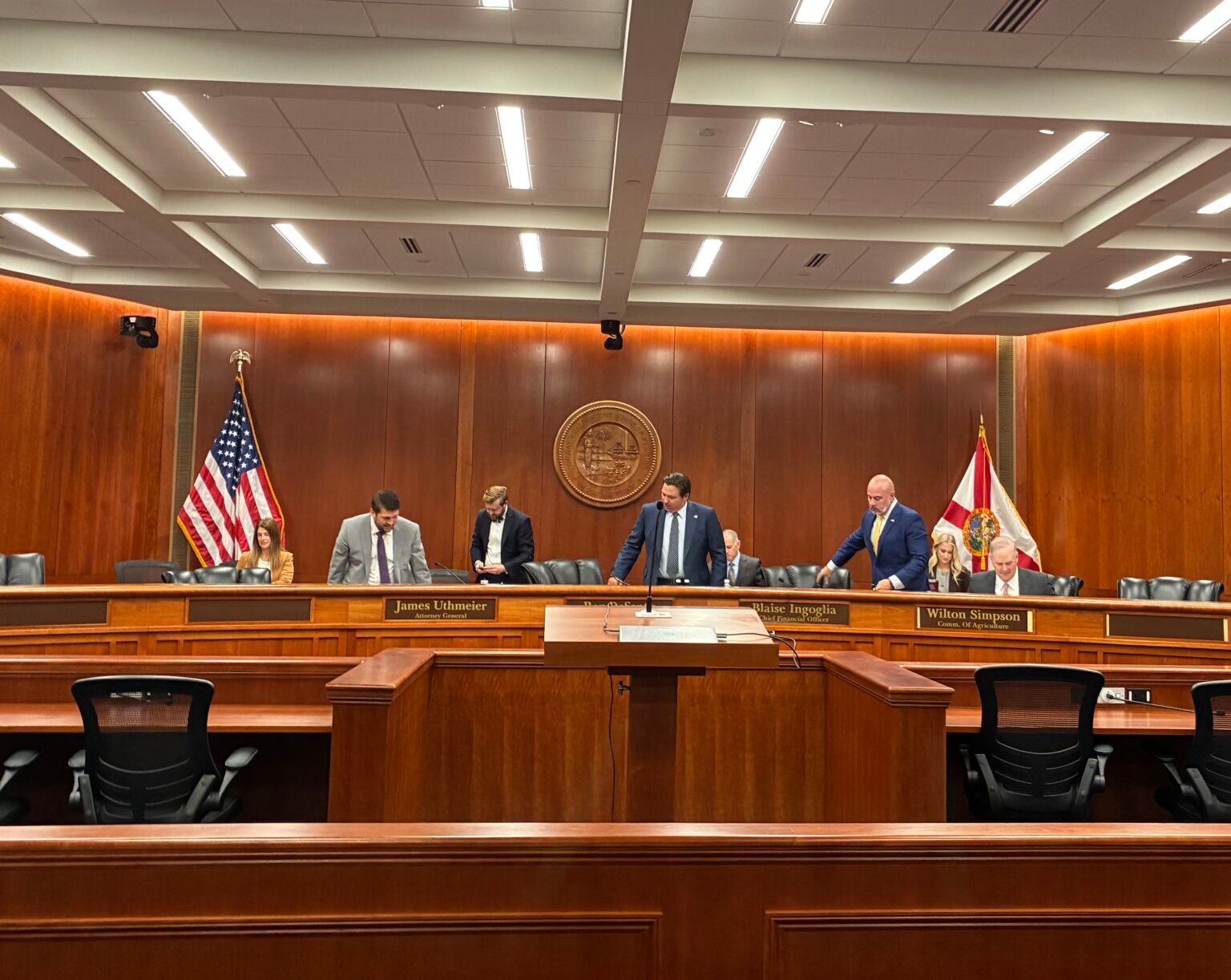
Cabinet approves cops’ immigration requests
Published

on


Gov. Ron DeSantis and the Florida Cabinet have approved more than $2 million in immigration enforcement money for local agencies seeking AI language translators, pepper spray, GPS trackers, handcuffs, bonuses, and more.

The $2.4 million greenlit to 10 law enforcement agencies means Florida has now approved roughly $21 million of the original $250 million diverted by the Legislature in February to support U.S. Immigration and Customs Enforcement (ICE).

DeSantis and the Cabinet members, who make up the newly created State Board of Immigration Enforcement, approved the money unanimously.

The Board is part of a broader Florida crackdown on undocumented immigration. In February, the GOP-dominated Legislature approved a sweeping measure demanding all counties partner with ICE, creating state-level penalties for entering Florida without proper documentation, and removing in-state tuition for undocumented college students.

The Florida law came right as President Donald Trump took office, ordering mass deportations and setting aside mass sums of money for states to set up migrant detention centers. Florida was the first state to do so with “Alligator Alcatraz,” a sprawling, controversial facility in the heart of the Everglades.

Where is the money going?

The largest lump of the $2.4 million will go to the Martin County Sheriff’s Office, which requested the most money ($738,451) for the widest-ranging variety of immigration-related activity.

After the Florida Highway Patrol, the South Florida county is responsible for the most encounters with suspected undocumented immigrants and the most noncitizens arrested on federal immigration charges, according to the Florida Department of Law Enforcement’s immigration dashboard.

Martin County’s breakdown includes $2,546 for 30 handcuffs and 30 leg irons; $13,153 for tactical goggles, ballistic helmets and bulletproof vests; $1,639 for 10 canisters of high-volume pepper spray; $271,103 for a rapid DNA testing machine; $136,736 for license plate readers; $185,029 for tasers; and $859 for Bluetooth rechargeable shooting ear protectors.

The next-highest grant is for Volusia County Corrections, totaling $505,789. The asks include $68,400 for detention beds, $22,400 to train 40 officers under the 287(g) program, $43,000 in bonuses for correctional officers, $183,760 for six detection screening systems to check migrants for “contraband,” $182,500 for a full-body security scanning system to check migrants for contraband, fevers and health problems, $1,400 for 72 uniforms, and $4,100 for 50 mattresses.

GPS trackers, AI translators, and biometric scans

The remaining requests came from the Hillsborough County Sheriff’s Office, the Madison Police Department, the Fruitland Park Police Department, the City of Port Richey Police Department, the town of Havana, the Putnam County Sheriff’s Office, the town of Welaka Police Department, and the Nassau County Sheriff’s Office.

The majority of the money is for license plate readers, overtime or bonuses for law enforcement or correctional officers. Fruitland Park received $22,300 for GPS trackers. According to the submitted request, the Department plans to deploy the trackers against “a suspect vehicle … allowing officers to safely monitor vehicles suspected of transporting unauthorized aliens.”

Havana received $93,687 for body-worn cameras, $90,088 for tasers, and $6,201 for nine universal AI language translators. These translators will “facilitate effective communication with non-English (speaking) individuals during stops and immigration focused activities.”

Putnam County received $17,378 for six laptops; $5,793 for handcuffs, leg cuffs, and chains; $69,384 for 21 Rapid ID devices, and $2,557 for one “Rapid ID two finger biometric device accompanied by a DNA barcode.”

These would be used to determine “accurate biometric identification of detainees.”

___

Reporting by Livia Caputo. Florida Phoenix is part of States Newsroom, a nonprofit news network supported by grants and a coalition of donors as a 501c(3) public charity. Florida Phoenix maintains editorial independence. Contact Editor Michael Moline for questions: [email protected].


Source link

Continue Reading

Politics

Frustrated Ron DeSantis waits for Donald Trump to address college sports NIL issues

Published

on


Gov. Ron DeSantis says college football is a “total mess” in light of athletes shopping around for better deals from programs, and that his efforts to reform it have been paused by Donald Trump’s White House.

Speaking in Sebring, DeSantis said he spoke to a bipartisan group of Governors “about a year ago” and said Governors on both sides of the aisle wanted to “come up with a framework.”

“Honestly, you really only need 10, 12 states, right? Because, you know, if you get Florida, Texas, Georgia, Alabama, Michigan, now you need Indiana, California,” DeSantis said, explaining that once states with “big-time programs” act, that would be enough to set up a workable framework.

But DeSantis said comments by Trump that the federal government planned to step in halted the state-led effort.

“So we’re like, all right, we’ll let the feds do it,” DeSantis added.

DeSantis said as early as last year that he wanted Governors to join him in some reform effort.

“I know they’re working on something, but I think it’s hit rock bottom just in terms of all the static that’s in the system,” DeSantis said.

He noted that “general managers” in college football make it “like a professional thing,” adding that many of the athletes recruited “haven’t even really produced that well.”

He also suggested that athletes are currently holding up programs for more money when they are performing.

“Now it’s like they have more rights than pro athletes,” he said.

“A quarterback will, you know, throw for four touchdowns. The third game of the season (he will) go, ‘Hey, coach, any more NIL money? Oh, I’m going to hit the transfer portal.’ And then you just go hop around schools. So you can play for four or five schools the way it goes now. And you can even play a few games, do very well, sit out and still get eligibility for the next year.”

Players’ mobility hurts programs, he argued.

“It’s hard to even know whether your teams are going to be good year after year because you don’t know who you’re going to lose. And then to do the transfer portal, right as we’re getting into the playoff, how does that make sense where these teams are going to have to make the decision?”

While the Governor stopped short of saying he regrets signing the name, image and likeness legislation that helped start the current cycle of professionalization of college sports, he does want a “happy medium” between athletes not being compensated and the current system.

But with time running out, reforms may not be realized before DeSantis leaves Tallahassee.


Source link

Continue Reading

Politics

Gov. DeSantis’ proposed budget changes how state funds cancer programs

Published

on


Gov. Ron DeSantis’ eighth and final proposed legislative budget makes another run at redirecting cancer funding in Florida, including jettisoning a requirement that funds be awarded only to peer-reviewed projects and empowering an eight-member “collaborative” to direct how the state spends hundreds of millions of dollars on cancer care and research.

The push by the Governor is likely to spark another largely behind-the-scenes battle among those who rely on the state money to help with their research programs.

Specifically, DeSantis’ proposed budget eliminates a decade-old law that spells out how $127 million should be distributed to four National Cancer Institute (NCI)-designated facilities: Moffitt Cancer Center; University of Florida Health Cancer Center; Sylvester Comprehensive Cancer Center at the University of Miami Miller School of Medicine; and Mayo Clinic Comprehensive Cancer Center.

Instead, the Governor’s budget would empower the Cancer Connect Collaborative to distribute the money to all cancer providers, with a requirement that at least 60% continues to be spent on the four NCI facilities. NCI is the federal government’s principal agency for cancer research and training. There are 72 NCI-designated facilities nationwide.

The collaborative, established in law in 2024, is a group of eight people — three appointed by the Governor, two by the Senate President, and two by the Speaker of the House.

Lobbyists representing the four NCI facilities did not immediately respond to Florida Phoenix’s request for comment on the proposal. But representatives of the four facilities testified against a similar plan in a House Health Care Budget Subcommittee earlier this year.

John Cleveland, Moffitt’s executive vice president, director and scientific officer, told members of the House Health Care Budget Subcommittee in February that NCI facilities have recruited 980 premier investigators since the Legislature created the program in 2014 and has helped change cancer care in Florida.

“Florida used to be a state where you flew to New York City or Boston to get your (cancer) care. No longer,” Cleveland said. “So, now they actually want to stay in the state. And I think that’s super important — we have to support our citizens. Having them get on a plane to get their care up in other states is just ridiculous.”

Florida has the second highest cancer burden in the nation. Between 2021 and 2023, the total number of cancer deaths in Florida was 140,955, according to the Department of Health (DOH).

Former Gov. Rick Scott championed the NCI program, which was passed by the Legislature in 2014. Lawmakers pumped an additional $37million into the program in 2022 and renamed it the Casey DeSantis Research Funds.

The DeSantis administration first tried to steer funding away from NCI facilities to additional providers during the 2024 Session and again in 2025.

DOH issued a long-range report in 2024 noting that restricting the funding to NCI facilities “limits funding accessibility for other cancer facilities and research institutions across Florida, including those in rural or underserved areas.”

Although the Legislature refused to go along with the changes, lawmakers did agree to create and fund two new cancer grant programs: the Cancer Innovation Fund in 2024 and the Cancer Incubator in 2025.

There is $60 million available in Cancer Innovation Fund and $30 million in the Cancer Incubator program, which is directed toward research at children’s specialty hospitals

The cancer collaborative oversees both grant programs and is charged with making recommendations to DOH, which awards the grants.

The Governor announced in November that four pediatric hospitals were each receiving $7.5 million grants: Nicklaus Children’s Hospital in Miami; Johns Hopkins All Children’s Hospital in Tampa; Wolfson Children’s Hospital in Jacksonville; and Nemours Children’s Hospital in Orlando.

Statutes require that proposals for both the Innovation Fund and the Cancer Incubator program are “appropriate and are evaluated fairly on the basis of scientific merit.” To that end, the law requires DOH to appoint peer review panels of independent, scientifically qualified individuals to review and score the merit of each proposal.

DeSantis’ proposed budget eliminates the requirement that grants for either fund be peer reviewed.

___

Reporting by Christine Sexton. Florida Phoenix is part of States Newsroom, a nonprofit news network supported by grants and a coalition of donors as a 501c(3) public charity. Florida Phoenix maintains editorial independence. Contact Editor Michael Moline for questions: [email protected].


Source link

Continue Reading

Politics

Gov. DeSantis appoints 3 Judges in Miami-Dade, 2 in Tallahassee

Published

on


Gov. Ron DeSantis just filled a handful of bench vacancies, three in Florida’s most populous county and two in the state’s capital.

In Miami-Dade, DeSantis named County Court Judge Christina Correa and Assistant State Attorney Jose Rohaidy to the 11th Judicial Circuit Court. He also tapped lawyer Jennifer Levin for a judgeship on the Miami-Dade County Court.

All fill vacancies created by the enactment of SB 2508, a measure the Governor signed this year increasing the number of circuit and county court Judges statewide.

Correa has served on the County Court since 2020, having previously worked as an Assistant State Attorney. She holds a Juris Doctor from Florida International University.

Rohaidy, part of State Attorney Katherine Fernandez Rundle’s team since 2019, previously worked as an associate at Zumpano Patricios and earned his Juris Doctor from St. Thomas University.

Levin, a partner at Stone Glass & Connolly and past associate at Martinez Morales Law, earned her Juris Doctor from FIU, too.

Two Tallahassee lawyers — both of whom have worked in the Legislature — are also donning robes, courtesy of DeSantis’ appointment pen.

The first is Jeremiah Hawkes, who will take a seat on the 2nd Judicial Circuit Court bench, which covers Franklin, Gadsden, Jefferson, Leon, Liberty and Wakulla counties. Hawkes has worked as a senior counsel for Bass Sox & Mercer since 2022. He previously worked as the General Counsel for the Senate and earned his Juris Doctor from Florida State University (FSU).

Carlos Rey, another FSU College of Law alum who has worked as the Senate’s General Counsel since 2023 and a senior attorney since 2020, is joining the Leon County Court. He previously served as an Assistant General Counsel for the Florida Department of State.

Hawkes’ seat opened up due to SB 2508. Rey’s was made available by the recent elevation of Judge Jason Jones.

Correa is from Coral Gables, while Rohaidy and Levin are from Miami, according to a press note from the Governor’s Office. Hawkes and Rey both live in Tallahassee.


Source link

Continue Reading

Trending

Copyright © Miami Select.