
Fashion
Buyer’s view: According to Maud Pupato of Printemps, the debuts of Blazy at Chanel and Anderson at Dior herald a ‘new era’

Published
October 13, 2025
Billed as the “fashion week of the century”, this season of shows and presentations was rich in debuts across the major luxury houses. Having brought you these moments, FashionNetwork.com wanted the buyers’ perspective on this special moment. Today, Maud Pupato, purchasing director for fashion – women’s luxury, accessories and footwear at the Parisian department store Printemps, shares her views on this season like no other.
FashionNetwork.com: What do you consider to be the most successful artistic director debuts or new creative directions of the season?
Maud Pupato: This season has been so rich in new creative director debuts at historic houses that it’s hard to choose. I think two important changes were made by Jonathan Anderson at Dior and Mathieu Blazy at Chanel. Beyond fresh interpretations of each house’s codes, both signal a new era for their maisons. At Dior, we see the birth of a modern, poetic silhouette. At Chanel, an elegant, passionate woman emerges. The debuts of Louise Trotter at Bottega Veneta, Jack and Lazaro (McCollough and Hernandez, ed.) at Loewe and Pierpaolo (Piccioli, ed.) at Balenciaga are also worthy of note.
FNW: What do you see as the pieces with immediate commercial potential?
MP: I think the stand-out products include Chanel’s two-tone shoes, Dior’s new quilted bag, and Chanel’s necklaces — not just the long styles, but also chokers — as well as Dior’s fitted coats. We also liked Margiela’s shirts and jackets, Balenciaga’s new Paris 7 bag and leather jackets, and at Bottega Veneta the leather coats and collars.
FNW: What are the major trends that emerged from fashion month as a whole, and which will structure your buying strategy?
MP: I think sophistication is very important this season. The cuts are feminine and fitted. There is a real embodiment of beauty, an intention to emphasise the body, make it elegant, and own it. Movement matters, especially in skirts and dresses. Heels are higher.

We also see the silhouette of a free, modern woman across many brands, including Alaïa, Chanel, Prada, Bottega Veneta, Celine and Balenciaga.
Overall, feminine codes are being emphasised and are evolving. The use of lingerie, lace and transparency is more subtle, more intimate and at the same time very assertive at Victoria Beckham, Dries Van Noten and Margiela. The play of textures and relief is a key element across the collections. Mixtures of materials, the use of new techniques, deconstruction–reconstruction, accumulation and layering… the collections have dimension. Even in monochrome white or black, the garment feels alive, almost organic. This is particularly evident in the work of Margiela, Pauline Dujancourt, Hodakova, Rescha and Miu Miu. Workwear also embodies this trend, with Miu Miu at the forefront.
Calvin Klein, Rick Owens and Saint Laurent
FNW: Which three shows stood out the most for you?
MP: In my opinion, Calvin Klein in New York was an important show, not only because it was the highlight of NYFW, but also because Veronica Leoni sets out her silhouette and cements her design codes. The collection is sublime and the cuts impeccable.

In Paris, Rick Owens was the show that moved me the most. The set, the music, the gradient of beige created an almost post-apocalyptic atmosphere and, at the same time, a message of sovereign love from a genius designer.
Finally, Saint Laurent presented a modern collection that I find one of the most accomplished in terms of vision, using more technical materials on unexpected cuts: nylon ruffled dresses and colours that are both autumnal and vibrant. The jewellery seals this dramatic, almost sacred effect, blended with a strong futurism that preserves the house’s glamour while projecting it further.
FNW: Beyond the garment, which catwalk universe or activation was the most impactful and could be translated into a strong in-store expression?
MP: Gauchère’s performance is, in my view, the most interesting, both in terms of experience and message. With this short ballet created in collaboration with Benjamin Millepied, the brand gives life to the garment and imbues it with new energy — true living poetry. The blend of culture, movement and material is a unique gesture this Fashion Week.
FNW: Among the independent brands and young designers, which proposals stood out for their ability to marry creative audacity with market potential?
MP: This season is inspiring not only because of the new creative directors in the historic houses, but also thanks to the emergence of new designers with propositions that go further than usual.

In my opinion, Pauline Dujancourt is one of the most promising designers of the moment, with unique creations interweaving knitwear and silk — a recognisable signature carrying a message of striking beauty. I also have a soft spot for Bonnetje, seen in Copenhagen. The technique of deconstructing and reconstructing pieces from existing tailoring is both a true technical feat and a powerful visual expression, with a genuine commitment to sustainability.
I can also see that Rescha continues on a strong trajectory with an ever-expanding collection. The designer is clearly evolving her vision through her materials and cuts — a nod to her origins that makes us want to discover and embody them.
FNW: In terms of products, what are the key pieces that you see as the season’s new sales drivers?
MP: There is significant focus on jackets: tailored suits in structured, fitted, feminine cuts, as at Alaïa and Celine; in lighter materials adapted for summer, as at Victoria Beckham; or reconstructed and textured, as at Margiela or Bonnetje.
Leather jackets also come in more creative shapes and colours. Leather is one of the season’s most important trends. There’s also a focus on footwear, with strong, creative pieces as well as casual flats and ballet sneakers.
A return to the dress, long set aside in favour of trouser suits or Bermuda shorts, is underway — longer, more sensual, almost ethereal yet empowered at the same time.
FNW: What materials, textures and colour palettes will most energise the offer and create desire among customers?
MP: This summer there is a return to optimism with fewer dark collections, less black. The colour palette remains fairly neutral overall, with lots of browns, beiges, black and white.
And it is also enlivened by almost autumnal colours — rust, khaki, mustard yellow — as perfectly illustrated by Bottega Veneta and Saint Laurent.
There are also brighter, bolder touches such as red at Chanel, yellow at Loewe, green at Dior and pink at Balenciaga.
Textures are very important and varied. They emphasise softness and vulnerability, and give a rawer effect.
In both cases, the aim is to bring dimension and power to the garment: a mark of quality and distinctiveness for pieces that twist the essentials through this medium.
FNW: When it comes to accessories, do you see a strong trend emerging? Which segment will be the most buoyant for the coming season?
MP: Jewellery has been emphasised and finely worked: from ‘statement’ earrings at Valentino, Balenciaga and Saint Laurent, to imposing necklaces at Givenchy or Chanel.
I can see that shoes and jewellery are the accessories of the season. They complete silhouettes and are bought in multiples. They are even becoming central, more than mere accessories. The two go together to affirm this new femininity that is both delicate and strong: a free, ornamented woman who has fun.
In addition, new bags and desirable shapes are emerging, notably from Dior, Chanel and Balenciaga.
Scarves and bandanas are also very important, either layered or attached to garments, as at Miu Miu, for example. We also like the minimalism of a black-and-white logo square like Loulou de Saison’s, which can be worn at the waist, around the neck, on the head, or even to wrap a bouquet, as Chloé Harrouche did during her presentation, in collaboration with the talented florist Aïdan Marcotte.
This article is an automatic translation.
Click here to read the original article.
Copyright © 2025 FashionNetwork.com All rights reserved.
Published
December 17, 2025
In 2025, South Korean fashion takes another step up on the global stage. In a sector where technological innovations are redefining production processes, South Korea stands out for its ability to turn these developments into drivers of growth and global appeal, according to a Spherical Insights study published in November.
According to the South Korean Ministry of Trade, Industry and Energy (MOTIE), almost $27 million is set to be invested in 2025 to strengthen the national textile value chain.
This policy forms part of a broader strategy that provides more than $19 billion in support for firms operating in industrial textiles, the creation of an Industrial Textile Alliance, and a certification centre for technical products. The aim is to lift digital transformation across the sector from 35% to 60% and increase South Korea’s share of the global markets for industrial and sustainable textiles from 2-3% to 10% by 2030.
A dynamic domestic market
These ambitions are underpinned by an already robust industry. In 2024, South Korea imported $12.37 billion worth of clothing, including $5.08 billion in menswear. Exports totalled almost $2 billion, of which $1.7 billion comprised synthetic textiles and crocheted fabrics. This momentum reinforces a domestic market characterised by diverse demand, rapid trend adoption and strong cultural influence.

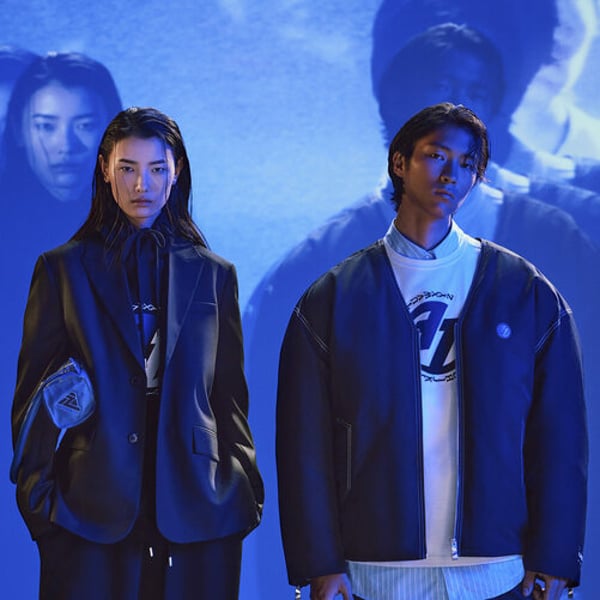
At the heart of this evolution lies the global rise of Korean menswear. Korean brands stand out for their attention to detail, mastery of cut and tailoring, and a strong appetite for exploring experimental materials, bold silhouettes and assertive colours. This stylistic approach, oscillating between minimalism and exuberance, meets a growing demand for pieces capable of expressing individual identity, according to the study.
Exports to be developed
The trends for 2025 confirm this direction: oversized cuts, unique patterns, bright colours, sustainable materials, a fusion of traditional and contemporary styles, as well as layering, athleisure and gender-fluid fashion, are at the forefront. From oversized kimono-polos to two-tone pink shirts, the Korean aesthetic offers a balance of comfort, experimentation and sophistication.

This creative ecosystem is supported by a myriad of ‘flagship’ brands. Names already recognised worldwide such as Gentle Monster, Andersson Bell, Kusikohc, Hyein Seo and We11done fuel the country’s international aura through their distinct worlds, blending art, streetwear, craftsmanship and conceptual design. In 2025, other labels are taking centre stage: Ader Error and its deconstructivist streetwear, Wooyoungmi and its modern tailoring, ThisIsNeverThat and its distinctly Korean take on streetwear, as well as 87MM, Recto, Amomento, PushButton and Minjukim, whose gender-fluid offerings are gaining visibility.
By combining massive public investment, a capacity for innovation, cultural richness and creative power, South Korea is putting its fashion industry on an upward trajectory in 2025. It can be seen not only as an exporter of aesthetics, but also as a key player in technical and sustainable textiles, with the ambition of playing a central role in contemporary global fashion.
This article is an automatic translation.
Copyright © 2025 FashionNetwork.com All rights reserved.


Brown University Person of Interest Captured in New Enhanced Video

Flourishing South Korean menswear aims to strengthen international standing

ACA — spendthrift — badge bounties — 404 — moon mining
-

 Politics8 years ago
Congress rolls out ‘Better Deal,’ new economic agenda
-
Entertainment8 years ago
New Season 8 Walking Dead trailer flashes forward in time
-
Politics8 years ago
Poll: Virginia governor’s race in dead heat
-
Entertainment8 years ago
The final 6 ‘Game of Thrones’ episodes might feel like a full season
-
Entertainment8 years ago
Meet Superman’s grandfather in new trailer for Krypton
-
Politics8 years ago
Illinois’ financial crisis could bring the state to a halt
-
Business8 years ago
6 Stunning new co-working spaces around the globe
-
Tech8 years ago
Hulu hires Google marketing veteran Kelly Campbell as CMO