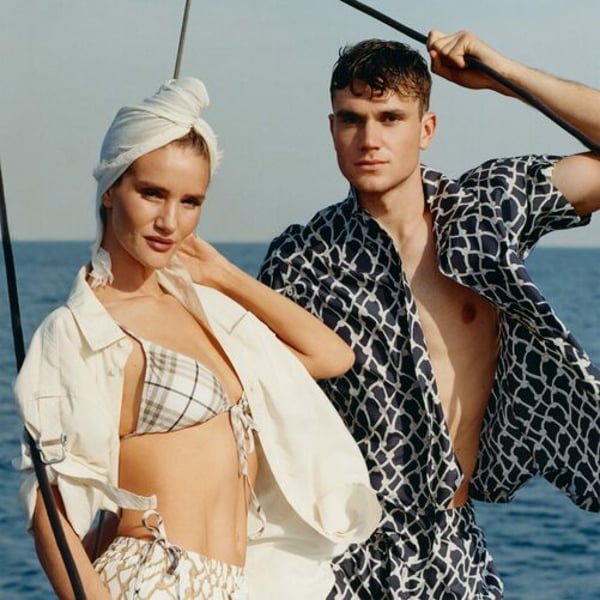
As Britain’s most prominent luxury label, Burberry’s results re always closely watched, but even more so since it started struggling and issuing profit warnings. And on Friday its Q1 figures were in the spotlight.
DR
So how did it do in the 13 weeks to late June? It’s not back in top form, although there were very clear signs of progress. The company said that its retail revenue fell 6% on a reported basis to £433 million and it was down 2% at constant exchange rates (CER), stripping out the negative impact of currency effects that have been denting a lot of fashion businesses this year. It was trading from a little less space this time too (-1%), so that also weighed on the figures.
Its comparable store sales were down 1% and one of the aforementioned signs of progress could be seen from the fact that a year ago that figure was negative to the tune of 21%. OK, it’s not yet been able to claw back any of that 21% deficit of this time last year but in the circumstances of an ongoing luxury slump and the company’s own turnaround drive, that 1% fall isn’t bad. And analysts had been expecting a fall of around 3% so that was more good news.
Most importantly though, comparable store sales in two of its key regions tipped into positive territory. In EMEIA, they were up 1% and in the all-important Americas market they rose 4%. Admittedly Asia in general remains an issue for the brand and Greater China comp sales were down 5% while Asia-Pacific fell 4%.
EMEIA had been boosted by local spend offsetting declines from tourists; the Americas was supported by new customer growth; the Greater China figure included a drop of 4% from Mainland China; and the Asia Pacific drop came as it saw a challenging performance in Japan, partially offset by growth in South Korea.
What it did right
In Q1, the company had taken various actions to boost its performance, “resulting in comparable retail sales improvement across all regions relative to the previous quarter. This was supported by stronger brand desirability, outperformance in outerwear and scarves and improved conversion”.
The company has issued a a series of distinctive monthly campaigns such as High Summer, Highgrove, and Festival, “each celebrating British summertime traditions while appealing to different customer archetypes”.
It rebalanced the autumn 25 collection (its first under the Burberry Forward era), “attracting a broad range of luxury customers, focused on fewer, bigger ideas, hero-ing recognisable brand codes”.
Visual merchandising was also enhanced in stores with fixtures to improve product densities. And its scarf bar pilot is outperforming the fleet with 200 targeted by year end.
It saw online momentum continuing for the third consecutive quarter, driven by a “stronger product mix, universal styling and storytelling”.
And its organisational changes are “fostering greater collaboration and agility”. Its cost efficiency programme is on track to deliver £80 million in annualised savings by FY26.
CEO Joshua Schulman understandably chose to focus on the positives and said: “Over the past year, we have moved from stabilising the business to driving Burberry Forward with confidence. The improvement in our first-quarter comparable sales, strength in our core categories, and uptick in brand desirability gives us conviction in the path ahead.”
Of course, it’s the future that counts and he added that the autumn 2025 collection “is being well received by a broad range of luxury customers as it arrives in stores. Although the external environment remains challenging and we are still in the early stages of our transformation, we are encouraged by the initial progress we are starting to see”.
As for the FY26 outlook, Schulman emphasised that as well as it still being early in its turnaround drive, the macroeconomic environment “remains uncertain”. Without giving any concrete figures, he said: “Our focus this year is to build on the early progress we have made in reigniting brand desire, as a key requisite to growing the top-line. In the first half we are continuing to prioritise investment and expect to see the impact of our initiatives build as the year progresses. We will deliver margin improvement with a continued focus on simplification, productivity and cash flow. We remain confident that we are positioning the business for a return to sustainable, profitable growth.”
Analyst view
The general view of all this from analysts is that the business is going in the right direction but they’re aware that there’s still much to do and the market remains tough.
Nick Sherrard, MD of innovation expert network Label Sessions, said: “The leadership team at Burberry has done so much right. In fact, in the year since Josh Schulman took over as CEO it has repositioned the brand in a way that shows real vision, and is hugely admired inside and outside the industry. There are tentative signs of why in today’s update.
“The work Burberry has done over leaves it well placed to eat into its competitors’ market share. Recent brand activations in Ibiza, Glastonbury, and Highgrove show a brand… clear on its strategy. Execute on that and this could be a classic case study of transformation.
“All of that said, 2025 is not a great time to run a luxury brand. The ad campaign reads ‘it’s always Burberry weather’ but in financial terms, at least, there are limits to how fast you can drive revenue recovery in economic conditions like these – particularly in China and the wider Asia Pacific region.”
Rebag’s Clair report, which studies the value retention of bags on the resale firm’s platform, said Hermès has reclaimed the top position in 2025, reaching an average 138% value retention—a 38% year-over-year increase.
Rebag
The New York-based Rebag’s report also said that a ten-year analysis of Birkin data shows resale values have surged 92% since 2015, outpacing Hermès’ own retail price growth of 43%.
Behind Hermès, Goyard logged 132% retention in 2025, up 28% from 2024; The Row recorded 97% value retention, while Miu Miu climbed to 104% average retention, according to the report.
In fine jewellery, Van Cleef & Arpels extended its lead, with 112% retention led by the Sweet Alhambra collection, while in the watches category, Rolex remained steady at 104%, with standout models like the Submariner Hulk reaching 244% of their original retail price. Comparatively, Cartier witnessed 87% retention.
Louis Vuitton x Takashi Murakami‘s return boosted search demand and pushed top styles above 130% resale value, the report added, while renewed interest in Balenciaga‘s Le City, Celine‘s Phantom, and Chloé‘s Paddington saw an increased demand for early-2000s bags.
Rebag’s 2025 Clair Report, which analyses millions of data points across the primary and secondary markets to reveal the brands, styles, and investment opportunities shaping the luxury landscape, said that global tariff shifts and changing consumer behaviours have made 2025 a “defining year for luxury resale.”
“Higher primary prices pushed more consumers to the secondary market, reaffirming its stability. The 2025 Clair Report highlights the brands demonstrating lasting long-term value,” said Charles Gorra, CEO and founder of Rebag.
In June, Rebag reported its launch on Luxury Stores at Amazon, bringing its pre-loved designer handbags, jewelry, watches, and more to the platform.
Lululemon Athletica’s CEO shake-up has put the spotlight on the once-dominant yoga pants maker’s race to wrest back younger and affluent shoppers from rivals and revive its sagging U.S. business.
Calvin McDonald – Reuters
Its shares, which have halved in value this year, rose 10% on Friday following the departure of CEO Calvin McDonald after about seven years in the role.
An athleisure pioneer known for its premium yoga apparel, Lululemon lost ground as newer rivals such as Alo Yoga and Vuori weaned away its core younger shoppers with trendier styles, marketing campaigns and celebrity partnerships.
Meanwhile, established players like Nike and Gap also entered the market with lower-priced styles.
Lululemon “caught the perfect wave in fashion, becoming the trend for the last five years,” said Brian Mulberry, senior client portfolio manager at Zacks Investment Management.
“But as its core customers graduate college and face tighter budgets, affordability is a challenge and a new outfit at Lulu can cost as much as a month’s groceries.”
Lululemon sells a range of yoga, running and training apparel such as Align yoga pants priced at $108 and men’s joggers at $128.
The slow refresh to core styles and product missteps, such as its decision to pull its $98 “Breezethrough” leggings from shelves last year, have led to heavy discounting to clear aged inventory.
At an earnings call late on Thursday, company executives said the board is “focused on a leader with experience and growth and transformation”.
“It’s understandable to think that a strategic overhaul with a new leader at the helm will be a positive, but this opens the door to more questions as to what direction the board will go with a replacement,” said Jay Woods, chief market strategist at Freedom Capital Markets.
Lululemon is the latest global consumer company facing leadership churn as macroeconomic uncertainty fuels increasingly divergent spending patterns.
Lululemon is making efforts to speed up product development, launch fresh styles and drive company-wide efficiencies to offset cost inflation and protect margins.
The company beat third-quarter results, lifted by strong China sales, but issued a weaker-than-expected holiday forecast as higher promotions and increased spending on marketing weigh on margins.
Founder Chip Wilson, who is also Lululemon’s largest independent shareholder, in a statement on Friday slammed the board for “poor succession planning” and value erosion.
He called for an urgent CEO search led by new, independent directors with deep company knowledge to restore a product-first focus. Lululemon did not immediately respond to a Reuters request for comment on Wilson’s statement.
The company’s forward price-to-earnings multiple, a common benchmark for valuing stocks, is 14.66, compared to 31.26 for Nike and Abercrombie & Fitch‘s ratio of 10.8, according to LSEG data.
“The main challenge I foresee for the new leadership is not how consumers see Lulu, but how does it see itself?” said Mulberry.
Ferragamo appoints Alberto Tomba as a brand ambassador. The collaboration with the Italian skiing legend celebrates values shared by the Florentine fashion house: dedication, perseverance, resilience and attention to detail.
Alberto Tomba
Born in 1966, Tomba is the quintessential emblem of an Italy that invests in talent, commitment and the ability to push beyond one’s limits. His career is marked by major international successes, including three Olympic gold medals and two silver medals, two World Championship gold medals and two bronze medals, and 50 World Cup victories.
The Bologna-born skier is also the only athlete to have won races in 11 consecutive seasons (1987-1998) and to have claimed four World Cup discipline titles in giant slalom and four in slalom.
“Tomba’s sporting journey perfectly reflects Ferragamo’s philosophy: every achievement comes from sacrifice, every result from dedication. We share with him a deep sense of authenticity and a love of excellence, values that continue to inspire our daily work,” said Leonardo Ferragamo.
“Being chosen by Ferragamo is an honour,” Tomba commented. “I have always believed that sport and style share a common language: that of passion, rigour and the desire to improve every day. Representing a brand that embodies all this, and that brings Italian beauty and craftsmanship to the world, is a source of great pride.”
This article is an automatic translation. Click here to read the original article.