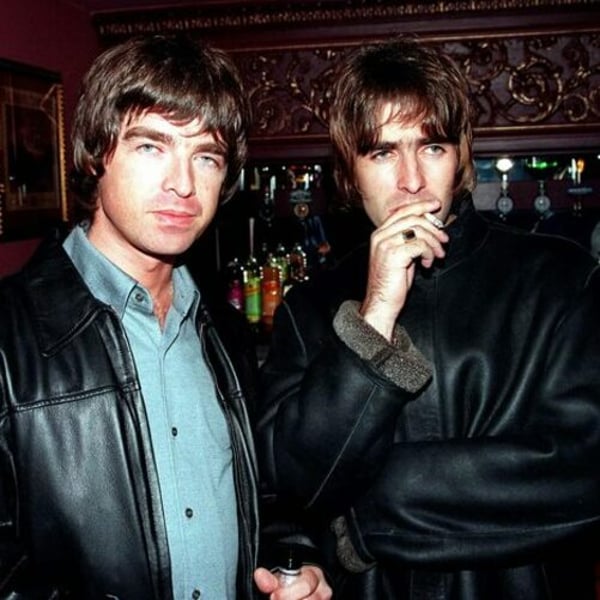
The iconic British band Oasis kicks off its long-anticipated reunion tour on Friday with a show in Cardiff, reigniting a wave of ’90s Britpop nostalgia—and fashion brands are ready to roll with it.
Oasis lead singer Liam Gallagher and brother Noel Gallagher in 1995. – Photographer: Dave Hogan/Hulton Archive
Despite the famously rocky relationship between Liam and Noel Gallagher, the tour promises a cultural moment too big for the fashion industry to ignore. From North America to Asia, retailers are tapping into the emotional pull of the past, hoping to turn a musical comeback into a sales boom.
Recent music events—most notably Beyoncé’s Cowboy Carter and Charli XCX’s Brat—have proven how album launches and tours can drive fashion trends. Levi Strauss & Co. famously joined forces with Beyoncé after her “Levii’s Jeans” lyric, temporarily renaming its Instagram account and launching a campaign with the singer. Coach’s Kate Spade line embraced Brat, while stars like Taylor Swift were dressed by brands including Versace, Cavalli, and Tiffany & Co.
Now, brands are calling this moment the “Wonderwall Summer.”
Leading the charge is Burberry Group Plc. Though not officially tied to the tour, Burberry’s latest campaign celebrates the Gallagher legacy. It stars Liam Gallagher along with his sons Lennon and Gene, and daughter Molly Moorish-Gallagher. The visuals—featuring music icons like Goldie, and models Cara Delevingne and Alexa Chung—recall Burberry’s golden era in the ’90s. Liam is seen wearing the parka he first debuted in 2018, which is now being reissued in limited quantities.
Meanwhile, Adidas AG is taking a more direct approach, launching a co-branded Oasis collection available online, in-store, on Oasisinet.com, and at concert venues throughout the tour. Levi’s created a limited series of graphic T-shirts, while Moncler’s Stone Island featured Liam Gallagher in its autumn campaign.
Unlike recent music-tour collaborations driven by female artists, Oasis draws a mixed-gender fan base, offering opportunities for both menswear and womenswear. With the men’s clothing and footwear market valued at roughly two-thirds of womenswear, brands see untapped potential.
While the Oasis revival has attracted a younger crowd through ongoing ’90s nostalgia, nearly half of the ticket holders have seen the band live before, according to Barclays Plc’s Consumer Spend report. The group hasn’t performed together since 2009, meaning the audience skews older—and often more affluent.
Many of Oasis’ signature styles—baggy jeans, football jerseys, and low-rise sneakers—have returned through the “Blokecore” trend. Fashion choices among fans reflect the times: Swifties wore sequins, the Beyhive chose cowboy hats, and Oasis fans are opting for parkas and bucket hats.
Even in summer heat, demand for parkas is rising. TikTok posts referencing parkas jumped 188% between June 1 and July 1, with video views up 121%, according to Trendalytics. Searches for parkas on resale platform Depop surged by 1,850% year over year in June. Bucket hats are also seeing renewed interest.
About one-third of British fans plan to dress in ’90s styles at the concerts, and more than 20% expect to wear co-branded items, according to Barclays.
Barclays estimates that Oasis fans in the UK alone will spend £1.06 billion ($1.4 billion) on the tour—including tickets, travel, and merchandise. That total edges out the £997 million spent by Taylor Swift fans during the Eras Tour, partly due to Oasis scheduling 17 shows compared to Swift’s 15.
After completing the UK leg, Oasis will head to North America in August and September, before performing in Asia and South America. For both the band and its partner brands, cracking the US market remains a major goal.
Burberry may stand to gain the most. With uncertainty in the Chinese luxury sector, a recovering US market—buoyed by easing tariffs—is looking more attractive. Adidas, still trailing behind Nike in US market share, also hopes to boost visibility stateside.
Oasis’ relationship with fashion has had its ups and downs. Liam Gallagher founded his label Pretty Green in 2009, but it went into administration and was acquired by JD Sports in 2019. The brand was later sold to Frasers Group, which no longer owns it.
The biggest risk? A band breakup mid-tour. Oasis famously split before a Paris show in 2009. Still, the current media frenzy and brand engagement have already paid off. Even if the tour falters, tension between the brothers is likely to generate more attention than silence.
Whether or not this becomes a true “Wonderwall Summer,” fashion brands betting on Oasis aren’t likely to look back in anger.
Another creative director departure at a major brand is shaking up the fashion industry. It is now the turn of Austrian designer Norbert Stumpfl to leave Brioni. The label has just confirmed the end of its collaboration with the designer in a statement. Stumpfl had designed Brioni’s collections for the past seven years.
The fashion house founded in 1945, which in 1952 became the first menswear brand to stage a fashion show (in Florence’s legendary Sala Bianca), has expressed its “deep gratitude for the contribution he has made over the years. During his tenure at Brioni, Norbert interpreted with precision the concepts of lightness and discretion, contributing to the evolution of the men’s wardrobe with a modern approach that pays homage to tradition,” Brioni said.
Federico Arrigoni, CEO of Brioni, said, “Our journey continues, and the Maison will continue to consolidate its tradition- perfection of craftsmanship, exceptional materials, and innovation in tailoring techniques- to create true masterpieces, from formalwear to leisurewear and accessories. Brioni pursues its mission of defining the contemporary codes of Italian elegance, while elevating its mastery of high tailoring and bespoke craftsmanship for those who lead and accept nothing but the exceptional.”
Since 2011, Brioni has been part of the Paris-based French luxury group Kering. From 2018 until his departure, the brand’s collections were designed by Norbert Stumpfl, the acclaimed Austrian menswear couturier, celebrated for his blend of impeccable tailoring and cutting-edge fabrics- among his creations were dinner jackets woven with 24-carat gold threads and enzyme-treated silk-linen blends with a soft, distinctive handle. During his tenure, Brioni also expanded masterfully into womenswear, expressing discreet luxury with rare aplomb.
A pinnacle of Roman sartorial luxury, the Italian label marked its 80th anniversary in late November with an exhibition of its superb tailoring and a gala dinner at the Chiostro del Bramante in Rome.
This article is an automatic translation. Click here to read the original article.
An Hermes handbag that once belonged to Jane Birkin was sold for $2.86 million (2.45 million euros) at auction in Abu Dhabi on Friday, just months after the record-breaking sale of her first bag from the French brand, Sotheby’s said.
Jane Birkin with one of her signature Hermes bags – Sotheby’s
Hermes first created the design for the British singer and actress in 1984 and it has gone on to become a modern and highly prized classic, sought by fashionistas the world over. The first prototype was sold for 8.58 million euros ($10 million) at a Sotheby’s auction in Paris in July, smashing previous price records for a handbag.
The one sold on Friday was a ‘Birkin Voyageur,’ which was gifted to the former wife of French singing legend Serge Gainsbourg in 2003. The final sale price was around six times times higher than the estimated price range of $230,000-$430,000 given before the sale.
“Jane Birkin’s handbag legacy continues to captivate collectors,” Sotheby’s said in a statement sent to AFP, adding that bidding took place over 11 minutes between six collectors. The new owner was a phone buyer and has not been identified.
The handbag was one of four owned by the late celebrity, who used to sell them to raise money for charitable causes. It has a handwritten inscription in French inside from Birkin that reads: “My Birkin bag, my globetrotting companion.”
A third Hermes bag owned by Birkin is set to go under the hammer on December 15 at the Hotel Drouot auction house in Paris. It was entrusted by the late star to her friend and biographer Gabrielle Crawford, who is selling it to help fund the future Jane Birkin Foundation, Drouot said in a statement.
Produced in very limited numbers, the modern Birkin bag manufactured by Hermes has maintained an aura of exclusivity and is beloved by celebrities such as the Kardashians, Jennifer Lopez, and Victoria Beckham. The most expensive fashion item ever sold at auction was a pair of ruby red slippers worn by actor Judy Garland from The Wizard of Oz in 1939, which sold for $32.5 million in 2024 in Dallas, Texas, according to Sotheby’s.
Artificial intelligence (AI) continues its march to transform businesses’/consumers’ lives with customer advocacy platform Mention Me launching ‘AI Discovery IQ’, a free-to-use tool that “helps brands reach target consumers in the new age of generative AI search”.
Kirill KUDRYAVTSEV / AFP/Archives
It claims to allow brands to “instantly audit how discoverable they are within popular AI systems” such as ChatGPT, Claude, Gemini and Perplexity.
According to Mention Me, 62% of UK consumers now turn to generative AI tools for product recommendations, brand discovery and comparisons, “bypassing traditional search engines entirely [so] businesses are under pressure to respond to this behaviour change,” said the platform’s CEO Wojtek Kokoszka whose platform works with firms including Charlotte Tilbury, Huel and Puma, “helping marketing teams to boost consumer awareness and sales”.
With AI, it says the modern customer journey, powered by natural language prompts instead of outdated keyword strings, means consumers are 4.4 times more likely to convert if they find a brand through a large language model (LLM).
“The rise of ‘agent-mode’ assistants and AI-driven voice search has pushed brands into a new world of digital visibility. Despite this, most brands have little to no insight into how they appear in AI-generated answers”, said Kokoszka.
AI Discoverability IQ claims to give brands an overall LLM discoverability score, specific details on areas such as technical website elements, content and structured data, and actionable recommendations to improve their AI discoverability.
Its tool generates “measurable, trackable outputs” like AI Visibility Score, brands’ prompt-based results, and a side-by-side comparisons with their competitive set. This means brands “can react quickly to improve their discoverability scores” with Mention Me’s wider suite of products and unique first-party data.
It’s also “innovating and evolving” its platform to include more capabilities, such as the ability to benchmark against competitors, to drive further improvements for marketing leaders in the age of AI.
Mention Me CMO Neha Mantri said: “AI Discoverability is not yet a named practice within most marketing teams; the same way SEO wasn’t in the early 2000s. But when up to 31% of consumers say they’re more likely to trust responses from generative AI than traditional search results, this needs to change. Mention Me is naming the problem and providing a solution at just the right time.”