Connect with us

Business

Brutal year for stock picking spurs trillion-dollar fund exodus

Published

on


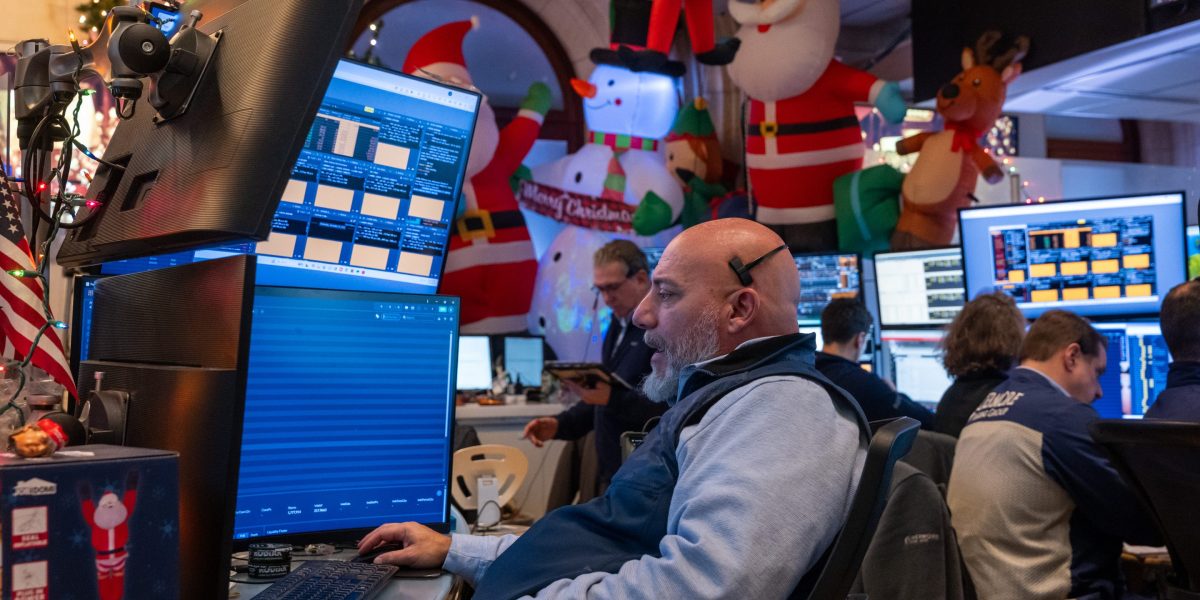
The last thing a diversified fund manager wants is to run a portfolio dominated by just seven technology companies — all American, all megacap, clustered in the same corner of the economy. Yet as the S&P 500 pushed to fresh records this week, investors were again forced to confront a painful reality: Keeping pace with the market has largely meant owning little else.

A small, tightly linked group of tech super stocks accounted for an outsize share of returns in 2025, extending a pattern in place for the better part of a decade. What stood out wasn’t simply that the winners remained largely the same, but the degree to which the gap started to seriously strain investor patience.

Frustration dictated how money moved. Around $1 trillion was pulled from active equity mutual funds over the year, according to estimates from Bloomberg Intelligence using ICI data, marking an 11th year of net outflows and, by some measures, the steepest of the cycle. By contrast, passive equity exchange-traded funds got more than $600 billion.

The exits happened gradually as the year progressed, with investors reassessing whether to pay for portfolios that looked meaningfully different from the index, only to be forced to live with the consequences when that difference didn’t pay off.

“The concentration makes it harder for active managers to do well,” said Dave Mazza, chief executive officer of Roundhill Investments. “If you do not benchmark weight the Magnificent Seven, then you’re likely taking risk of underperformance.”

Contrary to pundits who thought they saw an environment where stock picking could shine, it was a year in which the cost of deviating from the benchmark remained stubbornly high. 

Narrow Participation

On many days in the first half of the year, fewer than one in five stocks rose alongside the broader market, according to data compiled by BNY Investments. Narrow participation isn’t unusual in itself, but its persistence matters. When gains are repeatedly driven by a tiny few, spreading bets more widely stops helping and starts hurting relative performance.

The same dynamic was visible at the index level. Throughout the year, the S&P 500 outperformed its equal-weighted version, which assigns the same importance to a smallish retailer as it does to Apple Inc. 

For investors assessing active strategies, that translated into a simple arithmetic problem: Choose one that is underweight the largest stocks and risk falling behind, or go with another that holds them in close proportion to the index, and struggle to justify paying for an approach that is little different than a passive fund.

In the US, 73% of equity mutual funds have trailed their benchmarks this year, according BI’s Athanasios Psarofagis, the fourth most in data going back to 2007. The underperformance worsened after the recovery from April’s tariff scare as enthusiasm over artificial intelligence cemented leadership for the tech cohort.

There were exceptions, but they required investors to accept very different risks. One of the most striking came from Dimensional Fund Advisors LP, whose $14 billion International Small Cap Value Portfolio returned just over 50% this year, outpacing not only its benchmark but also the S&P 500 and the Nasdaq 100.

The structure of that portfolio is telling. It holds roughly 1,800 stocks, almost all outside the US, with heavy exposure to financials, industrials and materials. Rather than trying to navigate around the US large-cap index, it largely stepped outside it.

“This year provides a really good lesson,” said Joel Schneider, the firm’s deputy head of portfolio management for North America. “Everyone knows that global diversification makes sense, but it’s really hard to stay disciplined and actually maintain that. Choosing yesterday’s winners is not the right approach.”

Sticking With Winners

One manager who stuck with her convictions was Margie Patel of the Allspring Diversified Capital Builder Fund, which has returned some 20% this year thanks to bets on chipmakers Micron Technology Inc. and Advanced Micro Devices Inc.

“A lot of people like to be closet or quasi indexers. They like to have some exposure in all sectors even if they’re not convinced that they are going to outperform,” Patel said on Bloomberg TV. In contrast, her view is that “the winners are going to stay winners.”

The propensity of big stocks to get bigger made 2025 a banner year for would-be bubble hunters. The Nasdaq 100 trades at more than 30 times earnings and around six times sales, at or near historical highs. Dan Ives, the Wedbush Securities analyst who started an AI-focused ETF (IVES) in 2025 and saw it swell to nearly $1 billion, says valuations like those may test nerves, but are no reason to bail on the theme. 

“There are going to be white-knuckle moments. That just creates the opportunities,” he said in an interview. “We believe this tech bull market goes for another two years. To us, it’s about trying to find who the derivative beneficiaries are, and that’s how we’re going to continue to navigate this fourth industrial revolution from an investing perspective.”

Thematic Investing

Other successes leaned into concentration of a different kind. VanEck’s Global Resources Fundreturned almost 40% this year, benefiting from demand linked to alternative energy, agriculture and base metals. The fund, launched in 2006, owns companies such as Shell Plc, Exxon Mobil Corp. and Barrick Mining Corp., and is run by teams that include geologists and engineers alongside financial analysts. 

“When you are an active manager, it allows you to pursue big themes,” said Shawn Reynolds, who has managed the fund for 15 years, a geologist himself. But that approach, too, demands conviction and tolerance for volatility — qualities that many investors have shown less appetite for after several years of uneven results.

By the end of 2025, the lesson for investors was not that active management had stopped working, nor that the index had solved the market. It was simpler, and more uncomfortable. After another year of concentrated gains, the price of being different remained high, and for many, the willingness to keep paying it had worn thin.

Still, Osman Ali of Goldman Sachs Asset Management believes there is “alpha” to be found not just in Big Tech. The global co-head of quantitative investment strategies relies on the firm’s proprietary model, which ranks and analyzes roughly 15,000 stocks worldwide on a daily basis. The system, built around the team’s investment philosophy, has helped deliver gains of some 40% across its international large-cap, international small-cap and tax-managed funds on a total return basis.

“The markets will always give you something,” he said, “You just have to look in a very dispassionate, data-driven way.”


Source link

Continue Reading

Business

Russian official warns a banking crisis is possible amid nonpayments. ‘I don’t want to think about a continuation of the war or an escalation’

Published

on


Russia’s financial system is reportedly coming under more strain as Moscow’s war on Ukraine nears the end of its fourth full year.

The White House is seeking to revive peace talks this weekend with Ukrainian President Volodymyr Zelensky due to meet President Donald Trump in Florida on Sunday. Russian forces stepped up their bombardment of Ukraine ahead of the meeting, but prolonged fighting presents risks for the economy.

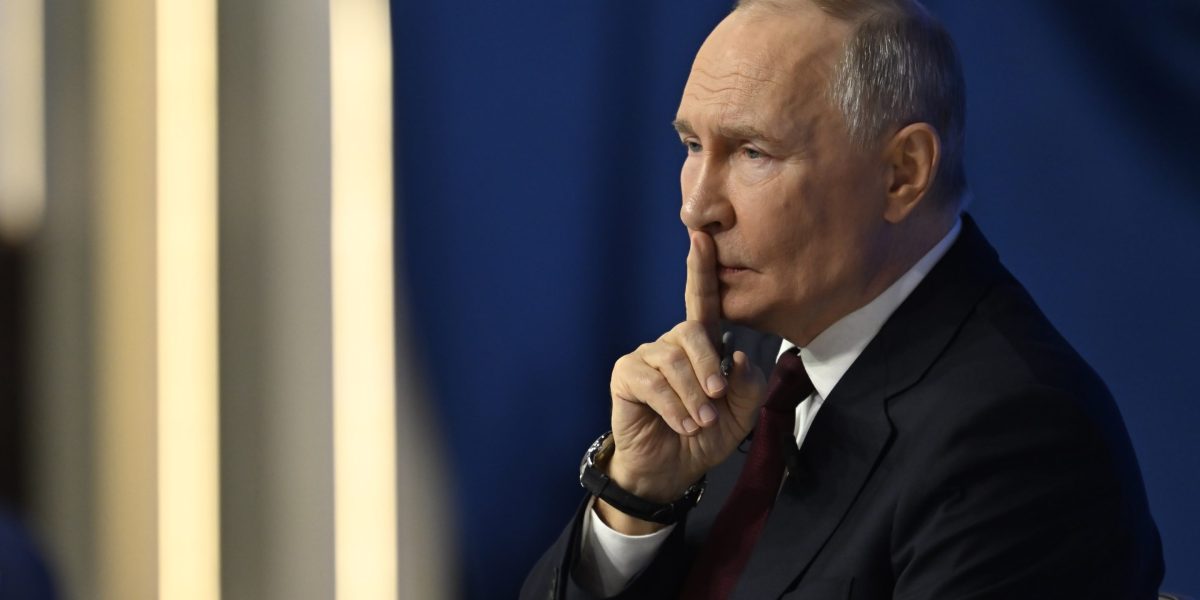
“A banking crisis is possible,” a Russian official told the Washington Post recently on condition of anonymity. “A nonpayments crisis is possible. I don’t want to think about a continuation of the war or an escalation.”

Russia’s economy was surprisingly resilient in the face of severe Western sanctions after President Vladimir Putin launched his invasion of Ukraine in early 2022. That’s as China and India were eager to snap up cheap Russian oil, keeping the Kremlin’s coffers full and providing revenue for its military.

But more recently, energy prices have slumped while Europe and the U.S. have tightened sanctions. Oil and gas revenue has tumbled 22% in the first 11 months of the year, and Reuters estimated that December proceeds are on pace to sink nearly 50%.

To cover the shortfall in energy revenue, Moscow has tapped its sovereign wealth fund. But that is running out now too, so the government has resorted to raising more revenue via tax hikes.

Meanwhile, a tight labor market and high inflation have forced the central bank to keep interest rates high, and recent easing has failed to prevent spending declines in several consumer categories.

With companies feeling the squeeze of high rates and weaker consumption, Russian data show unpaid wages nearly tripled in October from a year ago to more than $27 million, with the Post adding that furloughs and shorter workweeks are also becoming more common.

As a result, more consumers are having trouble servicing their loans. Given the headwinds, the Russian official warning of a banking or nonpayment crisis isn’t the first of its kind.

In June, Russian banks raised red flags on a potential debt crisis as high interest rates weigh on borrowers’ ability to service loans. Also that month, the head of the Russian Union of Industrialists and Entrepreneurs warned many companies were in “a pre-default situation.”

And in September, Sberbank CEO German Gref, one of Russia’s top banking chiefs, said the economy was in “technical stagnation,” following his warnings in July and August that growth was close to zero.

The Center for Macroeconomic Analysis and Short-Term Forecasting, a state-backed Russian think tank, said this month the country could face a banking crisis by next October if loan troubles worsen and depositors pull out their funds, according to the Post.

“The situation in the Russian economy has deteriorated markedly,” wrote Dmitry Belousov, head of the think tank, in a note seen by the Financial Times. “The economy has entered the brink of stagflation for the first time since early 2023.”

This story was originally featured on Fortune.com


Source link

Continue Reading

Business

Blue Origin names Tory Bruno to new national security group

Published

on


Tory Bruno, the former chief executive officer and president of United Launch Alliance, will become the president of the new national security group at Blue Origin, the Jeff Bezos-founded space venture that is one of ULA’s biggest suppliers and rivals.

The company announced the move in a post on X

As head of the group, Bruno will oversee “the development of cutting-edge products, services, and technologies aimed at enhancing national security missions,” according to an internal email from Blue Origin CEO Dave Limp, seen by Bloomberg.

“We share a deep belief in supporting our nation with the best technology we can build,” Limp said in a statement. “Tory brings unmatched experience, and I’m confident he’ll accelerate our ability to deliver on that mission.”

Bruno’s hiring and the creation of the new team indicates Blue Origin is placing further emphasis on national security applications for its various rockets and space projects. Both ULA and Blue Origin are part of an elite group of rocket launch providers, including SpaceX, that are allowed to loft the most sensitive national security satellites for the US military.

Bruno’s resignation from ULA, a joint rocket venture between Boeing Co. and Lockheed Martin Corp., was announced on Dec. 22. He served in the role for nearly 12 years.

During his tenure leading ULA, Bruno oversaw the retirement and phasing out of the company’s older Delta and Atlas rockets, while spearheading the development of a new rocket called Vulcan. The new rocket, however, suffered from numerous delays and has struggled to ramp up its launch cadence after debuting in January 2024.

Blue Origin provides the main engines for Vulcan, while also serving as a competitor to ULA with its own New Glenn orbital rocket. While at ULA, Bruno led a joint partnership with Blue Origin in 2014 to develop the company’s BE-4 engines to be used in the Vulcan rocket.

New Glenn, which will eventually be used for national security missions, launched its second mission in November. During that flight, the rocket’s main booster successfully landed on a floating barge in the ocean after takeoff.

Blue Origin is also transitioning its in-space systems business unit into the new national security group, according to Limp’s internal memo. The current head of the unit, Paul Ebertz, will now report to Bruno. 

The in-space systems group includes projects like Blue Ring, which aims to develop a versatile satellite that can do a diverse range of tasks in space, and the company’s efforts to build a new communications spacecraft that could orbit Mars.


Source link

Continue Reading

Business

Jeffrey R. Holland, next in line to lead Church of Latter-day Saints, dies at 85

Published

on


Jeffrey R. Holland, a high-ranking official in the Church of Jesus Christ of Latter-day Saints who was next in line to become the faith’s president, has died. He was 85.

Holland died early Saturday morning from complications associated with kidney disease, the church announced on its website.

Holland, who died in Salt Lake City, led a governing body called the Quorum of the Twelve Apostles, which helps set church policy while overseeing the many business interests of what is known widely as the Mormon church.

He was the longest-tenured member of the Quorum of the Twelve after President Dallin H. Oaks, making him next in line to lead the church under a long-established succession plan. Oaks, 93, became president of the church and its more than 17 million-strong global membership in October.

Henry B. Eyring, who is 92 and one of Oaks’ two top counselors, is now next in line for the presidency.

Holland had been hospitalized during the Christmas holiday for ongoing health complications, the church said. Experts on the faith pointed to his declining health in October when Oaks did not select Holland as a counselor.

His death leaves a vacancy in the Quorum of the Twelve that Oaks will fill in coming months, likely by calling a new apostle from a lower-tier leadership council. Apostles are all men in accordance with the church’s all-male priesthood.

Holland grew up in St. George, Utah, and worked for many years in education administration before his call to join the ranks of church leadership. He served as the ninth president of Brigham Young University, the Utah-based faith’s flagship school, from 1980 to 1989 and was a commissioner of the church’s global education system.

Under his leadership, the Provo university worked to improve interfaith relations and established a satellite campus in Jerusalem. The Anti-Defamation League later honored Holland with its “Torch of Liberty” award for helping foster greater understanding between Christian and Jewish communities.

Oaks, also a former BYU president, reflected Saturday on his more than 50 years of friendship and service with Holland, calling their relationship “long and loving.”

“Over the last three decades as a member of the Quorum of the Twelve Apostles, he lifted the weary, encouraged the faithful and bore a powerful witness of the Savior — even through seasons of significant personal trials,” Oaks said.

Holland was known as a dynamic orator whose sermons combined scholarship with tenderness. In 2013 he spoke to church members about supporting loved ones with depression and other mental illnesses, sharing openly about times when he felt “like a broken vessel.”

Holland is widely remembered for a 2021 speech in which he called on church members to take up metaphorical muskets in defense of the faith’s teachings against same-sex marriage. The talk, known colloquially as “the musket fire speech,” became required reading for BYU freshmen in 2024, raising concern among LGBTQ+ students and advocates.

Holland was preceded in death by his wife, Patricia Terry Holland. He is survived by their three children, 13 grandchildren and several great-grandchildren.


Source link

Continue Reading

Trending

Copyright © Miami Select.
