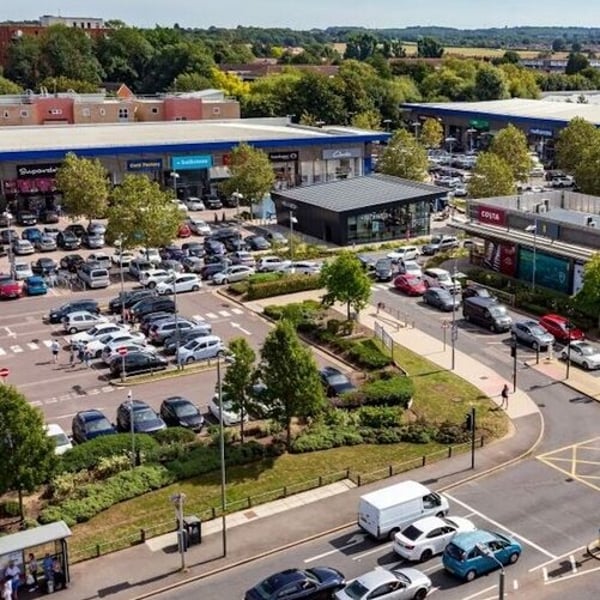
UK property giant British Land is looking for a new CEO. Simon Carter’s five-year tenure at the top oversaw the firm’s successful pivot to a retail park focus. He’s departing after an 18-year total association to head European logistics properties firm P3 Logistics Parks.
British Land’s Nugent Shopping Park, south London
His departure comes with a 12-month notice period so there’ll be no immediate hurry to sign a replacement.
Carter first joined British Land in 2004, working in several roles across Strategy, Corporate Finance and Treasury before leaving in 2015 to become CFO at Quintain Estates & Development and then Logicor. He returned to British Land as CFO in 2018 and was appointed CEO in 2020.
William Rucker, chairman, said: “I want to thank Simon for his significant contribution to British Land. During his 18 years here across two stints he has achieved a huge amount, and as CEO has positioned the business for future success with a very strong management team and an exceptional London office campus and retail park platform.”
Carter added: “British Land has been a huge part of my professional life, and it has been a privilege to work for such a fantastic business.
“The contrarian calls we made post-pandemic have positioned British Land for long-term success. There is never a perfect time to move on, but I will be leaving the business with market-leading positions in London campuses and retail parks – both of which are benefitting from strong rental growth in supply-constrained markets.”
Nearly 200 brands reached all-time annual sales highs on StockX in 2025, highlighting the growing influence of the secondary market across sneakers, apparel, and accessories, according to the platform’s seventh annual “Big Facts: Current Culture Index” report, released on Monday.
Scarcity and collaborations drive resale growth in 2025: StockX. – Ugg
“Our data shows that 2025 wasn’t defined by a single category or trend — it was shaped by a number of standout releases. Companies that moved quickly, prioritized innovation, and aligned with the right partners reaped the benefits,” said Greg Schwartz, StockX CEO.
“Nearly 200 brands reached all-time annual sales highs on StockX last year, from legacy leaders to emerging and independent labels. As we look ahead to 2026 and beyond, the brands that will win are those that understand scarcity, storytelling, and community — not just scale.”
Legacy sneaker brands including Nike, Jordan, Adidas, New Balance and Asics remained the platform’s top sellers for the third consecutive year, with Nike and Jordan showing early signs of recovery as average resale prices rose 5 percent and 6 percent year over year. At the same time, less conventional brands posted outsized growth, led by Mizuno, which recorded a 124 percent increase in sales, followed by Maison Mihara Yasuhiro, Saucony and Salomon.
Outside of sneakers, comfort-led and creatively driven footwear gained momentum. Ugg retained its position as the top-selling non-sneaker footwear brand, while Nike emerged as the fastest-growing in the category, fueled by demand for its ReactX Rejuven8 recovery shoe.
In apparel, Uniqlo ranked as the fastest-growing brand following collaborations with Needles and Kaws, while Skims and Adidas also posted strong gains tied to limited releases and partnerships.
Accessories continued to be shaped by scarcity. Sprayground was the only brand to rank among both the top five best-selling and fastest-growing accessories labels, with sales up 287 percent. Louis Vuitton climbed four spots to number 4, driven by strong demand for its latest Murakami collaboration.
Looking ahead, StockX expects major global sporting events to influence fashion demand in the year ahead, with the 2026 FifaWorld Cup likely to accelerate soccer’s impact on U.S. style, and the Milan Olympics presenting new opportunities for sport-fashion crossover.
Bad Bunny is also poised for a defining year, with a Super Bowl halftime performance and a fully original Adidas signature sneaker slated for release.
Ssense announce on Monday its co-founders, Rami Atallah, Bassel Atallah, and Firas Atallah will retain control of the Canadian luxury e-commerce platform after the firm filed for bankruptcy protection in September.
Ssense
The founding trio, in partnership with a Canadian multi-family office, have been selected as the successful bid in the Court-supervised Sale and Investment Solicitation Process conducted under the Companies’ Creditors Arrangement Act (CCAA). The parties have entered into a definitive purchase agreement, which is slated to finalise no later than February 13.
“The day-to-day leadership remains unchanged with our existing executive team under the transaction,” the company said in an internal memo.
“This outcome will allow us to provide continuity and stability for our customers, suppliers, partners, and you, our employees.”
The sale follows a troublesome period for Ssense. In May, the company axed 100 positions, as the firm tried to lower overheads amid the luxury slowdown affecting demand for high-price goods, especially more younger, aspirational luxury shoppers — Ssense’s target market.
In September, it filed for Canada’s equivalent of bankruptcy protection, owing more than $200 million in debt to banks and brand partners. The filing also served to fend off a legal manoeuvre by the company’s creditors to force a sale.
Ssense was founded in 2003 by Atallah and his brothers, Firas and Bassel, under the company name, Groupe Atallah Inc. In 2021, the luxury retailer received a minority investment from Sequoia Capital for a post-money enterprise value of more than $3.6 billion, according to an announcement at the time.
Louis Vuitton is marking the tenth anniversary of its partnership with Unicef with the launch of a limited gold edition of the Silver Lockit pendant.
Louis Vuitton marks 10 years of Unicef partnership with limited-edition Silver Lockit. – Louis Vuitton
Produced in a highly limited series, the exclusive unisex design is crafted, for the first time, in yellow gold. For each gold pendant sold, Louis Vuitton will donate $800 to Unicef, strengthening the impact of its collaboration in support of children.
The anniversary celebrations will continue throughout 2026, with additional pieces from the Silver Lockit collection set to launch in April, alongside further activations linked to the partnership.
The French luxury house first introduced the Silver Lockit collection, inspired by the padlock of the 1901 Louis Vuitton Steamer bag, as part of its partnership with Unicef, solidified on January 12, 2016. The design reflects shared values of trust, protection and transmission that underpin both Louis Vuitton’s heritage and Unicef’s mission.
Since its debut, the Silver Lockit collection has been reinterpreted annually as a fundraising and awareness initiative. Over the past decade, the partnership has generated more than $28 million for Unicef, contributing to programmes that support children in vulnerable situations worldwide.