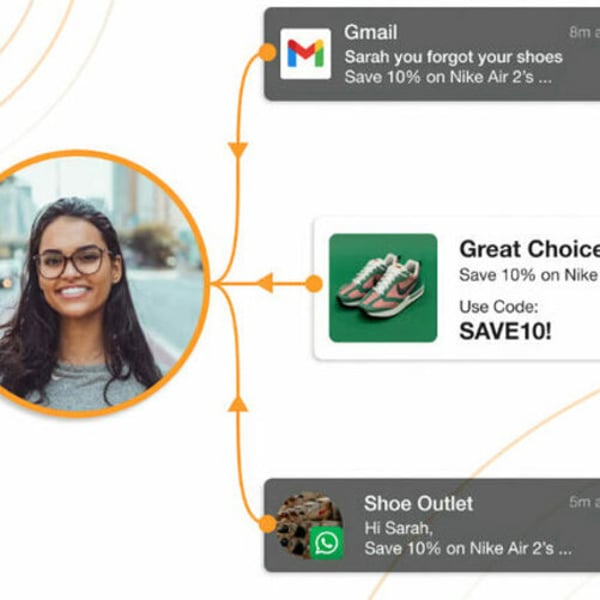
On January 13, British customer engagement and cart reactivation specialist SaleCycle bought Beyable, a French company whose solutions for customer experience personalisation and site visit conversion will merge into a unique platform following the acquisition.
Salecycle
The platform, covering all stages of the conversion funnel, is designed to address the challenges faced by brands in transforming site visits into purchases. An element that has become especially strategic given rising customer acquisition costs for e-tailers, now more than ever keen on monetising site traffic.
“By combining identity resolution tools… and onsite personalisation, we are creating a platform that will smartly help brand engage with and convert each visitor,” said Fabien Sanchez, CEO of SaleCycle.
In practice, SaleCycle’s identification and multi-channel re-engagement solutions (via email, SMS, WhatsApp etc) will be boosted by the behavioural scoring and personalisation technologies developed by Beyable since 2014. The two companies’ complementary solutions target becoming a relevant alternative to those offered by US tech giants.
The acquisition will also help Beyable, which includes names like APC, Sisley and Saint-Gobain among its clients, to expand internationally. “Joining forces with SaleCycle enables us to extend our vision into a global dimension,” said Julien Dugaret, CEO of Beyable. Dugaret founded the company with Florian Papillon, Saidi Mohamed and Julien Delhomme.
The value of the transaction has not been disclosed. The newly created group has a portfolio of some 300 brands in the retail, travel and luxury sectors, among them Balenciaga, Breitling, Lacoste, Adolfo Dominguez and L’Occitane.
Italian influencer and entrepreneur Chiara Ferragni was acquitted at the end of a fast-track trial focused on the high-profile Pink Christmas pandoro and Easter egg cases. The decision was handed down by Ilio Mannucci Pacini, a judge of the Third Criminal Section of the Milan Court.
Chiara Ferragni
The influencer had been charged with aggravated fraud over allegedly misleading messages posted on social media: according to prosecutors, she promoted sales of the two products, suggesting that a portion of the proceeds would fund charitable projects.
Judge Mannucci did not, as a matter of law, accept the aggravating factor- contested by prosecutors- relating to the diminished ability of consumers or online users to protect themselves, which would have made the fraud offence prosecutable even without a formal complaint. Consequently, since Codacons withdrew its complaint about a year ago following a settlement with the influencer, he ordered the case be dismissed on the grounds that the offence- reclassified as simple fraud- was extinguished.
The dismissal also applied to Chiara Ferragni’s co-defendants: her then right-hand man, Fabio Damato, and Cerealitalia’s president, Francesco Cannillo.
This article is an automatic translation. Click here to read the original article.
Saks Global Enterprises’ delayed payments to luxury brands played a key role in accelerating the retailer’s decline and pushing it into bankruptcy. Brands pulled back on shipments or cancelled orders during the past year or so, leaving Saks’ stores looking less than luxurious. Now, court documents from its Chapter 11 filing just after midnight on Wednesday give greater insight into why brands were so wary: Some are owed tens of millions of dollars.
Saks has a list of brands to which it owes money – Shutterstock
Making peace with the world’s top luxury brands will be crucial for incoming chief executive officer Geoffroy van Raemdonck because it needs them to keep shipping goods as it tries to restructure its finances. At the top of the list is Chanel Ltd., which is due $136 million, according to court documents in Texas where Saks filed for bankruptcy. Next is Kering SA- owner of brands including Gucci and Balenciaga– at about $60 million.
Other creditors with claims of about $30 million include Capri Holdings Ltd., which owns Michael Kors and Jimmy Choo; Mayhoola LLC, owner of Valentino along with Kering; LVMH, owner of Louis Vuitton and Christian Dior; and Compagnie Financière Richemont SA, owner of Cartier and Van Cleef & Arpels. The brands didn’t immediately respond to requests to comment.
Debts owed to brands and other vendors that provide merchandise and services are unsecured claims in bankruptcy court. That kind of liability is generally only repaid pennies on the dollar in Chapter 11.
Saks Global said in a statement Wednesday that it expects to be able to make “go-forward payments” to vendors. The company’s stores, which include Saks Fifth Avenue, Neiman Marcus, and Bergdorf Goodman, will remain open through the bankruptcy proceedings, the company added.
The former head of Neiman Marcus Group before its acquisition, van Raemdonck is bringing along several colleagues from his Neiman days, including Brandy Richardson as chief financial officer and Darcy Penick as chief commercial officer.
Brunello Cucinelli SpA, which is owed $21.3 million, said it has confidence in the new management. The company believes the Saks team “will be able to guide this storied department store with great distinction,” Brunello Cucinelli, founder of his eponymous brand, said in a statement Wednesday.
Saks Fifth Avenue was already falling behind on payments to brands that were sending it merchandise when its parent company acquired rival Neiman Marcus Group in December 2024. That deal was financed by about $2 billion in bonds that Saks Global Enterprises, as the new company was called, soon struggled to pay off- further delaying and extending what vendors were owed.
Some vendors worried about not getting paid and cancelled their shipments or demanded more onerous payment terms, which made Saks’ financial situation even worse. Less merchandise made stores look a bit bare, which turned off shoppers and sped up its decline. A few brands have sued: New York City-based Jovani Fashion Ltd. filed suit in October, saying Saks and Neiman owe it $295,651 plus interest for merchandise.
From more than a thousand applications spanning around 100 countries, L’Oréal has selected 13 “agents of change” to join its sustainable innovation programme, L’Accelerator (with an emphasis on the “Or”), backed by €5 million in funding over five years.
Shutterstock
Among the awardees are six packaging and materials companies, notably Sweden’s PulPac and the UK’s Pulpex, focused on low-carbon paper packaging and recyclable paper bottles respectively. They are joined by Sweden’s Blue Ocean Closures, which aims to replace plastic components with fibre-based caps and lids.
Estonia’s Raiku has also been chosen for its premium, shock-absorbing, wood-based packaging. The UK’s Kelpi contributes sustainable packaging made from algae, while Japan’s Bioworks joins the programme with its high-performance bioplastics made from sugar cane.
In keeping with L’Oréal’s focus, natural ingredients for cosmetics are also in the spotlight, notably French company Biosynthis for its renewable and biodegradable raw materials. Also selected are green-chemistry solutions and bio-based materials from US company P2 Science, as well as ingredients from US company Oberon Fuels derived from upcycled wood and pulp waste.
On the circular economy front, L’Oréal welcomes Belgian company Novobiom, which uses fungi to transform waste into usable material, as well as French company Replace for its technology to recycle complex, multi-layer waste. Brazil’s Gás Verde has also been selected for its biomethane, offered as an alternative to fossil fuels in the cosmetics industry. Rounding out these companies is the British company Neutreeno, whose solution enables emissions to be calculated and reduced throughout the production chain.
L’Accelerator is being deployed by the L’Oréal Group in partnership with the University of Cambridge, in particular its Institute for Sustainability Leadership (CISL), whose teams will offer “intensive” support to the thirteen organisations selected by the programme.
This article is an automatic translation. Click here to read the original article.