Connect with us

Politics

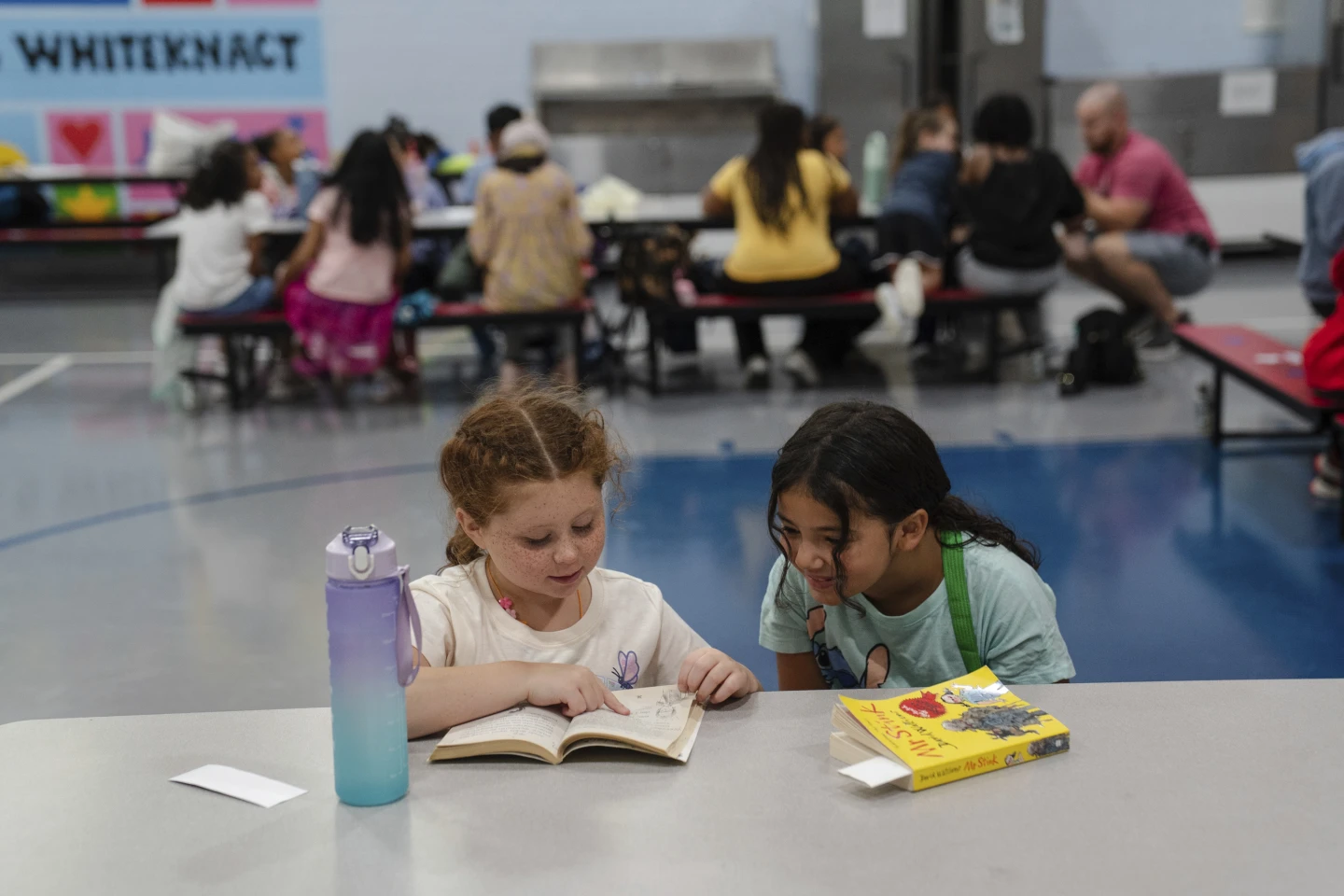
Boys & Girls Club programs threatened by Donald Trump grant freeze serve thousands of families
Published

on


After driving through a downpour to take her son to day camp, Darleen Reyes told camp administrators the rain would have kept her away but her son insisted on going.

As she marked her son’s name present on a clipboard at the Boys & Girls Club camp, she laughed about braving a flash flood warning to get there.

Before kissing his mother goodbye, Aiden Cazares, 8, explained to a reporter, “I wanted to see my friends and not just sit at home.” Then he ran off to play.

Aiden is one of 1.4 million children and teenagers around the country who have been attending after-school and summer programming at a Boys & Girls Club, the YMCA or a public school for free thanks to federal taxpayers. Congress set aside money for the programs to provide academic support, enrichment and child care to mostly low-income families, but President Donald Trump’s administration recently froze the funding.

The money for the 21st Century Community Learning Centers is among more than $6 billion in federal education grants Trump’s Republican administration has withheld, saying it wants to ensure recipients’ programs align with the President’s priorities.

After-school programs for the fall are in jeopardy

In Rhode Island, the state stepped in with funding to keep the summer programs running, according to the Boys & Girls Club of East Providence. Other Boys & Girls Clubs supported by the grants have found ways to keep open their summer programs, said Sara Leutzinger, vice president for communications for the Boys & Girls Club of America. But there isn’t the same hope for the after-school programming for the fall.

Some of the 926 Boys & Girls Clubs nationwide that run 21st Century Community Learning summer and after-school programs stand to close if the Trump administration doesn’t release the money in the next three to five weeks, Leutzinger said.

The YMCA and Save the Children say many of the centers they run are also at risk of shuttering.

“Time is of the essence,” said Christy Gleason, executive director of Save the Children Action Network, which provides after-school programming for 41 schools in rural areas in Washington state and across the South, where school will begin as soon as August. “It’s not too late to make a decision so the kids who really need this still have it.”

Schools in Republican-led areas are particularly affected by the freeze in federal education grants. Ninety-one of the 100 school districts that receive the most money from four frozen grant programs are in Republican congressional districts, according to an analysis from New America, a left-leaning think tank. Of those top 100 school districts, half are in four states: California, West Virginia, Florida and Georgia. New America’s analysis used funding levels reported in 2022 in 46 states.

Republican officials have been among the educators criticizing the grant freeze.

“I deeply believe in fiscal responsibility, which means evaluating the use of funds and seeking out efficiencies, but also means being responsible — releasing funds already approved by Congress and signed by President Trump,” said Georgia schools superintendent Richard Woods, an elected Republican. “In Georgia, we’re getting ready to start the school year, so I call on federal funds to be released so we can ensure the success of our students.”

The Office of Management and Budget said some grants supported left-wing causes, pointing to services for immigrants in the country illegally or LGBTQ+ inclusion efforts.

Summer clubs provide instruction for children

At the East Providence summer camp, Aiden, a rising third grader, played tag, built structures with magnetic tiles, played a fast-paced game with the other kids to review addition and subtraction, learned about pollination, watched a nature video and ate club-provided chicken nuggets.

Veteran teachers from his school corrected him when he spoke without raising his hand and offered common-sense advice when a boy in his group said something inappropriate.

“When someone says something inappropriate, you don’t repeat it,” teacher Kayla Creighton told the boys between answering their questions about horseflies and honeybees.

Indeed, it’s hard to find a more middle-of-the road organization in this country than the Boys & Girls Club.

Just last month, a Republican and a Democrat sponsored a resolution in the U.S. House celebrating the 165-year-old organization as a “beacon of hope and opportunity.” The Defense Department awarded the club $3 million in 1991 to support children left behind when their parents deployed for the Persian Gulf. And ever since, the Boys & Girls Club has created clubs on military installations to support the children of service members. Military families can sign up their kids for free.

“I suspect they will realize that most of those grants are fine and will release them,” said Mike Petrilli, president of the Thomas B. Fordham Institute, a conservative education policy think tank, speaking of the Trump administration’s review of the 21st Century Community Learning Center grants.

But not everyone is so sure.

Families see few affordable child care alternatives

Aiden’s mother has started looking into afternoon child care for September when kids return to school in Rhode Island.

“It costs $220 a week,” Reyes said, her eyes expanding. “I can’t afford that.”

The single mother and state worker said she’ll probably ask her 14-year-old son to stay home and watch Aiden. That will mean he would have to forgo getting a job when he turns 15 in the fall and couldn’t play basketball and football.

“I don’t have any other option,” she said.

At home, Aiden would likely stay inside on a screen. That would be heartbreaking since he’s thrived getting tutoring and “learning about healthy boundaries” from the Boys & Girls Club program, Reyes said.

Fernande Berard learned about the funding freeze and possible closure from a reporter after dropping off her three young boys for summer camp. “I would be really devastated if this goes away,” said the nurse. “I honestly don’t know what I would do.”

Her husband drives an Uber much of the day, and picking up the kids early would eat into his earnings. It’s money they need to pay the mortgage and everything else.

If her boss approves, she’d likely have to pick up her children from school and take them to the rehabilitation center where she oversees a team of nurses. The children would have to stay until her work day ends.

“It’s hard to imagine,” she said.

___

Republished with permission of The Associated Press.


Post Views: 0


Source link

Continue Reading

Politics

Michael Yaworsky says insurance costs are finally stabilizing for Floridians

Published

on


Florida Insurance Commissioner Michael Yaworsky said he believes the state’s insurance industry has stabilized, adding consumers “are finding relief” and have more options “than we’ve had in decades.”

“If you were in this meeting three years ago, it was like the equivalent of a funeral. It was very depressing; it was dark. Everyone thought the end was coming,” he said Friday during the Florida Chamber of Commerce’s annual insurance summit. “And two years later, we are in a fantastic place, seeing nothing but success on the horizon.”

In an interview this week with Florida Politics, Yaworsky said consumers went from “massive rate hikes year-over-year to very modest rate hikes.”

In some cases, people are seeking decreases, he added.

“Over 100 carriers have filed for a 0% increase or decrease,” he said.

But it’s clear Floridians are still worried about rising property insurance costs.

“The Invading Sea’s Florida Climate Survey also found that most Floridians – 54% – are worried about being able to afford and maintain homeowners insurance due to climate change,” Florida Atlantic University said in a press release this Spring. “According to a 2023 report by LexisNexis Risk Solutions, the average premiums for Florida homeowners rose nearly 60% between 2015 and 2023, the largest increase in any state.”

Yaworsky also touted reforms that would lower auto insurance costs.

“We’ve seen a $1 billion return to policyholders because despite the best actuarially sound estimates of just how good the reforms would be and how much of an impact that would have on rate making … It has exceeded all expectations,” he said.

In October, the state announced that the average Progressive auto insurance policyholder will receive a $300 rebate.

“A billion-dollar return from Progressive is just one of the first of what will likely be others,” Yaworsky told Florida Politics. “Those consumers will be getting additional money back in addition to rate reduction to make sure that insurers aren’t overcharging people because of the reforms.”


Source link

Continue Reading

Politics

Ron DeSantis says GOP must go on offense ahead of Midterms to bring back ‘complacent’ voters

Published

on


Gov. Ron DeSantis is continuing to warn Republicans that next year’s Midterm contests may not go their way if the party doesn’t change course.

He recommends that Republicans make a strong case for what they will do if they somehow retain control of Congress next year, given that “in an off-year Midterm, the party in power’s voters tend to be more complacent.”

But DeSantis, who himself served nearly three terms in Congress before resigning to focus on his campaign for Governor in 2018, says House Republicans haven’t accomplished much, and they need to be proactive in the time that’s left.

“I just think you’ve got to be bold. I think you’ve got to be strong. And I think one of the frustrations with the Congress is, what have they done since August till now? They really haven’t done anything, right?” DeSantis explained on “Fox & Friends.”

“I’d be like, every day, coming out with something new and make the Democrats go on the record, show the contrast.”

The Governor said the economy and immigration are two issues that would resonate with voters.

On immigration, DeSantis believes his party should remind voters that President Donald Trump stopped the “influx” of illegal border crossers given passage when Joe Biden was in power.

After providing contrast to some of his policy wins through the end of 2023 in Florida, DeSantis suggested that the GOP needs to blame the opposition party regarding continued economic struggles.

“Democrats, they caused a lot of this with the inflation and now they’re acting like … they had nothing to do with it,” he said.

DeSantis’ latest comments come after Tuesday’s narrow GOP victory in deep-red Tennessee, in yet another election where a candidate for Congress underperformed President Donald Trump.

Republican Matt Van Epps defeated Democrat Aftyn Behn by roughly 9 points in the Nashville area seat. That’s less than half the margin by which Trump bested Kamala Harris in 2024. This is after U.S. Reps. Randy Fine and Jimmy Patronis won by smaller margins than expected in Special Elections in Florida earlier this year.

Though partisan maps protect the GOP in many cases, with just a seven-vote advantage over Democrats in Congress there is scant room for error.

Bettors seem to believe the House will flip, with Democratic odds of victory at 78% on Polymarket on Friday morning.


Source link

Continue Reading

Politics

Ron DeSantis again downplays interest in a second presidential run

Published

on


The question won’t go away.

Gov. Ron DeSantis may be out of state, just like he was when he ran for President in 2024, but that doesn’t mean he’s eyeing another run for the White House.

“I’ve got my hands full, man. I’m good,” he told Stuart Varney during an in-studio interview Friday in New York City, responding to a question about his intentions.

DeSantis added that it was “not the first time” he got that question, which persists amid expectations of a crowded field of candidates to succeed President Donald Trump.

“I’m not thinking about anything because I think we have a President now who’s not even been in for a year. We’ve got a lot that we’ve got to accomplish,” the term-limited Governor told Jake Tapper last month when asked about 2028.

It may be for the best that DeSantis isn’t actively running, given some recent polls.

DeSantis, who ran in 2024 before withdrawing after failing to win a single county in the Iowa caucuses, has just 2% support in the latest survey from Emerson College.

Recent polling from the University of New Hampshire says he’ll struggle again in what is historically the first-in-the-nation Primary state. The “Granite State Poll,” his worst showing in any state poll so far, shows the Florida Governor with 3% support overall.

In January 2024, DeSantis had different messaging after leaving the GOP Primary race.

“When I was in Iowa, a lot of these folks that stuck with the President were very supportive of what I’ve done in Florida. They thought I was a good candidate,” DeSantis said. “I even had people say they think that I would even do better as President, but they felt that they owed Trump another shot. And so I think we really made a strong impression.”

But that was then, this is now.


Source link

Continue Reading

Trending

Copyright © Miami Select.