Connect with us

Business

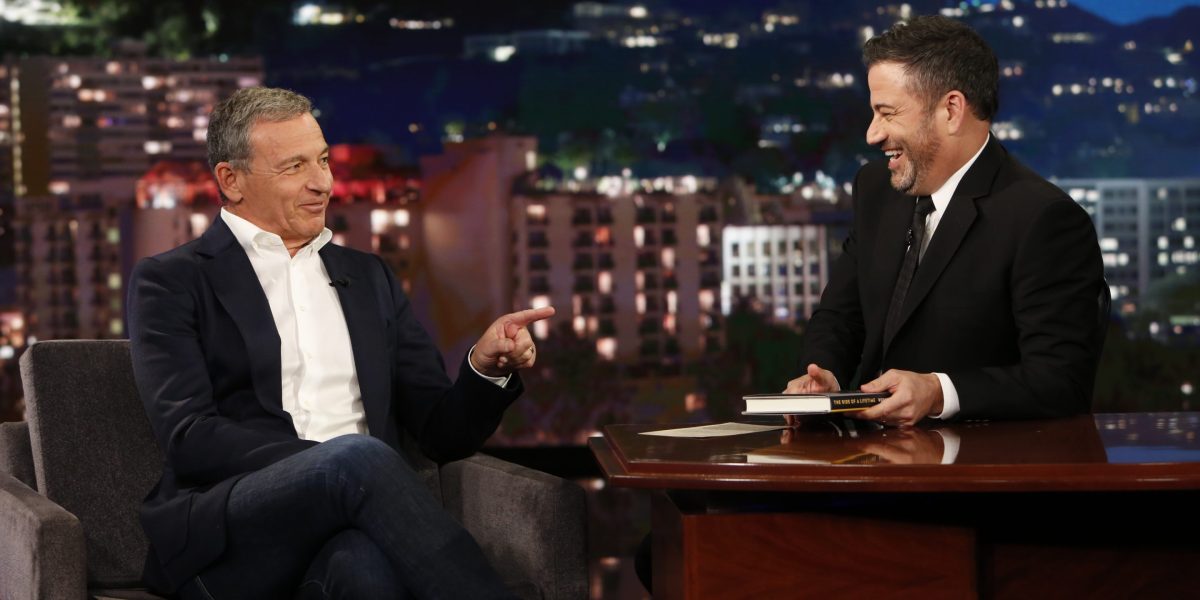
Bob Iger got it right suspending Jimmy Kimmel: It’s what Walt would have done

Published

on


Jimmy Kimmel could have saved his job with a simple apology for his tone—and he still could. Instead, he seems determined to continue to mix the murder and the MAGA in his monologues. 

The Hollywood trades are reporting that many people, from Disney corporate to ABC affiliates around the country, were begging Jimmy to apologize, as viewership and advertising were plummeting, and he just wouldn’t listen. We strongly believe that Disney CEO Bob Iger and Disney were concerned about real, lasting damage to the Disney brand, regardless of any executives’ personal political positions.

President Trump’s threats to suspend the licenses of any broadcasters who allow criticism of his administration, along with his meritless multibillion-dollar lawsuits against The Wall Street Journal and The New York Times, are an ominous cloud over freedom of expression and democracy. But the latest programming move by Disney should not just be seen as cowardly submission to an autocrat’s abuse of authority. 

Disney is coming under fire from critics on both sides of the aisle, with critics on the left outraged that they pulled their face of light-night TV off the air “indefinitely,” and critics on the right are outraged that Kimmel mocked Trump’s mourning of Charlie Kirk’s killing while seemingly mischaracterizing the politics of the alleged assassin. Funerals are not funny and responsible broadcasters always separate murder from mirth.  

Amidst a storm of outrage from both sides, we strongly believe that Iger is navigating a wise middle course, even if he isn’t getting much credit for it. The master builder of the brand, Walt Disney himself, would have done the same in a heartbeat. 

The romanticization of TV’s golden days is uninformed. Disney himself even went so far as to get sensitive film scripts and TV shows reviewed by the notorious FBI chief J. Edward Hoover. Do you think Iger is vetting Avengers scripts with Kash Patel? In fact, Iger has gone toe-to-toe against unwarranted government intrusion, standing by former GOP Governor Chris Christie as an ABC News commentator when he was being viciously attacked by Trump.

Critics are waxing nostalgic for the edgy and outrageous comments of social critic humorists such as Dick Gregory, Mort Sahl, George Carlin, and Don Imus, forgetting that none of those figures were ever the host of a broadcast network TV show. There were other outlets for them then and thousands more platforms for such free expression today. Guaranteed First Amendment legal rights in the town square are different from a private enterprise exercising editorial judgment on taste, respect and morality.

Iger’s choice to pull Kimmel off air was not a cowardly surrender to bullying by Trump or any kind of misguided, preemptive appeasement, contrary to what misguided scolds on the left are alleging. Sadly, misguided critics such as Kara Swisher are even lampooning Iger as a “quisling,” making an equivalence between the revered CEO of Disney and one of the despicable enablers of Hitler during World War II. And it’s similarly wrong to equate this with Shari Redstone’s cowardly concessions at Paramount.

Rather, this is merely one more reflection of how Iger has long sought to position Disney as a family-friendly, classic Americana brand with appeal across all sides while eschewing blatantly divisive programming.

That ethos has long guided Iger’s programming and content decisions, it’s really nothing to do with Trump. In fact, over a decade ago, when Sony was embroiled in controversy over a film depicting the fictional assassination of North Korean dictator Kim Jong Un, Iger confided in me that he would have never “greenlighted”  such inflammatory and offensive content, promoting murder as humor. Hewould never put Disney in such a position.

Just as Iger was not a Kim Jong Un apologist then, he is no Trump apologist now, and his choice to bench Kimmel is no concession to Trump but merely a reflection of his long-held vision for Disney’s brand. In fact, Iger candidly admitted that he pulled the plug on a prospective acquisition of Twitter a decade ago because he did not want Disney drawn into blatant political warfare.

This should always have been solely a private business enterprise call, but the current climate has let it get blurred by reckless bullying from Trump Administration officials, gleefully looking for political vengeance against a harsh critic.  In fact, Congressional officials are calling for the resignation of the FCC chair Brendan Carr for threatening to block the planned $6.2 billion merger between mega-ABC-affiliate Nextar (32 stations) and rival station operator Tegna. In fact, these threatening comments from the brash populist Carr was likely detrimental to his own self-professed goal of getting Kimmel off the air. If anything, Iger would have made the decision to pull Kimmel even faster without Carr wading in and giving it the appearance of a political drug deal. 

As huge fans of Jimmy Kimmel’s humor and political edge, citing examples almost weekly in classes and other forums, we acknowledge at the same time that what he said was wrong and insensitive. There is no dispute on that, even from Kimmel’s strongest defenders.

We haven’t hesitated to criticize Trump for genuine missteps and excesses, but Kimmel’s mockery of Trump’s mourning process — “this is how a four-year-old mourns a goldfish” — is indefensible amidst Trump’s mourning of a genuine long-time ally, gunned down in broad daylight at the tender age of 31. Similarly, Kimmel’s suggestion that “the MAGA gang (is) desperately trying to characterize this kid who murdered Charlie Kirk as anything other than one of them” doesn’t square with the facts which are known at this point. Regardless, these comments are blatantly insensitive as political violence should never be tolerated or exploited as comedic entertainment, no matter who perpetrated it.

Given Kimmel’s own self-inflicted errors, there should be no doubt that at a minimum, he needs to apologize and demonstrate genuine remorse. Thiswould present a pathway for him to return to the air, perhaps as soon as the next few days. Nobody deserves to be “canceled” and with hard lessons learned, second chances should be in order. But if Kimmel refuses to show contrition, then perhaps broadcast TV is no longer the right platform for him and he can become one of the 20,000 Substack authors writing for each other. It is unfortunate that, so far, he has refused that opportunity to restore his position and his bold brilliant voice.

Conversely, there should be no doubt that if Trump persists in using Kirk’s murder to justify retaliation against political rivals, the consequences for our country are dangerous.

Iger has been a fearless, equal opportunity offender in defending Disney’s corporate character, whether from intrusions by the left or by the right. He was criticized harshly from many on the political right when in 2018, he cancelled  Rosanne, then ABC’s #1 show, when its star imploded with a cruel racial tirade about President Obama’s former top advisor, Valerie Jarrett.

Iger saw no humor consistent with Disney’s brand in that episode. Barr’s bigoted character on and offscreen was far from the social satire and self-mocking of Archie Bunker of the 1960s, nor was it the breakthrough drama preaching racial tolerance from the film In the Heat of the Night.

Similarly, Iger was the very first CEO to stand behind Merck CEO Ken Frazier, who resigned from President Trump’s business advisory council when Trump failed to unequivocally condemn racial violence in Charlottesville, Virginia, which led to the murder of a peaceful young woman protester.

When Ron DeSantis foolishly attacked Disney and threatened to revoke its special tax-exempt status, effectively trying to frighten the entertainment giant into silence, Iger drew parallels with those CEOs who were intimidated into silence over human rights abuses during World War II, writing to his shareholders, “Those that stood in silence, in some ways, still carry the stain of indifference. So as long as I’m on the job, I’m going to continue to be guided by a sense of decency and respect.”

Just as some voices on the political right howled at Iger’s careful navigation of the Disney brand in earlier times, the political left should similarly respect Disney’s values now. Iger is threading the needle by safeguarding Disney’s brand as one that will continue to be guided by decency and respect, no matter how overheated political rhetoric becomes at times—on both sides.

The opinions expressed in Fortune.com commentary pieces are solely the views of their authors and do not necessarily reflect the opinions and beliefs of Fortune.


Source link

Continue Reading

Business

Ford CEO Jim Farley said Trump would halve the EV market by ending subsidies. Now he’s writing down $19.5 billion amid a ‘customer-driven’ shift

Published

on


Several months ago, Ford CEO Jim Farley said ending the nearly two-decade-long EV tax credit would halve America’s electric vehicle market. Now, his company is facing its own reality check.

Ford said this week it would cease production for the original electric F-150 Lightning, which was once touted as a breakthrough for the industry, and shift some of its existing workforce to producing a hybrid version of the pickup with a gas-powered generator called an EREV‚ or an extended range electric vehicle. The automaker said it would be taking a $19.5 billion charge in 2026 as a result of this “customer-driven shift.” 

With that in mind, it’s worth reviewing what Farley said at the Ford Pro Accelerate summit in Detroit in September. EVs will remain a “vibrant industry” going forward, he said, but also “smaller, way smaller than we thought.” The end of the $7,500 consumer incentive would be a game-changer, Farley added, before predicting that EV sales in the U.S. could plummet from to 5% from a previous 10%-12%.

Speaking to CNBC on Monday about Ford’s electric pivot, Farley claimed the EV market had, in fact, already shrunk to around 5% of the U.S. vehicle market. The automaker’s EV lineup was simply out of sync with consumer demand, he said.

“More importantly, the very high end EVs, the 50, 60, 70, $80,000 vehicles, they just weren’t selling,” Farley told CNBC.

Farley had established Ford’s Model E division in 2022 to innovate on electric vehicles and operate as a startup within the more-than-100-year-old automaker. At the same time, Farley told CNBC that he knew when he established Model E, it would be “brutal business-wise.” That may have been an understatement. In under three years, the Model E division has lost $13 billion, more than double Ford’s net income for 2024

As part of its pivot, Farley said the company is listening to consumers.

“We’re following customers to where the market is, not where people thought it was going to be, but to where it is today,” he said. 

This means prioritizing hybrid and semi-gas-powered EREVs over pure-play EVs. These categories are what customers are still interested in, Farley said. 

To be sure, the company says its Model E division will still be profitable, but in 2029, three years after the 2026 date it had previously targeted. By 2030, the company is also predicting that hybrids, semi-gas-powered EREVs, and pure-play EVs will make up half of Ford’s global sales, a stark increase from about 17% now. And most of that, Farley told CNBC, will be “hybrid and EREV.”

This story was originally featured on Fortune.com


Source link

Continue Reading

Business

A SpaceX IPO could be the largest public offering of all time—and Elon Musk’s biggest headache

Published

on


The SpaceX public offering could very well be the largest public offering of all time—bringing in even more money than Saudi Aramco’s cosmic $29 billion public listing in 2019. And with the rocketing costs (pun intended) that SpaceX would rack up as it paves the way for more test flights for the mega-rocket Starship it wants to send to Mars, the thousands of additional satellites it intends to send to orbit, and the artificial intelligence data centers it may decide to construct in outer space, some extra billions in cash sure wouldn’t hurt.

But the multibillion-dollar question is: Does Elon Musk really want the headaches that would come with all that money?

Since reports of the potential IPO emerged, would-be buyers have been acting like Christmas came early. Investors—from Wall Street mainstay institutions to the Elon fan-boys who trade shibu inu meme coins in their basements—will clamor to purchase shares in SpaceX on the public markets. The company, which Musk founded in 2002 with a large portion of the money he had made off PayPal, has quite literally built the foundation of America’s private space ecosystem. It is the leading space company in the world and is one of the U.S. government’s most important—and well-paid—private contractors.

Reporting has, thus far, pegged a potential market capitalization at $1.5 trillion, meaning that a public debut would immediately catapult SpaceX into the ranks of the 10 most valuable public companies in the world. Payload Space, which publishes detailed annual revenue research and estimates on SpaceX, forecasted that SpaceX will generate around $15 billion in revenue this year, and between $22 billion to $24 billion in 2026. Musk said earlier this month that SpaceX has been cash flow positive for “many” years. “The SpaceX IPO will be the most anticipated and successful IPO ever, in my opinion,” says Andrew Rocco, a stock strategist at Zacks Investment Research.

Early shareholders who have had to wait for their turn to sell shares in SpaceX’s liquidity events will finally get all the liquidity their hearts desire. And journalists like myself will finally have real visibility into the company’s business and profit breakdowns, and an explanation of what SpaceX has determined are key risks to the business. 

In short, pretty much everyone has a legitimate reason to get excited about a SpaceX IPO—except for Elon Musk.

It’s hard at first to grasp why Musk has suddenly become convinced that taking SpaceX public is worth the scrutiny, criticism, and regulatory burden he has long said he wanted to avoid. He was the leader who took Twitter private, after all, so he could instill sweeping layoffs and changes without the criticisms of the public markets. And, in earlier business history lore, he famously tweeted he was considering taking Tesla private in 2018—a tweet that prompted an SEC investigation and litigation with shareholders. Keeping his other companies private—including Neuralink, xAI, and the Boring Co.—has allowed Musk to run his businesses the way he likes without much public scrutiny.

Tesla—the only one of Musk’s six companies that is publicly traded—has, on several occasions, attracted more short sellers than any other stock in the last several years; Musk’s pay package has been ridiculed and challenged; his tweets have been investigated; and his improbable timelines for product delivery have been picked apart by analysts. Investors punished Tesla stock when Musk stepped away to work in the White House earlier this year, even as SpaceX, thanks to being private, was able to avoid much of the fallout. Indeed, quite the opposite: A share sale this summer pegged SpaceX’s value at $400 billion, while an impending tender offer will double that valuation, according to the Wall Street Journal

The fickle tendencies and demands of public investors haven’t only been inconvenient for Musk at Tesla; he’s sometimes taken them as a personal affront. In a 2017 interview, Musk described a heaping $9 billion short position into Tesla as “hurtful.” In March, during the heat of Musk’s episode running President Trump’s Department of Government Efficiency, Musk admitted on Fox News the personal toll the vandalism to Tesla vehicles and showrooms and Tesla’s plummeting stock price had taken on him.

If SpaceX goes public next year, it will be immediately thrown into the frenzy of Wall Street scrutiny over short-term financials, product delays, and costs. Few analysts will be asking Musk about his long-term plans for colonizing Mars. Surely Musk would never subject SpaceX—the beating heart of his broader cosmic ambitions—to the scrutiny that Tesla endures. That is: unless he felt it was the only option. 

Hitting the ceiling of private markets

It’s hard to imagine that Musk would ever take SpaceX public unless the math depended on it. And, to be sure, the math may not, at least in the short term. SpaceX’s CFO has reportedly told employees that whether and when an IPO would take place was “highly uncertain.”

To date, SpaceX has managed to reel in more capital than most other private companies in history. The company has raised more than $10 billion, according to PitchBook, a figure that, just a decade ago, would have sounded absurd. 

Of course, this is 2025, and—as the private markets have exploded as institutional investors like endowments, pension funds, mutual funds, and sovereign wealth funds have sought outsized returns in venture capital funds—companies like the AI juggernaut Musk cofounded, OpenAI, and TikTok-owner ByteDance have reached valuations in the hundreds of billions that are well above those of most public companies. An $800 billion tender offer would put SpaceX among the 20 most valuable public companies in the U.S., right alongside JPMorgan Chase, which has an $880 billion market cap, and Walmart, which was worth $931 billion at market close on Monday. 

But the private markets have their limits. While there may be some $2 trillion to $3 trillion in capital sitting on the sidelines, available to deploy into private companies—which is nothing to sneeze at—there is somewhere around $100 trillion to $150 trillion that has been invested in global equities, according to PitchBook emerging technology analyst Ali Javaheri. 

“SpaceX has effectively hit the ceiling of what private markets can support,” Javaheri says. “Financing a multi-decade, industrial-scale roadmap simply doesn’t map cleanly onto private fund structures.”

In pure numbers, reports peg discussions for a more than $30 billion raise for SpaceX, which would be—in a single listing—about three times the capital the company has raised since its inception in 2002. To be clear, not all that money would go to fund future SpaceX operations. In an IPO, it all comes down to which shareholders choose to float shares, and it remains to be seen how many shares—if any—SpaceX would list itself.

But it’s hard to imagine a scenario where SpaceX didn’t raise any money at all, or was simply under pressure from shareholders to give them an opportunity to cash out. The company does regular liquidity events, and there is never a shortage of demand. SpaceX’s board includes personal confidants as well as investors who have already made a fortune off of Musk’s various companies, and it would seem unlikely they’d be putting any kind of pressure on Musk to take the company public.

Given that SpaceX is already profitable, and therefore likely doesn’t need immediate cash to continue operation, SpaceX must need capital for some of its impending priorities.

If you follow Musk’s X account and public comments closely, he has suggested a series of places that money might go: the rollout of Starlink for mobile devices, data centers in space, Starlink factories on the moon, and a Starlink-esque satellite network around Mars. There’s the whole defense business, Star Shield, which we know so little about. SpaceX is also working on new Starship launch pads.

All of this will cost money—and a lot of it.

More scrutiny going public

Preparing SpaceX for an IPO would be a headache for Musk. For one, SpaceX would probably need to make some adjustments to its board. As we learned with Tesla early last year, there will be skepticism over whether its members are adequately independent—or if their ties are too close to the founder.

In the heat of the litigation over Musk’s compensation package agreement with Tesla, a judge determined that the process for approval for Musk’s compensation was “deeply flawed,” due to Musk’s close personal and financial ties with the members of the compensation committee, which included SpaceX board member Antonio Gracias.

Based on Fortune’s reporting, SpaceX’s board currently has six members. In addition to Musk and Tesla board member Gracias, who is an investor at Valor Equity Partners and a close friend of Musk; there is Luke Nosek, who was also a PayPal cofounder; Steve Jurvetson, one of the original SpaceX investors and a longtime friend of Musk; and Gwynne Shotwell, who is an insider as president and COO of SpaceX. The only truly independent board member seems to be Donald Harrison, who is president of global partnerships and corporate development at Google. That board composition could expose SpaceX to pressure from investors and potential litigation if it went public.

It’s “heavily weighted toward insiders and Musk loyalists,” PitchBook’s Javaheri says. “I would expect a meaningful expansion of truly independent board members ahead of any listing.”

There’s also ongoing litigation that would draw scrutiny should SpaceX start having to explain it in annual reports. The company is currently fighting a case with the National Labor Relations Board, over allegations from eight engineers who say they were fired for contributing to and signing an open letter that criticized Musk. In March 2025, an appeals court determined that the case could proceed, after SpaceX had attempted to block the Board from pursuing its claims.

Musk’s compensation plan at SpaceX—along with the compensation of all the other top executives, like Shotwell—will become public, too. And, depending on what those plans look like, they could end up provoking more public, and legal, attention.

To infinity and beyond

In 2018, Musk had the phrase “DON’T PANIC” written on the touchscreen of a Tesla Roadster that SpaceX launched into space on board the Falcon Heavy it was testing. It was in homage to one of his favorite books, A Hitchhiker’s Guide to the Galaxy, in which that message was written on the cover of a  guidebook meant to reassure confused space travelers who might be frightened by the chaotic universe they suddenly found themselves in.

As companies graduate from the private markets to the public, executives must start spending as much time reassuring their shareholders as they do running their businesses. There is a slowdown that happens when you have to explain and answer for the decisions you make, versus just looping in a few people on your board. For people like Musk—someone who will sometimes demand that engineers figure out how to catch a rocket with chopstick arms—there is a constant tension between the predetermined rules and bureaucracy of regulation and the desire to move faster, dream bigger.

At Tesla, Musk must balance his ultimate vision for humanoid robots and self-driving vehicles with quarterly metrics and manufacturing costs. A SpaceX IPO will almost certainly hinder the speed at which his plans for Mars become a reality. At the same time, it may be the money and financing generated via that IPO that is the only means to make it possible.

But, for Musk, it will be a sacrifice. He will have to spend an increasing amount of his time saying the same thing to his investors, over and over: DON’T PANIC.


Source link

Continue Reading

Business

Down Arrow Button Icon

Published

on


It was the week before Christmas, and Americans got one more dispiriting look at the jobs market. 

After a year of stalled hiring and “ghost jobs,” Americans are going back to school, retraining, and trying to get off the sidelines. But they’ve been flying blind after the longest federal government shutdown in history clouded the picture on job growth and unemployment. Finally, the October and November figures confirmed what most of them seem to feel already: The labor market has no room for them.

The unemployment rate rose to 4.6% in November, the highest since 2021. But this isn’t a standard recession: The BLS isn’t seeing layoffs happen as much in the private sector. Instead, it continues to see a virtual hiring freeze, two-thirds of a year after the bottom fell out of employment growth in April.

Jeffrey Roach, chief economist at LPL Financial, wrote in a note the jump in unemployment reflects a “transformation” in the labor force. Rather than unemployment being driven by layoffs, he said, “it was driven by an increase of individuals formerly not in the labor force.” In other words, people who had been without work for so long they weren’t considered to be in the labor force started looking during the holiday, and didn’t find any takers. 

Changes could be driven by ‘idiosyncratic spikes’

That shift is becoming increasingly visible in the data. During the past year, the total number of unemployed Americans has risen by more than 700,000. The fastest-growing segment isn’t people who lost jobs, but “re-entrants,” or workers returning after a period of inactivity. That number spiked roughly 20% year-over-year, outpacing every other category of unemployed, according to a note from Nicole Bachaud, ZipRecruiter’s labor economist. 

Bank of America Research, in a note by U.S. economist Shruti Mishra and her team, noted this increase was “noisy,” driven by one-time effects and “idiosyncratic spikes.” One such example she noted was the indirect impacts of DOGE. These “furloughed employees,” she said, likely drove this spike in unemployment. Leisure and hospitality jobs also fell in November, “likely due to slower air travel” as the FAA struggled with staffing. Air-traffic controllers were ordered to work without pay for over a month and the government slashed hundreds of flights, a situation the Trump administration addressed by only giving post-shutdown bonuses to the 776 workers who had perfect shutdown attendance, leaving out nearly 20,000 others. 

Bachaud wrote she saw the increase of re-entrants as a “positive” signal, though, for the labor market, since it counteracts the dual negative forces of “an aging population and lower immigration.” It suggests people who were previously sidelined—by caregiving, health issues, or discouragement—are willing or compelled to try again, “rebalancing the labor force,” Bachaud wrote. 

But in many cases, re-entry might not be a sign of optimism so much as a necessity. Pandemic savings are gone, inflation has strained household budgets, and higher borrowing costs have made living on one income more difficult to sustain. As financial cushions thin, the rebalancing Bachaud referenced is a function of the economy pushing more Americans back into the job search.

The Department of Government Efficiency (DOGE), Elon Musk’s short-lived effort to reduce the size of the federal government, also clearly drove a sharp federal payroll drop: The federal government shed 162,000 jobs in October alone as government employees’ “fork in the road” buyout offers took effect. Data suggests when Uncle Sam moves to aggressively shed headcount, it has a chilling effect on the entire private sector.

How the job search is changing 

The average job search is also lengthening, another sign the hiring door is locked. The number of people unemployed for 27 weeks or more has climbed more than 15% during the past year, now accounting for nearly one-in- four unemployed workers, Bachaud calculated. At the same time, the ranks of marginally attached and discouraged workers—those hovering at the edge of the labor force—are also growing, suggesting some re-entrants may be cycling back out after failing to land work.

Wages are also no longer providing much of a cushion. Average hourly earnings rose just 0.1% in November, slowing annual growth to 3.5%, the weakest pace since 2021. This slowing down in wage growth, Roach wrote, “may turn out to be a big story for the job market in the coming months.”

Slower wage gains have the positive of easing inflation pressures—beneficial in a time in which more Americans complain about affordability—but they also limit income growth for households already facing tighter job prospects.

Industry data reinforces the imbalance. Outside of health care, social assistance, and construction, hiring has been flat to negative in recent months. Seasonal hiring—which typically helps absorb marginal workers over the holidays—has “disappointed this year,” particularly in retail, leisure, hospitality, and transportation, Bill Adams, chief economist for Comerica Bank, wrote in a note.

Adams described the labor market as having “hit an air pocket” in the fourth quarter. Federal job losses amplified the slowdown, but private-sector hiring outside a narrow set of industries has also failed to keep pace with rising labor-force participation.

The S&P 500 greeted the news with a disappointed shrug, down 0.8% intraday, as the jobs report was balanced by an October retail sales report that surprised to the upside, showing Americans are still splashing the cash, driving the all-important consumer spending that powers two-thirds of GDP. But as a general lump of coal in the stocking, Mishra concluded after so many months of strong spending that appears bifurcated by income cohort and a “low-hire, low-fire” jobs market, “the consumer labor conundrum remains.”


Source link

Continue Reading

Trending

Copyright © Miami Select.