Connect with us

Politics

Blaise Ingoglia calls for more stipulations to proposed local government spending legislation
Published

on


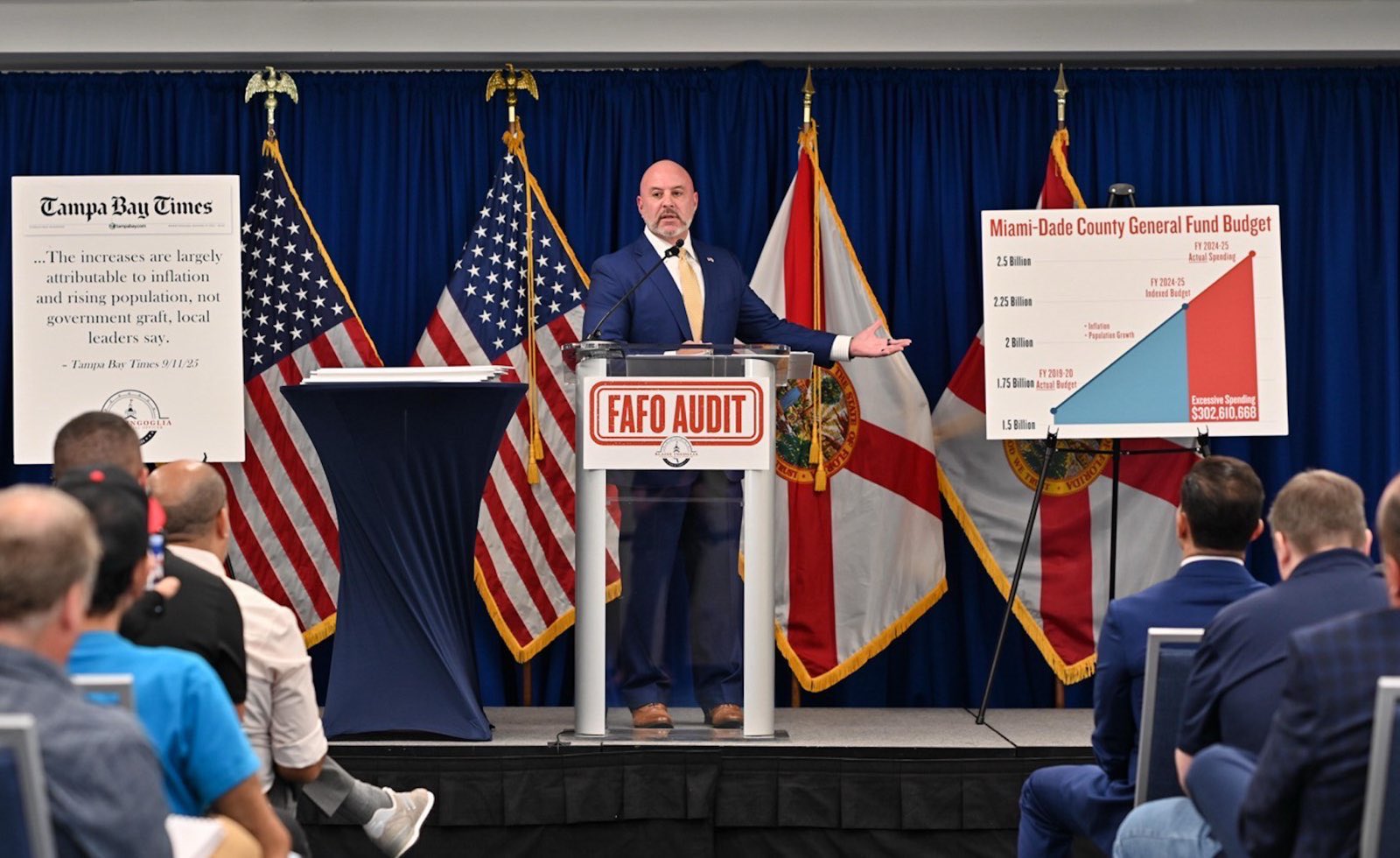
Chief Financial Officer Blaise Ingoglia rolled out additional stipulations Thursday in his proposed legislation to tighten spending plans for local governments in Florida.

On the heels of his initial announcement on Wednesday, Ingoglia held another news conference in Winter Park to outline additional elements of legislative proposals he wants state lawmakers to consider during the Florida Legislative Session, which begins Jan. 13.

Ingoglia announced that the proposed measures would require local governments to post all proposed budgets in easily accessible online formats at least two weeks before annual budget hearings begin at the regional level. Any budget amendments should be posted online seven days before hearings.

“Too often local budgets are being passed that local taxpayers cannot follow,” Ingoglia said during his Central Florida appearance.

Ingoglia added that he wants to “mandate” that all municipal governments review all proposed annual budgets and identify at least 10% of their spending plans that could be eliminated. He said that would exclude spending on police, fire and public safety departments.

Ingoglia said the proposed legislation would also eliminate diversity, equity and inclusion (DEI) awards by local governments to contractors for municipal projects. Sometimes, there are incentives for letting contracts to companies that engage in DEI considerations, a move Ingoglia called “division, exclusion and indoctrination.”

He said awarding contracts should be based only on merit and price.

Thursday’s announcements were additions to Ingoglia’s initial announcement the day before on proposed legislation. He’s been visiting several counties since the Summer and has ripped at least 11 local governments for what he calls overspending and overtaxation. He concluded his tour of different counties and cities on Dec. 4 in Palm Beach County, where he blasted the government for “wasteful and excessive” spending.

To bring some of that municipal spending under control, Ingoglia’s proposed legislation would establish what he calls the Florida Agency for Fiscal Oversight (FAFO) as a permanent initiative and agency. And there are several other elements to the legislation.

Ingoglia said he already has several members of the Florida House of Representatives and Senate who are willing to sponsor the bills. He added that Gov. Ron DeSantis is encouraged by the proposals as well.

Rep. Yvette Benarroch, a Naples Republican, was at Thursday’s event and said she’s thrilled to back Ingoglia’s proposed legislation.

“It’s about trust, respect and most of all the taxpayers who pay the bills,” Benarroch said.


Source link

Continue Reading

Politics

AARP study shows Medicare negotiations will bring massive savings for consumers in 2026

Published

on


New abilities for Medicare to negotiate prescription prices mean certain drugs should be 50% to 70% cheaper for many Floridians in 2026.

That’s according to an analysis by AARP.

“That’s real relief for older adults who have been stretched to the breaking point by high drug prices for far too long,” said AARP Executive Vice President Nancy LeaMond in a media briefing.

The study looked specifically at how negotiated prices impact customers in five states with a high number of Medicare users: Florida, California, New York, Pennsylvania and Texas. Medicare has selected 25 drugs so far to start price negotiations.

The AARP study shows out-of-pocket costs for the first 10 Medicare-negotiated prescription drugs, which are used by 9 million Medicare seniors to treat diabetes, heart disease, autoimmune disorders and cancer, will drop by more than half for those on standalone Medicare Part D plans.

AARP attributes those savings to a law signed by former President Joe Biden in 2022 and backed by the AARP for years.

LeaMond said it’s especially valuable now, at a time when upward of 95% of Americans age 65 and older have at least one chronic condition, and close to 80% are dealing with two or more.

“The law now requires Medicare to identify high-cost drugs and negotiate lower prices on behalf of beneficiaries and the taxpayers who help fund the program,” she said.

“The law also stops price gouging by requiring rebates when companies raise prices faster than inflation. It caps insulin at $35 per month for people on Medicare, makes vaccines for things like shingles free, and limits what folks in Medicare drug plans pay out of pocket for their prescriptions. And today’s new AARP analysis shows that the 2022 law will continue to make a big impact, helping older Americans save money on their prescriptions.”

Medicare Part D currently provides prescription drug coverage for nearly 56 million Americans, according to Leigh Purvis, the AARP Public Policy Institute’s Prescription Drug Policy Principal and the author of the report.

“Rising drug prices have placed an immense burden on many of these enrollees, leading far too many to make difficult choices like not filling prescriptions or skipping doses to make ends meet,” Purvis told press. “This is particularly troubling for those on fixed incomes, where every dollar counts.”

But AARP cautioned that the policies could also draw reaction from pharmaceutical companies.

“Beware: big drug companies are spending millions to delay negotiation and keep prices sky high — while lining their own pockets,” LeaMond said. “As the voice for 125 million Americans age 50 and over, AARP will keep fighting any attempts to undermine Medicare’s ability to negotiate prescription drugs.”

In total, the change should provide a collective $1.5 billion in out-of-pocket costs to Medicare enrollees in 2026, based on figures available from the Centers for Medicare & Medicaid Services.

AARP has also supported state policies, like giving the ability to import cheaper drugs internationally. Florida in January 2024 received a long-sought approval to import certain prescription drugs, making it the first state to win such an approval.

Megan O’Reilly, AARP Vice President of Public Affairs, stressed that AARP supports importation efforts.

“We know there’s a number of states in different processes and discussions with the federal government,” she told Florida Politics. “As we talk about AARP support across the board for all the different levers that we think can have an impact on lowering drug prices and the costs that seniors pay, importation has been one of those issues we’ve been strongly advocating on.”

But Purvis cautioned that the process for such approvals is a lengthy one. Florida’s request to the federal government was pending for two years.

“Most of the states that have engaged in this still have not fully completed that process,” Purvis said. “But one really important criteria is that they have to be able to demonstrate savings, and so should a program be finally approved and implemented? The expectation is yes, they should see savings from having that program in place.”

The study came out as Congress debates health care reforms and the best way to address health care costs. The U.S. House on Wednesday passed a Republican-crafted plan that leadership said should reduce insurance premiums for most Americans, but which notably included no extension of pandemic-era tax credits tied to the Affordable Care Act insurance marketplace.

Will that change impact drug costs? AARP officials noted that the legislative package included a pharmacy benefit manager (PBM) policy. The senior advocacy organization has yet to take a public stance on that specific measure, but said it broadly supports reforms to the PBM system.

AARP has backed Senate language in a bipartisan health care proposal from U.S. Sens. Mike Crapo, an Idaho Republican, and Rob Wyden, an Oregon Democrat. LeoMand said the organization will ultimately support any proposal with proven opportunity to “bring relief and efficiencies to prescription drug pricing and make improvements in the drug supply chain.”


Source link

Continue Reading

Politics

Ron DeSantis gives more grants to help rural infrastructure

Published

on


To help preserve rural Florida, Gov. Ron DeSantis announced a new round of state grants totaling $311 million to bolster infrastructure in some of Florida’s less populated areas.

“There’s a lot of flavors in Florida, but Miami is not for everybody,” DeSantis said at a news conference Thursday in Sebring. “Having the old Florida is important for our culture. It’s important for our economy, and ultimately I think it’s something that we have to preserve.”

Some of the projects getting state funding are from Senate President Ben Albritton’s district.

“It helps to have the President of the Florida Senate be from Wauchula and Hardee County,” DeSantis said. “Ben Albritton, he’s a good guy.”

Wauchula will get a $2.4 million grant “to support wastewater system repairs, rehabilitation and floodwater,” the Governor said, while Hardee County will receive $1.9 million to clean up the Peace River.

Other grants include $22 million to the city of Avon Park in Highlands County for the city’s sanitary sewer collection system and $3 million for the Sebring Airport Authority to demolish and replace the existing stormwater system and handle other infrastructure needs at the Sebring Regional Airport and Multimodal Logistics Center.

For the Avon City project, “I know people have been asking for that for a long time. So we delivered on that,” DeSantis said.

DeSanis also announced about $16 million in Citrus County for replacing the sanitary sewer system and nearly $6 million in Bradford County for road improvement projects. Jacksonville Electric Authority will get $20 million to redirect wastewater flows to JEA’s existing wastewater treatment facility.

“Some of this stuff, honestly, isn’t sexy, but it’s important,” DeSantis added.

Baker County’s Macclenny will get nearly $8 million to improve the Ohio Street Water Treatment Plant, as well as almost $5 million to the city of Palatka in Putnam County to enhance and expand its wastewater treatment plant, plus $14 million in the town of Arcadia in DeSoto County to widen the main stormwater channel.

DeSantis also said the state is giving $13.5 million in grants for 11 small rural infrastructure projects.

“I bring like $20 million to Miami, and it’s like not a big deal,” DeSantis said. “The money goes farther in some of the rural (areas) and so we’re happy to be able to be a champion for rural Florida.”

DeSantis, who has been pushing to repeal property taxes, is also facing criticism that his plan could disproportionately harm rural communities, according to a new study released this week by the Florida League of Cities.


Source link

Continue Reading

Politics

Gov. DeSantis gives state employees the gift of extra paid time off

Published

on


Gov. Ron DeSantis is playing Santa and giving state employees some extra holiday time off.

State offices will officially be closed on Dec. 26 and Jan. 2, per DeSantis. That’s on top of the normal days off for Christmas Day and New Year’s Day. The Governor also already gave employees off an extra day on Nov. 26.

“Our state employees have worked hard throughout the year,” DeSantis said in a press release. “I hope they enjoy additional time off with loved ones and friends this holiday season. The First Lady and I are thankful for their continued dedication to the people of Florida.”

Times have been good in the state of Florida this year: There have been no hurricanes, with the season officially ending this month, and surpluses in the budget have been used to pay off the state’s debt early.

DeSantis — and a long line of Florida Governors — have given state employees extended holiday weekends. (Private sector bosses, take note!)

For instance, for this year’s July 4 holiday, DeSantis also shut down state offices on July 3 for the 100,000 people in the State Personnel System.

Former Govs. Rick Scott and Charlie Crist also gave more time off during the holidays.

Florida employees normally get nine holidays off throughout the year: New Year’s, the birthday of Martin Luther King Jr., Memorial Day, Independence Day, Labor Day, Veterans’ Day, Thanksgiving and the Friday after, and Christmas.

However, not everyone benefits when the state offices shut down.

According to media reports, OPS, or the “part-time employees hired to fill temporary staff shortages,” won’t get the extra paid time off and are essentially furloughed.


Source link

Continue Reading

Trending

Copyright © Miami Select.