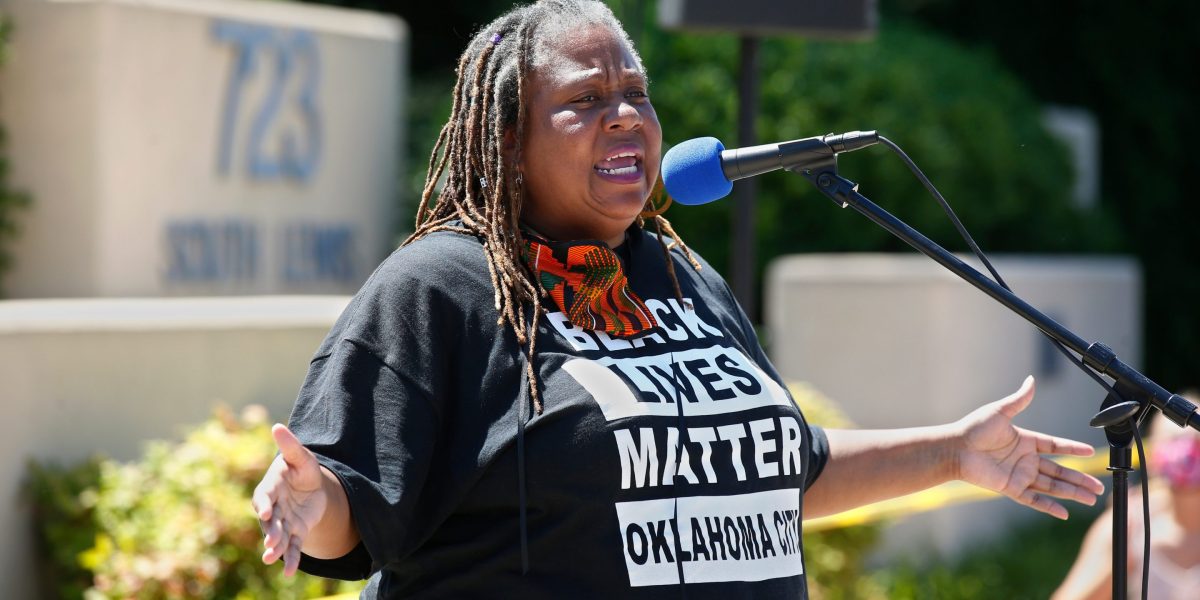
Tashella Sheri Amore Dickerson, 52, was indicted earlier this month on 20 counts of wire fraud and five counts of money laundering, court records show.
Court records do not indicate the name of Dickerson’s attorney, and messages left Thursday at her mobile number and by email were not immediately returned.
According to the indictment, Dickerson served since at least 2016 as the executive director of Black Lives Matter OKC, which accepted charitable donations through its affiliation with the Arizona-based Alliance for Global Justice.
In total, BLM OKC raised more than $5.6 million dating back to 2020, largely from online donors and national bail funds that were supposed to be used to post bail for individuals arrested in connection with racial justice protests after the killing of George Floyd by a Minnesota police officer in 2020, the indictment alleges.
When those bail funds were returned to BLM OKC, the indictment alleges, Dickerson embezzled at least $3.15 million into her personal accounts and then used the money to pay for trips to Jamaica and the Dominican Republic, retail shopping, at least $50,000 in food and grocery deliveries for herself and her children, a personal vehicle, and six properties in Oklahoma City deeded to her or to a company she controlled.
The indictment also alleges she submitted false annual reports to the alliance stating that the funds were used only for tax-exempt purposes.
If convicted, Dickerson faces up to 20 years in federal prison and a fine of up to $250,000 for each count of wire fraud and 10 years in prison and fines for each count of money laundering.
In a live video posted on her Facebook page Thursday afternoon, Dickerson said she was not in custody and was “fine.”
“I cannot make an official comment about what transpired today,” she said. “I am home. I am safe. I have confidence in our team.”
“A lot of times when people come at you with these types of things … it’s evidence that you are doing the work,” she continued. “That is what I’m standing on.”
The Black Lives Matter movement first emerged in 2013 after the acquittal of George Zimmerman, the neighborhood watch volunteer who killed 17-year-old Trayvon Martin in Florida. But it was the 2014 death of Michael Brown at the hands of police in Ferguson, Missouri, that made the slogan “Black lives matter” a rallying cry for progressives and a favorite target of derision for conservatives.
The Associated Press reported in October that the Justice Department was investigating whether leaders in the Black Lives Matter movement defrauded donors who contributed tens of millions of dollars during racial justice protests in 2020. There was no immediate indication that Dickerson’s indictment is connected to that probe.