
Politics
Bird-defending Audubon chapter defeats Florida development planned by nation’s largest homebuilder
Since the 1880s we’ve referred to dopey people as birdbrains. I contend it’s a misnomer. Birds are actually pretty smart — think about how far they migrate without any access to maps or GPS! I think the people who like birds are pretty smart too.
Exhibit A of my argument would be what the Sarasota Audubon Society has accomplished in defending a bird sanctuary called the Celery Fields. A piece of property next door was targeted for development by the nation’s largest homebuilder, D.R. Horton, but the Audubon folks didn’t chicken out. They took them on and won.
“Sarasota County again rejects D.R. Horton development near Celery Fields,” the Sarasota Herald-Tribune reported last week.
The decision wasn’t even close, either — a 5-0 vote by the Commissioners to tell the big homebuilder to go home.
I was so intrigued by what happened that I contacted the Sarasota Audubon folks. I wound up talking to their President and their attorney.
“I saw this as the wrong development on the wrong piece of land in the wrong place,” the attorney, Susan Schoettle, told me.
The President, Sara Reisinger, explained their success even more concisely.
“This property floods,” she told me. “After (Hurricane) Debby, it was under 3 feet of water.”
Still, getting a Florida government agency to reject a major homebuilder is what the ornithologists would call “a rara avis.”
Suckered in Sarasota
Many Florida towns have oddball origin stories. The Panhandle hamlet of Two Egg got its name from a local store where the poor residents bartered for goods. Central Florida’s Nalcrest was built by retired postal workers from the National Association of Letter Carriers. Sweetwater in South Florida was populated by a troupe of Russian circus midgets. Sarasota was settled by a bunch of Scotsmen who got suckered into buying lots in a town that hadn’t been built yet.

“When the steamer ship that brought them to Florida arrived at its destination in 1885, “the colonists gathered to see their new home but could not find it,” the Sarasota History Alive website reports. “There was not a sign of a town anywhere up or down the coast. It was then that the colonists found out that the Town of Sarasota just existed on a map.”
By the mid-1900s, Sarasota really WAS on the map. It became nationally known as the winter quarters of the Ringling Brothers and Barnum & Bailey Circus. The Oscar-winning 1952 circus movie “The Greatest Show on Earth,” starring Charlton Heston and Jimmy Stewart, was filmed there.
Sarasota has come a long way since those days. It’s now known for its culture and sophistication, with opera, ballet and multiple theater companies. In Sarasota, the circus is now confined to the Ringling Museum and the occasional political shenanigan.
Sarasota has plenty of environmental attractions, too, from acclaimed Siesta Beach to majestic Myakka River State Park.
And that includes the Celery Fields.
Swamp to celery to swamp again
Sarasota’s most influential early resident was Bertha Palmer, wife of millionaire Potter Palmer and the woman many called “the Queen of Chicago.”
When she bought more than 100,000 acres of land in Florida in the early 1900s, she had lots of ideas about turning swamps into farms — including one parcel for growing celery.
In 1995, though, Sarasota County bought the Celery Fields with an eye toward a different use for the land: turning it back into a swamp. The county acquired the 400-acre parcel “primarily for stormwater management purposes to intercept and store upstream runoff from the largely undeveloped watersheds north and east during extremely heavy rain events, thereby to prevent downstream flooding,” former Sarasota County administrator John Wesley White told me.
Then someone hatched the notion that the Celery Fields could also be for the birds both local and migratory.
“The idea of the Celery Fields becoming a bird rookery and nature park only occurred after we started excavating the site to create more storage capacity,” White added. “It has become a popular draw for those purposes.”
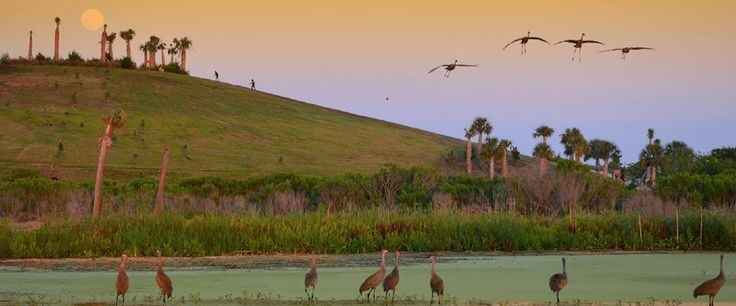
County officials worked with Audubon to restore about 100 acres to resemble the wetlands that existed before Mrs. Palmer came along. The property is edged by oaks, willows, and pines, and the county built a pair of boardwalks to accommodate visitors. Audubon has counted more than 240 kinds of birds that use the site originally intended just for stormwater.
“It’s an incredible example of a dual-purpose facility,” Reisinger told me.
Sarasota Audubon folks love the Celery Fields so much they built their $1 million nature center there. You could say they’ve nested there. The nature center is open from October to May to accommodate Sarasota’s snowbirds.
The staff and volunteers hold regularly scheduled hikes. It’s become a major eco-tourist destination, attracting 130,000 visitors a year from all over the world.
But then D.R. Horton swooped in, ready to ruin things by building a bunch of houses next door.
Strike one
Builders are having a tough time these days. They’re reeling from a presidential one-two punch: his tariffs on steel, copper and lumber has driven up the costs of building materials, and his crackdown on immigration has chased away lots of their employees.
Nevertheless, D.R. Horton marched into a Sarasota County planning and zoning meeting a year ago with big plans, seeking to rezone a 50-acre ranch.
They wanted to change it from “open use rural,” which allows one unit per 10 acres, to “residential single family,” which allows 3.5 units per acre. That way they could build 170 houses.
More than 100 people flocked to the meeting, a crowd that the Herald-Tribune described as “mostly middle-aged and older residents, fed up with what they see as rampant over development.”
The developers’ land-use attorney, Charles “Charlie” Bailey III, crowed that the Horton project would create more wildlife habitat than what was on the existing ranchland. Feel free to roll your eyes about that claim. I sure did.
He also pointed out that the developers had met with Sarasota Audubon officials to discuss their objections to the project. Reisinger confirmed that such a meeting happened. But she also said that Audubon’s objections didn’t suddenly fly away because of the meeting.
“We were very adamant right from the beginning that this was not a suitable site for development,” Reisinger told me.
While the county’s land-use plan would allow this kind of project to be built, Schoettle told me, it fails to meet a major condition included in county rules.
“The development has to be compatible with the adjacent land uses,” Schoettle explained. “D.R. Horton knew when they entered into a contract to buy the land that it was next to the Celery Fields bird sanctuary.”
In the end, the planning and zoning committee agreed. They voted 4-3 to tell Commissioners to keep the zoning the way it was, no matter what D.R. Horton wanted.
In February, the developers tried again.
Strike two
This time, they attempted to egg the County Commissioners on to reject the committee’s recommendation. Bailey characterized their prior defeat as the developer having “received some meaningful feedback,” which I think belongs in the Putting a Positive Spin on Bad News Hall of Fame.
Now D.R. Horton wanted to build 126 units. The project was the same turkey, just smaller.
“We hope that you’ll see the great effort that D.R. Horton went into to ensure that this property is done the right way,” Bailey said.
Five hours of comments followed, with 61 speakers ranging from a 9-year-old girl to a 90-year-old retiree. I watched the video. Not a single person piped up in favor of D.R. Horton’s Plans.
People talked about everything from the impacts on the Celery Fields’ nesting and migratory habitat, to the economic impact of losing such an important eco-tourism site, to D.R. Horton’s horrible national reputation for building bad homes.
Plenty of bird fans squawked about the dire consequences of approving the rezoning. But the lineup of opponents recruited by Sarasota Audubon also included a stormwater expert, a landscape architect and even an urban planner, all of whom talked in detail about how inappropriate this development would be on that site.
One of the speakers, retired New College environmental science instructor Jono Miller, pointed out that the property was listed as flood-prone by both the state and federal government.
He questioned where the water from Hurricane Debby would have gone if Horton had already built its 126 houses there.
The County Commissioners, after a brief discussion, voted Horton’s rezoning request down 5-0.
Their two defeats led D.R. Horton to take an unorthodox step.
Strike three
This time, the company was the one that squawked. It filed a complaint through the Florida Land Use and Environmental Dispute Resolution Act. It’s designed to provide a speedier resolution than just suing.
The act allows property owners to seek arbitration if they feel a local development decision “unreasonable or unfairly burdens” them. That arbitration effort brought them back before the Commission last week with a brand-new proposal.
Now, Bailey told the Commissioners, D.R. Horton wanted permission to build a mere 85 homes on that soggy property.
Bailey promised there would be no streetlights to spook the birds. And he said his clients would install flood protection measures that would be more stringent than what the county usually required.
The bird fans came loaded for bear.
“This would be our only opportunity to talk to the board about their decision, so we showed up with 10 people who spoke for three minutes each,” Schoettle told me. “We reminded them why this was a bad idea and they should reject it. They did.”
The Commissioners’ 5-0 vote marked a third strike for the mighty Horton, which went down swinging just like “Casey at the Bat.”
The reason was simple, one Commissioner said: “I mean, this is a flood plain.”
Next step
Reisinger told me Audubon’s triple victories were “shocking.” She’s right.
But they’re also instructive for anyone going through something similar. If you’re trying to preserve your slice of Florida paradise from the runaway growth that’s wrecking a lot of special places around the state, then you need to imitate the Sarasota folks like you’re a mockingbird.
The lessons are: Be organized, know how land-use law works, keep your emotions in check as you focus on your goal, present photos showing the downside of the development and use subject-matter experts to testify.
Property rights are fine, but “there is no right to a rezoning,” Schoettle reminded me.
I asked Miller why the Sarasota Commissioners — each one a self-described fan of property rights — were uniformly opposed to D.R. Horton’s rezoning.
“Our latest County Commission is generally more willing to say no than the previous version,” he told me (so remember that come election time). He also said it’s a sign of the “general awareness that citizens have had it with growth.”
He also credited “better than average organizing” by the Audubon opponents, using “dramatic images” of the site being flooded last year.
Although the Sarasota Audubon folks have won three times, they’re under no illusion that they have triumphed permanently. Like a mama bird preparing to fight off a persistent predator, they’re ready for rounds four, five and six.
But they have come up with a possible solution, one that would allow the current owner of the property to get a profit from selling it.
Just not to D.R. Horton.
“We’d like to see the county purchase it,” Schoettle told me. “It would be a useful addition to the Celery Fields.”
Wouldn’t that be a wonderful conclusion to this birdbrained story? I hope it happens. For the Audubon folks, that would be a real feather in their caps.
___
Reporting by Craig Pittman. Florida Phoenix is part of States Newsroom, a nonprofit news network supported by grants and a coalition of donors as a 501c(3) public charity. Florida Phoenix maintains editorial independence. Contact Editor Michael Moline for questions: [email protected].