Sports
Big Ten and SEC look at Miami and FSU for the future
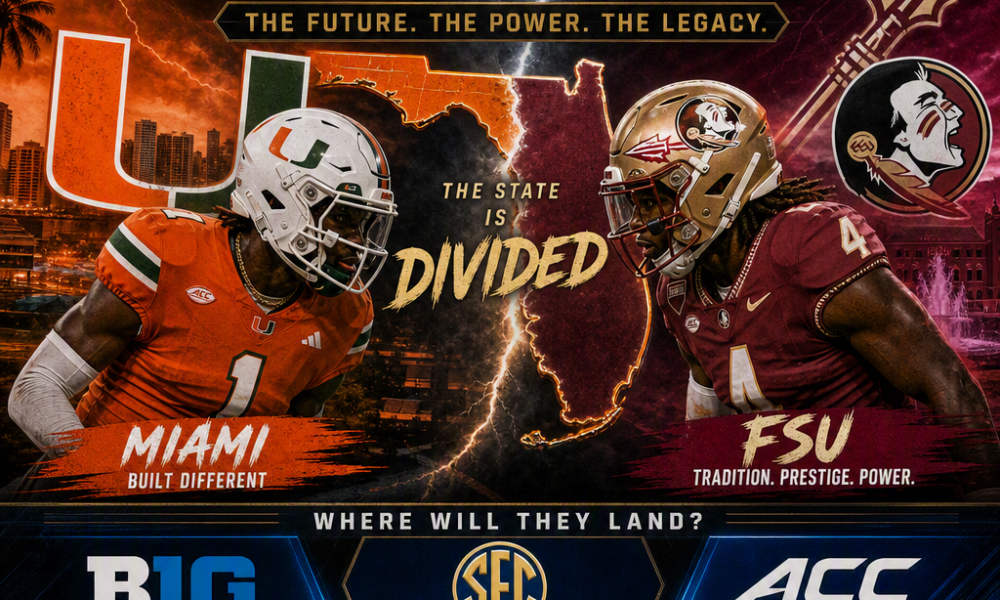

The next major chapter in college football realignment could arrive in 2030 or 2031, when the ACC’s exit cost falls to a level that makes a Big Ten or SEC move financially realistic for its biggest brands.
For Miami, the Big Ten remains the best overall fit. For Florida State, the SEC remains the most logical destination because it combines geography, football culture and the chance to turn Florida-Florida State into a major annual conference rivalry.
Neither school has an announced invitation, and both could remain in the ACC. But the odds become more serious once the cost of leaving reaches $75 million in the 2030-31 period.
The Realignment Percentages
These are projections, not reports of pending moves. They reflect current conference fit, media value, institutional profile, existing rivalries, likely television demand and the ACC’s changing exit structure.
| School | SEC by 2031 | Big Ten by 2031 | Remains in ACC through 2031 | Other conference or outcome |
|---|---|---|---|---|
| Florida State | 55% | 25% | 15% | 5% |
| Miami | 20% | 45% | 30% | 5% |
Florida State has an estimated 80% chance of landing in either the SEC or Big Ten by 2031. Miami has an estimated 65% chance of joining one of those two leagues, with the Big Ten clearly its more likely destination.
The difference is simple. Florida State has the stronger SEC profile. Miami has the stronger Big Ten profile.
The ACC Exit Fee Opens the Door
The ACC settlement involving Florida State and Clemson created a more realistic exit route for schools that decide the league no longer provides the best long-term financial answer.
The exit fee falls from $165 million in 2026 to $75 million by 2030-31. The settlement also allows a departing school to regain its media rights after paying the applicable fee.
That means 2030 and 2031 become the key years.
A $75 million payment remains substantial. No athletic department will casually write that check. But a school headed to the SEC or Big Ten could view the fee as an investment, particularly if it expects a significantly higher annual conference distribution and a more valuable long-term media platform.
The larger question is whether the Big Ten and SEC want to expand, have room to expand and believe Miami or Florida State creates new value for their media partners.
Miami is a better Big Ten candidate than an SEC candidate.
The Hurricanes bring a historic football brand, South Florida recruiting access, a metropolitan identity and a major-market presence. Miami’s national profile can rise quickly when the football program is competing for conference titles and College Football Playoff access.
The Big Ten also offers Miami a strong institutional fit.
Miami is an AAU university, which adds credibility in a conference that has traditionally valued academic profile, research standing and institutional alignment. The Big Ten is no longer restricted by its old Midwest map after adding USC, UCLA, Oregon and Washington. A South Florida school would fit the league’s larger national strategy.
Miami would give the Big Ten an entry point into a crucial recruiting region. It would also give television partners a recognizable brand in Miami-Fort Lauderdale, one of the country’s largest and most diverse sports markets.
That is why the Big Ten is Miami’s preferred realignment destination.
Miami’s estimated 45% chance of joining the Big Ten by 2031 is based on the academic fit, recruiting value and market opportunity. The main concerns are whether the league expands again, how many spots it has available and whether another candidate such as Notre Dame, North Carolina or Virginia becomes a higher priority.
The SEC Has a Miami Problem
Miami would be competitive in the SEC, but the University of Florida complicates the equation.
Florida already gives the SEC an established brand in the state. The Gators have benefited from being Florida’s lone SEC member, a status that affects recruiting, donor interest, statewide visibility and conference identity.
Adding Miami could create more attractive games, especially Florida-Miami. But it also would weaken Florida’s exclusive SEC position.
The SEC does not need Miami to gain access to Florida. It already has Florida.
That means Miami must be sold as a national television brand rather than simply a Florida-market acquisition. Miami has a different identity from Florida: a private institution, an urban South Florida setting, a national championship history and a distinctive cultural profile.
Sources at Miami have told Sports Talk Florida that the Big Ten remains the preferred destination. If the Big Ten invitation does not arrive, the SEC could become a fallback possibility. Miami remaining in the ACC is also a real scenario, which is why the Hurricanes carry a 30% estimated chance of still being in the league through 2031.
Florida State Is Built for the SEC
Florida State has the strongest SEC case among the ACC’s premier football programs.
The Seminoles fit the conference geographically, competitively and culturally. Tallahassee sits in the SEC’s traditional footprint. Florida State recruits against SEC programs, has a large football-first fan base and carries the kind of championship history that fits the league’s brand.
FSU’s 55% SEC probability reflects more than location. It reflects the television opportunity created by an annual conference game against Florida.
Florida-Florida State already has the ingredients of a major national rivalry: state pride, recruiting stakes, history, passion and potential playoff implications. Making it a conference game would elevate its value even further.
Florida-FSU Would Be a Television Event
The SEC’s appeal is built around annual rivalries that draw viewers regardless of the rankings.
Florida-Georgia, traditionally called the World’s Largest Outdoor Cocktail Party, is a signature event. Alabama-Auburn is the Iron Bowl. Mississippi-Mississippi State is the Egg Bowl. Oklahoma-Texas carries the Red River rivalry. Tennessee-Vanderbilt remains an annual in-state game.
The SEC’s current format assigns three annual opponents to each of its 16 schools, emphasizing the preservation of many traditional rivalries. Florida’s annual opponents through 2029 are Georgia, Kentucky and South Carolina. Alabama’s include Auburn, Mississippi State and Tennessee.
Florida versus Florida State would immediately become one of the SEC’s most marketable annual games.
Television networks would know they have a major rivalry every year. The game could carry conference title implications, College Football Playoff stakes and recruiting consequences throughout the state. It would be a high-visibility broadcast property before either team plays its first game of the season.
That is why FSU to the SEC makes so much business sense.
The Cleanest 2030 Outcome
The most logical split remains Florida State to the SEC and Miami to the Big Ten.
Florida State gives the SEC a traditional football power, a geographic fit and a major new annual rivalry game with Florida. Miami gives the Big Ten an AAU institution, a South Florida recruiting base and a nationally recognized brand in a major metro market.
That outcome is not guaranteed. The ACC could retain both schools. The Big Ten may choose another expansion target. The SEC may decide that adding a second Florida program is not worth the political and economic complications.
Still, the percentages point toward separate paths.
Florida State is more likely than not to be an SEC school by 2031. Miami is more likely to join the Big Ten than the SEC, but the Hurricanes’ ACC future remains very much alive if the Big Ten does not extend an invitation.