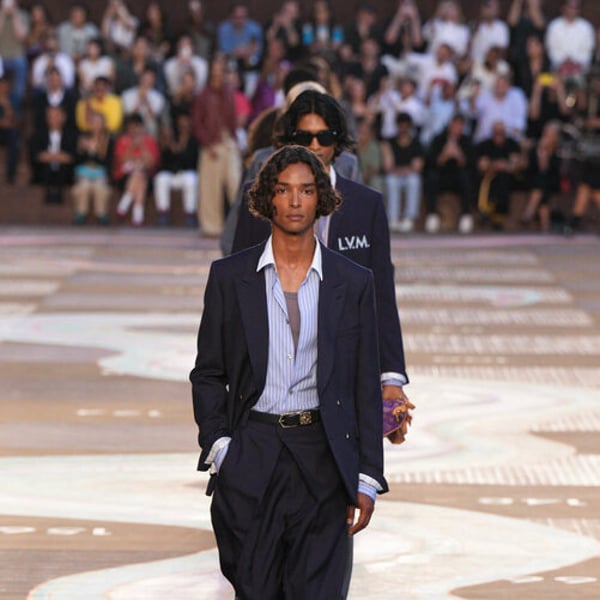
Bernard Arnault is pressing ahead with two major developments on Rodeo Drive in Beverly Hills, tightening his grip on one of the world’s most exclusive retail corridors.
Arnault’s luxury conglomerate, LVMH Moët Hennessy Louis Vuitton SE, is planning a new Tiffany & Co. flagship store on the site of the old Luxe Hotel, which will be demolished, according to city filings reviewed by Bloomberg.
Just a block away, LVMH has submitted plans for a big new Louis Vuitton store and cultural campus designed by architect Frank Gehry – a pivot from the company’s original plan to build a hotel, which was rejected by voters in 2023. The new proposal would be the company’s largest project yet in the tony Los Angeles-area enclave.
LVMH is deepening its bet on Rodeo Drive as it contends with headwinds including higher US tariffs on European goods and what it described in July as softening demand in key markets such as China and Japan. Despite that weakness, Rodeo Drive still draws a steady flow of wealthy visitors from Asia, the Middle East and the Americas, offering a palm-tree-lined stage and selfie backdrop that few other shopping venues can match.
Rodeo Drive is in a league with shopping high streets such as Madison Avenue and Fifth Avenue in Manhattan and the Miami Design District, said Milton Pedraza, chief executive officer of Luxury Institute, a consulting firm. “There are some places and spaces that are iconic, and they are some of the most pleasant and desirable places to be.”
LVMH declined to comment for this article. Executives have previously named Rodeo Drive on a select list of places where it makes more sense to own than rent.
“You can mention Paris, London, New York and Fifth Avenue and probably Rodeo Drive in Los Angeles and that’s about it,” Jean-Jacques Guiony, LVMH’s chief financial officer at the time, said on a 2023 earnings call.
The Paris-based company already has spent more than $900 million on 12 leased or owned boutiques on Rodeo Drive over the years. That includes a new three-floor Bvlgari boutique opening in October.
Its plans to invest more underscore the strength of high-end luxury in the Los Angeles area even as the regional economy struggles in the aftermath of the deadly wildfires in January, a downturn in Hollywood and US immigration raids backed up by a temporary military deployment.
LVMH bought the Luxe Hotel site for $200 million in 2021. Plans for the Tiffany project, the most recent version of which was filed Aug. 4 with the Beverly Hills planning commission, haven’t been publicly announced.
Designs filed with the city call for a three-story building on Rodeo Drive spanning 30,466 square feet (2,830 square meters), featuring a rooftop indoor-outdoor space for very important clients and a restaurant. The plans by architect Peter Marino are wending their way through the planning department. The plan is occurring as LVMH renovates its Tiffany stores, a process that’s about 30% complete, CFO Cecile Cabanis said in July.
The campus proposed for Louis Vuitton calls for about 100,000 square feet in two buildings connected by pedestrian bridges and an underground tunnel, according to an application with the planning commission. The development, which LVMH disclosed earlier this year, would include luxury retail, a cafe, restaurant, open-air terrace, exhibition space and a garden rooftop. If approved by the city, construction could start in 2026 and finish by 2029.
Pedraza likened the concept to a theme park, with LVMH “becoming more like Disney or Universal Studios than they are just purveyors of luxury goods.”
LVMH originally planned a Cheval Blanc hotel for the same corner of Rodeo Drive and South Santa Monica Boulevard, a proposal rejected by Beverly Hills voters after a contentious fight over zoning and public benefit.
This time, the company’s proposal doesn’t require changes in zoning rules. Darian Bojeaux, an attorney who led opposition to the hotel, said she doesn’t personally like what’s being proposed — but she isn’t campaigning against it either, saying it’s her understanding that the project complies with local codes.
For Beverly Hills City Councilmember John Mirisch, who also opposed the hotel plan, the earlier fight wasn’t over luxury itself but whether the development gave enough back to the community. While he hasn’t taken a position on the Louis Vuitton campus, Mirisch said the project could offer a civic benefit if it draws from LVMH’s art holdings.
“If they use that to feature the amazing LVMH world-class art collection and bring that to Beverly Hills, that would be a tremendous community benefit,” he said.
LVMH’s latest plans cap a buying spree on the street that began more than a decade ago, mirroring its approach in other global hot spots such as New York and Paris, where it paid $1 billion in 2023 for a retail property on the Champs-Elysees.
In 2012, LVMH paid $85 million for a site on Rodeo Drive now being developed into a Dior flagship opening later this year. Between 2018 and 2020, the company spent another $465 million to piece together four parcels for the planned Cheval Blanc hotel.
“There’s these hubs where people go and they have expectations of what stores are there — and if you’re not there, then the money flows to competitors,” said Justin Mateen, a tech and real estate investor who co-founded Tinder.
Mateen and his brother Tyler paid $211 million in 2024 for a building on the corner of Rodeo and Wilshire Boulevard they plan to rebrand as One Rodeo, a new deluxe retail venue.
Prime real estate on Rodeo Drive typically commands annual rents of between $960 and $1,200 a square foot, while store sales often top $10,000 per square foot, said Houman Mahboubi, a broker with CBRE Group Inc.
“That limited supply creates urgency for groups like LVMH to buy rather than lease,” said Mahboubi, who was involved in the sale of the Luxe Hotel site.
Beverly Hills trailed only New York in new luxury openings from July 2023 to July 2024, with Rodeo Drive accounting for more than 40% of all new luxury space in the Los Angeles market, according to a report from Jones Lang LaSalle Inc.
Strong demand illustrates the willingness of high-end brands to splurge on one of the areas that make up the “absolute core” of global glamor, said Jay Luchs, vice chairman at Newmark Group Inc. and a longtime broker on Rodeo Drive. It’s not just about securing space on the street, he said. It’s about appearing on the feeds of influencers who flock to Rodeo Drive.
“People that have hundreds of millions of followers on Instagram — those are very important in fashion and in influence in the world,” he said.
In the last four years, Italian luxury outerwear label Moorer has doubled its revenue by extending its product range and opening several monobrand stores. Its founder and CEO Moreno Faccincani took back full control of the company in October 2025. In fiscal 2025, Moorer recorded revenue of approximately €60 million, growing in single digits. The Verona-based company’s performance was driven by Italy, Germany, the USA and Japan.
Moorer, Fall/Winter 2026-27
Last May, Moorer moved from its previous Milanese showroom into new, 1,000 sq m+ premises elsewhere in the city, in viale Regina Giovanna. A strategic decision dictated by Moorer’s desire to showcase the full extent of its collections, which now also include womenswear and feature a total look approach covering all product categories. Besides outerwear, whose revenue share has fallen from 95% to 70% of the total in the last five years, Moorer also sells shoes, knitwear, trousers and perfumes, as well as a first skiwear capsule collection launched last year.
Moorer products are available at Milan’s Global Blue tax-free shopping lounge in via Sant’Andrea, where they are on display for two months ahead of the Milano-Cortina Winter Olympics, and are also available at Moorer’s monobrand store in Cortina d’Ampezzo.
Moorer has expanded its mountain resort range, introducing high-tech ski suits with linings decorated with prints of the Dolomites, enhanced by silk details and equipped with deep, comfortable pockets. The garments almost look like works of art. In the Fall/Winter 2026-27 collection, Moorer has extended its knitwear assortment, introducing new models and original prints, broadened its footwear’s colour palette, and premièred a socks range.
Moorer, Fall/Winter 2026-27
Retail-wise, Moorer currently operates monobrand stores in via Montenapoleone in Milan, at Ginza in Tokyo, and in Prague, Knokke (Flanders) and Cortina d’Ampezzo. Six months ago, the label opened a new store in via Borgognona in Rome. A 260 sq m store with 11 shop windows is scheduled to open in New York City, in the heart of the Meatpacking District, in March. It will be followed in September by a store in Miami, and by a second store in Japan.
Moorer’s growth is underpinned by a substantial investment plan. The company is now operating its e-shop in-house, and has hired new staff to reach a total of 200 employees.
It serves approximately 600 wholesale clients worldwide, and is boosting its direct presence within multibrand stores by means of pop-up projects, marketing activations involving shop windows, and by setting up more permanent shop-in-shops. The label’s wholesale channel growth is primarily driven by the DACH area. Moorer is currently the best-selling outerwear brand at Lodenfrey in Munich. The label will soon open a new corner at Harrods, while the space at Rinascente in Milan has been converted into a concession following its successful sell-out results.
A year and a half after his co-founder, Max Svärdh, stepped back, Albin Johansson is likewise taking a step back at Axel Arigato, the label they co-founded in 2014. In June 2024, the Swedish brand, renowned for its trainers and chic streetwear, appointed Jens Werner as creative director, a role previously held by Max Svärdh.
Axel Arigato boutique – Axel Arigato
At that time, Albin Johansson retained the role of chief executive of the brand, in which Eurazeo acquired a majority stake in 2020. However, at the start of 2026 the company- which reportedly surpassed SEK 1 billion in revenue in 2024 (over €90 million)- has handed this role to Frédéric Serrant. He brings more than 16 years’ experience in international leadership roles across Asia and Latin America, gained at the sports and lifestyle giant Adidas.
His expertise is expected to help Axel Arigato reach a new milestone after years of expansion. The brand operates more than 15 own-name stores in major Scandinavian cities, as well as in key locations such as London, Paris, New York, Dubai, and Berlin. It is also stocked in numerous department stores worldwide. That expansion, however, has posed challenges, eroding the company’s margins between 2023 and 2024. The company, which has yet to file its 2025 results in Sweden, has therefore had to refine its strategy to improve profitability.
‘I am genuinely impressed by the remarkable work done so far to make Axel Arigato such a strong, distinctive, and inspiring brand. It truly reflects the talent, passion and commitment of the teams, and I am convinced that the brand’s potential is enormous. I look forward to joining the team, learning alongside them and writing the next chapters of the Axel Arigato story together,’ said Frédéric Serrant in a message on LinkedIn.
Albin Johansson will remain chairman of the board of directors.
This article is an automatic translation. Click here to read the original article.
Everything is in place for the major innovation of Pitti Immagine’s Winter 2026 shows: the concurrent scheduling at Florence’s Fortezza da Basso of the events dedicated to childrenswear and yarns, with Pitti Bimbo 102 scheduled for January 21 and 22 and Pitti Filati running from January 21 to 23.
On the Top Floor of the Central Pavilion, Pitti Bimbo brings together more than 100 childrenswear brands, over 65% of which are from abroad. “This winter edition of Pitti, and the one next June, are very important for the fair, because we expect them to provide feedback- and we trust it will be a positive endorsement- of the new approach we have given to the exhibition offering, aligning it with the profound transformations in children’s clothing and accessories, which in recent seasons have accelerated at a very fast pace,” commented Raffaello Napoleone, CEO of Pitti Immagine. “The fragmentation of the production structure, the polarisation between luxury and fast fashion, the drastic downsizing of retail, not to mention regressive demographic trends and their effects on consumption models and volumes. It was inevitable that all this would completely call into question the entire international trade fair system, including our show. We do not hide the difficulties; the next steps are crucial, but Pitti Bimbo remains the most important event in Europe and the only champion of Italy’s industry in the sector- a high-quality, long-established industry. Reacting, innovating, and proposing effective meeting formats are our duty, and we are working on this with great determination.”
Interpreting the “Motion” theme of Pitti Immagine’s winter shows through the cute penguin Pitt, the star of the campaign created by Amedeo Piccione, the show will bring together on the Top Floor of the Central Pavilion all the facets of childrenswear: from the big names and leading brands that reinterpret adult fashion in mini-me form, to younger, pioneering research labels spanning fashion, design, toys, objects, and small furnishings.
Spanish brand Bobo Choses is a partner in The New Edit project.
During the show, Miniconf celebrates 35 years of Sarabanda with an art project that reinterprets the brand’s most iconic campaigns through a contemporary lens, spanning four decades of style and creativity with four works created by Casentino artist Elia Fiumicelli.
New for this edition is the debut of The New Edit, a project focused on contemporary childrenswear that pairs collections with special events and presentations, developed in collaboration with Spanish brand Bobo Choses, which leads the line-up alongside Cozmo, Grey Label, Maison Mangostan, Mini Rodini, PiuPiuChick, The Campamento, The New Society, Tangerine, and True Artist.
The Family Circle, the marketplace founded in Hamburg by Nadine Jung, once again brings to the fair a selection of lifestyle labels and emerging designers that combine quality, attention to materials, and a playful approach to style. The featured brands are 2StoriesKids, Alwero, Bygge, FabFabStickers, Holzwald, Igelkind, Kiko+ & gg, Little Who, and Organicera. In addition to individual stands in the Pitti Bimbo exhibition itinerary, The Family Circle curates a collective exhibition area dedicated to the latest trends, featuring the brands Ambosstoys, Cosy Roots, Routinchen, The Momence Club, and Yogitier.
Finally, Ama Gioconaturalmente, Italy’s leading distributor of brands specialising in kids & family lifestyle, presents a carefully curated selection of high-quality labels, perfect for supporting children’s growth and fulfilling their wishes: Hoppstar, Kids’ Concept, Oli&Carol, Play&Go, Petit Jour Paris / Maison Petit Jour, Quut, Scoot&Ride, Wild&Soft, Egmont Toys, We Are Gommu, and Trixie.
Turning to Pitti Filati, 103 companies are presenting their S/S 2027 collections, including many of the most important Italian and international spinning mills. In detail, there are 67 exhibitors in the Filati area (including nine from abroad: the UK, Japan, Turkey, China, Peru); 21 companies in the CustomEasy area (five from abroad: Japan, Romania, China); 10 exhibitors within the KnitClub area (three from abroad: Hong Kong, Japan, the US); and five companies in the Institutional Area (including one from Australia).
During the show, the Feel the Yarn knitwear contest returns, now in its 17th edition, showcasing the mood boards of 34 participants, selected from over 150 entries and paired with 34 spinning mills from the Feel the Yarn group.
The two shows have separate entrances, but childrenswear brands and designers also have the opportunity to visit Pitti Filati and its Spazio Ricerca to draw inspiration for their future collections.
This article is an automatic translation. Click here to read the original article.