Connect with us

Business

Before Maduro arrest, opposition leader Mariá Corina Machado said Venezuelans should run country

Published

on


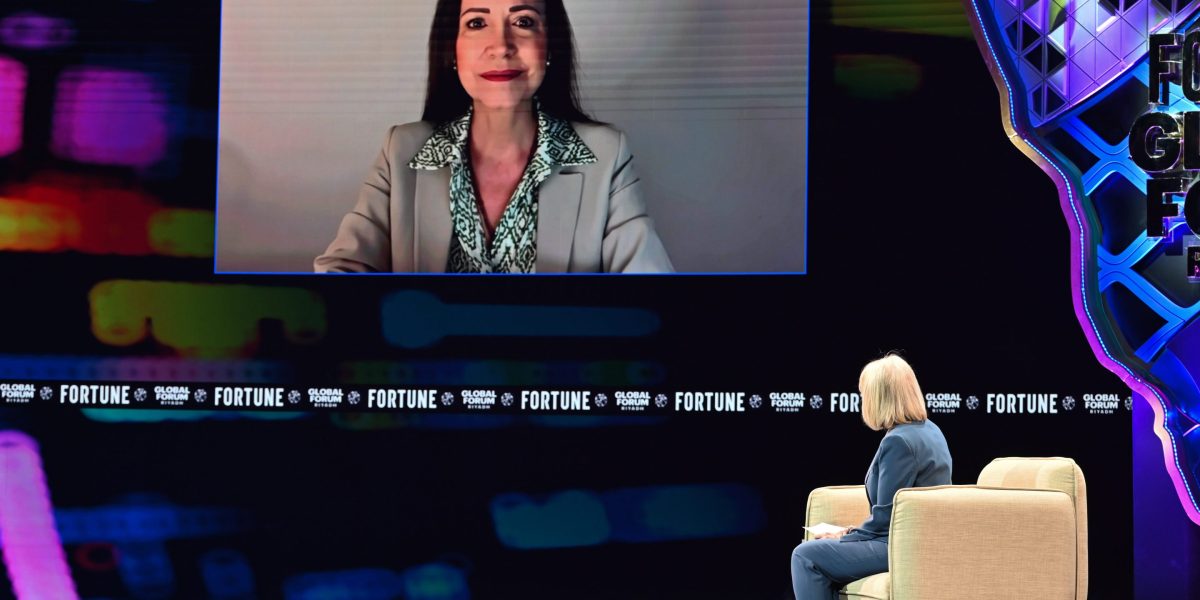
Good morning. A little over two months ago, I interviewed Venezuelan opposition leader and 2025 Nobel Peace Prize winner Mariá Corina Machado at the Fortune Global Forum. She spoke to us from an undisclosed location, later escaped to Norway, and remains in hiding. One of the most prominent advocates for reform in a country that was praised as a stable and affluent democracy just a generation ago, Machado was blocked from running for president in Venezuela’s 2024 election. Edmundo González ran in her place and won, according to independent observers. 

With Donald Trump’s surprise invasion of Venezuela to arrest President Nicolás Maduro and his wife on drug trafficking charges, many might have assumed that Machado would be chosen to lead. Instead, Trump picked Maduro’s deputy, Delcy Rodríguez, saying Machado lacked the respect needed.

Of course, much can change in the coming days. Rodríguez described Trump’s move as a criminal military intervention that violated international law while Machado thanked the U.S. for its action in a letter posted on X. But anyone who leads Venezuela right now faces a Faustian choice, as Trump has said the U.S. will temporarily “run” the country and boasted that Americans are “going to be taking a tremendous amount of wealth out of the ground” from the country’s vast oil reserves.

Rodríguez refuses to accept any violation of national sovereignty, despite Trump’s threats, and Machado won’t, either. The Nobel Prize winner said as much in her letter and was clearly hesitant to endorse the administration’s methods when we spoke in October. At that time, the U.S. was deploying war ships to the Caribbean and had blown up ten Venezuelan boats because of suspected drug trafficking. When I asked her if it was right for the U.S. to take such unilateral action, she deflected to accusing Maduro of criminal actions. While Machado welcomes U.S. support—“Maduro started the war; President Trump is ending the war”—she made it clear that Venezuelans could handle it from here.

“We are ready to take over; we know what we need to do,” she told me back in October, predicting a $1.7 trillion opportunity for foreign investors. “Venezuela will be the single biggest economic opportunity for decades to come in this region.” You can watch the full interview here. And be sure to check out Jeff Sonnenfeld’s memo to CEOs on the aftermath of U.S. action in Venezuela.

Contact CEO Daily via Diane Brady at diane.brady@fortune.com

Top news

Opportunity in Venezuela

Foreign investors are already circling Venezuela as the regime change promises to unlock business opportunities in the country. A former Chevron executive is raising $2 billion for Venezuelan oil projects while a group of American investors is planning to visit Venezuela in March. At the same time, the U.S. oil majors with enough resources and expertise to tap Venezuela’s proven oil reserves—the world’s largest—were reportedly blindsided by the Trump administration’s action, plus it’s unclear if the world has an appetite for more oil

How to ‘run’ Venezuela 

The urgent question following the U.S.’s ouster of Maduro is how the U.S. will “run” Venezuela, as Trump has promised to do. Trump suggested Sunday night that the U.S. has direct control of the country, while Secretary of State Marco Rubio has said the U.S. will coerce Venezuela’s new leadership to get what it wants. 

Bitcoin surges

Bitcoin hit a three-week high of just over $93,000 Monday following the U.S.’s arrest of Maduro. Investors seem to be regarding the top cryptocurrency as a safe haven amid geopolitical turmoil. Bitcoin ended 2025 down 6.5%. 

Is Greenland next?

The U.S.’s intervention in Venezuela is heightening tensions between Denmark and Washington as Trump and his allies suggest that they’re eyeing Greenland, a Danish territory, next. “We do need Greenland,” Trump said Sunday. Danish Prime Minister Mette Frederiksen has demanded that Trump stop his “threats against a historically close ally.”

The risk of ‘fiscal dominance’

Former Fed Chair Janet Yellen is warning that preconditions for “fiscal dominance”—in which the Federal Reserve maintains low interest rates to minimize debt servicing costs, rather than control inflation, due to the size of the federal debt—“are clearly strengthening.” If Trump succeeds in convincing the Fed to keep rates low for that reason, the U.S. could become a “banana republic,” Yellen says.

College matters again

As white collar hiring slows and companies dismantle DEI mandates, corporate recruiters are once again relying on university credentials as a way to screen potential candidates, favoring elite institutions. A survey of employers found that a quarter are now hiring from a shortlist of schools, up from 17% in 2022. 

BYD overtakes Tesla

China’s BYD is now the world’s largest seller of fully-electric vehicles after beating Tesla’s sales in 2025. BYD sold about 2.26 million battery-electric cars last year, nearly 28% more than in 2024, even as its overall auto business recorded its slowest annual growth in several years. Tesla, by contrast, has logged its second consecutive year of declining vehicle sales.

Another shutdown deadline

The U.S. Congress is back in session this week as the deadline for the next government shutdown looms less than four weeks away, though both Senate Minority Leader Chuck Schumer and Senate Majority Leader John Thune indicated over the holidays that another funding stalemate is unlikely.

The markets

S&P 500 futures were up 0.27% this morning. The last session closed up 0.19%. STOXX Europe 600 was up 0.36% in early trading. The U.K.’s FTSE 100 was up 0.13% in early trading. Japan’s Nikkei 225 was up 2.97%. China’s CSI 300 was up 1.90%. The South Korea KOSPI was up 3.43%. India’s NIFTY 50 was down 0.3%. Bitcoin was at $93K.

Around the watercooler

Behind glam luxury brands Michael Kors and Jimmy Choo lurks a troubled holding company losing millions by Amanda Gerut

Michael Saylor’s Strategy flirts again with the danger threshold at which his company is worth less than his Bitcoin by Jim Edwards

Even top CEOs check their phones first thing in the morning—these are the apps business executives are reaching for by Emma Burleigh

CEO of $90 billion Waste Management hauled trash and went to 1 a.m. safety briefings—‘It’s not always just dollars and cents’ by Amanda Gerut

Bosses are fighting a new battle in the RTO wars: It’s not about where you work, but when you work by Nick Lichtenberg

CEO Daily is compiled and edited by Joey Abrams, Claire Zillman and Lee Clifford.


Source link

Continue Reading

Business

Singapore-based startup founder Anand Roy thinks generative AI can help fix a broken music sector

Published

on


For Anand Roy, making music used to mean jamming with his progressive rock band based out of Bangalore. Today, the one-time metalhead now makes music with a simple tap of a button through his start-up Wubble AI, which allows users to generate, edit, and customize royalty-free music in over 60 different genres.

Roy started Wubble with his co-founder, Shaad Sufi, in 2024, from a small office in Singapore’s central business district. Since then, his platform has generated tunes for global giants like Microsoft, HP, L’Oreal and NBCUniversal. They’re even used on the Taipei Metro, where AI-generated tunes soothe harried commuters. 

Generative AI has been a controversial subject in the creative industry: Artists, musicians and other content creators worry that companies will train AI on copyrighted materials, then ultimately automate away the need for human creators at all.

Roy, however, thinks Wubble is a way to fix a music sector that’s already broken. Artists are awarded micro-payments on streaming sites like Spotify, which only works for the most famous artists. 

Roy spent almost two decades at Disney, where he oversaw operations at its networks and studios in major cities like Tokyo, Mumbai and Los Angeles. He said his time leading Disney’s music group opened his eyes to the tedious process of music licensing.

“So many licensing deals were not going through because of the quantum of paperwork, the amount of red tape, and how expensive, complex and convoluted the entire process was,” he says. Yet, the incumbent music firms “don’t have a lot of motivation to streamline processes.”

Wubble is trying something different, collaborating directly with musicians and paying them for the raw material used to train Wubble’s AI. “If we’re looking at Latino hip hop, we’ll go to a recording studio in Buenos Aires or Rio de Janeiro, and tell them we need ten hours of Latino music,” Roy says. Wubble then negotiates a deal and offers a one-time payment for their work, at rates Roy argues are more competitive than other companies offering music streaming services.

He admits that a one-time payment isn’t a perfect solution, however, and adds that he’s currently exploring how technologies like blockchain can uncover new ways to compensate musicians for their help training Wubble’s AI models.

David Gunkel, who teaches communication studies at Northern Illinois University in Chicago, thinks training AI from artist-commissioned material is a smarter business move than just trawling the web for copyrighted content.

Production companies like Disney, Universal and Warner Bros., for example, are suing AI companies like Midjourney and Minimax of copyright infringement, arguing that users can easily generate images and videos of protected characters like Star Wars’s Darth Vader. 

“If you’re curating your data sets, and compensating and giving credit to the artists that are being utilized to train your model, you won’t find yourself in a lawsuit,” he explains. “It’s a better business practice, just in terms of your long-term viability as a commercial actor.”

Text-to-speech generation

Wubble currently offers just instrumental music and audio effects, but Roy thinks voice is the next step. By end-January, Roy says his platform will offer AI-generated voiceovers created from written scripts, to cater to clients who require narrative-led audio tracks. “So, the entire audio content workflow for a business can be housed on Wubble,” he concludes proudly. 

AI music startups are popping up around the world, hoping to use the powerful new technology to make the process of creating tunes and songs easier. Some, like Suno, cater in generating full songs, while others like Moises offer tools for artists.

In Asia, too, Korean AI startup Supertone offers voice synthesis and cloning, using samples to generate new vocal tracks. The startup, founded by Kyogu Lee, was acquired by HYBE, the entertainment company behind K-pop sensation BTS, and now operates as its subsidiary. Supertone even debuted a fully virtual K-pop girl group, SYNDI8, in 2024. 

At Fortune Brainstorm AI Singapore last year, Lee said he saw musical artists as “co-creators,” not just in terms of licensing their voices, but also asking for their help in refining the technology. 

AI “will democratize the creative process, so every creator or artist can experiment with this new technology to explore and experiment with new ideas,” he told the audience.

Roy, from Wubble, also sees AI as a way to make it easier for more people to get involved in music creation.

“Music creation has always been a privilege. It’s been the domain of those who have the time and resources to learn an instrument,” he says. “We believe that every human being should be able to create—and AI enables that now.”


Source link

Continue Reading

Business

Tim Walz insists Minnesota has a role to play in investigating fatal shooting of a U.S. citizen by ICE

Published

on


Minnesota must play a role in investigating the fatal shooting of a Minneapolis woman by an Immigration and Customs Enforcement officer, Gov. Tim Walz insisted Thursday, pushing back against the Trump administration’s decision to keep the investigation solely in federal hands.

A day after the ICE officer shot Renee Good in the head as she tried to drive away on a snowy Minneapolis street, tensions remained high, with dozens of protesters venting their outrage outside of a federal facility that’s serving as a hub for the administration’s latest immigration crackdown on a major city.

“We should be horrified,” protester Shanta Hejmadi said as demonstrators shouted “No More ICE,” “Go Home Nazis,” and other slogans at a line of Border Patrol officers, who responded with tear gas and pepper spray. “We should be saddened that our government is waging war on our citizens. We should get out and say no. What else can we do?”

Homeland Security Secretary Kristi Noem, President Donald Trump and others in his administration characterized the shooting as an act of self-defense and cast Good as a villain, suggesting she used her vehicle as a weapon to attack the officer who shot her.

Vice President JD Vance weighed in Thursday, saying the shooting was justified and that Good, a 37-year-old mother of three, was a “victim of left-wing ideology.”

“I can believe that her death is a tragedy while also recognizing that it is a tragedy of her own making,” Vance said, noting that the officer who killed her was injured while making an arrest last June.

But state and local officials and protesters rejected that characterization, with Minneapolis Mayor Jacob Frey saying video of the shooting shows the self-defense argument to be “garbage.”

An immigration crackdown quickly turns deadly

The shooting happened on the second day of the Trump administration’s immigration crackdown on the Twin Cities of Minneapolis and St. Paul, which the Department of Homeland Security said is the biggest immigration enforcement operation ever. More than 2,000 officers are taking part, and Noem said they have already made more than 1,500 arrests.

It provoked an immediate response in the city where police killed George Floyd in 2020, with hundreds of people turning up to the scene to vent their outrage at the ICE officers and the school district later canceling classes for the rest of the week as a precaution.

Good’s death — at least the fifth tied to an immigration crackdown under Trump — has resonated far beyond Minneapolis, as anti-immigration enforcement protests took place or were expected Thursday in New York City, Seattle, Detroit, Washington, D.C., Los Angeles, Philadelphia, San Antonio, New Orleans and Chicago. Protests were also scheduled for later this week in Arizona, North Carolina, and New Hampshire.

Who will investigate?

On Thursday, the Minnesota agency that investigates officer-involved shootings said it was informed that the FBI and U.S. Justice Department would not work with the department, effectively ending any role for the state to determine if crimes were committed. Noem said the state has no jurisdiction.

“Without complete access to the evidence, witnesses and information collected, we cannot meet the investigative standards that Minnesota law and the public demands,” Drew Evans, the Minnesota Bureau of Criminal Apprehension’s superintendent, said in a statement.

Walz publicly demanded that the state be allowed to take part, repeatedly emphasizing that it would be “very, very difficult for Minnesotans” to accept that an investigation that excludes the state could be fair.

Noem, he said, was “judge, jury and basically executioner” during her public comments defending the officer’s actions.

“People in positions of power have already passed judgment, from the president to the vice president to Kristi Noem — have stood and told you things that are verifiably false, verifiably inaccurate,” said the governor, who repeated his calls for protesters to remain calm.

Mary Moriarty, the prosecutor in Hennepin County, which includes Minneapolis, said her office is exploring whether a state investigation can proceed.

“We want to make sure that there is a check on this administration to ensure that this investigation is done for justice, not for the sake of a cover-up,” Frey, the mayor, told The Associated Press.

Deadly encounter seen from multiple angles

Several bystanders captured footage of Good’s killing, which happened in a residential neighborhood south of downtown.

The videos show an officer approaching an SUV stopped across the middle of the road, demanding the driver open the door and grabbing the handle. The Honda Pilot begins to pull forward, and a different ICE officer standing in front of it pulls his weapon and immediately fires at least two shots at close range, jumping back as the vehicle moves toward him.

It isn’t clear from the videos if the vehicle makes contact with the officer, and there is no indication of whether the woman had interactions with ICE agents earlier. After the shooting the SUV speeds into two cars parked on a curb before crashing to a stop.

In another recording made afterward, an unidentified woman who identifies Good as her spouse is seen crying near the vehicle. She says she and Good recently arrived in Minnesota and that they had a child.

The mayor said he’s working with community leaders to try to keep Minneapolis calm and ensure that residents keep their protests peaceful.

“The top thing that this Trump administration is looking for is an excuse to come in with militarized force, to further occupy our streets, to cause more chaos, to have this kind of civil war on the streets of America in a Democratically run city,” Frey told the AP. “We cannot give them what they want.”

Officer identified in court documents

Noem hasn’t publicly named the officer who shot Good. But a Homeland Security spokesperson said her description of his injuries last summer refers to an incident in Bloomington, Minnesota, in which court documents identify him as Jonathan Ross.

Ross got his arm stuck in the window of a vehicle of a driver who was fleeing arrest on an immigration violation, and was dragged roughly 100 yards (91 meters) before he was knocked free, records show.

He fired his Taser, but the prongs didn’t incapacitate the driver, according to prosecutors. Ross was transported to a hospital, where he received more than 50 stitches.

The driver claimed he didn’t know that Ross was a federal agent. A jury, however, found him guilty of assaulting a federal officer with a dangerous or deadly weapon.

DHS assistant secretary Tricia McLaughlin said the officer involved in the shooting had worked more than 10 years as a deportation officer and had been selected for ICE’s special response team, which includes a 30-hour tryout and additional training. She said those skills include breaching techniques, perimeter control, advanced firearms training and hostage rescue.

McLaughlin declined to confirm the identity of the officer as Ross. The AP wasn’t immediately able to locate a phone number or address for Ross, and ICE no longer has a union that might comment on his behalf.

___

Associated Press reporters Steve Karnowski, Giovanna Dell’Orto and Mark Vancleave in Minneapolis, Ed White in Detroit, Valerie Gonzalez in Brownsville, Texas, Graham Lee Brewer in Norman, Oklahoma, Michael Biesecker In Washington, Jim Mustian in New York and Ryan Foley in Iowa City, Iowa contributed.

This story was originally featured on Fortune.com


Source link

Continue Reading

Business

Vance on woman shot and killed by ICE: ‘a tragedy of her own making’

Published

on


Vice President JD Vance on Thursday blamed a federal immigration officer’s fatal shooting of a Minneapolis woman on “a left-wing network,” Democrats, the news media and the woman who was killed as protests related to her death expanded to cities across the country.

The vice president, who made his critiques in a rare appearance in the White House briefing room and on social media, was the most prominent example yet of the Trump administration quickly assigning culpability for the death of 37-year-old Renee Good while the investigation is still underway. Good was shot and killed by an ICE officer while she tried to drive away on a snowy residential street as officers were carrying out an operation related to the administration’s immigration crackdown.

Vance said at the White House that he wasn’t worried about prejudging the investigation into Good’s killing, saying of the videos he’d seen of the Wednesday incident, “What you see is what you get in this case.”

Vance said he was certain that Good accelerated her car into the officer and hit him. It isn’t clear from the videos if the vehicle makes contact with the officer. Minneapolis Mayor Jacob Frey said Wednesday that video of the shooting shows arguments that the officer was acting in self-defense were “garbage.”

The vice president also said part of him felt “very, very sad” for Good. He called her “brainwashed” and “a victim of left-wing ideology.”

“I can believe that her death is a tragedy, while also recognizing that it’s a tragedy of her own making and a tragedy of the far left who has marshaled an entire movement — a lunatic fringe — against our law enforcement officers,” Vance said.

His defense of the officer, at times fiery, came as Homeland Security Secretary Kristi Noem and President Donald Trump likewise said the officer’s actions were a justified act of self-defense. Trump said Good “viciously ran over” the ICE officer, though video footage of the event contradicts that claim.

Trump has made a wide-ranging crackdown on crime and immigration in Democratic cities a centerpiece of his second term in office. He has deployed federal law enforcement officials and National Guard troops to support the operations and has floated the idea of invoking the Insurrection Act to try to stop his opponents from blocking his plans through the courts.

Trump officials made it clear that they were rejecting claims by Democrats and officials in Minnesota that the president’s move to deploy immigration officers in American cities had been inflammatory and needed to end.

“The Trump administration will redouble our efforts to get the worst of the worst criminal, illegal alien killers, rapists and pedophiles off of American streets,” White House press secretary Karoline Leavitt said Thursday before Vance spoke.

She called Good’s killing “a result of a large, sinister left-wing movement.”

Vance was selected as Trump’s running mate last year partly for his ability to verbally spar, especially with the media. He opened his remarks by condemning headlines he saw about the shooting, at times raising his voice and decrying the “corporate media.”

“This was an attack on law and order. This was an attack on the American people,” Vance said.

He accused journalists of falsely portraying Good as “innocent” and said: “You should be ashamed of yourselves. Every single one of you.”

“The way that the media, by and large, has reported this story has been an absolute disgrace,” he added. “And it puts our law enforcement officers at risk every single day.”

When asked what responsibility he and Trump bore to defuse tension in the country over the incident, Vance said their responsibility was to “protect the people who are enforcing law and protect the country writ large.”

“The best way to turn down the temperature is to tell people to take their concerns about immigration policy to the ballot box,” he said.

Vance also announced that the administration was deputizing a new assistant attorney general to prosecute the abuse of government assistance programs in response to growing attention to fraud in childcare programs in Minnesota.

He said the prosecutor will focus primarily on Minnesota, and will be nominated in coming days. Vance added that Senate Majority Leader John Thune told him he’d seek a prompt confirmation.

___

Associated Press writers Konstantin Toropin, Will Weissert and Jonathan J. Cooper contributed to this report.


Source link

Continue Reading

Trending

Copyright © Miami Select.