Connect with us

Business

Bank of America’s Moynihan says AI’s economic benefit is ‘kicking in more’

Published

on


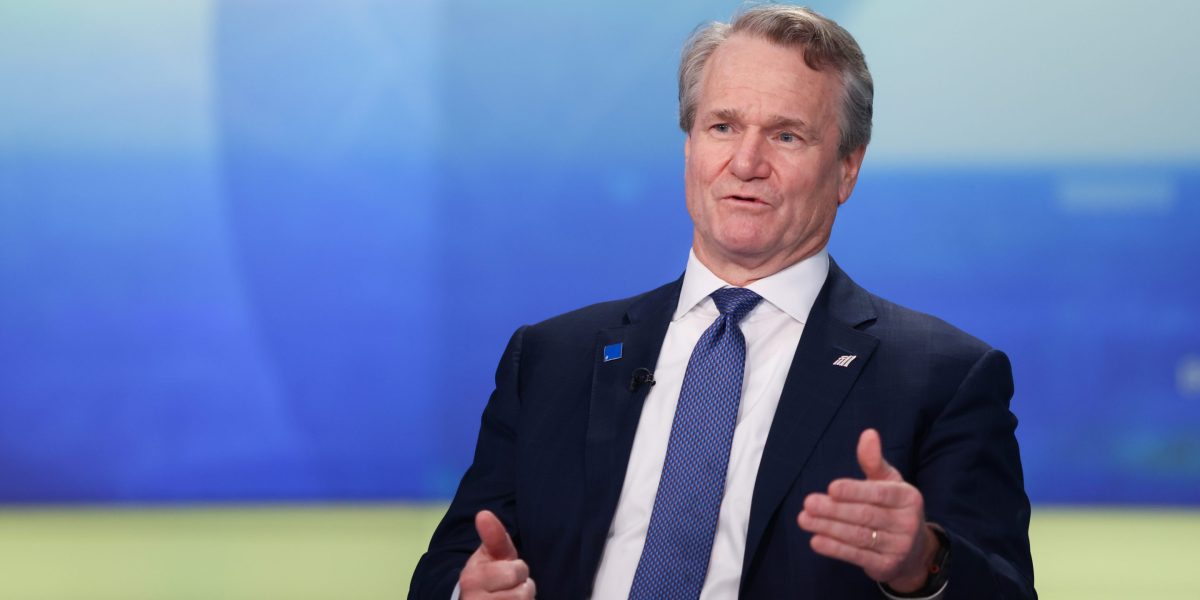
Bank of America Corp. Chief Executive Officer Brian Moynihan said that artificial intelligence is starting to have a bigger impact on the US economy.

“The AI investment’s been building during the year and is probably a bigger contributor next year and the years beyond,” Moynihan said Monday in a Bloomberg Television interview. “AI is kicking in more and more, and so it’s not all attributable to AI, but that’s having a marginal impact that’s pretty strong.”

Moynihan, who has led the bank for nearly 15 years, said the firm is predicting a strong economy for the US next year, with expected growth of 2.4%, up from about 2% in 2025. While the labor market has started to get softer, it appears that it’s more of a normalization for jobs, Moynihan said.

AI companies including OpenAI have been pulling in billions of dollars of funds in recent months as investors are eager to bet on the industry. But executives such as Amazon.com Inc. founder Jeff Bezos have warned that AI spending is an “industrial bubble” that could lead to lost investment, but will ultimately help society.

Moynihan said his bank sees relatively limited risk to the economy — including the impact on consumers and job losses — if the AI industry became too overheated and had to pull back, given that the sector is composed of a narrow group of companies.

“As a lender we look at the leverage on these projects and make sure we’re comfortable with that and the duration of the contract by the person who’s going to commit to use the data center,” Moynihan said.

The bank itself is also using artificial intelligence, he said in the interview. The company launched Erica, its agent bot, in 2018. Now, Erica can answer 700 questions, up from 200, Moynihan said.

Read More: Nvidia Looks Past DeepSeek and Tariffs for AI’s Next Chapter

“We’ll be applying more and more of automated intelligence — or augmented intelligence, as we call it, with a person using AI, using that to be more effective — and that’ll affect all the businesses,” Moynihan said.


Source link

Continue Reading

Business

Goldman Sachs CEO says he’d hire someone ‘smart enough’ over the smartest person in the world because ultimately experience trumps brains

Published

on


It’s easier to get into an Ivy League school than it is to land a job at $268 billion banking giant Goldman Sachs. But unlike the colleges, the business isn’t chasing the most intelligent minds floating into its talent pools. David Solomon, the CEO of Goldman, says he’s in the “camp of smart enough.” 

“You have to be smart enough, but the smartest person in the world without a whole package of other things [is] not going to navigate Goldman Sachs well, not going to be successful in Goldman Sachs over the long run,” Solomon revealed recently on Sequoia Capital’s Long Strange Trip podcast.

There are a few key qualities Solomon looks for in new hires, over educational pedigree. The CEO said the most attractive candidates are in touch with “human elements” like the ability to connect, be resilient, and determined. They always need to be striving for excellence—and on top of everything else, should come to Goldman Sachs with a proven track record. 

Experience, Solomon said, is “hugely underrated” and “a big differentiator for the firm.” It’s not impossible to do very well without it, he added, but relying on book smarts over real-life expertise won’t get one hired at the bank.

“You can’t teach experience,” Solomon explained. “Experience matters in these big organizations and when it matters it doesn’t matter when things are going well. It matters when the bumps come. You’ve got to make difficult judgments.”

CEOs aren’t always going for the brightest Ivy League grads

Solomon isn’t the only CEO choosing life skills over intellectual excellence. Even the CEO of LinkedIn, Ryan Roslansky, has cautioned that instead of chasing candidates with Ivy League backgrounds, hiring managers today will be on the hunt for AI-savvy talent. 

“I think the mindset shift is probably the most exciting thing because my guess is that the future of work belongs not anymore to the people that have the fanciest degrees or went to the best colleges,” Roslansky said during a recent fireside chat.

Even Berkshire Hathaway’s Warren Buffett looks past Ivy League degrees when it comes to hiring. The hedge fund mogul, worth $149 billion, doesn’t care if his employees went to Stanford or Princeton—or any college at all. 

While discussing Berkshire Hathaway’s 2005 acquisition of Forest River, an RV manufacturer led by Pete Liegl, he said “no competitor came close to his performance” despite Liegl not hailing from an incredibly prestigious university. Buffett also pointed to Microsoft entrepreneur Bill Gates, who achieved billion-dollar success without a college diploma. 

“I never look at where a candidate has gone to school. Never!” Buffett said in his 2025 annual letter to shareholders. “Of course, there are great managers who attended the most famous schools. But there are plenty such as Pete [Liegl] who may have benefited by attending a less prestigious institution or even not bothering to finish school.”

Even elite college degrees—once the benchmark of intelligence—have fallen flat, according to business leaders. The iconic Harvard University dropout himself, Meta’s Mark Zuckerberg, said that colleges aren’t skilling graduates for the jobs they need. The Facebook creator cautioned that the tide is changing as people figure out whether pursuing a degree makes sense anymore, especially as employers hunt for new talent skills.  

“There’s going to have to be a reckoning,” Zuckerberg said on the This Past Weekend podcast in April. “People are going to have to figure out whether that makes sense. It’s sort of been this taboo thing to say, ‘Maybe not everyone needs to go to college,’ and because there’s a lot of jobs that don’t require that…People are probably coming around to that opinion a little more now than maybe like 10 years ago.”


Source link

Continue Reading

Business

Trump will lead the design of his new class of warships ‘because I’m a very aesthetic person’

Published

on


President Donald Trump has announced a bold plan for the Navy to build a new, large warship that he is calling a “battleship” as part of a larger vision to create a “Golden Fleet.”

“They’ll be the fastest, the biggest, and by far 100 times more powerful than any battleship ever built,” Trump claimed during the announcement at his Mar-a-Lago resort in Florida.

The ship, according to Trump, will be longer and larger than the World War II-era Iowa-class battleships and will be armed with hypersonic missiles, rail guns, and high-powered lasers — all technologies that are still being developed by the Navy.

Just a month ago, the Navy scrapped its plans to build a new, small warship, citing growing delays and cost overruns, deciding instead to go with a modified version of a Coast Guard cutter that was being produced until recently. The sea service has also failed to build its other newly designed ships, like the new Ford-class aircraft carrier and Columbia-class submarines, on time and on budget.

Historically, the term battleship has referred to a very specific type of ship — a large, heavily armored vessel armed with massive guns designed to bombard other ships or targets ashore. This type of ship was at the height of prominence during World War II, and the largest of the U.S. battleships, the Iowa-class, were roughly 60,000 tons.

After World War II, the battleship’s role in modern fleets diminished rapidly in favor of aircraft carriers and long-range missiles. The U.S. Navy did modernize four Iowa-class battleships in the 1980s by adding cruise missiles and anti-ship missiles, along with modern radars, but by the 1990s all four were decommissioned.

Trump has long held strong opinions on specific aspects of the Navy’s fleet, sometimes with a view toward keeping older technology instead of modernizing.

During his first term, he unsuccessfully called for the return to steam-powered catapults to launch jets from the Navy’s newest aircraft carriers instead of the more modern electromagnetic system.

He has also complained to Phelan about the look of the Navy’s destroyers and decried Navy ships being covered in rust.

Phelan told senators at his confirmation hearing that Trump “has texted me numerous times very late at night, sometimes after one (o’clock) in the morning” about “rusty ships or ships in a yard, asking me what am I doing about it.”

On a visit to a shipyard that was working on the now-canceled Constellation-class frigate in 2020, Trump said he personally changed the design of the ship.

“I looked at it, I said, ‘That’s a terrible-looking ship, let’s make it beautiful,’” Trump said at the time.

He said Monday he will have a direct role in designing this new warship as well.

“The U.S. Navy will lead the design of these ships along with me, because I’m a very aesthetic person,” Trump said.


Source link

Continue Reading

Business

Waymo chaos during San Francisco power outage likely due to ‘operational management failure’ instead of software flaw, expert says

Published

on


Many of Waymo’s self-driving cars blocked streets of San Francisco during a mass power outage Saturday and forced the company to temporarily suspend service, raising questions about the cars’ ability to to adapt to real-world driving conditions.

Social media users posted videos of Waymos as they encountered traffic lights that were off. Some cars’ hazard lights blinked and they abruptly stopped in place, failing to cross the intersection. Others stopped in the middle of the intersection, forcing other cars to swerve around them.

The power outage affected 130,000 homes and businesses in San Francisco, nearly one-third of the customers served by Pacific Gas and Electric Co. It was caused by a fire at a power substation, officials said. On Monday, the utility company was still working to restore power to thousands of customers.

Waymo operates hundreds of robotaxis in San Francisco, but it wasn’t clear how many cars were on the road at the time of the outage. The company paused service Saturday evening and resumed it Sunday afternoon.

The road-blocking problems that prompted Waymo to suspend its service during the weekend power outages revived concerns that city officials raised about the robotaxis periodically coming to abrupt and inexplicable stops before California regulators approved them as a commercial service in August 2023.

Tyler Cervini, who lives in the Mission District, said he was calling an Uber to bring him to the airport since his train station was not operating due to the outage. At the traffic light outside his apartment, there were five Waymos crowding the intersection, he said.

He got into his Uber right outside where all the Waymos were, but his driver “had to swerve through them to pick me up,” Cervini said. “He seemed extremely frustrated by what was going on.”

Waymo said that its vehicles are designed to treat nonfunctioning traffic signals as four-way stops, but the scale of the outage created unusual conditions.

“While the failure of the utility infrastructure was significant, we are committed to ensuring our technology adjusts to traffic flow during such events,” a Waymo spokesperson said. “Throughout the outage, we closely coordinated with San Francisco city officials.”

The company said most active trips were completed before vehicles were safely returned to depots or pulled over.

Philip Koopman, professor emeritus at Carnegie Mellon University and expert on self-driving vehicle safety, said the scale of the traffic disruption was concerning. Autonomous vehicles are generally programmed to come to a stop if they are unsure or confused on what to do and ask for remote assistance, he said.

Koopman said it did not appear to be a software failure in the cars themselves, but an “operational management failure” where the company did not have the capability to deal with so many robotaxis needing assistance at once.

Waymo should have suspended service earlier — as soon as their vehicles started having issues, he said.

“If you have thousands of robotaxis that stop, you have a problem,” he said. “What if this had been an earthquake? You would have thousands of robotaxis blocking the road.”

Waymo, which started as a secret project within Google in 2009, has steadily expanded its operations in San Francisco while also introducing its robotaxis into other California cities such as Los Angeles and San Jose, in addition to other U.S. markets in Texas, Arizona, Florida and Georgia.

In the months leading up to the approval from the state’s Public Utilities Commission, San Francisco’s transportation and fire department leaders flagged dozens of reports about robotaxis coming to standstills, blocking traffic.

Besides inconveniencing other drivers trying to get to their destinations, the road-blocking robotaxis were viewed as a possible impediment in life-threatening emergencies when firefighters and police officers were responding to calls for help.

Waymo’s fleet of robotaxis is on pace to complete more than 14 million rides this year, more than tripling from last year, according to the company.

California is considering expanding approval for heavy-duty autonomous trucks and vehicles carrying up to 15 passengers to operate, a move opposed by unions representing truck drivers.

Shane Gusman, director of Teamsters California, called the Waymo disruption “a clear warning that turning our roads and lives over to autonomous vehicles is premature and dangerous.”

“We live in a state where blackouts, wildfires, floods and earthquakes affecting power and roadways are all too common,” Gusman said in a statement. “AVs stalled in streets and intersections threaten the safety of AV passengers, and others on the road, and inhibit emergency response when we need it most.”

This story was originally featured on Fortune.com


Source link

Continue Reading

Trending

Copyright © Miami Select.