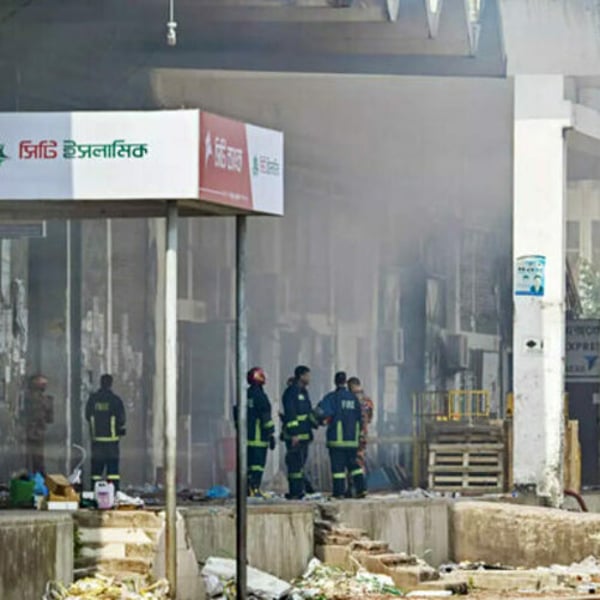
The cost of the damage caused by Saturday’s fire at the main airport in Bangladesh’s capital, Dhaka, could exceed $1 billion, according to an initial estimate on Sunday from the Bangladesh Garment Manufacturers and Exporters Association (BGMEA).
AFP
“The entire imports area has been reduced to ashes,” said Faisal Samade, a director at BGMEA, describing “a scene of devastation.” “We fear that losses could well exceed $1 billion,” he added, noting that around 200 to 250 companies in the country, the world’s second-largest textile producer, export their products by air every day.
The cause of the fire is not yet known; it broke out in the cargo terminal of Dhaka’s main international airport, where fabrics, clothing accessories, pharmaceuticals, and chemicals are stored.
Four people with minor injuries were taken to hospital, according to Moinul Ahsan, a senior official at the Bangladesh Department of Health.
Earlier in the day, the country’s tax authorities said they had begun assessing the damage, while the government announced the opening of an investigation. “We have started our assessment of the damage,” Moshiur Rahman, head of the National Board of Revenue (NBR), told AFP.
Flights resumed on Saturday evening, the airport’s director general, S M Ragib Samad, told AFP.
On Sunday, smoke was still rising from the rubble. “The fire spread everywhere; I don’t know if a single cargo shipment could be saved,” said an exhausted firefighter, whose uniform was greyish and whose hands were blackened.
“We were due to deliver goods to our customers today, and I suppose everything has been reduced to ashes,” a shopkeeper, Anand Kumar Ghosh, told AFP.
In a statement, the government said it was aware of growing public concern following a series of recent fires, notably in the Chittagong industrial free zone and at a chemical and textile factory in Dhaka on Tuesday, where 16 people died.
The security services are investigating all incidents “thoroughly,” and “any credible evidence of sabotage or arson will be followed by a swift and resolute response,” it added.
“No criminal or provocative act will be tolerated to disrupt public life or the political process,” it warned.
Bangladesh is the third-largest supplier of clothing to the US ($7.5 billion in 2024) and the second-largest to the European Union (€4.3 billion). This position has been achieved thanks to its low wages, while its main competitor, China, raised its minimum wage in the early 2010s.
However, this situation makes Bangladesh highly dependent on its textile sector, which accounts for 80% of its exports and 20% of its GDP, and provides around four million direct jobs.
This article is an automatic translation. Click here to read the original article.
A three-year-old family office backed by Europe’s wealthiest clan is quietly laying the groundwork for acquiring additional assets outside their luxury behemoth, Hermes International SCA.
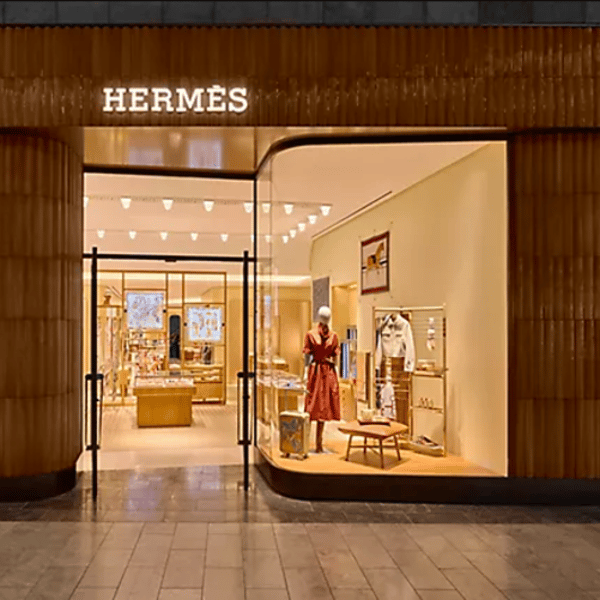
An Hermes store in Arizona, US – Hermès
Krefeld, named after the town in Germany where ancestor Thierry Hermes was born, has created a separate company called Breithorn Holding that can oversee fund and asset management, according to a filing. Charles-Henri Chaliac, 49, who heads the family office, will also serve as the new firm’s chief executive officer.
The move signals the growing ambitions of the family office created in 2022 by descendants from different branches of the sprawling dynasty. In the aftermath of fighting off a 2010 takeover attempt by LVMH founder and rival Bernard Arnault, the heirs pooled their separate investment vehicles into what has emerged as Krefeld. Reflecting the clan’s penchant for discretion, the family office has remained secretive about operations, management, and strategy since then.
Krefeld has so far made few investment announcements, one of the first being in French insurer Albingia. The family office also took a minority stake in closely held Anjac Health & Beauty alongside KKR & Co., Les Echos reported. A spokesperson for Hermes didn’t respond to requests for comment about Krefeld.
The more than 100 heirs to the Hermes fortune have a combined net worth of $186 billion, according to the Bloomberg Billionaires Index, making them the richest family in Europe. With a stake of around 67% in the listed company, they have pocketed €5.1 billion ($5.9 billion) in dividends for the past four record-breaking years, giving Krefeld firepower for investments.
With Krefeld, the Hermes descendants joined other ultra-wealthy French clans with family offices including Francoise Bettencourt Meyers, the billionaire L’Oreal heiress, who has Tethys; the Wertheimer brothers behind Chanel, with Mousse Partners; and Arnault, who invests through closely held Agache among other vehicles.
There are few public details about Krefeld and its new offshoot, Breithorn, which are based at the same address in central Paris.
Krefeld has raised its maximum authorised capital to €1 billion and its statutes stipulate that shareholders can only be descendants of Emile Maurice Hermes, who expanded the Parisian harness workshop started in 1837 by his grandfather, Thierry, into leather goods and baggage lines. Today, Hermes is best known for pricey handbags, silk scarves, and high-end fashion, having reported €15 billion in sales last year.
Krefeld, which is charged with investing the personal wealth of its Hermes backers, is chaired by Matthieu Dumas and the board populated by heirs with surnames including Bauer, de Seynes, Guerrand, and Mommeja. Chaliac joined last year from Belgian private equity firm Cobepa, while Claire Zeng moved to Krefeld in 2024 from Morgan Stanley, according to a LinkedIn post.
Frasers Group has made yet another property acquisition, announcing on Tuesday that it has bought Swindon Designer Outlet.
Swindon Designer Outlet – Photo: McArthurGlen
The company said the move marks “a meaningful step towards achieving the group’s vision of building the planet’s most admired and compelling brand ecosystem”.
It added that through acquisitions of “strategic physical retail locations like Swindon, Frasers Group supports key brand partners’ outlet strategies — including Nike, Adidas, Boss — and aims to serve consumers across the UK with the best value and product offerings”.
It didn’t share the price it paid but reports a few months ago suggested it was in talks to buy the property for around £275 million.
Swindon Designer Outlet opened in 1997 and covers 250,000 sq ft. It attracts over 3 million visitors annually with outlet centres at all price levels among the most buoyant shopping destinations in the UK. The centre has been owned by LaSalle Investment Management since 2022 and has been managed by outlet-specialist McArthurGlen Group.
The news comes just a month after we learned that Frasers had acquired Braehead Shopping Centre in Glasgow and also comes in the wake of a flurry of property deals by the acquisitive retail giant.
The company has also acquired shopping centres such as Princesshay, Overgate, Fremlin Walk, Frenchgate, Junction 32 Outlet Park and more.
CEO Michael Murray said: “Physical retail is central to our Elevation Strategy and investing in Swindon — one of the UK’s top five outlets by footfall — strengthens our position as both retailer and landlord. This acquisition reinforces our property strategy and unlocks new opportunities for our brands and our partners.”
London’s Covent Garden always has a high-profile installation during the festive period with recent activations from Jo Malone, Max mara and Marc Jacobs. And this year’s big name is Chanel.
Chanel
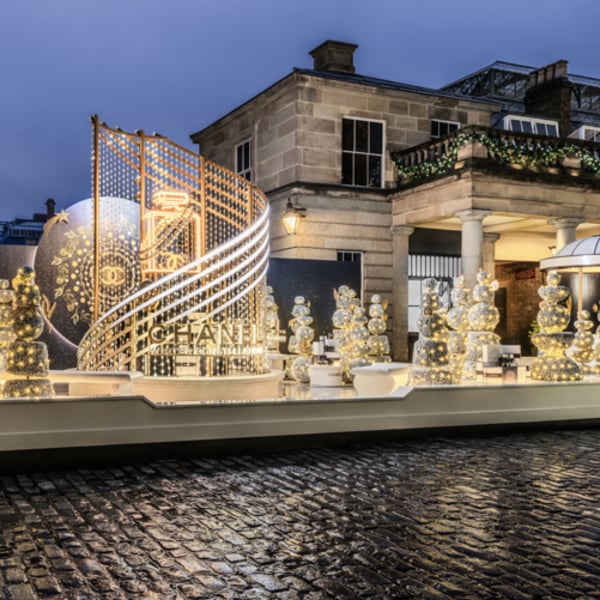
For the first time, Chanel has designed “an enchanted and immersive installation” in Covent Garden, North Piazza. The light installation highlights the brand’s first flagship boutique presence in Covent Garden which opened over 10 years ago.
Within the installation, we’re told visitors can experience an “enchanted, festive moment influenced by the constellations and emblematic symbols of Chanel: the lion, wheat, camellia, comet, and pearls”.
All of this is “reimagined in a starry sky with an illuminated Nº5 bottle encased in a helix that will create a magical atmosphere in the piazza”.
It’s open until 28 December, excluding Christmas Day, and attractions will also include live music performances every hour starting at 2:00pm until 6:30pm on Thursdays, Fridays, and Saturdays.
Covent Garden is a key destination for both UK and international shoppers during the festive period with its giant Christmas tree, its street entertainers and its historic architecture giving the Piazza extra allure at this time of year in particular.
And with its large weighting of beauty boutiques, it’s also a major destination for beauty shoppers.