
Fashion
Azzedine Alaïa’s Dior Collection: parallel dialogues
Published
November 19, 2025
Though at first sight they might appear very distant aesthetically, a striking new exhibition in Paris reveals that history’s most famous couturier and the most influential independent fashion designer of the past half century, respectively Christian Dior and Azzedine Alaïa, enjoyed a far greater proximity than first appears.
Both towered over fashion during their careers, even if their aesthetics differed widely. Dior invented the New Look and developed a romantic vision of couture, rippling with garden and floral prints. Alaïa created warrior women and empowered super heroines in body-con, highly sculpted clothes.
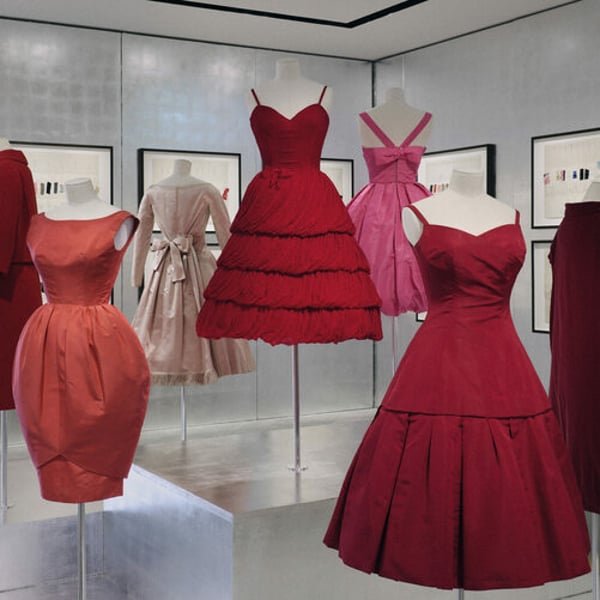
Titled Azzedine Alaïa’s Dior Collection, the exhibition opened Wednesday evening inside La Galerie Dior, the brand’s ultra elegant museum, presenting a scenographic narrative of the history of the famed couture house. The show features 101 looks by Christian Dior and five of his successors – Yves Saint Laurent, Marc Bohan, Gianfranco Ferré, John Galliano, and Maria Grazia Chiuri, owned by the Fondation Alaïa, possibly the greatest private collection of high fashion ever assembled.
In effect, the exhibition is in sync with a parallel dialogue between Dior and Alaïa, as a second exhibition will open on December 14 in the Alaïa Foundation in the Marais, where 30 Dior looks acquired by Azzedine will be juxtaposed against his own creations.
Professionally, the designers’ paths crossed, even if just for five days. An employment contract on display shows that Azzedine Ben Alaïa did a short internship at the house of Dior in June 1956.

The genesis of the project dates back two years, when the Alaïa Foundation’s director Olivier Saillard realised just how many pieces Alaïa had acquired by Dior and by Monsieur’s successor couturiers.
“When we put them all together, we realised there was a whopping 600 pieces. Wow! So, we proposed to Dior Heritage to view the collection, and provide their expert advice,” recalled Saillard.
Eventually, Dior Heritage prepared a special inventory, sleuthing the right season and collection each piece belonged to, the date the dress was made, and its exact fabrics. That very fashion detective work is highlighted by walls of exactly dated sketches by Monsieur Dior and photos of him at work, alongside panels of fabric swatches, precise details about fabric manufacturers, embroiderers, and even the name of the model who first wore the look.
“Dior Heritage ended up asking, as there are so many very important creations, would you be able to create a show to present at least part of this collection? In the end, we chose 101 pieces for this exhibition here. It makes sense because Alaïa’s collection is right back where he started in Paris, pushing open the door of Christian Dior for five days,” said Saillard.
Noting a remarkable serendipity, the exhibition opens on the eighth anniversary of Azzedine, who passed aged 82 on November 18, 2017.

Alaïa first began collecting fashion rarities in the late 1960s, long before even the great houses of Paris – like Dior, Givenchy and Chanel – had begun assembling their own historic collections.
“Around 1968, when Balenciaga, closed his doors, Azzedine became very concerned about the preservation of great couture. In fact, he bought a lot more than every museum at that time in Paris. This was in an era when fashion museums simply didn’t have the budgets they do today,” explained Saillard, one of fashion’s greatest curators, and the former director of the Galliera, one of Paris’ most important fashion museums.
Shopping for fashion and couture was such a passion, Alaïa eventually acquired over 20,000 pieces, managed today by his Foundation and held in a secret location.
“I used to see Azzedine almost every week at auctions bidding without limit for the most important pieces I ever saw in my life. And, sometimes he would yell, “Olivier! You have to buy this dress.” And I replied, Azzedine I just don’t have the money.” And he would respond: “Call the Minister of Culture and get some! Which wasn’t really possible.”
The Tunisan-born designer collected all the great Masters – like Vionnet, Balenciaga, and Madame Grès. Some 900 pieces by the latter became the subject of another expo by his foundation.

Alaïa bought so much, and for such high prices – like a famed Schiaparelli dress worn by Marlene Dietrich that went for over €200,000 – that traders were concerned the bottom would fall out of the vintage market after he died. But the ever-growing interest in fashion has meant it hasn’t.
The week Alaïa sold part of his house to Prada in 2000, he immediately went out shopping. Buying many pieces by Poiret, the rarest and most expensive fashion designer of all.
Alaïa’s family were well-to-do wheat farmers in Tunisia, and he discovered fashion reading his mother’s copies of French Vogue. As a result, this exhibition opens with a gown from an era that influenced Dior massively, the Belle Epoque, and a dress just like one Christian’s mother Madelaine would have worn.
“It’s a reminder of the influence so many mothers have had on so many fashion designers,” noted Galerie Dior’s director Olivier Flaviano, who joined Saillard for an exclusive presentation of the exhibition for FashionNetwork.com.
Each look has a name, all positioned on simple stands in practically all the 14 sections of La Galerie Dior.
The opening room contains a series of early works, including one by Dior for Lucien Lelong, where he learnt the métier of a couturier prior to opening his own house in 1947. A 1950 printed nylon taffeta looks like it was made last week, while a 1951 ensemble in pleated wool could almost have been designed by Alaïa.

In other ways, these two legends are lightyears apart, as seen in a charming display of beaded floral organza and lace dresses by Dior and Chiuri, all staged in a mock garden in front of a backdrop of Granville, the seafront villa in Normandy where Christian grew up.
“Several of these dresses date from 1956, the year Alaïa worked here. So, theoretically Azzedine might even have done a little work on one of them,” winked Flaviano.
Monsieur’s successors all are given their moments. Notably in a superb black and white trilogy of embroidered lace and printed silk twill, where creations by Ferré and Bohan accompany a nipped-waist New Look dress by Monsieur like two kid sisters.
Saint Laurent, who barely lasted two years as Christian’s first successor, enjoys a wow factor with an avant-garde bouffant and bevelled rose blush dress. It is named Nuit d’Ispahan, after the ancient Persian city. While Galliano, who managed a decade in charge, is represented by a bravura funnel necked bar jacket from 2005 that scores magna cum laude for its tailoring.
Ultimately, though their styles were distant, Alaïa loved Christian Dior for the simple fact that he was the incarnate of both couture and France, the profession and country he adopted. Alaïa was such a fan of Dior he even bought three versions of the same dress: a brilliant swirling cocktail number in silk faille entitled Venezuela from 1957, the year of Dior’s death. Quite frankly, any woman would jump at the chance to wear this look. There’s a concise photo by Guy Bourdin of that very dress from French Vogue nearby. And another version of Venezuela in a blotchy red floral that is quite simply beautiful.
“When he first fell in love with fashion as a teenager in Tunis, he became fascinated by Dior and by dresses that seemed “to stand up by themselves.” Which is what we have tried to capture in this exhibition,” concluded Saillard.
For serious aficionados of fashion, this is quite simply a must-see display.
Copyright © 2025 FashionNetwork.com All rights reserved.