Connect with us

Politics

Author Dave Aronberg says federal law ‘tweaks,’ not money are what’s needed for addiction treatment
Published

on


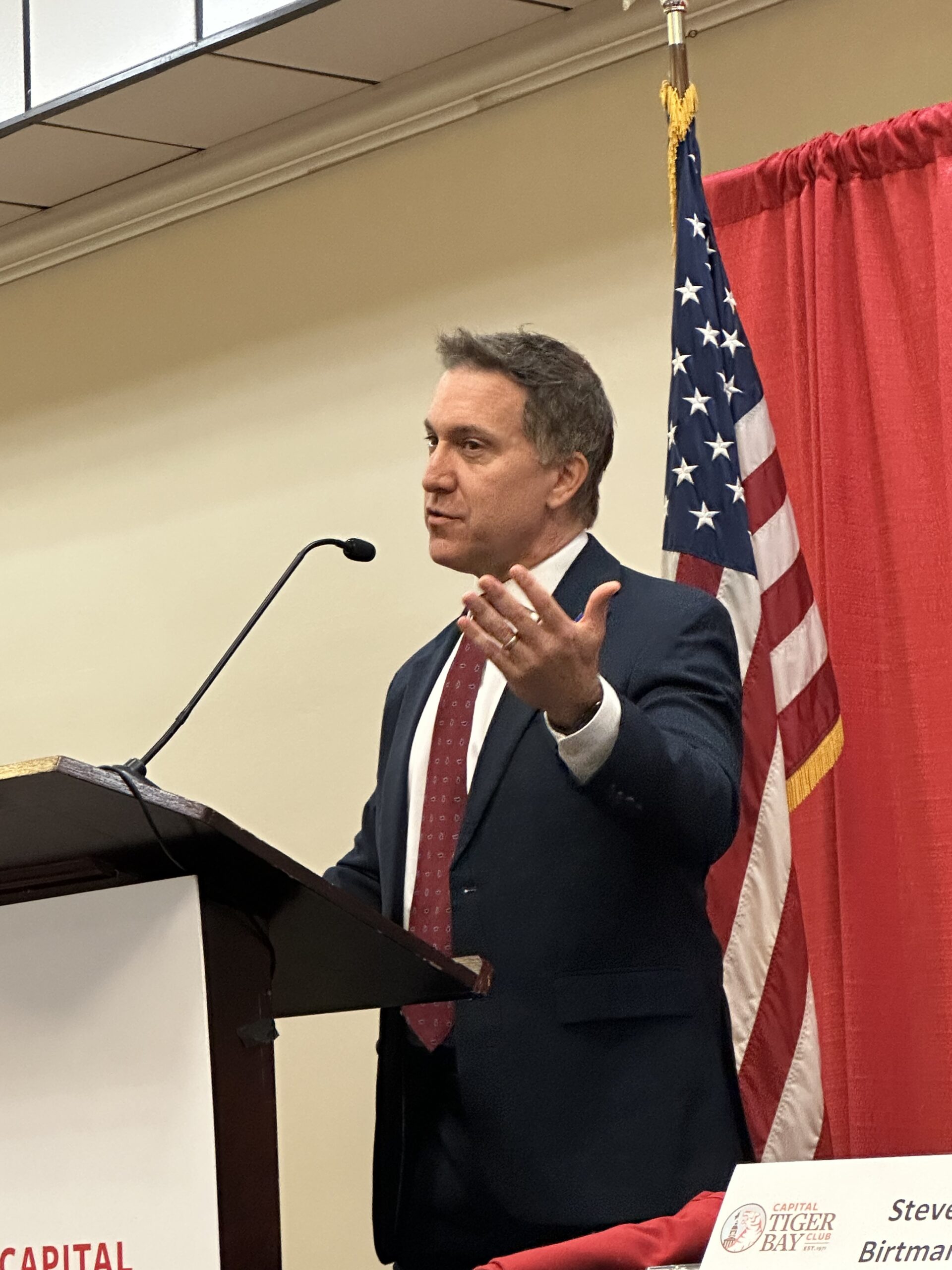
As a prosecutor, a politician, and a pundit, Dave Aronberg has opinions — and he wasn’t afraid to share them at a Capital City Tiger Bay Club luncheon in Tallahassee on Tuesday.

Most of his prepared remarks focused on his recently published book, “Fighting the Florida Shuffle,” which takes a deep dive into opioid drug problems and a flawed drug treatment system — while proposing specific actions to alter well-intentioned federal laws being abused by bad actors.

But in a question-and-answer session afterward, Aronberg also weighed in on U.S. Attorney General Pam Bondi and what he calls her “red line,” the state of the national Democratic Party, antisemitism, and a Tallahassee murder conspiracy trial.

When it comes to drug abuse and treatment, the Palm Beach County native knows whereof he speaks. One of his first assignments at the turn of the century as an assistant Attorney General under Florida AG Bob Butterworth was to investigate Purdue Pharma, which by then had been marketing the dangerous, addictive “new” pain-relieving drug, OxyContin, for about five years.

After a stint in the Florida Senate, Aronberg would campaign for Attorney General on the state’s drug crisis but was eliminated in the primary. Republican Bondi, who ultimately was elected to the office in that race, reached across the aisle to tap him as the state’s “drug czar.”

“It was not easy for her to do that, but she did, and we shut down pill mills … and we got the PDMP (Prescription Drug Monitoring Program) passed,” he said. “We were able to make some real progress when we worked together in a bipartisan way. Unfortunately, when you eliminated the supply of these drugs, the demand didn’t go away. So people … went from oxycodone to heroin. And then everything spiked with fentanyl.”

He would go on to serve three terms as the State Attorney for Palm Beach County starting in 2013, where drug problems were again top of mind, as his home county became a hotbed of criminality relating to substance use disorder treatment, what Aronberg termed the Florida Shuffle.

His book, coauthored with Dr. David Campbell, includes anecdotal stories of young adults and their families lured by promises of sunshine, serenity and sobriety, only to discover themselves trapped by a system of treatment centers and sober houses that prioritized money over recovery — with kickbacks for placements, unnecessary and overpriced testing, at best — and criminal abuse resulting in overdose or death, at worst.

As State Attorney, Aronberg created a Sober Home Task Force to address the crisis, which had great success and is now a model for the rest of the state and around the nation.

“Florida went from the weakest laws in the country to the strongest laws in the country. We went from having a slap on the wrist for patient brokering to making it into a felony (and) making a one-way plane tickets into a felony,” he told the group. “It’s amazing how a pair of steel bracelets will influence someone’s behavior.”

Problems still exist in the system, but they won’t be solved at state or local level — or even with money — because well-intended federal laws favored by Democrats are throwing up roadblocks to ultimate success, Aronberg said.

“It’s the ACA, the ADA, HIPAA, which keeps parents from knowing where their kids are going when their kids are now all of a sudden sent down to Florida with a one-way plane ticket. If you’re over 18, your parents don’t get to know.”

“The fact that you are here listening to this means that you now know more than 99% of the individuals in Congress,” he told the group. “They have the power to do something about this. Thankfully, you have a voice and you can ask them, ‘What are you doing about the Florida shuffle? Why are you letting this happen? And if their response is more money for rehab, you know they’re not paying attention and maybe we should have new people in Congress.”

Democrats fear that changing the laws might lead to the Affordable Care Act and others being completely overturned, saying, “If we try to tweak this, someone’s gonna overturn the whole thing.” He counters with, “Don’t let the perfect be the enemy of the good.”

These days, Aronberg has his own legal practice (Mike Tyson is a client), is a strategic consultant for Capital City Consulting, and migrates between MSNBC and other channels and podcasts weighing in on the legal issues d’jour.

“I love doing it,” he said of his commentary gigs. “It fills my political void of not being in office. I get to talk about issues without having to take bad votes. So I love the whole media business.”

He has spent time over the past couple weeks weighing in on the murder trial of Donna Adelson, who was found guilty of hiring men to kill Dan Markel, her ex-son-in-law, in his Tallahassee home 11 years ago. The two hitmen, a go-between and her son have already been convicted in the case and there is speculation his ex-wife may be charged for her role in his death.

Aronberg quipped: “If I were Wendi Adelson, I would not be buying any green bananas.”

One of his opinions relates to his old boss:

“Pam Bondi will do the right thing in the end. I still believe that she will not prosecute Trump’s political enemies purely for political reasons. If she wanted to do that, she could have … walked out all those people in handcuffs — and the right wing is is very upset with her that she hasn’t done it.”

Aronberg encouraged his niece to attend Florida State University rather than a northeastern college she’d been accepted to because of antisemitism on those campuses.

“I’ve been troubled by the rise of antisemitism in this country and in my political party. And if you want to know why I’m still a Democrat, it’s because the extremists have not taken over the party yet. The fact that Hakeem Jeffries is refusing to endorse (New York Mayoral candidate Zohran) Mamdani to me is a reason why I I’m a Democrat because he is the leader, not Mamdani.”

“Florida Shuffle” offers a sympathetic view of the scourge of drug abuse. Aronberg puts it this way:

“I’ve seen so many families wrecked and yet there are people out there who think … drug addiction is a moral failing, (that) people make the choice to get high and they deserve what they get,” he said. “That is so myopic and also so heartless because most of the people in the throes of addiction today got there because they were given a prescription by a doctor who were told that the prescription was safe and non-addictive — when neither was true.”


Post Views: 0


Source link

Continue Reading

Politics

University of Florida breaks ground on College of Dentistry building facelift and overhaul

Published

on


The original College of Dentistry building was errected half a century ago at UF.

The University of Florida (UF) College of Dentistry building is undergoing major renovations and a multi-phase overhaul that will add more than 100,000 square feet to the facility.

UF officials announced this month that the 11-story college “dental tower” is undergoing waterproofing and insulation upgrades. There is also a modernization of key spaces in the existing building and a new building addition that will tack on a new area that will cover the 100,0000 of additional space. The original building was erected 50 years ago and the new additions and upgrades are expected to be completed in five years.

“This project represents the largest investment made by the state of Florida in a medical science building at any state university,” said Mori Hosseini, UF Board of Trustees Chair in a news release. “We fought for this because we understand what it will deliver for our community – for our students, our faculty and families across Florida.”

Some of the brick exterior of the original building is being removed. Crews are “sealing” the structure with work that is designed to prevent water intrusion. When that’s complete they’ll modernize the front of the building with a panel system that blend with the new addition. Work on that element is set to begin in August.

“The transformation helps ensure that the College of Dentistry remains at the forefront of academic distinction education, research and clinical innovation for decades to come,” said c, Dean of the college in Gainesville.

When completed, the College of Dentistry will see every room modernized within the building. Technological upgrades will accompany the physical overhaul as well.

“The College of Dentistry faculty and students deserve a space that allows them to focus on the patient, and the patients deserve a building that puts them at ease,” said UF Interim President Donald Landry. “The research done here will be transformative and add to the glory of this institution.”


Source link

Continue Reading

Politics

Monica Matteo-Salinas, Monique Pardo Pope square off in Miami Beach Commission runoff

Published

on


Early voting is underway in Miami Beach ahead of a Dec. 9 runoff that will decide the city’s only open Commission seat — a head-to-head contest between Monica Matteo-Salinas and Monique Pardo Pope for the Group 1 seat.

Matteo-Salinas, a Democrat and longtime City Hall aide, finished first last month with 23.2% of the vote. Pardo Pope, a Republican lawyer, advanced with 20.1%.

They outpaced four other candidates competing to succeed outgoing Commissioner Kristen Rosen Gonzalez last month, but neither captured a large enough share of the vote — more than 50% — to win outright.

The runoff has sharpened into a choice between two contrasting résumés, platforms and campaign narratives along with a late-cycle revelation about Pardo Pope that has drawn national headlines.

Voters are heading to the polls for the second time in just over a month as Miami Beach faces turbulence on multiple fronts, from state scrutiny over finances and charges that a local ordinance conflicts with Florida’s homelessness law to the removal of cultural landmarks due to their so-called “woke” significance and accusations of pay-for-play policymaking.

Matteo-Salinas, 46, has consolidated establishment support for her campaign, which centers on a promise to work on expanding trolley service, increasing the city’s affordable housing index and establishing a new “water czar” position in the city, paid by resort taxes.

She’s earned endorsements from several local pols, including Miami-Dade County Mayor Daniella Levine Cava, Miami Beach Commissioners Alex Fernandez, Laura Dominguez and Tanya Bhatt; and former Miami Beach Dan Gelber.

Groups backing her bid include the Miami Beach Fraternal Order of Police, LGBTQ groups SAVE Action PAC and Equality Florida Action PAC, and the public-safety-focused neighborhood group SOBESafe.

Pardo Pope, 45, has centered her messaging on public safety, investing in mental health, backing school choice initiatives, supporting homelessness services, encouraging “smart, thoughtful development” that preserves Miami Beach’s character while addressing flooding and roadway congestion, and alleviating cost-of-living issues for longtime residents and first-time homebuyers through “fair taxation.”

Though she has touted her guardian ad litem work as evidence of her temperament and commitment to service, that part of her record has drawn renewed scrutiny in recent weeks. A review of Pardo Pope’s case records with the Miami-Dade Clerk’s Office shows her listed as a guardian ad litem on just three cases — one of which she was discharged from after trying to get the mother in the case jailed.

She’s also been the subject of negative attention for omitting that her father was the convicted, Nazi-adoring serial killer Manuel Pardo, to whom she wrote several loving social media posts.

Pardo Pope has said that she forgave him in order to move forward with her life and asked voters to judge her on her own life and work.

Her backing includes the Miami-Dade Republican Party, Miami-Dade Commissioner René García, state Rep. Alex Rizo, former Miami Beach City Attorney Jose Smith, Miami Realtors PAC, the Venezuelan American Republican Club and Teach Florida PAC, a Jewish education group.

Two of her former Group 1 opponents, Daniel Ciraldo and Omar Gimenez, are also backing her.

Matteo-Salinas raised about $133,000 and spent $82,000 by Dec. 4. Pardo Pope raised about $190,000 — of which 29% was self-given — and spent close to $170,000.

Early voting runs through Sunday at four locations citywide. Election Day is Monday, Dec. 9.


Source link

Continue Reading

Politics

Hialeah voters head to polls as City Commission runoffs test new Mayor’s political clout

Published

on


Early voting is underway in Hialeah as two Council runoff contests will decide who rounds out a markedly different dais at City Hall.

The Group 3 and Group 4 races — featuring Jessica Castillo versus Gelien Perez and William “Willy” Marrero versus Javier Morejon, respectively — also stand to determine whether new Mayor Bryan Calvo gains early influence over the Council.

Perez and Castillo advanced to the Group 3 runoff in last month’s General Election with 40.5% and 36% of the vote, respectively, leaving one third-place candidate behind.

In Group 4, Marrero narrowly led the field with 24.8%, followed by Morejon at 23.3%. They outpaced three others in the contest.

To win outright, a candidate had to capture more than half the vote in their respective races.

The runoffs present one of the first real tests of how much sway Calvo, who made history last month as the youngest person ever elected Hialeah Mayor, will have as he prepares to take office.

He has endorsed Perez and Marrero — a strategic pairing that blends rival factions from the mayoral contest into his new governing coalition. Both ran with political slates opposing him. He told the Miami Herald last month that he’s aiming to create “a coalition to approve the agenda,” without an expectation that Perez and Matteo “will vote with (him) 100% of the time.”

If both candidates win, Calvo could enter January with a working majority on the seven-member Council and greater control over the upcoming appointment to fill Jesus Tundidor’s soon-to-be-vacant seat. Tundidor ran unsuccessfully for Mayor.

In Group 3, Perez, 35, a former city Human Resources Director and one-time mayoral aide, has campaigned on supporting first responders and small businesses, improving infrastructure and parks, expanding senior services and rejecting millage rate increases.

But her tenure as HR director drew scrutiny: a two-year Miami-Dade ethics investigation found employees under her influence received sizable raises while she acted as their real estate agent. She has not publicly responded to inquiries about the probe.

(L-R) Jessica Castillo and Gelien Perez are competing in Group 3. Images via the candidates.

Castillo, 37, has run as an independent voice focused on transparency, accountability, traffic relief, infrastructure upgrades and lower taxes. She has kept her campaign largely offline, with no website and minimal social media activity.

In Group 4, Marrero, 23, a Florida International University public administration student and former Council aide, has emphasized affordability, issues facing working families and seniors, and support for first responders.

Earlier this year, three Council members attempted to appoint him to the same seat he now seeks, but opposition from others blocked the move.

(L-R) William “Willy” Marrero and Javier Morejon aim to take the City Council’s Group 4 seat. Images via LinkedIn and Javier Morejon.

Morejon, 34, a land-use specialist with an extensive volunteer résumé, is running on infrastructure repairs, government transparency, beautification and reducing the cost of city services.

Election Day is Monday, Dec. 9. Because Hialeah elects Council members at-large, all voters can cast ballots in both races.


Source link

Continue Reading

Trending

Copyright © Miami Select.