Connect with us

Business

Australia will lower U.S. ‘Mad Cow’ beef import restrictions that Trump called a ‘ban’

Published

on


Australia announced it will reduce restrictions on U.S. beef imports in a move U.S. President Donald Trump’s administration claimed as a major victory over “non-scientific trade barriers.”

Agriculture Minister Julie Collins said Thursday that relaxing the restrictions designed to keep Australia free of mad cow disease, also known as bovine spongiform encephalopathy or BSE, would not compromise biosecurity.

Australia stands for open and free trade — our cattle industry has significantly benefited from this,” Collins said in a statement.

U.S. Secretary of Agriculture Brooke L. Rollins responded to Australia’s annoucement by congratulating Trump on a “major trade breakthrough that gives greater access to U.S. beef producers selling to Australia.”

She issued a statemeant under the leadline: Make Agriculture Great Again Trade Wins.

“American farmers and ranchers produce the safest, healthiest beef in the world. It’s absurd that non-scientific trade barriers prevented our beef from being sold to consumers in Australia for the last 20 years,” Rollins said.

“Gone are the days of putting American farmers on the sidelines. This is yet another example of the kind of market access the President negotiates to bring America into a new golden age of prosperity, with American agriculture leading the way,” she added.

Australia has allowed imports of beef grown in the United States since 2019. But Australia has not allowed imports from the U.S. of beef sourced from Canada or Mexico because of the disease risk.

But the U.S. has recently introduced additional movement controls that identify and trace all cattle from Mexico and Canada to their farms of origin.

US cattle import controls satisfy Australian authorities

Australian authorities were “satisfied the strengthened control measures put in place by the U.S. effectively manage biosecurity risks,” Collins said.

The timing of the new, reduced restrictions has not been finalized.

Trump attacked Australian import restrictions on U.S. beef when he announced in April that tariffs of at least 10% would be placed on Australian imports, with steel and aluminum facing a 50% tariff.

“Australia bans — and they’re wonderful people, and wonderful everything — but they ban American beef,” Trump told reporters then.

“Yet we imported $3 billion of Australian beef from them just last year alone. They won’t take any of our beef. They don’t want it because they don’t want it to affect their farmers and, you know, I don’t blame them, but we’re doing the same thing right now,” Trump added.

Lawmaker fears appeasing Trump endangers Australian cattle industry

Opposition lawmaker David Littleproud suspected the government was endangering Australia’s cattle industry to appease Trump.

“I want to see the science and it should be predicated on science. I’m suspicious of the speed at which this has been done,” Littleproud told reporters.

“We need to give confidence to the industry, but also to you (the public): this is not just about animal welfare, this is about human welfare, this is about BSE potentially coming into this country and having a human impact, so I think it’s important the government’s very transparent about the science and I don’t think it’s even beyond the question to have an independent panel review that science to give confidence to everybody,” he added.

Around 70% of Australian beef is exported. Producers fear that export market would vanish overnight if diseases including mad cow or foot-and-mouth disease infected Australian cattle.

Will Evans, chief executive of Cattle Australia who represents more than 52,000 grass-fed beef producers across the nation, said he was confident the agriculture department had taken a cautious approach toward U.S. imports.

“The department’s undertaken a technical scientific assessment and we have to put faith in them. They’ve made this assessment themselves. They’ve said: ‘We’ve looked at this, we’ve looked at the best science, this is a decision that we feel comfortable with,’” Evans said.

“When you have a $75 billion (Australian $50 billion) industry relying on them not making this mistake, I’m sure they’ve been very cautious in their decision-making,” he added.

US beef prices rise because of drought and a domestic cattle shortage

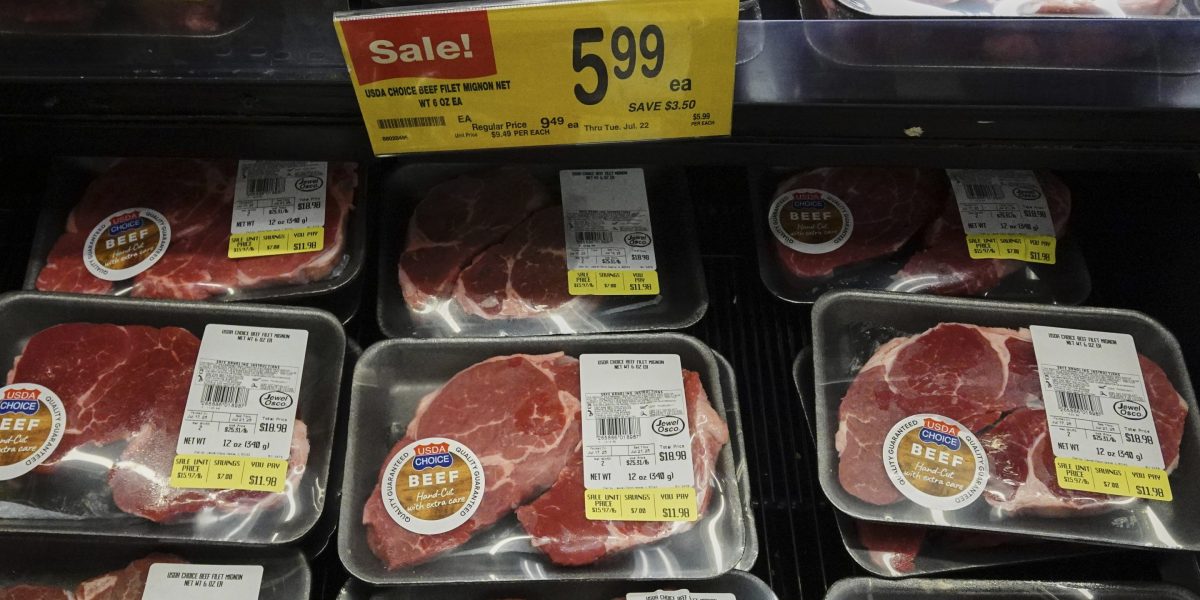
Beef prices have been rising in the U.S. due to factors that include drought and shrinking domestic herd numbers.

The average price of a pound of ground beef in the U.S. rose to $6.12 in June, up nearly 12% from a year ago, according to U.S. government data. The average price of all uncooked beef steaks rose 8% to $11.49 per pound.

Australian demand for U.S. beef is likely to remain low for reasons including a relatively weak Australian dollar.

Australia’s opposition to any U.S. tariffs will be high on the agenda when Prime Minister Anthony Albanese secures his first face-to-face meeting with Trump.

Albanese and Trump were to hold a one-on-one meeting on the sidelines of a Group of Seven summit in Canada last month, but the U.S. president left early.

Albanese expects the pair will meet this year, although no date has been announced.

The two countries have had a bilateral free trade deal for 20 years and the U.S. has maintained a trade surplus with Australia for decades.


Source link

Continue Reading

Business

Unlimited vacation policies can work—it just depends on where employees are based

Published

on


For years, the prevailing theory amongst workers about “unlimited vacation” is that it actually encourages workers to take less time off. Without the entitlement to a set number of days, employees can feel awkward requesting days off, or worried that doing so will make them look less committed to work. 

But a new study from payroll and HR platform Deel finds it’s less about specific PTO policies than about culture. It all depends on where you live, says Lauren Thomas, the startup’s economist. 

On average, European employees with unlimited vacation policies took four more days off than their counterparts with fixed time off this year27 vs. 23. But in North America, there was hardly a difference, as both those with unlimited and fixed vacation policies averaged about 17.

“Americans and Canadians are definitely getting less time off, even when you only look at fixed time, than Europeans are,” Thomas said. “That is a combination of policy and culture.” 

In fact, Canadian workers are taking less time off than those in the U.S. Thomas said this is because 77% of U.S. workers have access to paid vacation, while just 73% of Canadians do, based on U.S. Bureau of Labor Statistics and Statistics Canada data.

But Americans and Canadians who work for companies that span the Atlantic do take more time off than their counterparts working for companies that do not have hires in Europe, Thomas said.

“I think companies need to think really carefully about how much productivity they’re really getting when they’re requiring so much [working] time from their employees,” she said. “At the end of the day, we know that time off is important for productivity, it’s important for making a good company, it’s also really important for attracting talent.” 

Which cities are best at encouraging workers to take time off to rest and recharge? Stockholm, Berlin or Paris, where Thomas found employees took 25 or more days off this year. 

Kristin Stoller
Editorial Director, Fortune Live Media
kristin.stoller@fortune.com

Around the Table

A round-up of the most important HR headlines.

The Society for Human Resource Management, or SHRM, was hit with a $11.5 million verdict after a former employee accused the trade group of racial discrimination and retaliation. Business Insider

As jobs get more niche, it has become harder for workers to explain exactly what they do to family and friends. Wall Street Journal

OpenAI says its tools save workers roughly 40 to 60 minutes per day, and has helped improve either the speed or quality of their work. Bloomberg

Watercooler

Everything you need to know from Fortune.

Leaning out. For the first time in a decade, fewer women than men are interested in getting a promotion at work. —Sasha Rogelberg

Interview test. Gagan Biyani, CEO of the education platform Maven, says he gives candidates live feedback during job interviews to see how they react. —Orianna Rosa Royle

Manager shake-up. As AI agents are automating busy work, some managerial drudgery can be avoided—but human interaction is still essential. —Beatrice Nolan


Source link

Continue Reading

Business

Crypto wallets now feel a lot more like Venmo

Published

on


Crypto wallets are having a moment. The latest example is Kalshi announcing an integration with Phantom to offer event contracts to the wallet’s 15 million users. While the prediction market angle is intriguing (these markets are a HUGE story right now), the news also highlights the light-speed advancements taking place in the wallet realm.

Consider how, just three years ago, the only thing you could do with Phantom was access the Solana blockchain. MetaMask, meanwhile, was limited to Ethereum. Sure, alternatives like Coinbase Wallet offered access to more assets but, like other wallets of the time, it suffered from a ghastly interface that required users to run a gauntlet of sub-nets, confusing gas fees, and more. The experience was miserable for crypto natives. For everyone else, it was nigh impossible.

Then something changed. After years of promises, developers finally succeeded in pushing the clunky technical elements to the background, while adding a host of practical features. The result has been an uptick in useful real-world applications, including Phantom’s Kalshi offering, and also in souped-up new offerings like Coinbase’s rebranded Base as well as Robinhood Wallet.

This new generation of wallets offers the best aspects of decentralized crypto by making the customers the ultimate custodians of their assets. At the same time, they offer interfaces that are starting to feel like Venmo or online banking apps—which should be table stakes for any of these products looking to break into the mainstream. The question now is where these wallets will fit in day-to-day life. Will they become the successor to web browsers, as Coinbase CEO Brian Armstrong and others have predicted, or will they be something else entirely?

JP Richardson is the founder and CEO of Exodus, another leading wallet that recently added a suite of stablecoin payment tools. He told me the browser analogy doesn’t really fit, arguing wallets are better seen as a superior type of banking app—one that will be able to bridge disparate financial services. “We believe it should not be three apps, it should be one app. Why can’t you take your brokerage app, and tap and buy groceries?” he asked.

Trevor Traina, the founder of a wallet called Kresus, whose customers include Sotheby’s auction house, has another take. He believes the tools will have a much broader footprint. He sees a world where wallets are not just for managing our assets, but also become repositories for vital documents such as a will, insurance, or a law license. 

The technology is certainly there to support Traina’s vision. That includes blockchains, which can supply a permanent and tamper-proof ledger, but also newer privacy tools like zero-knowledge proofs. Together, this tech provides a way to safeguard all of one’s personal data, while also being able to meet the constant need to show identification that modern life demands. All of this could get more interesting still if wallets like Sam Altman’s World App, which includes an anti-bot biometric layer, get more traction.

Now for the cold water: Just because you build it doesn’t mean they will come—or come anytime soon at least. I spoke with analyst James Wester, one of the shrewder observers of the crypto and fintech scene, and he pointed out that the idea of an “everything app” has been around for years but shows few signs of getting adopted. A big reason for this is inertia.

Right now, our existing apps and payment tools work pretty well, so it’s unlikely we’ll see mass wallet adoption anytime soon without some sort of external nudge. Wester points out that Apple Pay and Google Pay have been around for a decade, yet a huge number of people keep paying with physical cards—because they can. This will change as younger people who are well versed in tech and crypto make up a greater portion of the economy. But until then, wallet makers may have to find a way to make their suddenly attractive products downright irresistible.

Jeff John Roberts
jeff.roberts@fortune.com
@jeffjohnroberts

DECENTRALIZED NEWS

Stablecoins at YouTube: In a landmark moment for crypto in mainstream commerce, YouTube is now giving U.S. creators on the platform the option to receive payment in the form of PayPal’s stablecoin PYUSD. (Fortune)

Circle’s new privacy coin: Stablecoin giant Circle is working with an upstart blockchain called Aleo to issue a spin-off of its flagship token called USDCx, which will let banking clients obscure private transaction histories. (Fortune)

Charters for all: The OCC issued national trust bank charters to Circle, Ripple, BitGo, Paxos and Fidelity Digital Assets. The move comes amid a broader move by the agency to issue more such charters, which do not allow taking customer deposits or accessing FDIC insurance. (Axios)

Tokenization tipping point? The SEC issued a no-action letter to the DTCC, which will let the country’s main clearing house custody stocks on the blockchain. The permission applies only to 1,000 of the most liquid stocks, but is a key first step for what is likely to be a wholesale shift toward putting custody and record keeping on-chain. (Bloomberg)

Think I’ll buy me a football team: Tether, whose CEO is Italian and a lifetime fan of Juventus, made a bid to buy the storied football club. Its board rebuffed the offer even as the publicly-traded club struggles to keep up with financial dominance of Premier League teams and Real Madrid. (Reuters

MAIN CHARACTER OF THE WEEK

Do Kwon in Podgorica, Montenegro, in 2024—before he was extradited to the U.S.

Filip Filipovic—Getty Images

Do Kwon is arguably the second most notorious fraudster in crypto history. Now, the Terra Luna founder, known for his “steady lads” rallying cry, will get to test how steady he is after a U.S. judge sentenced him to 15 years in prison. If it’s any consolation, this earns him Fortune Crypto’s weekly Main Character designation.

MEME O’ THE MOMENT

Satoshi Nakamoto wanted to reinvent finance. Now, he’s at the New York Stock Exchange.

@NYSE

The cult of Satoshi keeps spreading as the New York Stock Exchange becomes the latest venue to install a physical statue of the Bitcoin creator. 


Source link

Continue Reading

Business

Magnificent 7 isn’t that magnificent: 5 stocks have underperformed the market this year

Published

on


S&P 500 futures were up 0.44%  this morning after the index lost 1.07% on Friday, a day after setting a new all-time high on Dec.11.

The index is still up 16% year-to-date—an above-average performance for U.S. stocks. Analysts have long complained that the index is dominated by the “Magnificent 7” tech stocks. Between October 2022 and November 2025 roughly 75% of gains in the S&P 500 came from this handful of companies.

But as we draw near to the close of the year, only two of those stocks—Alphabet and Nvidia—have beaten the market as a whole, year to date:

What appears to be happening is that investors are picking between winners and losers in tech, as opposed to just herding into the index or tech stocks as a whole. That’s probably healthy if you are worried that AI spending is creating a bubble in tech stocks.

The best example of this is Oracle, which is up a respectable 14% year to date but has declined 42% from its high in September. Investors have not liked the extra debt that Oracle has taken on, at increasingly wider interest spreads above the risk-free benchmarks, to fund its AI buildout. 

Wall Street is not yet ready to declare the AI gold rush a bubble. “If this is a bubble, it is still in its early stages,” Deutsche Bank analysts Adrian Cox and Stefan Abrudan said in a recent deep-dive research note on AI.

Thus far, the capital expenditure and the revenue is real: it’s hitting the top and bottom lines of Alphabet and Nvidia, and that’s why valuations for those companies are so healthy. “The charge is led by well-established Big Tech companies with multiple revenue streams, who are paying for their investment in data centers mostly out of free cash flow and from which they are generating immediate returns from enterprise customers,” Cox and Abrudan wrote.

“We think that reports of a bubble are exaggerated (for now),” they said.

Elsewhere: Asian markets were down today but markets in Europe largely rose in early trading. The STOXX Europe 600 was up 0.63% at the time of writing; The U.K.’s FTSE 100 was up 0.74%.

Here’s a snapshot of the markets ahead of the opening bell in New York this morning:

  • S&P 500 futures were up 0.44%  this morning. The last session closed down 1.07%. 
  • STOXX Europe 600 was up 0.63% in early trading. 
  • The U.K.’s FTSE 100 was up 0.74% in early trading. 
  • Japan’s Nikkei 225 was down 1.31%. 
  • China’s CSI 300 was down 0.63%. 
  • The South Korea KOSPI was down 1.84%. 
  • India’s NIFTY 50 was down 0.12%. 
  • Bitcoin was at $89K.
Join us at the Fortune Workplace Innovation Summit May 19–20, 2026, in Atlanta. The next era of workplace innovation is here—and the old playbook is being rewritten. At this exclusive, high-energy event, the world’s most innovative leaders will convene to explore how AI, humanity, and strategy converge to redefine, again, the future of work. Register now.


Source link

Continue Reading

Trending

Copyright © Miami Select.