Connect with us

Politics

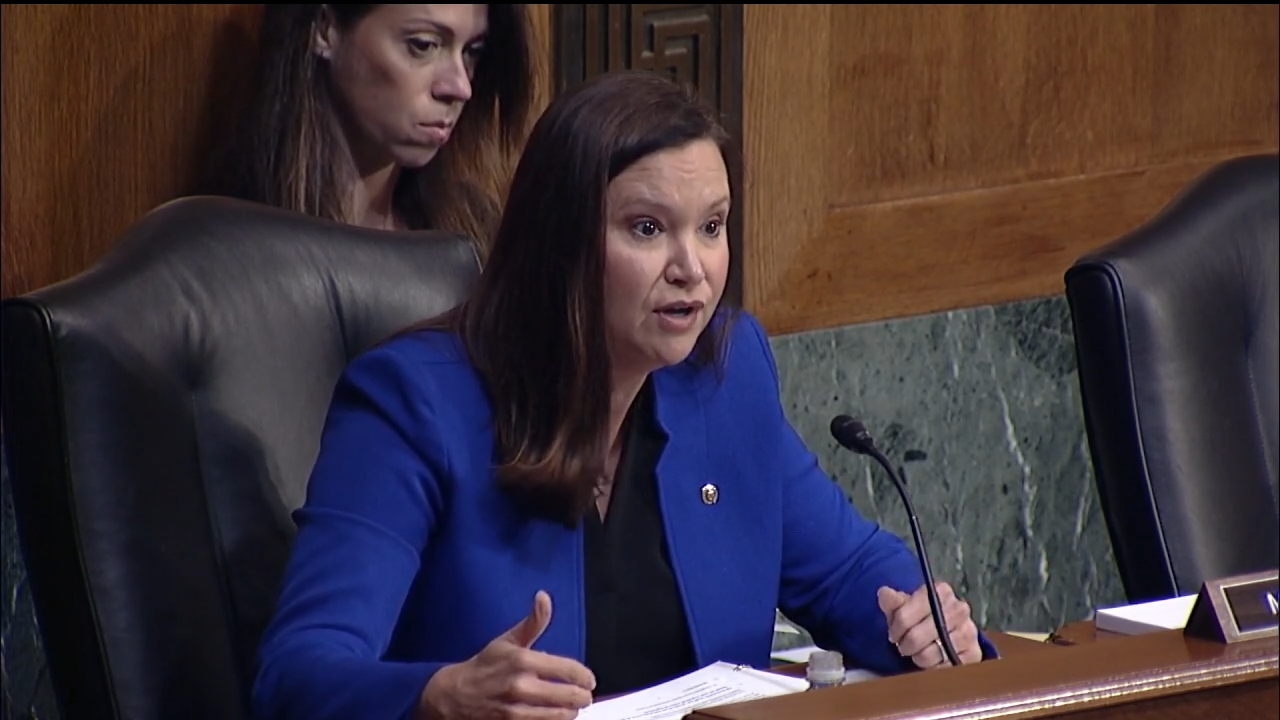
Ashley Moody cosponsors proposed measure that stem illegal resident impact on congressional districts
Published

on


The proposed Equal Representation Act would also limite illegal migrants from impact the Electoral College.

U.S. Sen. Ashley Moody is throwing her support behind a proposed measure designed to ensure only legal residents are counted when it comes to formulating congressional districts.

Moody announced she is cosponsoring the Equal Representation Act which was drafted to ensure that residents who are legally in the U.S. are the only people factored into the count that establishes the Electoral College map. That’s also the process that determines Congressional districts and the map that determines presidential elections.

In a news release, Moody said presently , the process counts migrants who are illegally in the U.S. “as a perverse incentive for open borders to boost the relative political power of the states and voters that court it.”

Moody said she cosponsored the Equal Representation Act that was reintroduced by U.S. Sen. Bill Haggerty, a Tennessee Republican. Moody claims that states such as California count “millions” of residents who are not in the state legally and that allows the west coast state to be apportioned more congressional seats along with more votes in the Electoral College than other states. She said that makes California a “magnet for illegal immigration” that boosts the political power of that state compared to other states.

“America’s democratic republic is built on the premise of equal representation of citizens. After years of open borders under (former President) Joe Biden, states like California have unfairly inflated their electoral counts by including illegal immigrants, boosting their political power while diluting the vote from actual Americans,” Moody said. “We are fighting to ensure that our voter rolls and congressional representation accurately reflects our citizenry.”

The Equal Representation Act is proposing several stipulations to stem the impact on  the congressional district process by those who are in the country illegally:

— It would require that the Census Bureau include a citizenship question on any future census to provide a greater understanding of the U.S. population and delineate between citizens and non-citizens for apportionment purposes.

— It proposes to prohibit non-citizens from being counted for purposes of congressional district and Electoral College apportionment.

— And it would require that the U.S. Census Bureau publicly report on certain demographic data.

There are about 20 Republican senators that have signed on to cosponsor the measure. No Democrats have taken that step.


Source link

Continue Reading

Politics

Last Call for 12.11.25 – A prime-time read of what’s going down in Florida

Published

on


Last Call – A prime-time read of what’s going down in Florida politics.

Ed. Note — After a hectic Election Night on Tuesday, we have decided to give Sunburn the night off. Don’t worry, the morning read of what’s HOT in Florida Politics will return to your inboxes bright and early Monday morning! Thanks for your support, and have a wonderful weekend.

___

A huge top-of-Last-Call birthday shoutout to our friend, Florida TaxWatch President & CEO Dominic Calabro.

___

Happening tomorrow — The Florida Department of Health is holding a rulemaking workshop in Panama City Beach on proposed changes to Rule 64D-3.046, which governs immunization requirements for children in public and private schools and child care. Surgeon General Joseph Ladapo has signaled interest in dropping several routine childhood vaccines from the school/child care list, revisiting the Florida SHOTS registry, and broadening the process for obtaining religious exemptions. Pediatric, legal and patient advocates from American Families for Vaccines, Florida Families for Vaccines, the Florida Chapter of the American Academy of Pediatrics, Southern Legal Counsel, the Pro-Vaccine Legal Alliance, and The J.A.I.M.E. Group are on-site, urging DOH to keep long-standing protections in place and avoid moves they say could put Florida families at greater risk for preventable disease: 9 a.m. CT, Hyatt Place Panama City Beach, 15727 Front Beach Rd., Dunes Conference Room, Panama City Beach.

First Shot

Gov. Ron DeSantis is supporting a plan that boots the University of South Florida from its Sarasota-Manatee campus and shifts every building, dorm and facility to New College of Florida, which would mark a dramatic reshaping of Sarasota’s higher education landscape.

The measure, pitched as part of the Governor’s 2026-27 budget proposal, would create a new section of Florida law directing the two institutions to shift all real property, buildings, leaseholds and related liabilities associated with the Sarasota-Manatee campus from USF to New College.

“This is a policy matter that is going to be discussed, debated and worked through over the coming months of the Legislative Session,” USF Board of Trustees Chair Will Weatherford said during a meeting on Thursday. “We don’t control the outcome of that discussion.”

The conforming bill specifies that no students, employees, fund balances, research contracts or grants would be part of the transfer, which applies only to real estate, fixed capital facilities, particular furnishings and any outstanding debts tied to those facilities. It would also ensure that current USF Sarasota-Manatee students can complete their degrees for up to four more years.

“Our priority, and what we do control as a university, is how we treat and protect our students, our faculty and our staff,” Weatherford said.

If approved, New College would be required to assume full legal and financial liability for the campus’s outstanding facility debt no later than Oct. 30, 2026. Until that assumption is complete, New College would make monthly payments of $166,617 to USF to cover the debt service. Failure by New College to make those payments would void the transfer and return the facilities to USF.

The real property transfer must be completed by July 1, 2026, with specific assets and liabilities identified in a joint agreement approved by both schools’ Boards of Trustees and submitted to the Board of Governors.

Read more on Florida Politics.

Evening Reads

—”Always on my mind: Donald Trump’s enduring focus on Joe Biden” via Shawn McCreesh of The New York Times

—”Disguised and in danger: How a Nobel Peace Prize winner escaped Venezuela” via José de Córdoba, Vera Bergengruen and Alex Leary of The Wall Street Journal

—”The Republicans fighting Trump’s latest redistricting plan” via Kelli Wessinger and Anstead Herndon of Vox

—”When did the job market get so rude?” via Franklin Schneider of The Atlantic

—”Doxxers posing as cops are tricking Big Tech firms into sharing people’s private data” via David Gilbert of WIRED

—“The VA was a safe space for veterans. That era is over” via Michael Embrich of Rolling Stone

—”Florida leads nation in cuts to environmental protection jobs, report says” via Jeffrey Schweers of the Orlando Sentinel

—“Eileen Higgins says backlash to Trump’s ‘trickle-down hatred’ helped her Miami Mayor win” via Jesse Scheckner of Florida Politics

—“House Committee advances bill expanding E-Verify to all Florida businesses” via Gabrielle Russon of Florida Politics

—”University of West Florida approves American Civic Republicanism Center” via Jay Waagmeester of the Florida Phoenix

Quote of the Day

“Every time a state does something like this, we get that much further away from all of our goals, which is to fix immigration in this country.”

— AFL-CIO lobbyist Rich Templin, on a bill expanding E-Verify to all businesses.

Put it on the Tab

Look to your left, then look to your right. If you see one of these people at your happy hour haunt, flag down the bartender and put one of these on your tab. Recipes included, just in case the Cocktail Codex fell into the well.

It needs a real-world recipe, but once that’s hammered out, Attorney General James Uthmeier gets The Bite of ’87 for going after Roblox creeps in court.

With Florida farmers getting a chunk of a $1 billion federal specialty crop bailout, it’s time for a Tomatini — c’mon, a citrus-based cocktail would’ve been low-hanging fruit.

Rep. Dean Black’s HB 4017 would serve the Nassau County Recreation & Water Conservation & Control Districts a Trashcan, whether they like it or not.

Breakthrough Insights

Tune In

Army-Navy takes college football spotlight this weekend

With conference championship games played and the College Football Playoff not kicking off until Dec. 19, this weekend is highlighted by a singular spectacle of college football: the 126th playing of the Army-Navy game, this year in Baltimore (3 p.m. ET Saturday, CBS).

Both teams will play in a bowl game. Army is scheduled to face UConn in the Fenway Bowl on Dec. 27, while Navy is booked for the Liberty Bowl against Cincinnati on Jan. 2. But this is the game that will live the longest in the minds of the players.

Army (6-5) is coming off a three-point win over Texas-San Antonio. The Black Knights’ last four games have been decided by three points or less. In that stretch, Army has won three games, with the only loss coming in a 26-25 defeat by Tulsa. As usual, Army’s offense is based around the ground game. Quarterback Cale Hellums has rushed for 1,078 yards while throwing for just 504 yards this season.

Navy (9-2) won the last two games after suffering its only losses of the season in back-to-back weeks. After falling to North Texas and then No. 10 Notre Dame, the Midshipmen responded with wins over 24th-ranked South Florida and at Memphis.

Like Army, Navy’s top rusher is a quarterback. Blake Horvath has thrown for 1,390 yards and rushed for 1,040 yards this season. Navy is the top rushing team in the nation, averaging 298.4 yards per game, while Army ranks fifth at 256.9 yards per game. 

___

Last Call is published by Peter Schorsch, assembled and edited by Phil Ammann and Drew Wilson, with contributions from the staff of Florida Politics.


Source link

Continue Reading

Politics

Ashley Moody, Rick Scott vote to kill extension of health care subsidies

Published

on


The U.S. Senate has shot down a proposal to extend health care subsidies for three years. Both U.S. Sens. Rick Scott and Ashley Moody voted against the proposal.

The rejection from Florida’s Senate delegation came even though Florida has 4.7 million consumers, more than any other state, relying on tax credits obtained in the Affordable Care Act (ACA) Marketplace.

As of now, those consumers are set to see premiums increase without subsidies that were expanded in 2020 in response to the COVID pandemic. A shorter extension of the subsidies is still possible, but no plan has been agreed upon despite price hikes nearing.

The Florida Senators drew pushback from Florida Democrats immediately.

“It is exactly two weeks before Christmas and 4.7 million Floridians are terrified they are going to lose access to their healthcare,” said Florida Democratic Party Chair Nikki Fried.

“Instead of fighting for their health and safety our Senators, Rick Scott and Ashley Moody have decided to leave them out in the cold by voting against ensuring their health and safety. Floridians are scrambling to keep food on the table and the lights on during this affordability crisis. The least our elected officials can do is ensure that their healthcare costs don’t balloon by thousands of dollars, pushing more Florida families to the brink.”

But it’s little surprise that either Scott or Moody voted against the bill.

Scott, a Naples Republican, made clear throughout a Rescuing the American Dream summit he led in Washington last week that he considers the ACA subsidies bad policy. He instead has pushed his alternative More Affordable Care Act, which seeks out free market solutions to reduce the costs paid by consumers.

Ahead of the vote, he said Congress should not continue down the road of further subsidizing insurance.

“American families see clearly that Obamacare has failed to deliver on its promises — instead, it created a broken system that screwed over the American people with higher costs and fewer options,” Scott said.

“Families are left paying higher premiums and higher deductibles for health care plans that don’t even fit their needs. We can fix that: we just have to let Americans be the consumer so they can get care that truly fits their needs and drive competition to lower costs.”

Shortly after the vote against extending subsidies, Scott’s Office issued a roundup of conservative groups endorsing his bill, though the Republican majority in the Senate has failed to coalesce around Scott’s plan, or any other specific health care proposal.

Moody hasn’t been vocal on health care, but was among the 48 Republicans who voted against taking up a Democratic bill to extend subsidies. While 51 Senators supported taking up the bill, Senate rules require 60 votes to advance legislation.

Notably, Moody, who was appointed to the Senate in January, stands for election in 2026. A Republican polling firm in October released survey results earlier this year showing the Plant City Republican may be more vulnerable to a challenge if she does not support extending tax credits, a program supported by 73% of Florida voters.

Democrats suggested they intend to highlight the vote against subsidies in the Midterms. Due to the vote, all Floridians receiving subsidies will likely see them expire at the close of 2025.

“If these subsidies expire, costs will skyrocket forcing families to make impossible choices — including forgoing healthcare. That means higher costs, strained services, and longer wait times for everyone,” Fried said.

“Floridians deserve better. Healthcare should not be a partisan issue and it’s a shame that millions of Americans have to endure this during the holidays.”

The debate around the subsidies for insurance were at the heart of a government shutdown this year.


Source link

Continue Reading

Politics

Fiona McFarland pushes to raise payout caps on lawsuits against cities and counties

Published

on


A bill pitched by Sarasota Rep. Fiona McFarland that increases the payout cap on lawsuits against state and local governments has advanced through the committee stage, but it’s still in search of a Senate sponsor despite favorable outlook in the House.

The House Judiciary Committee advanced McFarland’s legislation (HB 145) that would significantly raise Florida’s sovereign immunity caps placed on lawsuits against state and local governments, reviving an effort to update how much people can recover when they sue. 

The measure would increase the current limits of $200,000 per person and $300,000 per incident to $500,000 and $1 million beginning in 2026. The caps would rise again in 2031 to $600,000 per person and $1.2 million per incident.

The bill would also allow cities, counties and other public agencies to settle claims above those limits without needing a separate act of the Legislature. It shortens the time to file notices of claim against government entities, reduces the statute of limitations for negligence cases to two years, and bars insurers from requiring a claims bill before paying benefits.

Supporters say the updates modernize payout limits that have not changed over a decade, and streamline a process that forces victims to seek additional compensation through a claims bill.

“I’ll remind you that approximately one-fourth of claims bills that are filed every year pass, and again these caps were last updated in 2010.” McFarland said during Thursday’s committee meeting. 

However local governments and school districts have previously warned that higher caps could increase insurance costs and pressure local budgets, especially since it comes at a time when state legislators aim to cut property taxes.

The committee reported favorably on the measure with a 12 to 2 vote. HB 145 next heads to the House floor for debate, but a Senate companion has not yet been filed ahead of the Jan. 9 deadline.

The 2025 Session version of SB 145 passed in the House on a 103-11 vote in April, but it stalled out in the Senate where its upper-chamber companion, sponsored by St. Petersburg Republican Sen. Nick DiCeglie, died without a hearing. DiCeglie previously told Florida Politics he isn’t refiling the bill for the 2026 Session and doesn’t know if another Senator will.

___

Jesse Scheckner of Florida Politics contributed to this report.


Source link

Continue Reading

Trending

Copyright © Miami Select.