Connect with us

Business

ASEAN chair Philippines starts 2026 on ‘weaker footing’ after corruption scandal, trade tensions

Published

on


The Philippines is on a “weaker footing” heading into 2026, thanks to corruption scandals and a complicated trade environment, testing President Ferdinand “Bongbong” Marcos Jr. as he assumes the chairmanship of the Association of Southeast Asian Nations (ASEAN).

Malaysia, the previous chair, had a busy 2025, needing to handle both the effects of U.S. President Donald Trump’s steep tariffs on Southeast Asian economies, and a violent border conflict between member countries Thailand and Cambodia.

Marcos, now leading the 11-nation bloc, has bold plans for his chairmanship in 2026, including signing a pact to integrate the region’s digital economy. But he has economic problems closer to home.

Investor confidence has withered in the wake of a corruption scandal, as probes discovered that $2 billion in government funding for flood management projects had disappeared. Since September, the Philippines has been rocked by investigations into misallocated funds, tight links between politicians and contractors, substandard materials and “ghost projects.” Marcos’s approval ratings have dropped amid the scandal.

The corruption scandal has sparked greater public outrage due to the Philippines’ continual problems with tropical storms and flooding. In November, Typhoon Kalmaegi wreaked havoc on portions of central Philippines, causing a death toll of over 200 and economic losses of more than $60 million, from damage to crops and farmland alone.

The news has put the Philippines’ economy on a “weaker footing,” says Lavanya Venkateswaran, senior ASEAN economist at OCBC Bank. Third-quarter GDP growth fell to a four-year low of 4%, prompting Manila to slash growth targets for 2026 through 2028. 

“The authorities will need to prioritize addressing administrative and bureaucratic challenges to restore confidence in public administration,” Venkateswaran says, pointing to persistent inefficiencies like corruption, uneven digitalization and excessive red tape, which hinder economic growth in the Philippines. 

Challenging trade dynamics

The Philippines also occupies a complex position in world trade. Manila boasts closer security ties with the U.S., which officials at times present as an asset as Washington embraces “friendshoring” and supply chains based in friendly countries. Yet economists are skeptical that relatively friendly relations with Washington will confer a trade advantage.

The U.S. and the Philippines signed a trade deal last July that set a 19% tariff on U.S.-bound exports from the Southeast Asian country. In exchange, the Philippines agreed to remove tariffs on key U.S. goods, including agricultural and pharmaceutical products. 

Closer to home, the nation also faces strong competition from ASEAN peers like Singapore, Malaysia, Indonesia and Vietnam, both in terms of attracting foreign investment and connecting into global supply chains. 

In the immediate aftermath of “Liberation Day”, when the U.S. imposed steep tariffs on the rest of the world, some Philippine officials hoped that a relatively lower import duty on the island nation might give it a competitive advantage over other Southeast Asian countries. Yet the U.S.’s recent trade deals with major Asian trading partners has eroded that gap: Vietnam and Malaysia now have tariffs of 20% and 19% respectively, compared to 19% for the Philippines.

The Philippines also has a long-running territorial dispute with China over islands in the South China Sea. Over $5 trillion worth of trade passes through the region annually, and conflict could disrupt critical shipping lanes through the waterway. 

The biggest problem for the country, however, is its limited manufacturing depth, says Andrew Tsang, the senior economist at the ASEAN+3 Macroeconomic Research Office (AMRO). Unlike its peers like Vietnam, the Philippines relies heavily on imported intermediate goods, used as inputs in manufacturing. That means the country has struggled to integrate itself into regional supply chains. “Without faster investment execution and industrial upgrading, the Philippines risks missing the next wave of supply-chain reconfiguration,” he cautions.

Wielding ASEAN leadership

Despite these challenges, experts are hopeful that the Philippines can use its ASEAN chairmanship to rebuild its reputation and strengthen investor trust. 

With its new position, the country “gains a valuable convening role to advance regional priorities on connectivity, resilience, the digital economy, and supply chains,” says Tsang of AMRO.

The Philippines can also leverage multilateral accords like the ASEAN Digital Economy Framework Agreement (DEFA)—which the bloc is set to sign in 2026—to secure its own future by setting broader goals which benefit all neighbors.

The agreement, slated to be the world’s first regional digital economy agreement, would boost not just the country’s business process outsourcing (BPO) industry, but also create a $2 trillion unified digital market across Southeast Asia. This way, “a small business in Mindanao can sell to a customer in Jakarta as easily as they do at home,” explains Nona Pepito, a professor of economics at the Singapore Management University (SMU).

The Philippines can also help make regional supply chains more resilient. It can “lead a push to weave the bloc’s diverse strengths—like Vietnamese manufacturing, Thai automotive parts, and Philippine electronics—into a single, unbreakable ASEAN factory that is shielded from the U.S.-China trade wars,” she adds.

Finally, experts say the country should also invest in equipping its population with digital literacy skills, while pushing for regional standards in AI ethics.

The Philippines’ services sector is a pillar of the country’s growth and a major employer, yet AI could threaten jobs in the BPO sector. Investing in training could help workers find new employment opportunities and avoid getting automated out of a job. 

“The key macroeconomic risk lies in the speed of adjustment,” says Tan Sook Rei, a senior lecturer at Singapore’s James Cook University (JCU). “Whether 2026’s opportunity translates into durable economic gains will ultimately depend on credibility, execution, and governance.”


Source link

Continue Reading

Business

JPMorgan CEO Jamie Dimon says US national debt issue will ‘bite eventually’

Published

on


JPMorgan Chase CEO Jamie Dimon had a dose of reality for analysts and investors tuning into his company’s earnings call this week: At some point, governments around the globe are going to have to examine their spending habits.

Shares in America’s largest bank declined following its Q4 2025 earnings call yesterday, which reported revenue of $45.8 billion and assets under management of $4.8 trillion, representing an 18% year-over-year increase.

On the call, Dimon shared a mixed outlook on the economy, saying that “while labor markets have softened, conditions do not appear to be worsening.” He added that consumers remain resilient in their spending and “businesses generally remain healthy.” That’s despite upheaval in markets, which last year had to wrangle with rapidly changing foreign and trade policy from the White House.

While the billionaire banker was bullish on artificial intelligence, he also reiterated his warning that a looming shadow over the macroeconomic outlook is government debt. He has previously cautioned that Washington faces a market “rebellion” over the issue.

When asked about his outlook for 2026, Dimon said the short-term looked good. He explained: “Call it six months and nine months and even a year, it’s pretty positive. Consumers have money. There’s still jobs, even though it’s weakened a little bit. There’s a lot of stimulus coming from the One Big Beautiful Bill. Deregulation is a plus in general, not just for banks, but banks will be able to redeploy capital.”

However, the macro “backdrop” must also be considered, he added, and these work on different timelines: “Geopolitical is an enormous amount of risk … It’s just a big amount of risk that may or may not be determining the fate of the economy.”

He continued: “The deficits in the United States and around the world are quite large. We don’t know when that’s going to bite. It will bite eventually because you can’t just keep on borrowing money endlessly.”

That doesn’t seem to have trickled through to government, which spent $276 billion on interest payments on the national debt in the final three months of 2025 alone. In its most recent budget review released Friday, the Congressional Budget Office reported that the deficit totaled $601 billion in the first quarter of the fiscal year 2026 (October to December), $110 billion less than the deficit recorded the same period last year. 

Following the release, Maya MacGuineas, president of the Committee for a Responsible Federal Budget, said the U.S. government is already on track for a $2 trillion deficit in 2026. “Meanwhile, despite being more than a quarter into [fiscal 2026], our government is still not fully funded for the rest of the fiscal year, with another funding deadline around the corner in just over two weeks,” she added. “Lawmakers should come to an agreement on appropriations that avoids increasing our debt even more, restores the caps on discretionary spending, and maintains flat funding from the last fiscal year.”

White House officials have argued that tariff revenue will offset some of the government’s borrowing (despite the president also promising it for other uses), but Dimon remained realistic. “We have to deal with the world we got, not the world we want,” he said, adding his focus is not to guess economic outcomes but serving clients.

Who owns America’s debt?

One of the paths out of a potential debt crunch is that a central bank could simply print more money. By increasing the supply of money, the value of a currency is pushed down, making the interest payments on borrowed money relatively cheaper. However, this comes with inflationary, or hyperinflationary, side-effects.

Moreover, buyers of debt may realise the returns they are getting are decreasing in value, and so demand higher interest payments in the future.

This would be less of a concern for some buyers than others. For example, according to Treasury data analysis by the Peter G Peterson Foundation, which focuses on maintaining a stable fiscal future, the Federal Reserve System is the largest single holder of U.S. debt, owning $4.5 trillion as of March 2025. State and local governments own $1.7 trillion, and mutual funds own $4.4 trillion.

A problem may come from further afield, particularly if geopolitical tensions continue to rise, tempting foreign governments to order their central banks to ditch U.S. debt in protest. That would hurt the value of the dollar, generate inflation, and force the interest yield on U.S. debt upward—all scenarios that would make life more expensive for the federal government.

Investors in Japan, China, and the U.K. are among the highest buyers of U.S. debt, owning $1.1 trillion, $779 billion, and $765 billion, respectively. “While the holdings of U.S. debt by both [Japan and the U.K.] have declined over the past decade, China’s purchases of U.S. Treasury securities have declined more than Japan’s,” the foundation wrote.


Source link

Continue Reading

Business

Down Arrow Button Icon

Published

on


President Donald Trump announced yesterday he would impose a new tariff of 25% on any country trading with Iran. He also predicted disaster if the U.S. Supreme Court were to rule his tariff orders are illegal. The president estimated that “many Hundreds of Billions of Dollars” or even “Trillions” were at stake if the government was forced to refund anyone who paid them.

“It would be a complete mess, and almost impossible for our Country to pay,” he said on Truth Social. “If the Supreme Court rules against the United States of America on this National Security bonanza, WE’RE SCREWED!”

The court could issue a ruling as soon as Wednesday. It had been expected to rule last week. It is not clear why the court is delaying.

But Wall Street analysts are increasingly sanguine about the ruling. As time goes by, many say, the tariff issue becomes less and less dramatic. And in the bigger macro picture, the tariffs are less significant than predicted.

The longer the delay in the ruling the more likely it is the court is leaning toward Trump, according to JPMorgan.

“Legal experts continue to expect the Supreme Court to rule against the use of emergency powers [under the International Emergency Economic Powers Act] to authorize tariffs, but note that each week the Supreme Court delays its decision increases the likelihood of the Trump administration prevailing,” JPMorgan analysts Amy Ho and Joyce Chang told their clients. “Historically, SCOTUS reserves its most impactful decisions for the end of its term in June, which allows for extended deliberation.” Both Supreme Court cases on the Affordable Care Act were pushed to June, they wrote.

The pair also note that in the underlying case, only $135 billion in potential tariff refunds are at stake. 

Although Trump has touted the tariffs as a method of paying off the $38 trillion national debt, the reality is that collections so far have been too small to have much of an affect, according to James Knightley, ING’s chief international economist in the U.S. “Since April, tariff revenues are up $206 billion in those eight months relative to [fiscal] 2024, but not all are the IEEPA tariffs—they are estimated to perhaps be $130 billion. Sounds a lot, but the U.S. is a $30 trillion–plus economy,” he told Fortune in an email.

“Many companies will be wary of drawing the ire of the president by claiming a refund, and the hoops to jump through to reclaim through the courts could be quite onerous and deter others. Hence the actual amount that is reclaimed may be quite a lot less than $130 billion.”

Besides, he said, even if Trump loses the Supreme Court case he will likely reimpose the tariffs via some other regulation. “Given tariffs are a signature policy and the Republican polling isn’t looking very strong right now ahead of the midterms, the administration will move swiftly to reinstate tariffs through other legally recognized routes. The promise of a $2,000 tariff dividend needs to be paid for somehow. This is merely shuffling money around seeing as Americans paid the tariffs in the first place only to get money returned, so it is difficult to argue this will be a major stimulus for the economy,” he said.

Tariff revenue is being generated at a current rate of $30.4 billion per month, for an annualized rate of $364.5 billion, according to data from Bloomberg provided to Fortune via Pantheon Macroeconomics. However, those revenues are already in decline as companies find workarounds and as Trump himself cuts deals, compromises, or delays the imposition of harsher measures. 

Convera analyst Antonio Ruggiero is also unruffled by the upcoming ruling. If the tariffs are ruled illegal, “we expect the immediate [foreign currency exchange] reaction to be limited, as the broader consensus is that alternative mechanisms will be found to keep tariff revenues intact.

“That said, in the medium term, we cannot exclude the possibility of mild bearish pressure on the dollar tied to expectations of further uncertainty and erratic trade maneuvers should the administration be forced to remove such tariffs, particularly at a time when USD sentiment is increasingly fragile amid concerns over Federal Reserve independence,” he advised clients in an email seen by Fortune.

Here’s a snapshot of the markets ahead of the opening bell in New York this morning:

  • S&P 500 futures were down 0.15% this morning. The last session closed up 0.16%. 
  • The STOXX Europe 600 was flat in early trading.
  • The U.K.’s FTSE 100 was up 0.05% in early trading. 
  • Japan’s Nikkei 225 was up 3.1%.
  • China’s CSI 300 was down 0.6%. 
  • The South Korea Kospi was up 1.47%. 
  • India’s Nifty 50 was down 0.25%. 
  • Bitcoin was at $92K.


Source link

Continue Reading

Business

Down Arrow Button Icon

Published

on


The S&P 500 fell 0.19% yesterday but, interestingly, the “equal weight” S&P 500 (a notional index that values each stock equally) was marginally up. That’s because more investors are picking between winners and losers on the index—and many of the losers are the “Magnificent Seven” tech stocks.

The market as a whole is up 0.48% year-to-date. Given that the year is only a few days old, that pace promises healthy gains ahead.

But only two of the Mag 7 stocks are in positive territory so far, Alphabet and Amazon. All the others are down. Some of them are down bad. Tesla has lost 4.73% so far, Apple is down 4.83%.

The collapse of the Mag 7 is important because in the last few years the valuation of those stocks has grown so big that they now form more 30% of the value of the S&P as a whole. It created a situation where even if you bought an S&P 500 exchange-traded fund your results were mostly affected by the Mag 7.

To give you an idea of how worried analysts are about this concentration risk, Apollo Global Management chief economist Torsten Sløk recently published a note whose opening page looked like this:

But the dominance of the Mag 7 is likely to come to an end this year, many on Wall Street believe—if only because their valuations can’t exponentially go up forever. 

Morgan Stanley Wealth Management Chief Investment Officer Lisa Shalett believes the market is undergoing a healthy rotation away from tech stocks and back into the non-tech components of the S&P.

“We see several drivers of healthy deconcentration of the current ‘top 10’ components persisting,” she said in a recent note. “First is relative earnings acceleration. Growth rates are apt to continue to decline for the ‘Magnificent Seven’ while those of ‘the 493’ improve. Second, stock-buyback activity among the tech giants is falling as operating cash flow increasingly goes to [AI-related] capex.” 

The result is something that traders are pretty happy about because—as yesterday’s equal weight S&P performance shows—the other 493 stocks are still able to generate gains even if the Mag 7 are crumbling.

“On a [year-to-date] basis, the bull market in the S&P 500 is broadening, as we expected it might this year. The S&P 400 and S&P 600 are outperforming the S&P 500,” Ed Yardeni of Yardeni Research told clients this morning:
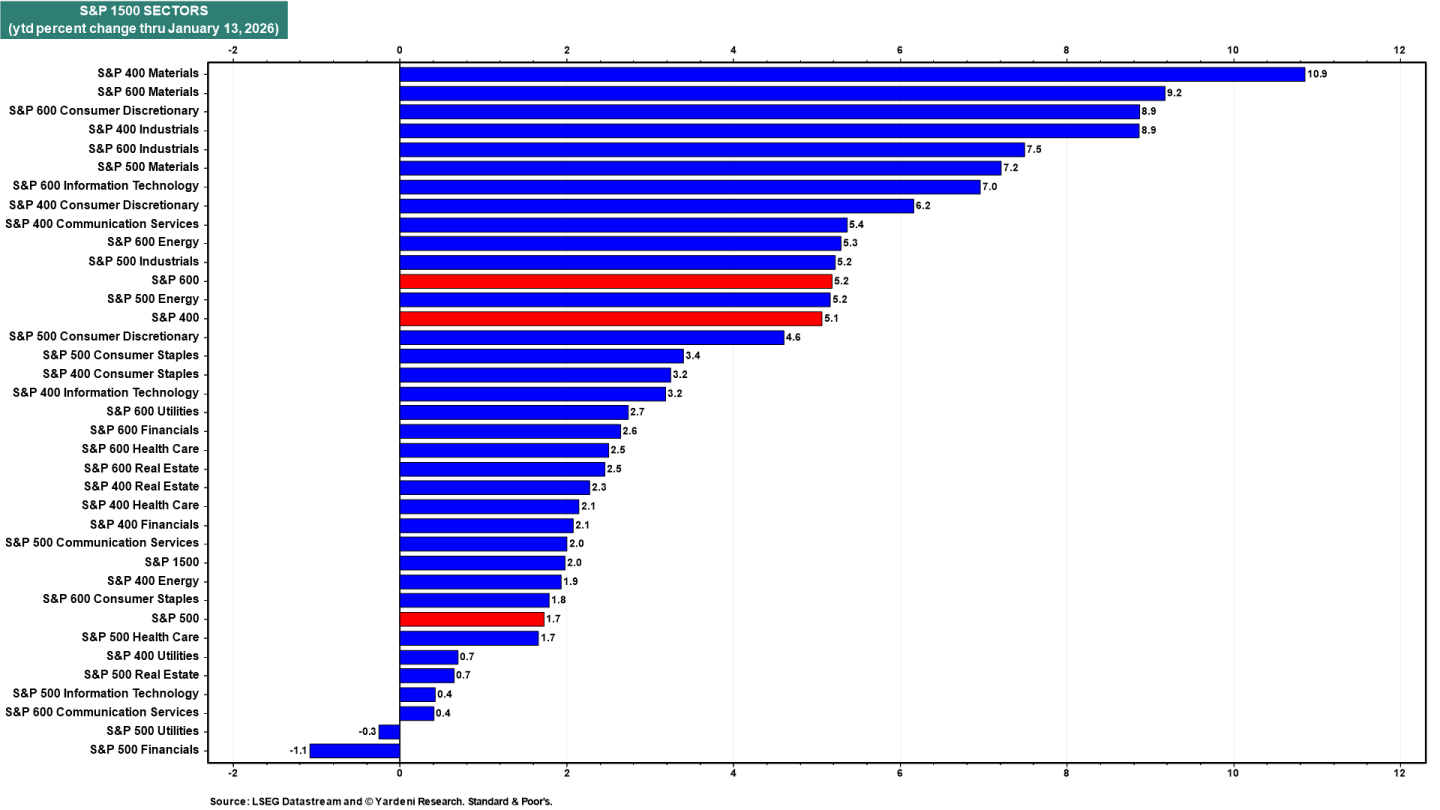
The Mag 7 has been in decline for two and a half months. “The Impressive-493 has outperformed the Magnificent-7 since last November. We expect this will continue in 2026, as last year’s LargeCap laggards catch up,” Yardeni said.

Here’s a snapshot of the markets ahead of the opening bell in New York this morning:

  • S&P 500 futures were down 0.44% this morning. The last session closed down 0.19%.
  • STOXX Europe 600 was up 0.27% in early trading.
  • The U.K.’s FTSE 100 was up o.3% in early trading. 
  • Japan’s Nikkei 225 was up 1.48%.
  • China’s CSI 300 was down o.4%. 
  • The South Korea KOSPI was up 0.65%. 
  • India’s NIFTY 50 was down 0.26%. 
  • Bitcoin was at $95K.
Join us at the Fortune Workplace Innovation Summit May 19–20, 2026, in Atlanta. The next era of workplace innovation is here—and the old playbook is being rewritten. At this exclusive, high-energy event, the world’s most innovative leaders will convene to explore how AI, humanity, and strategy converge to redefine, again, the future of work. Register now.


Source link

Continue Reading

Trending

Copyright © Miami Select.