Connect with us

Politics

As legal betting booms, James Uthmeier, lawmakers target shadow gambling economy
Published

on


Hundreds of millions of dollars in legal sports betting revenue are flowing into Florida each year, but a growing shadow gambling economy is siphoning money away from the state and its taxpayers.

Attorney General James Uthmeier is working to rein it in. He’s also asking the state lawmakers to raise the stakes by steepening penalties.

A key objective for Uthmeier in 2026 is to address the rapid expansion of illegal and legally ambiguous gambling activities across the state, particularly as they intersect with the Seminole Tribe’s Gaming Compact.

While the Seminole Tribe’s legal, state-sanctioned sports betting platform, Hard Rock Bet, has generated hundreds of millions of dollars for Florida, a parallel and largely unregulated ecosystem has emerged with it. This includes illegal brick-and-mortar casinos, offshore gambling platforms, sweepstakes-style gaming apps, fantasy sports platforms whose offerings blur into sports betting and federally regulated prediction markets like Kalshi and Polymarket.

Each of those developments presents problems. Together, they have complicated enforcement and raised questions about compliance with state law and the 2021 Gaming Compact, which expanded Seminole-exclusive gambling across the state, including online sports betting operations projected to yield Florida $4.4 billion through 2030.

“We stand by the Compact with the Seminole Tribe,” Uthmeier told Florida Politics. “It’s been a huge success, and it’s a great way to ensure that Florida taxpayers are getting the benefit of a significant revenue share to the state, moving through an application and gaming apparatus that is highly regulated, safe and free from illicit activities.”

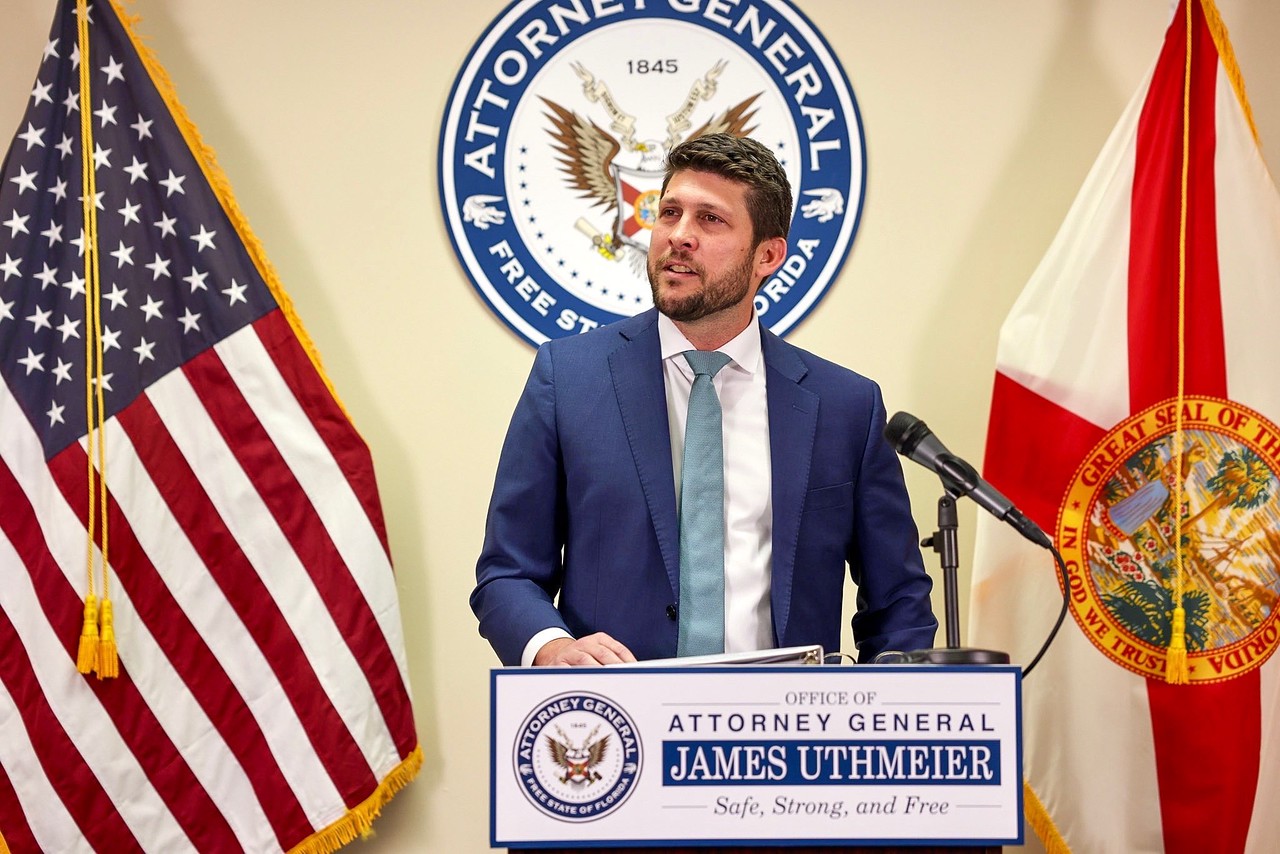
James Uthmeier, now almost 11 months into his appointment as Florida Attorney General, is making a statewide clampdown on illegal gambling a cornerstone of his 2026 agenda. Image via the State Attorney’s Office.

Uthmeier hasn’t been idle. He said he’s taken down numerous large-scale gambling operations over the past year. The highest-profile takedown occurred in June, when Uthmeier’s Office of Statewide Prosecution charged Osceola County Sheriff Marcos López and others in what it called a “massive Central Florida illegal gambling operation.”

The arrest followed an investigation by Uthmeier’s Office in collaboration with the U.S. Department of Homeland Security and the Florida Department of Law Enforcement. López, whom Gov. Ron DeSantis suspended on the same day of his arrest, faces racketeering and conspiracy charges for alleged crimes that generated nearly $22 million in illicit proceeds.

Uthmeier has said such illegal gambling operations are frequently tied to money laundering, human trafficking and other serious financial crimes beyond gambling violations.

To tackle online gambling platforms that operate from overseas, like Bovada and MyBookie, Uthmeier is looking into disrupting payment processor servers, web hosts that facilitate unlicensed gambling and access via virtual private networks (VPNs). It’s not an easily scalable effort — Uthmeier describes it as something of a “whack-a-mole” challenge — but it will be a big priority in 2026.

For fantasy- and sweepstakes-focused platforms, the Attorney General’s Office has issued subpoenas to several companies. Uthmeier and his staff plan to meet with leaders from those companies and others early in the year to exchange information, allow the companies to present their cases and inform them of the strict guidelines by which they must abide to continue doing business in the state.

Some fantasy sports and sweepstakes operators have publicly disputed characterizations of their offerings as illegal gambling, but said they’d work with regulators and lawmakers to ensure compliance with state law.

Meanwhile, operators of federally regulated prediction markets argue their products fall under the Commodity Futures Trading Commission’s jurisdiction, setting up a potential legal battle over whether state gambling laws apply to these platforms.

Alongside Uthmeier’s efforts, the Florida Gaming Control Commission (FGCC) has been ramping up enforcement operations through partnerships with local, state and federal law enforcement agencies.

In 2025, the FGCC said it seized nearly $14.5 million and 6,725 slot machines from illegal casinos — up from $7.1 million and 1,287 slot machines in 2024. The Commission said it also entered into 29 new memoranda of understanding with various law enforcement bodies.

New legislation to back it up

Uthmeier is also backing 2026 bills to strengthen penalties for illegal gambling and related advertising, both online and in physical locations. Many of the penalties in statute now are misdemeanors and, he said, insufficient and “make the risk-reward analysis very imbalanced.”

“We’re not doing enough to disincentivize people from engaging in this behavior,” he said. “People stand to make tens of millions of dollars through these operations, and getting a misdemeanor is really just a slap on the wrist.”

One measure now advancing in the House (HB 189) would institute a sweeping overhaul of Florida’s gambling laws, dramatically expanding criminal penalties, regulatory authority and enforcement tools across nearly all forms of wagering.

(L-R) Sen. Jennifer Bradley and Reps. Berny Jacques and Dana Trabulsy — all Republicans — are each carrying bills that would steepen penalties for illegal gambling, though to varying degrees of severity. Images via Florida Politics and the Florida House.

The bill, sponsored by Fort Pierce Republican Rep. Dana Trabulsy, targets illegal casinos, online gambling, fantasy sports, slot machine trafficking, advertising and even transportation tied to illegal gambling.

It would also tighten ethics rules, add felony penalties for repeat or large-scale violations and strengthen the authority of the FGCC, which assisted in a multicounty seizure of hundreds of illegal gambling machines last month through a crackdown initiative dubbed “Operation Funny Money.”

Another bill (SB 204) by Fleming Island Republican Sen. Jennifer Bradley is narrower and more procedural, focusing primarily on amusement games and slot machines.

The bill, which awaits its first Committee hearing in the Legislature’s upper chamber, would require specific organizations — especially veterans’ groups — to seek advance approval from the FGCC when legality is unclear.

It would also clarify when slot machine shipments are lawful, including on tribal lands, and modestly strengthen penalties for unlawful possession. Unlike the House bill, SB 204, in its current form, would not broadly expand criminal categories or address online gambling, fantasy sports, or advertising.

There’s also Seminole Republican Rep. Berny Jacques’ proposal, HB 591, which would dramatically overhaul Florida’s gambling enforcement framework, reclassifying many existing gambling-related crimes into higher felony tiers and creating new felony offenses for internet gambling, advertising gambling, transporting gamblers and manipulating games.

Unlike HB 189, which strengthens existing enforcement authorities while maintaining a focus on gaming integrity and compliance, HB 591 would pre-empt local regulation entirely, expanding the FGCC’s influence across nearly all gambling-related activity.

Some lawmakers and advocacy groups, including veterans’ organizations, have warned that broad felony expansions could unintentionally sweep in lawful activities or charitable events and need clearer definitions to avoid unintended consequences.

Jeremy Redfern, Uthmeier’s Deputy Chief of Staff, told Florida Politics that those who run unlawful gambling markets while providing no avenue for transparency or accountability to Florida consumers face a tough road ahead.

“Our office is working with the Florida Legislature to increase penalties and the Gaming Commission to take down illicit markets,” he said. “2026 will be a record year in the fight against illegal gambling and the other major crime it brings to our state.”


Source link

Continue Reading

Politics

Maduro — communism — seniors — SPEED — improper ideology

Published

on


Florida at the helm

Amid controversy about the arrest and capture of Venezuelan President Nicolás Maduro, it fell to Floridians to defend the U.S. on the domestic and international stage.

That unfolded at the United Nations, where Michael Waltz gave an emphatic defense of the action during an emergency hearing.

“If the U.N. … confers legitimacy on an illegitimate narco-terrorist and the same treatment in this charter of a democratically elected President or head of state, what kind of organization is this?” Waltz said.

Michael Waltz addresses the United Nations as Nicolás Maduro’s arrest sparks Florida-led defense of U.S. action.

That followed a weekend of consternation from U.N. Secretary-General António Guterres about the ongoing developments in Caracas.

“I am deeply concerned about the possible intensification of instability in the country, the potential impact on the region, and the precedent it may set for how relations between and among states are conducted,” Guterres said in a statement reported by Reuters.

Meanwhile, Secretary of State Marco Rubio, who played a critical role in the decision to apprehend Maduro, argued to U.S. national media that the mission was both warranted and legal. He noted that the U.S. years ago issued indictments on drug trafficking charges against Maduro and several others within the congressional delegation.

“We can pick and choose which ones we go after, and we have court orders for each one,” Rubio told CBS’s “Face the Nation.” “That will continue to be in place until the people who have the control over the levers of power in that country make changes that are not just in the interests of Venezuela, but in the interests of the United States and the things that we care about.”

Meanwhile, President Donald Trump asserted shortly after Maduro’s arrest that Rubio and a few others in the administration were “going to run” Venezuela in the near term. Rubio, for his part, later clarified that he will work with Delcy Rodriguez, Maduro’s Vice President, who on Monday was sworn in as interim President of Venezuela.

Both Rubio and Waltz, for years, closely followed the situation in Venezuela as members of Florida’s congressional delegation. Nearly half of Venezuelans in the U.S. live in Florida, a number that has surged during the 15 years Maduro has been in power, according to the Migration Policy Institute.

Before holding their current posts, Rubio served as Florida’s senior Senator, while Waltz represented parts of North and Central Florida in the House. Over his 14 years on the Hill, Rubio pushed for regime change in Venezuela, including visiting the South American nation’s border and encouraging Maduro’s own military to ignore orders and allow humanitarian aid across the border.

Waltz, meanwhile, crafted multiple bipartisan pieces of legislation that impose sanctions and pressure Maduro.

A Florida story

Meanwhile, the sitting members of Florida’s congressional delegation offered varied support and criticism of the administration’s actions. But there appeared to be bipartisan agreement on one key fact: Maduro belongs in prison and out of power.

Rep. Maxwell Frost demanded an immediate briefing of Congress regarding the situation on the ground. He expressed strong skepticism about positive outcomes should the U.S. indeed try to run the government in Venezuela or install a seemingly friendly regime there. He also raised questions about whether the administration bypassed legal requirements to obtain congressional approval before a military operation.

Maxwell Frost urges congressional briefing as Florida delegation splits on Maduro arrest, despite bipartisan agreement.

“But a lot of things can be true at once,” the Orlando Democrat said. “There are a lot of people in the Venezuelan diaspora celebrating today, and the reason there is a diaspora is that there is a brutal dictatorship in Venezuela.”

Rep. Debbie Wasserman Schultz, who represents the largest concentration of Venezuelans in the country, said she was upset that the U.S. didn’t immediately install Edmundo González, whom most international observers believe won an election against Maduro in 2024, to head the government.

“To replace one unelected regime with another, which apparently Donald Trump has decided is him, is wildly inappropriate,” the Weston Democrat said.

But among Republicans in the delegation, the chief reaction to Maduro’s arrest was joy. Sen. Ashley Moody publicly defended the action’s legality as a drug enforcement operation. “Do not become the mouthpiece of our foreign adversaries,” the Plant City Republican said to Democratic critics.

South Florida’s Cuban American contingent in Congress held a news conference in Doral celebrating a “glorious day” for the Venezuelan diaspora. All expressed confidence that Venezuela would quickly become self-sufficient and free.

“They have the largest reserves of oil in the world, so they’re going to be able to pay for their own reconstruction. They’re not going to be asking and asking or begging any other country, including ours, to lend them money,” said Rep. María Elvira Salazar, a Coral Gables Republican who chairs the House Western Hemisphere Committee. She also said Maduro’s arrest removes a foothold for Russia, China and Hezbollah in South America.

Reps. Mario Díaz-Balart and Carlos Giménez, both Miami-Dade Republicans, suggested the end of Maduro’s regime could mark impending trouble for Nicaragua and, perhaps more quickly, Cuba, which provided security for Maduro that was neutralized in the raid.

Sen. Rick Scott, days after the arrest, held a news conference alongside Cuban dissident leader José Daniel Ferrer and an associate of Venezuelan opposition leader María Corina Machado. He also signaled, in contrast to Trump’s remarks about Machado this week, a belief that Machado will play a key role in the region’s future. “She’s well respected by Venezuelans,” the Naples Republican said.

But he signaled that it could take time for a new government to come into power. “We would all like it to happen in a day, right? And I think it’s going to happen, but it’s going to take time to make that happen,” Scott said.

Denouncing communism

The power shift in Venezuela unfolded days after Scott filed legislation to raise awareness of the fallout from communism. His bill (S 3244) would designate Nov. 2-8 as “Anti-Communism Week” to increase education about the problems faced by nations adopting the form of government.

“Communism is one of the most destructive and deadly ideologies in human history, responsible for the suffering and deaths of millions while crushing freedom wherever it takes hold,” Florida’s senior Senator said.

Rick Scott links Maduro power shift to Anti-Communism Week push amid renewed ideological warnings nationwide.

“As a nation founded on liberty and individual freedoms, we must never forget these horrors or allow dangerous ideals to be repackaged, idealized or sold to future generations. Designating Anti-Communism Week serves as a reminder of this evil ideology and reaffirms America’s unwavering commitment to freedom and opportunity for all.”

Salazar will carry a version of the bill in the House.

“Communism has left a trail of death, suffering, and shattered nations across the globe, from Cuba to China, from Venezuela to North Korea. Too many Americans, especially in our schools, are now dangerously unaware of the real history and real horrors behind these failed systems,” she said.

“That’s why I’m proud to lead the Anti-Communism Week bill, which formally designates a week when we will reaffirm America’s commitment to freedom, educate our youth about the deadly consequences of communist ideology, and honor the memory of the tens of millions who have died under it. If we lose sight of history, we risk repeating it. This week isn’t just symbolic; it’s a necessary stand for liberty and truth.”

Serving seniors

Moody, before heading home for the holidays, joined a bipartisan effort to strengthen services for America’s seniors. She co-sponsored legislation (S 2120) to reauthorize the Older Americans Act.

That bill would guarantee funding through 2030 for nutrition, social and health services helping seniors for 60 years. It also aims to streamline programs and improve user flexibility.

Ashley Moody backs bipartisan Older Americans Act reauthorization as Florida’s aging population remains policy focus.

“Florida is not only the Sunshine State, but we are also a Silver State — the proud home of nearly 5 million seniors,” she said.

“As the former Florida Attorney General, fighting for our older Floridians was one of my main missions — and it is a fight I continue today as one of the newest United States Senators. I’m proud to co-sponsor the reauthorization of the Older Americans Act, which would strengthen services for our seniors, and support them as they face aging-related diseases and threats.”

Scott, who chairs the Senate Special Aging Committee, has already signed on as a co-sponsor of the bill.

Up to SPEED

A change in permitting policies has cleared the House. The Standardizing Permitting and Expediting Economic Development (SPEED) Act (HR 4776) passed last month on a narrow 221-196 vote, largely along party lines.

Rep. Dan Webster, a Clermont Republican, worked on the bill as it made its way through the House Natural Resources Committee. He said the legislation would restore the original intent of the National Environmental Policy Act (NEPA) from 1969, which authorized federal assessments.

Daniel Webster calls Nicolás Maduro a criminal, urges accountability while cautioning against United States entanglement.

“The SPEED Act — legislation I helped develop — delivers long-overdue, common sense reforms to help streamline the permitting process and expedite critical energy and infrastructure projects,” Webster said.

“For too long, statutory flaws in NEPA have slowed or stalled important projects, driving up costs for taxpayers. By passing the SPEED Act, Congress can cut bureaucratic red tape, establish clear timelines and put the United States back in the business of building again.”

But the bill still proved controversial, with all but 11 Democrats voting against it and one Republican. Florida’s delegation in the House broke along straight party lines, with all Republicans in favor and all Democrats voting “no.”

Making the trade

A stock trading ban, championed by Rep. Anna Paulina Luna and opposed by leadership of both parties, continues to gain steam. A discharge petition filed by the St. Petersburg Republican that could force a vote had 74 signatures as of Dec. 17, and could pick up more as House members return to Washington on Tuesday.

Luna, meanwhile, has continued to publicly push for the bill, including during a speech at Turning Point USA’s conference in December, when she said she may yet convince Speaker Mike Johnson to support some level of restrictions.

Anna Paulina Luna presses for a stock trading ban as Mike Johnson faces pressure from rank-and-file lawmakers.

“Do you think Congress will ever vote to codify Trump’s agenda, like capping prescription prices, when members collectively hold hundreds of millions in Big Pharma stocks that would be negatively impacted? This cannot continue,” she posted on social media.

“I am happy to announce that we have a commitment from Speaker Johnson that in the first quarter of 2026, we will finally deliver this win for the American people and end this corruption for good.”

Keeping bigger bonuses?

For many, the end of the year brought holiday bonuses. Rep. Jared Moskowitz wants the IRS to provide one more gift during the season: tax relief.

The Parkland Democrat filed the Holiday Bonus Tax Relief Act, which would exempt up to $2,500 in bonuses paid out from November through January. As written, it would cover those bonuses paid out starting in November 2025.

Jared Moskowitz proposes a holiday bonus tax relief bill, exempting year-end bonuses from federal taxation temporarily.

“If your employer gives you a holiday bonus, Washington, D.C., shouldn’t take a cut,” Moskowitz said. “This bipartisan, pro-worker, pro-family legislation makes sure workers can keep more of their year-end bonus when they need it most: around the holidays. This is the anti-Grinch bill, and we should pass it immediately.”

He filed the bill with Rep. Ryan MacKenzie, a Pennsylvania Republican. It also includes safeguards to prevent abuse, such as reclassifying standard income as bonuses. It also includes language to grow the exemption after 2026, indexed with inflation.

Smithsonian struggle

The White House, ahead of Christmas, threatened to withhold federal funding from the Smithsonian Institution if its museums don’t purge “improper ideology” that portrays American history negatively.

“Funds apportioned for the Smithsonian Institution are only available for use in a manner consistent with Executive Order 14253 ‘Restoring Truth and Sanity to American History,’ and the fulfillment of the requests set forth in our Aug. 12, 2025 letter,” reads an excerpt of a letter from Domestic Policy Council director Vince Haley and White House budget director Russell Vought and first reported by The Washington Post.

Frederica Wilson criticizes White House pressure on the Smithsonian, warning against erasing Black and immigrant history.

But Rep. Frederica Wilson said Congress should not tolerate such whitewashing of America’s story. She suggested that in many cases, the White House’s directive doesn’t just gloss over dark moments in history but erases the stories of people of color.

“This White House is advancing a vision of America rooted in white supremacy and exclusion. This administration has shown nothing but contempt for immigrants, diversity and Black people. And all these threats to withhold funding are just about whitewashing our history. But America was built on the backs of immigrants! Black immigrants were brought here in chains as slaves to build this nation,” Wilson said.

“We can never forget that, and today, we’re an immigrant-rich country. So, as this White House goes after all the museums, we must stand up and protect the truth. All Americans must unite to protect our history and protect the Smithsonian’s independence to ensure unbiased content across its institutions. When we lose our history, we lose our democracy. And we must fight back and stand up for our history and democracy. The soul of our nation is on the line.”

Marriage troubles

While Salazar spent much of the weekend praising the results of the Trump administration’s Venezuela raid, the Coral Gables Republican also issued intense criticism a week before on the mass deportation agenda.

She said a new report from American Families United spotlighted the destructive impact of anti-immigrant policies on American families. The report focused on an administration policy to deport immigrants even if they are married to citizens. That has caused financial hardship for many spouses and children left behind as parents return to their countries of origin. Key findings show that 97.5% of impacted families reported emotional hardship, while 78% reported financial hardship.

Maria Elvira Salazar backs Venezuela raid while criticizing deportations, pushing Dignity Act to protect families.

“This report exposes a system that is failing American citizens,” Salazar said.

But she suggested that her Office has a solution in mind. She promoted the Dignity Act, a moderate immigration reform proposal she has pushed since her first year in Congress. It would create a path to legal status for those who have lived in the nation for years and have no criminal record, so long as individuals pay fees used to fund border security.

“The Dignity Act puts American families first, restores order and common sense to immigration enforcement and ensures U.S. citizens are no longer separated from their loved ones and treated as collateral damage,” Salazar said.

Personnel notes

Some of the communications staff serving Florida’s congressional delegation made moves as 2025 came to a close.

Kaley Stidham, beginning Tuesday, will serve as Communications Director for Rep. Mike Haridopolos, an Indian Harbour Beach Republican. She wrapped up her time this week in the same capacity, working for Rep. Kat Cammack, a Gainesville Republican.

Stidham will replace George Alderman, who left Haridopolos’ Office in November for a communications post at NASA.

Kaley Stidham moves to Mike Haridopolos’ office as the Florida congressional communications staff shuffle continues statewide.

Elsewhere, Wilson has ads out to replace Alvaro Perpuly as Communications Director. Perpuly is leaving the Hill to relocate to New York City and will remain in the political and media scene there.

Another Florida figure, Brian Hughes, departed NASA as the agency’s Chief of Staff. The longtime Florida government and political leader had followed Susie Wiles, the Jacksonville consultant-turned White House Chief of Staff, to Washington, first working with the National Security Council and later at the space agency.

He said he had agreed to stay with the agency only until Jared Isaacman’s confirmation as NASA Administrator. He was succeeded in the administrative role by Jackie Jester, who had previously served as Deputy Chief of Staff.

On this day

Jan. 6, 2021 — “Florida delegation universally condemns violence in Capitol” via Florida Politics — Protesters in Washington objected to a scheduled certification of President-elect Joe Biden’s victory over Trump. But even those House members who said they would join in objection to electors from several Biden states said the protests seen in Washington were unacceptable. Rubio strongly called on Trump to restore order: “There is nothing patriotic about what is occurring on Capitol Hill. This is third-world style anti-American anarchy.” Added Scott: “No one has a right to commit violence.” And Waltz tweeted: “This is despicable. This is not who we are as a country.”

Jan. 6, 1853 — “The train wreck that derailed Franklin Pierce” — The President-elect boarded a train bound for New Hampshire with wife Jane and 11-year-old son Benny. Frigid weather may have been a factor as the car hit rocks upon the tracks, breaking an axle. Several cars were derailed, toppling off the embankment and plunging into a rocky field. Benny, standing up to look out the window, was horribly maimed in front of his parents’ eyes, the only casualty among some 60 passengers. Survivors later sued the Boston and Maine Railroad, but Jane believed their son was the price paid for Franklin’s political ambitions. She never forgave her husband for betraying the promise he had made to keep out of politics.

___

Peter Schorsch publishes Delegation, compiled by Jacob Ogles, edited and assembled by Phil Ammann and Ryan Nicol.


Source link

Continue Reading

Politics

Anheuser-Busch to pump $30M in new money into First Coast brewing operations

Published

on


One of America’s leading brewers is stepping up its financial commitment in North Florida.

Anheuser-Busch announced it’s investing another $30 million in the company’s Jacksonville brewery and can plant. The infusion of new funding will go toward an upgrade of the company’s brewing and packaging equipment at the company’s plant on the city’s Northside. The new money is designed to increase production at the plant that brews products such as staples as Michelob Ultra, Busch Light, Budweiser, Bud Light, Cutwater Spirits and other beverages.

“Investing in our Jacksonville facilities enables us to brew more of the highest-quality American beers that consumers love, including Michelob Ultra, the No. 1 top-selling and fastest-growing beer in America,” said Brendon Whitworth, CEO of Anheuser-Busch. “Investments like these are incredibly important because they help us to enhance our operations while also sustaining jobs and driving local economic growth in the communities where we operate.”

The increased cash into the Jacksonville operations is part of a larger $300 million infusion the company is making in its facilities across the U.S. The new investments are part of a program Anheuser-Busch officials are calling Brewing Futures that involve features such as creating and sustaining manufacturing jobs, advancing technical skills and enhancing career opportunities for military veterans.

The investment in the Jacksonville facility was seen as a welcome economic boost in the area.

“Anheuser-Busch’s announcement of a new $30 million investment to expand production at its Jacksonville facilities is excellent news for Northeast Florida. This kind of bold, forward-looking investment will create new jobs, provide more opportunities, boost our state’s economy, and further solidify our region as a cornerstone of American manufacturing,” said U.S. Rep. Aaron Bean, a Fernandina Beach Republican.

“Thanks to the Working Families Tax Cut, pro-growth investments like this are becoming more possible, empowering businesses to grow, workers to succeed, and communities to prosper.”

Florida House Speaker Pro Tempore Wyman Duggan, a Jacksonville Republican, said the cash going to upgrades to the Anheuser-Busch operations represent a boost to the First Coast workforce.

“By upgrading brewing and packaging capabilities with a $30 million investment, Anheuser‑Busch is helping position Jacksonville to grow its manufacturing sector and strengthen our workforce development in this area,” Duggan said. “We look forward to working together to turn this investment into a sustained opportunity for the hard-working people of Jacksonville.”

Anheuser-Busch has had brewing operations in Jacksonville since 1969.


Source link

Continue Reading

Politics

This Jan. 6 plaque was made to honor law enforcement. It’s nowhere to be found at the Capitol

Published

on


Approaching the fifth anniversary of the Jan. 6, 2021, attack on the Capitol, the official plaque honoring the police who defended democracy that day is nowhere to be found.

It’s not on display at the Capitol, as is required by law. Its whereabouts aren’t publicly known, though it’s believed to be in storage.

House Speaker Mike Johnson, a Louisiana Republican, has yet to formally unveil the plaque. And the Trump administration’s Department of Justice is seeking to dismiss a police officers’ lawsuit asking that it be displayed as intended. The Architect of the Capitol, which was responsible for obtaining and displaying the plaque, said in light of the federal litigation, it cannot comment.

A replica plaque commemorating the Jan. 6, 2021 Capitol riot hangs outside the office of Speaker Emerita Nancy Pelosi, D-Calif., Tuesday, Dec. 30, 2025, at the Longworth House Office Building on Capitol Hill in Washington. (AP Photo/Julia Demaree Nikhinson)

Determined to preserve the nation’s history, some 100 members of Congress, mostly Democrats, have taken it upon themselves to memorialize the moment. For months, they’ve mounted poster board-style replicas of the Jan. 6 plaque outside their office doors, resulting in a Capitol complex awash with makeshift remembrances.

“On behalf of a grateful Congress, this plaque honors the extraordinary individuals who bravely protected and defended this symbol of democracy on Jan. 6, 2021,” reads the faux bronze stand-in for the real thing. “Their heroism will never be forgotten.”

Jan. 6 void in the Capitol

In Washington, a capital city lined with monuments to the nation’s history, the plaque was intended to become a simple but permanent marker, situated near the Capitol’s west front, where some of the most violent fighting took place as rioters breached the building.

But in its absence, the missing plaque makes way for something else entirely — a culture of forgetting.

Visitors can pass through the Capitol without any formal reminder of what happened that day, when a mob of President Donald Trump’s supporters stormed the building trying to overturn the Republican’s 2020 reelection defeat to Democrat Joe Biden. With memory left unchecked, it allows new narratives to swirl and revised histories to take hold.

Five years ago, the jarring scene watched the world over was declared an “insurrection” by the then-GOP leader of the Senate, while the House GOP leader at the time called it his “saddest day” in Congress. But those condemnations have faded.

Trump calls it a “day of love.” And Johnson, who was among those lawmakers challenging the 2020 election results, is now the House Speaker.

“The question of January 6 remains – democracy was on the guillotine — how important is that event in the overall sweep of 21st century U.S. history,” said Douglas Brinkley, a professor of history at Rice University and noted scholar.

“Will January 6 be seen as the seminal moment when democracy was in peril?” he asked. Or will it be remembered as “kind of a weird one-off?”

“There’s not as much consensus on that as one would have thought on the fifth anniversary,” he said.

Memories shift but violent legacy lingers

At least five people died in the riot and its aftermath, including Trump supporter Ashli Babbitt, who was fatally shot by police while trying to climb through a window toward the House chamber. More than 140 law enforcement officers were wounded, some gravely, and several died later, some by suicide.

All told, some 1,500 people were charged in the Capitol attack, among the largest federal prosecutions in the nation’s history. When Trump returned to power in January 2025, he pardoned all of them within hours of taking office.

Unlike the twin light beams that commemorated the Sept. 11, 2001, attack or the stand-alone chairs at the Oklahoma City bombing site memorial, the failure to recognize Jan. 6 has left a gap not only in memory but in helping to stitch the country back together.

“That’s why you put up a plaque,” said Rep. Mary Gay Scanlon, a Pennsylvania Democrat. “You respect the memory and the service of the people involved.”

Police sued, DOJ seeks to dismiss

The Speaker’s office said in a statement late Monday the statute authorizing the plaque is “not implementable” and proposed alternatives also “do not comply.” Johnson’s spokesman said if Democrats are serious about commemorating the police, they’re free to work with the appropriate committees to develop a framework for proper vetting and consideration.

Lawmakers approved the plaque in March 2022 as part of a broader government funding package. The resolution said the U.S. “owes its deepest gratitude to those officers,” and it set out instructions for an honorific plaque listing the names of officers “who responded to the violence that occurred.” It gave a one-year deadline for installation at the Capitol.

This summer, two officers who fought the mob that day sued over the delay.

“By refusing to follow the law and honor officers as it is required to do, Congress encourages this rewriting of history,” said the claim by officers Harry Dunn and Daniel Hodges. “It suggests that the officers are not worthy of being recognized, because Congress refuses to recognize them.”

The Justice Department is seeking to have the case dismissed. U.S. Attorney Jeanine Pirro and others argued Congress “already has publicly recognized the service of law enforcement personnel” by approving the plaque and displaying it wouldn’t alleviate the problems they claim to face from their work.

“It is implausible,” the Justice Department attorneys wrote, to suggest installation of the plaque “would stop the alleged death threats they claim to have been receiving.”

The department also said the plaque is required to include the names of “all law enforcement officers” involved in the response that day — some 3,600 people.

Makeshift memorials emerge

Lawmakers who’ve installed replicas of the plaque outside their offices said it’s important for the public to know what happened.

“There are new generations of people who are just growing up now who don’t understand how close we came to losing our democracy on Jan 6, 2021,” said Rep. Jamie Raskin, a Maryland Democrat, a member of the Jan. 6 committee, which was opposed by GOP leadership but nevertheless issued a nearly 1,000-page report investigating the run-up to the attack and the attempt to overturn the 2020 election.

Raskin envisions the Capitol one day holding tours around what happened. “People need to study that as an essential part of American history,” he said.

“Think about the dates in American history that we know only by the dates: There’s the 4th of July. There’s December 7th. There’s 9/11. And there’s January 6th,” said Rep. Zoe Lofgren, a California Democrat, who also served on the committee and has a plaque outside her office.

“They really saved my life, and they saved the democracy and they deserve to be thanked for it,” she said.

But as time passes, there are no longer bipartisan memorial services for Jan. 6. On Tuesday, the Democrats will reconvene members from the Jan. 6 committee for a hearing to “examine ongoing threats to free and fair elections,” House Democratic Leader Hakeem Jeffries of New York announced. It’s unlikely Republicans will participate.

The Republicans under Johnson have tapped Rep. Barry Loudermilk of Georgia to stand up their own special committee to uncover what the speaker calls the “full truth” of what happened. They’re planning a hearing this month.

“We should stop this silliness of trying to whitewash history — it’s not going to happen,” said Rep. Joe Morelle, a New York Democrat, who helped lead the effort to display the replica plaques.

“I was here that day so I’ll never forget,” he said. “I think that Americans will not forget what happened.”

The number of makeshift plaques that fill the halls is a testimony to that remembrance, he said.

Instead of one plaque, he said, they’ve “now got 100.”

___

Republished with permission of The Associated Press.


Source link

Continue Reading

Trending

Copyright © Miami Select.