Connect with us

Business

As AI impersonation scams boom, startup imper.ai just raised $28M to stop deepfakes in real time
Published

on


Welcome to Eye on AI, with AI reporter Sharon Goldman. In this edition, a new startup is tackling AI impersonation…legal AI startup Harvey raised $160 million at an $8 billion valuation…VC ‘kingmaking’ is happening earlier than ever with AI startups…Why AI writes like that…Microsoft lowers sales staff’s growth targets for newer AI software.

A year ago, I spoke to several cybersecurity leaders at companies like SoftBank and Mastercard who were already sounding alarms about AI-powered impersonation threats, including deepfakes and voice clones. They warned that fraud would evolve quickly: The first wave of scams were about scammers using deepfakes to pretended to be someone you know. But attackers would soon begin using AI-generated video and audio to impersonate strangers from trusted sources, such as a help-desk rep from your bank or an IT administrator at work. 

A year later, this is exactly what’s happening: The Identity Theft Resource Center reported a 148% surge in impersonation scams between April 2024 and March 2025, driven by scammers spinning up fake business websites, deploying lifelike AI chatbots, and generating voice agents that sound indistinguishable from real company representatives. In 2024 alone, the Federal Trade Commission recorded $2.95 billion in losses tied to impersonation scams.

Now, a new startup is stepping directly into the breach. imper.ai aims to stop AI impersonation attacks in real time, and today announced its public launch and $28 million in new funding. Redpoint Ventures and Battery Ventures led the investment round, with participation from Maple VC, Vessy VC, and Cerca Partners.

Instead of trying to spot visual or audio anomalies—an approach that is rapidly becoming almost impossible—imper.ai says it analyzes the digital breadcrumbs attackers can’t fake. These include device telemetry (the background data your device gives off, like location, operating system, hardware details, and network behavior), network diagnostics, and environmental signals. Its platform runs silently across systems including Zoom, Teams, Slack, WhatsApp, Google Workspace, and IT help-desk environments, flagging risky sessions before a human ever gets deceived.

CEO Noam Awadish, a veteran of autonomous-driving pioneer Mobileye and a longtime member of Israel’s 8200 cyberwarfare unit, said AI has supercharged classic social-engineering tactics—the kind of attacks that manipulate people into giving up sensitive information or approving actions that compromise security. Whether through impersonation, fake urgency, or psychological pressure, attackers are increasingly using AI to trick victims into revealing passwords, financial details, or remote access.

A recent example is Jaguar Land Rover. Last month hackers used  fake credentials to carry out coordinated phishing and “vishing” (voice-phishing) campaigns impersonating JLR’s IT support staff to harvest credentials and gain access. The attack forced the automaker to shut down critical IT systems and ultimately its production lines, resulting in estimated losses of $1.5 billion so far. 

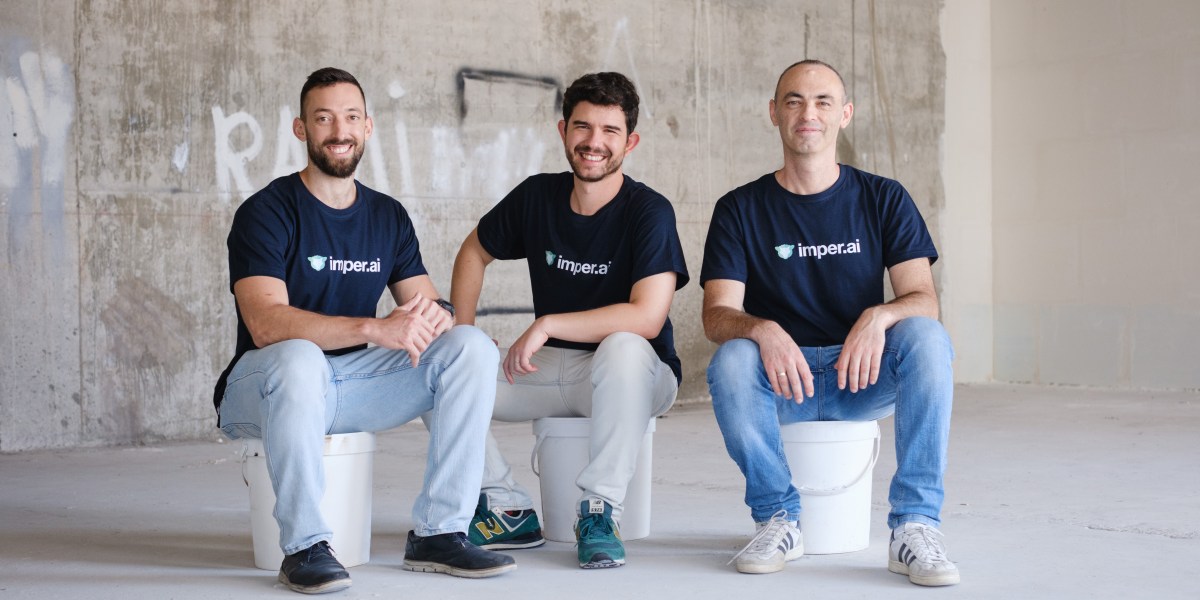
Imper.ai’s founding team of Awadish, along with other 8200 veterans Anatoly Blighovsky and Rom Dudkiewicz, believes their background as both cyber attackers and defenders gives them an edge. “I think that people don’t understand that most of the major breaches start with social engineering,” Awadish told me, adding that AI is a game changer because emails, videos, and voice clones have become almost perfect. 

In addition, he pointed out that collaboration tools have multiplied far beyond email and phone calls. Now attackers have dozens of communication tools, and AI lets them generate “spear-phishing” messages (personalized phishing emails) at scale, as well as cloned voices, and deepfake videos at massive speed.

That’s why imper.ai avoids trying to out-detect AI impersonation directly from the AI-generated content itself. “We don’t want to get into an AI arms race,” Awadish said. Instead, the startup focuses on what attackers cannot fake—mostly metadata. 

As the company’s traction has accelerated, so has investor interest. “We want to build a platform that safeguards the entire communication space,” Awadish said. “ It’s not something small, it’s not like a plugin that one of the giants is going to build.” With the new funding, he said that the company can double its R&D headcount and triple its go-to-market organization in the US.  

“At the moment, there is really high traction, so we need to keep up with the pace, so we need to grow,” he said. 

Note: I am super-excited to be headed to San Francisco for Fortune Brainstorm AI on Monday and Tuesday! I’ll be interviewing Prakhar Mehrotra, SVP and global head of AI at PayPal, and Marc Hamilton, VP of solutions architecture and engineering at Nvidia, on the main stage. I’ll also be moderating a spicy roundtable session all about AI data centers. Plus, I’m looking forward to seeing some of the other speakers, including actor Joseph Gordon-Levitt, OpenAI COO Brad Lightcap, and Ali Ghodsi, CEO of Databricks.

And with that, here’s more AI news.

Sharon Goldman
sharon.goldman@fortune.com
@sharongoldman

FORTUNE ON AI

Microsoft AI wants all its employees to be AI-native by the end of the fiscal year, says VP of design Liz Danzico–by Angelica Ang

China’s ByteDance could be forced to sell TikTok U.S., but its quiet lead in AI will help it survive—and maybe even thrive–by Nicholas Gordon

Anthropic considers IPO despite warnings that excess liquidity is blowing a bubble in the markets–by Jim Edwards

Sam Altman declares ‘Code Red’ as Google’s Gemini surges—three years after ChatGPT caused Google CEO Sundar Pichai to do the same–by Sharon Goldman

ServiceNow’s president says acquiring identity and access management platform Veza will help customers track the whereabouts of AI agents—by Jeremy Kahn

AI IN THE NEWS

Legal AI startup Harvey raises $160 million at an $8 billion valuation. Harvey, one of the fastest-rising startups in the AI legal-tech boom, just raised $160 million at an $8 billion valuation, according to the New York Times. This more than doubles its valuation since February and brings its total funding this year to roughly $760 million. The four-year-old company, already used by about half of the Am Law 100, builds AI assistants that help lawyers draft and review documents, answer case-law questions, and automate routine workflows. The round was led by Andreessen Horowitz with participation from T. Rowe Price, WndrCo, Sequoia, Kleiner Perkins, and others, and signals that investor enthusiasm for AI tools built for white-collar professionals remains intense even as broader tech markets wobble.

VC ‘kingmaking’ is happening earlier than ever with AI startups. AI ERP startup DualEntry raised a $90 million Series A at a $415 million valuation—despite being just a year old—as Lightspeed and Khosla Ventures bet that a next-generation replacement for legacy systems like Oracle NetSuite can scale fast. But according to TechCrunch, the size of the round has revived questions about “kingmaking,” the increasingly common VC tactic of pouring huge sums into a single early-stage company to manufacture category dominance. While one investor told TechCrunch that DualEntry had only around $400,000 in ARR last summer—a figure the company disputes—the aggressive funding mirrors a broader shift: venture firms are picking winners earlier than ever. 

Why does AI write like that? I definitely wanted to shout out this (long) essay in the New York Times that is well worth a read. It argues that AI-generated writing has quietly become the dominant voice of the internet—shaping everything from student essays to political statements—with its now-familiar mix of em dashes, ghostly metaphors, triplets, and overpolished sincerity. What’s unsettling, the author writes, isn’t just that AI prose is everywhere, but that humans are starting to unconsciously imitate it, creating a feedback loop where machine-bred language becomes the default cultural tone. Personally, I had heard about how AI chatbots love the word “delve,” but not that they love ghostly words and all things “quiet”: “Everything is a shadow, or a memory, or a whisper. They also love quietness. For no obvious reason, and often against the logic of a narrative, they will describe things as being quiet, or softly humming.” 

Microsoft lowers sales staff’s growth targets for newer AI software. Like every other Big Tech company, Microsoft spent much of 2025 loudly touting AI agents as the next big leap in enterprise automation, but as the year ends the company is quietly dialing back expectations, according to new reporting from The Information. After multiple sales teams missed aggressive growth targets, Microsoft has relaxed quotas for certain AI products—an unusually public acknowledgment that traditional enterprises are still hesitant to pay for advanced automation. Customers say the ROI remains hard to measure and the tech too error-prone for high-stakes workflows like finance and cybersecurity. While AI has been a major boon to Microsoft’s cloud business—thanks largely to massive spending from OpenAI and strong demand for tools like Microsoft 365 Copilot and GitHub Copilot—getting mainstream companies to significantly increase their AI budgets is proving far tougher than selling to AI labs.

AI CALENDAR

Dec. 2-7: NeurIPS, San Diego.

Dec. 8-9: Fortune Brainstorm AI San Francisco. Apply to attend here.

Jan. 7-10: Consumer Electronics Show, Las Vegas. 

March 12-18: SWSW, Austin. 

March 16-19: Nvidia GTC, San Jose. 

April 6-9: HumanX, San Francisco. 

EYE ON AI NUMBERS

221 Million

That’s how many YouTube users subscribe to so-called “AI slop” channels, or those posting mostly AI-generated content, according to a new report from cloud-based video editing platform Kapwing. 

The report analyzed 15,000 YouTube channels in 21 countries and identified which ones are posting AI-generated content. Then they examined their view counts, subscriber totals, and estimated earnings to find where “AI slop” channels are competing most aggressively with human creators.

The report found these channels have already amassed a combined 221 million subscribers, generated 63 billion views, and pull in more than $117 million each year.

Some notable findings from the report: 

  • The U.S.-based “AI slop” channel Cuentos Facinates has the most subscribers globally (5.95M).
  • Spain has eight such channels in their top 100 trending channels with a combined 20.22M subscribers, the most of any country.
  • These channels get the most views in South Korea (8.45B views across 11 trending channels).
  • India is home to the most-viewed “AI slop” channel, Bandar Apna Dost, with 2.07B views and an estimated $4.25M in annual earnings.


Source link

Continue Reading

Business

‘This species is recovering’: Jaguar spotted in Arizona, far from Central and South American core

Published

on


The spots gave it away. Just like a human fingerprint, the rosette pattern on each jaguar is unique so researchers knew they had a new animal on their hands after reviewing images captured by a remote camera in southern Arizona.

The University of Arizona Wild Cat Research and Conservation Center says it’s the fifth big cat over the last 15 years to be spotted in the area after crossing the U.S.-Mexico border. The animal was captured by the camera as it visited a watering hole in November, its distinctive spots setting it apart from previous sightings.

“We’re very excited. It signifies this edge population of jaguars continues to come here because they’re finding what they need,” Susan Malusa, director of the center’s jaguar and ocelot project, said during an interview Thursday.

The team is now working to collect scat samples to conduct genetic analysis and determine the sex and other details about the new jaguar, including what it likes to eat. The menu can include everything from skunks and javelina to small deer.

As an indicator species, Malusa said the continued presence of big cats in the region suggests a healthy landscape but that climate change and border barriers can threaten migratory corridors. She explained that warming temperatures and significant drought increase the urgency to ensure connectivity for jaguars with their historic range in Arizona.

More than 99% of the jaguar’s range is found in Central and South America, and the few male jaguars that have been spotted in the U.S. are believed to have dispersed from core populations in Mexico, according to the U.S. Fish and Wildlife Service. Officials have said that jaguar breeding in the U.S. has not been documented in more than 100 years.

Federal biologists have listed primary threats to the endangered species as habitat loss and fragmentation along with the animals being targeted for trophies and illegal trade.

The Fish and Wildlife Service issued a final rule in 2024, revising the habitat set aside for jaguars in response to a legal challenge. The area was reduced to about 1,000 square miles (2,590 square kilometers) in Arizona’s Pima, Santa Cruz and Cochise counties.

Recent detection data supports findings that a jaguar appears every few years, Malusa said, with movement often tied to the availability of water. When food and water are plentiful, there’s less movement.

In the case of Jaguar #5, she said it was remarkable that the cat kept returning to the area over a 10-day period. Otherwise, she described the animals as quite elusive.

“That’s the message — that this species is recovering,” Malusa said. “We want people to know that and that we still do have a chance to get it right and keep these corridors open.”


Source link

Continue Reading

Business

MacKenzie Scott tries to close the higher ed DEI gap, giving away $155 million this week alone

Published

on


MacKenzie Scott has arguably been the biggest name in philanthropy this year—and has nonstop been making major gifts to organizations focused on education, DEI, disaster recovery, and many other causes.

This week alone, several higher education institutions announced major gifts from the billionaire philanthropist and ex-wife of Amazon founder Jeff Bezos—donations totaling well over $100 million. In true Scott fashion, many of these donations are the largest single donations these schools have ever received.

The donations announced this week include: 

  • $50 million to California State University-East Bay
  • $50 million to Lehman College (part of the City University of New York system)
  • $38 million to Texas A&M University-Kingsville
  • $17 million to Seminole State College

All four institutions are public, access-oriented colleges that enroll large shares of low‑income, first‑generation, and racially diverse students and function as minority‑serving institutions or similar engines of social mobility. They fit MacKenzie Scott’s broader pattern of directing large, unrestricted gifts to colleges that serve “chronically underserved” communities rather than already wealthy, highly selective universities.

Scott, who is worth about $40 billion and has donated over $20 billion in the past five years, has doubled down this year on causes that the Trump administration has cut deeply, such as education, DEI, and disaster recovery.

“As higher education, in general, works to find its way in an uncertain environment, this gift is a major source of encouragement that we are on the right path,” Lehman College President Fernando Delgado said in a statement. 

Scott also made one of the largest donations in HBCU Howard University’s 158-year history with an $80 million gift earlier this fall, and a $60 million donation to the Center for Disaster Philanthropy after Trump administration’s cuts to the Federal Emergency Management Agency (FEMA)—an organization Americans rely on for help during and after hurricanes, wildfires, tornadoes, and floods.

“All sectors of society—public, private, and social—share responsibility for helping communities thrive after a disaster,” CDP president and CEO Patricia McIlreavy previously told Fortune. “Philanthropy plays a critical role in providing communities with resources to rebuild stronger, but it cannot—and should not—replace government and its essential responsibilities.”

Trust-based philanthropy

Scott accumulated the vast majority of her wealth from her 2019 divorce from Bezos, but is dedicated to giving away most of her fortune. She’s considered a unique philanthropist in today’s environment because her gifts are typically unrestricted, meaning the organizations can use the funding however they choose. 

“She practices trust-based philanthropy,” Anne Marie Dougherty, CEO of the Bob Woodruff Foundation previously told Fortune. Scott has donated $15 million to the veteran-focused nonprofit organization in 2022, and made a subsequent $20 million donation this fall.

Scott is also considered one of the most generous philanthropists, and credits acts of kindness for inspiring her to give back.

“It was the local dentist who offered me free dental work when he saw me securing a broken tooth with denture glue in college,” Scott wrote of her inspiration for philanthropy in an Oct. 15 essay published to her Yield Giving site. “It was the college roommate who found me crying, and acted on her urge to loan me a thousand dollars to keep me from having to drop out in my sophomore year.”


Source link

Continue Reading

Business

Netflix’s bombshell deal to buy Warner Bros. brings Batman and Harry Potter to the streamer, infuriates theater owners and the Ellisons

Published

on


Netflix’s agreement to buy Warner Bros. in a $72 billion deal marks a seismic shift in Hollywood, handing the streaming giant control of iconic franchises such as Batman and Harry Potter and triggering an immediate backlash from theater owners and the jilted Ellison family behind Paramount. The bombshell transaction, struck after a bidding war that ensued after David Ellison’sunsolicited bids several months ago, positions Netflix ever more at the center of the Southern California entertainment business that the Northern California company disrupted so famously decades ago.

The deal will see Netflix acquire Warner Bros. Discovery’s film and TV studios and its streaming operations, including HBO Max, in a deal with an equity value of roughly $72 billion, or about $27.75 per share in cash and stock, valuing Warner Bros. at $82.7 billion. The agreement followed a heated auction in which Netflix’s bid edged out offers from Paramount Skydance and Comcast, both of which had pushed to keep the storied Warner assets in more traditional hands.

Two days before Netflix won the bidding, Paramount hinted at its fury with a strongly worded letter to WBD CEO David Zaslav, arguing the process was “tainted” and Warner Bros. was favoring a single bidder: Netflix. Paramount called it a “myopic process with a predetermined outcome that favors a single bidder,” Bloomberg reported, although Netflix’s bid is understood to be the highest of the three.

Another angry group is theater owners, who have famously warred with Netflix for years over the big red streamer’s reluctance, even refusal to follow traditional theatrical-release practices. Netflix Co-CEO Ted Sarandos has adamantly defended Netflix’s streaming-forward distribution, saying it’s what consumers really want. At the Time 100 event in April of this year, Sarandos called theatrical release “an outmoded idea for most people” and said Netflix was “saving Hollywood” by giving people what they want: streaming at home.

Cinema United, the trade association which represents over 30,000 movie screens in the U.S. and 26,000 internationally, immediately announced its opposition to Netflix acquiring a legacy Hollywood studio. The organization’s chief, Michael O’Leary, said it “poses an unprecedented threat to the global exhibition business” as Netflix’s states business model simply does not support theatrical exhibition. He urged regulators to look closely at the acquisition.

Deadline reported that other producers are warning of “the death of Hollywood” as a result of this deal. Several days earlier, Bank of America Research’s analysts had surveyed the landscape and concluded that as a defensive move, Netflix would be “killing three birds with one stone,” as its ownership of Warner Bros’ would be a daunting blow to Paramount and Comcast, while taking the Warner legacy studio out of the running. The bank calculated that a combined Netflix and Warner Bros. would comprise roughly 21% of total streaming time—still shy of YouTube’s 28% hold on the market, but far greater than Paramount’s 5% and Comcast’s 4%.

What’s known and what’s still at play

As part of the deal, Netflix will retain the studio that controls the superheroes of DC, the Wizarding World of Harry Potter, and HBO’s prestige brands. Other details on what will happen to the standalone streaming service HBO Max were scant, with the companies saying only that Netflix will “maintain” Warner Bros. current operations. The companies expect the transaction to close after regulatory review, with Netflix projecting billions in annual cost savings by the third year after completion.

​The deal will not include all of Warner Bros. Discovery, according to the press release announcing the acquisition, which said the previously announced plans to separate WBD’s cable operations will be completed before the Netflix deal, in the third quarter of 2026. The newly separated publicly traded company holding the Global Networks division will be called Discovery Global, and will include CNN, TNT Sports in the U.S., as well as Discovery, free-to-air channels across Europe, plus digital products such as Discovery+ and Bleacher Report.  

On a conference call with reporters Friday morning, Sarandos said Netflix is “highly confident in the regulatory process,” calling the deal pro-consumer, pro-innovation, pro-worker, pro-creator and pro-growth. He said Netflix planned to work closely with regulators and was running “full speed” ahead toward getting all regulatory approvals. He added that Netflix executives were “tired” after “an incredibly rigorous and competitive process.” Alluding to Netflix’s traditional resistance to big M&A, Sarandos added that “we don’t do many of these, but we were deep in this one.”

Influential entertainment journalist Matt Belloni of Puck previewed the likely deal on Bill Simmons’ podcast on Spotify’s Ringer network (which recently struck a deal to bring some video podcasts to Netflix), and they speculated about potential problems inside Netflix that brought the deal to a head. In conversation about how defensive the move is, Belloni said Netflix is “doing this for a reason” and may have reached a “stress point” because it hasn’t been getting traction with its own moviemaking efforts after 10 years of trying. (Netflix has also been agonizingly close to an elusive Best Picture Oscar, with close calls on Roma and Emilia Perez, the latter of which was derailed in a bizarre social-media controversy.) Belloni also acknowledged the criticism that Netflix has struggled to create its own franchises, also after years of trying.

Sarandos highlighted Netflix’s homegrown franchises while announcing the deal, arguing that Netflix’s ” culture-defining titles like Stranger Things, KPop Demon Hunters and Squid Game” will now combine with Warner’s deep library including classics Casablanca and Citizen Kane, even Friends.

The biggest losers in the bidding war may be David Ellison and his father, Oracle co‑founder (and long-time Republican donor)Larry Ellison, whose Paramount‑Skydance empire had been widely seen as a front‑runner to acquire Warner Bros. Discovery. David Ellison, has since reportedly been pleading his case around Washington, meeting Trump administration officials as allies float antitrust and national‑interest concerns about giving Netflix control of such a critical studio.

While Netflix has tried to calm regulators by arguing that a combined Netflix–HBO Max bundle would increase competition with Disney and others, the Ellisons and their supporters are signaling they will continue to press for tougher scrutiny or even intervention. Large M&A has made a big comeback in 2025 as the Trump administration has been notably friendlier to big deals than the deep freeze of the Biden administration, making this deal an acid test for just how true that is when a company with deep ties to the White House gets jilted.​

[Disclosure: The author worked internally at Netflix from June 2024 through July 2025.]


Source link

Continue Reading

Trending

Copyright © Miami Select.